
Solar Panel Scaffolding Cost UK: 2026 Price Guide
Check Your Eligibility for Boiler Upgrade Scheme (BUS)
Complete your details below to check your eligibility.
Thank you
We've received your details and will be in touch shortly.

Quick answer: how much does scaffolding for solar panels cost?
For most domestic solar installations, a sensible 2026 planning allowance is approximately £500–£1,200 for scaffolding, with straightforward regional jobs sometimes costing less. More complicated scaffolds can reach £1,500–£2,000 or above.
Current UK market guides illustrate how widely prices vary. One specialist scaffolder quotes roughly £350–£800 for common domestic installations in its North West service area, while Sunsave gives a broader UK guide of approximately £700–£2,000.
Treat these figures as estimates rather than fixed tariffs. Your property must be assessed before an accurate price can be given.
Solar Panel Scaffolding Cost UK: What Should You Expect to Pay in 2026?
If you are comparing solar quotes, scaffolding can be one of the least obvious costs in the proposal. For a straightforward UK home, solar panel scaffolding will often cost around £500 to £1,200, although simple jobs can cost less and complicated properties can push the price towards £1,500 to £2,000 or more.
The final figure depends less on the number of solar panels than on the building itself. Height, roof layout, access, conservatories, extensions and whether scaffold must stand on a public pavement can all affect the price.
That makes it important to check whether scaffolding is already included when comparing solar installation quotations. A cheap-looking solar quote is not necessarily cheaper if several hundred pounds of access costs are added later.
This guide explains what solar panel scaffolding costs in the UK in 2026, what affects the price, when scaffolding is needed and how to compare quotations fairly.
If you are gathering prices for a complete installation, you can also compare solar quotations through Get Free Quote.
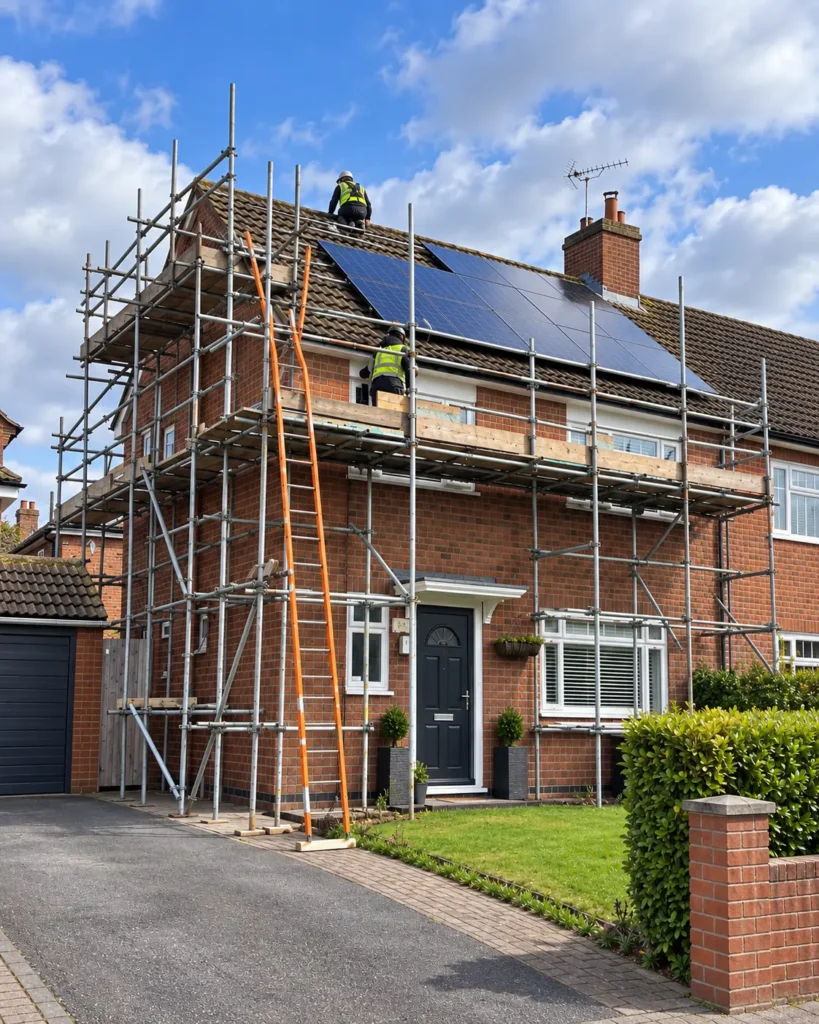
Solar panel scaffolding cost by property typ
The following ranges are useful for initial budgeting. They are not guaranteed quotations.
| Property or access situation | Indicative scaffold budget | Main considerations |
|---|---|---|
| Simple low-rise or single working elevation | £350–£700 | Straight access, limited scaffold length |
| Typical two-storey terrace or semi-detached home | £500–£1,000 | Building width, roof edge protection and access |
| Larger detached home or multiple elevations | £700–£1,200+ | More scaffold, labour and erection time |
| Three-storey, conservatory, extension or difficult access | £1,200–£2,000+ | Bridging, extra lifts, design complexity or licences |
Regional contractor pricing shows that straightforward domestic scaffolds can start below the national ranges often quoted online. However, complex access can quickly increase the bill.
For context, the Energy Saving Trust currently puts an average domestic solar PV system at about £7,600 installed. It specifically identifies roof access as one factor affecting total installation cost.
You can read more about complete system pricing and specifications on the Get Free Quote solar panel comparison page.
What affects solar panel scaffolding cost?
Two similar houses can receive very different scaffold prices. The installer or scaffolding contractor needs to consider how workers will safely reach and work around the roof.
| Cost factor | Why it can increase the price |
|---|---|
| Building height | Extra scaffold lifts require more equipment and labour |
| Number of roof elevations | Panels on front and rear roofs may need separate scaffold runs |
| Property width | Longer elevations require more tubes, boards and erection time |
| Conservatories or extensions | Scaffold may need bridging or additional support |
| Restricted side access | Equipment may take longer to move into position |
| Pavements or roads | A highway scaffold licence may be required |
| Complex roof shape | Dormers, valleys and different roof levels can complicate access |
| Hire duration | Keeping the scaffold longer may trigger additional charges |
Building height
A conventional two-storey property is usually easier to scaffold than a three-storey townhouse.
Extra height means more equipment, more erection time and potentially more complicated fall protection. Consequently, the scaffold can become a significant part of the solar installation price.
One roof face versus two
A solar array installed entirely on one accessible roof elevation may need only one principal scaffold run.
If panels are split between the front and back of the house, additional access may be required. That can increase the scaffold price even when the number of panels stays exactly the same.
This is one reason you should compare the installation scope, not simply the price per panel.
Conservatories, garages and extensions
A conservatory beneath the working roof can create a more difficult scaffolding problem.
The contractor may need to bridge over the structure or find alternative support positions rather than placing ordinary scaffold directly in front of the house. Rear extensions, narrow passages and sloping ground can create similar issues.
These situations need a site-specific assessment.
Do solar panels always need scaffolding?
Not necessarily, but installers need a safe system for working at height.
The Health and Safety Executive’s work-at-height guidance requires work at height to be properly planned, risks assessed and suitable equipment selected. HSE gives scaffolding and mobile elevating work platforms as examples of equipment that can prevent falls. It also says ladders are generally suitable for low-risk, short-duration work rather than prolonged roof work.
Installing rooftop solar normally involves carrying and positioning modules, fitting mounting components and working around the roof edge for considerably longer than a brief ladder task. As a result, full scaffold with suitable edge protection is common on pitched-roof domestic installations.
The important distinction is that the legislation requires safe access and fall prevention, rather than stating that every solar installation must use one specific scaffold configuration.
Get Free Quote’s existing solar panel installation process guide explains where scaffolding normally fits into the wider survey-to-commissioning process.
Is scaffolding included in a solar panel quote?
Often it is, but never assume.
Some installers give an all-inclusive installation figure incorporating scaffolding. Others itemise access separately, while some initially provide a system price before the scaffold has been fully assessed.
A good quotation should make clear:
whether scaffolding is included
which elevations are included
whether difficult access has already been allowed for
whether licence charges are included
how long scaffold hire is covered
whether removal is included
what happens if the installation date changes
Get Free Quote’s solar comparison page already advises homeowners to check that mounting, scaffolding and electrical work are included in the quotation.
For a wider quotation checklist, see the solar panel installation quote guide.
Does scaffolding on a pavement cost more?
It can.
If scaffolding occupies a public highway, including a pavement, the contractor may need permission from the relevant local authority. GOV.UK states that the builder or scaffolding contractor is responsible for obtaining the licence, while the homeowner should check that the required permission is in place.
Council fees differ significantly. For example, published 2026 charges vary between authorities and may depend on scaffold length or how long it remains in place.
Therefore, homeowners should not assume that an online national scaffold price includes local highway charges.
Can you reduce the cost of solar scaffolding?
Sometimes.
Coordinate solar with planned roof work
The biggest opportunity can arise when scaffolding is already required for roofing work.
The Energy Saving Trust notes that solar installation costs can be reduced when scaffolding is already in place for roof repairs.
If your roof will need replacement or substantial repairs soon, it may make sense to coordinate both projects rather than pay to scaffold the property twice.
Our guide to replacing a roof before installing solar panels can help with that decision.
However, never assume another contractor’s scaffold is automatically suitable for solar work. The solar installer must be satisfied that the access arrangement is appropriate for their work.
Get comparable quotations
Another effective approach is simply to compare like with like.
One installer quoting £7,500 including scaffold may be cheaper overall than an installer quoting £7,000 plus £900 for access.
Ask each company to confirm the total installed price and list any potential extras.
Avoid arranging your own scaffold without agreement
Finding a local scaffolder independently may sometimes save money, but agree this with the solar installer first.
The installer may have specific requirements for working platforms, edge protection, loading areas or access. Saving £100 on an unsuitable scaffold is not a useful saving if the installation team cannot safely use it.
Is solar scaffolding worth paying for?
Scaffolding does not generate electricity, so it is understandable that homeowners dislike seeing a large access charge.
However, the relevant question is not whether the scaffold adds to the system’s energy output. It is whether it provides the safe access needed to install the system correctly.
HSE guidance requires employers and contractors to assess work-at-height risks and choose suitable equipment. Proper access also allows installers to position rails, panels and roof fixings without treating a ladder as a long-duration working platform.
For that reason, unusually low quotes based on avoiding appropriate access deserve closer examination rather than automatic preference.
What should you ask about scaffolding before accepting a solar quote?
Before signing a contract, confirm exactly what the quoted price covers.
Ask whether the scaffold covers every roof elevation where panels will be installed. Check whether the installer has accounted for conservatories, extensions, sloping ground or restricted side access.
If any scaffold will occupy a pavement or road, establish who obtains the necessary licence and whether the fee is already included.
Also check how long the scaffold is expected to remain in place. A typical installation may take only one or two days on site, but scaffolding can arrive before the solar team and remain afterwards while removal is scheduled. Get Free Quote’s installation-process guidance notes that scaffolding is normally erected shortly before physical installation.
Finally, compare the complete project cost rather than a headline solar-system price.
Get Your Free Air Source Heat Pump Quote
Find the right air source heat pump solution for your home. Tell us a few details and our team will help you explore suitable options at a competitive price.
Quick to complete. No obligation.
Get your quote
Enter your details below and one of our team will get back to you.
Frequently asked questions
Find clear answers to common questions comparing air source and ground source heat pumps, including efficiency, installation and running costs, winter performance, noise, land requirements and borehole depth.
A typical domestic allowance is roughly £500–£1,200, although straightforward jobs can be cheaper and difficult properties can cost £1,500–£2,000 or more. Current published market guides show a wide range because access conditions vary substantially.
Often, but not always. Ask the installer to state explicitly whether scaffolding, erection, hire and dismantling are included.
UK work-at-height rules require suitable measures to prevent or minimise falls, but they do not prescribe scaffolding for every solar project. Scaffolding is nevertheless the normal access solution for many pitched-roof domestic installations.
A ladder is generally intended for low-risk, short-duration work where more suitable equipment is not justified. A normal rooftop solar installation involves substantially more work than simply climbing onto the roof.
The price covers more than scaffold hire. Transport, erection, dismantling, labour, equipment quantity, property height, access and design complexity all contribute.
Usually. Additional height commonly requires more equipment and labour and may make the scaffold configuration more complex.
It can. Separate working elevations can require extra scaffold compared with an array installed entirely on one accessible roof face.
Often. Contractors may have to bridge the scaffold over the conservatory or design an alternative arrangement rather than using a simple elevation scaffold.
Scaffolding placed on a public highway, including a pavement, generally requires a local-authority licence. The scaffolding contractor normally obtains it, but the homeowner should check that the permission is valid.
It may be erected shortly before installation and removed afterwards according to the scaffolder's schedule. Ask how much hire time is included because delays can affect some agreements.
Potentially, but agree it with the installer first. They need to confirm that the scaffold provides suitable access and protection for their planned work.
Potentially, and this may reduce duplicated installation costs. However, the solar installer should confirm that the existing scaffold is suitable for the solar work. The Energy Saving Trust specifically notes the potential saving where scaffold is already erected for roof repairs.
Not directly in the same way as building size and access. However, a larger array may cover more roof elevations, which can increase the scaffold required.
It can be because the working height is lower, but building width, roof configuration and access still affect the quotation.
Compare the total installed price and ensure every installer is pricing the same scope. Check panels, inverter, electrical work, mounting, scaffolding, certification and any potential extras rather than comparing the headline system price alone.
Conclusion
For a typical UK home in 2026, allowing roughly £500–£1,200 for solar panel scaffolding is a reasonable starting point. Straightforward installations can cost less, while tall buildings, multiple roof elevations, conservatories, restricted access or public-highway licences can push the figure towards £1,500–£2,000 or more.
Scaffold cost should therefore be considered alongside the whole installation design.
Check what each quotation includes, compare the same scope between installers and make sure any access assumptions match your property. If scaffolding is already planned for roofing work, coordinating the projects may also reduce duplicated costs.
A clear, itemised quotation is far more useful than the lowest headline figure.


