
Solar Panel Labour Cost UK (2026): Prices & Guide
Check Your Eligibility for Boiler Upgrade Scheme (BUS)
Complete your details below to check your eligibility.
Thank you
We've received your details and will be in touch shortly.

Quick answer: what does solar panel labour cost in the UK?
Solar panel labour in the UK does not have one standard national price. A current trade-price guide puts installer labour at about £300 per person per day. With two installers, a straightforward one-day job would therefore imply around £600 of basic on-site crew labour. However, a complete installation involves more than lifting and fixing panels. Design, roof work, electrical installation, testing, commissioning and paperwork can push the broader labour-and-installation element into the low thousands. One 2026 cost guide estimates £1,700–£2,000 for 3kW systems and £2,000–£2,500 for 4kW systems. Treat all figures as indicative until the property has been surveyed.
Solar Panel Labour Cost UK: 2026 Installation Prices Explained
If you are comparing solar quotes, the labour figure can be confusing. Some installers roll most work into one fixed price. Others separate roof labour, electrical work, scaffolding, design and certification.
For a typical UK home in 2026, a useful starting point is around £300 per installer per day for on-site solar fitting. A two-person crew therefore represents roughly £600 for one day of labour before separate electrical work, scaffolding or other project costs. Broader labour-and-installation estimates can be much higher: current UK cost guides put labour for a 3kW system at about £1,700–£2,000 and a 4kW system at about £2,000–£2,500.
This guide explains those figures, what raises labour costs and how to compare quotes fairly.
Looking for a property-specific price? Compare solar panel installation quotes and check exactly what each installer includes before choosing.
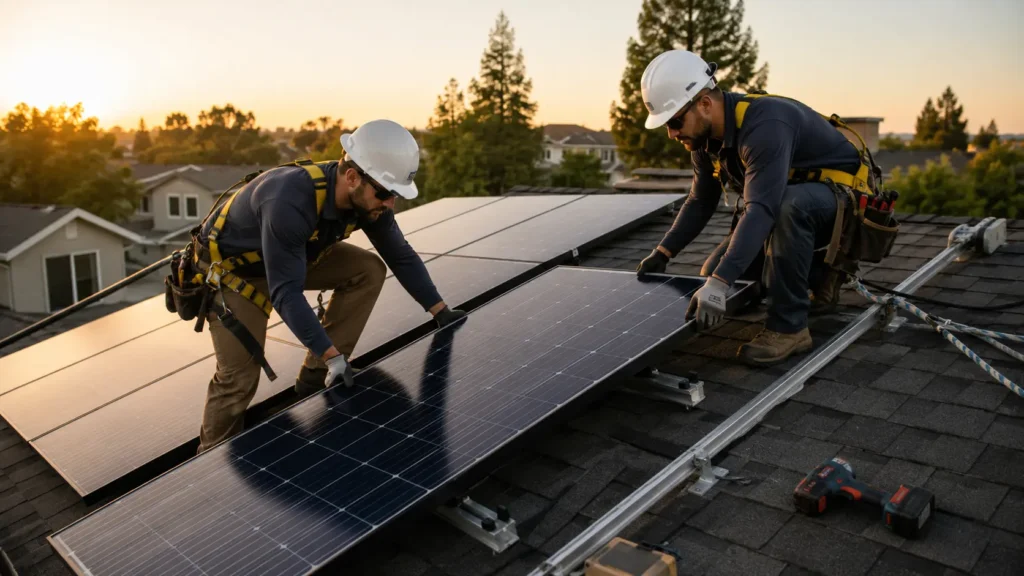
How much does solar panel labour cost in the UK in 2026?
There are two useful measures: the on-site day rate and the wider installation-service cost.
| Cost measure | Indicative 2026 figure | What it tells you |
|---|---|---|
| Installer day rate | Around £300 per installer per day | Rough benchmark for physical on-site labour |
| Two-person crew for one day | Around £600 | Simple crew-cost benchmark before other project items |
| 3kW system labour estimate | About £1,700–£2,000 | Broader labour allowance from a UK trade-quote guide |
| 4kW system labour estimate | About £2,000–£2,500 | Broader labour allowance for a typical domestic-sized system |
| 5kW system labour estimate | About £2,500–£3,000 | Higher allowance for a larger installation |
| Typical 4.5kWp whole-system cost | Around £7,600 | Complete installed system, not labour alone |
These figures are not directly interchangeable. A day rate covers people on site; a project labour figure may also absorb design, electrical work, commissioning and certification.
Energy Saving Trust currently gives around £7,600 as the cost of a typical 4.5kWp domestic solar installation. That is a complete installed price, not an official labour breakdown. See the Energy Saving Trust solar panel guidance.
The Department for Energy Security and Net Zero also publishes official solar cost statistics using MCS installation data, but these report installed costs and cost per kW rather than a national labour-only tariff.
Why does “solar panel labour cost” vary so much?
Physical fitting is only part of the job
The visible work happens on the roof, but installation starts earlier. The installer may need to survey the roof, plan cable routes, check the consumer unit and prepare grid paperwork.
On site, the team fits mounting hardware and panels, runs cabling, installs the inverter, completes electrical work, tests the system and commissions it. A typical domestic installation commonly takes one to two days.
So a “£600 labour” figure and a “£2,000 installation labour” figure may describe different scopes.
Fixed tasks do not disappear on a smaller system
A six-panel system still needs survey work, safe access, inverter installation, testing and handover. Those fixed tasks are spread across fewer panels, so a price “per panel” can be misleading.
What should solar installation labour include?
A well-scoped quotation should state who handles each stage. Labour may include:
technical survey and final system design
arranging or coordinating safe roof access
fitting roof hooks, brackets, rails and panels
running DC cabling from the array
installing and configuring the inverter
AC electrical connection and protective devices
installing a battery or diverter if ordered
testing, commissioning and monitoring setup
MCS documentation where applicable
Distribution Network Operator notification or application
homeowner handover and system explanation.
If you want to understand where those tasks sit in the overall job, read the solar panel installation process guide.
What increases solar panel labour costs?
1. Roof type
A simple concrete-tile pitched roof is generally quicker to work on than slate, fragile tiles, complex roof coverings or several separate roof faces. Extra time spent protecting the roof and using specialist fixings increases labour.
2. Access and building height
Restricted access, conservatories, extensions and taller properties can slow material handling and increase scaffolding costs. Energy Saving Trust specifically identifies difficult roof access as a factor affecting installation cost.
3. System size and panel layout
More panels mean more mounting and testing, although fixed tasks stop labour rising in direct proportion to system size.
4. Electrical upgrades
Older consumer units, difficult cable routes or extra protection can add electrician time. A survey should identify likely extras.
5. Battery storage
Adding a battery can extend electrical installation and commissioning, especially where backup circuits or extra equipment are needed.
6. Roof repairs or structural concerns
If the roof needs repairs, doing them first can avoid paying later to remove and reinstall the array. Get Free Quote’s existing installation guidance also highlights the value of dealing with significant roof repairs before the panels go on.
Does roof type make a big difference to labour?
Yes. Straightforward pitched roofs tend to sit toward the lower end because mounting is simpler.
Slate roofs can take longer because installers need to avoid damaging the covering and may require specialist mounting methods. Multiple roof faces also add measuring, rail alignment and cable-routing work.
Flat roofs may need ballasted or mechanically fixed frames and extra load checks, so labour can be higher for the same panel count. Energy Saving Trust notes that flat-roof installations can be more complex because additional mounting may be required and the roof must support the extra weight.
How to compare solar labour quotes fairly
Do not compare the labour line in isolation. Compare the same scope across every installer.
Ask for the system size in kWp, exact panel and inverter models, and whether scaffolding is included. Confirm roof mounting, cabling, electrical connection, testing, commissioning and paperwork.
Ask what could change after the survey. A quote with key items “to be confirmed” may not stay cheap.
Energy Saving Trust recommends getting at least three quotes from MCS-certified installers. Compare price, equipment, generation estimates, warranties, exclusions and scope.
For a more detailed checklist, use the solar panel installation quote guide and review your options alongside the solar panel installers UK guide.
Is the cheapest solar labour quote the best value?
Not necessarily. Labour quality affects the part of the system that physically interfaces with your roof and electrical installation.
Poor mounting can create roof problems, while weak electrical work or commissioning can affect safety, maintenance and performance.
MCS publishes standards for certified contractors, and an MCS certificate records that an eligible installation has been designed, installed and commissioned to recognised scheme requirements. See the MCS guidance for solar PV installations.
If access to an export tariff matters to you, check the supplier’s current eligibility requirements before signing.
The aim is not to pay the highest labour price. It is to understand what work is included and whether the installer can demonstrate suitable competence, insurance, warranties and certification.
VAT: does 0% VAT apply to solar labour in 2026?
Qualifying solar installations in residential accommodation are currently covered by the UK’s temporary 0% VAT rate for specified energy-saving materials. Under current HMRC rules, the zero rate applies until 31 March 2027. From 1 April 2027, the reduced rate is scheduled to apply instead.
Read the current HMRC VAT guidance for energy-saving materials.
Check that the installer has shown the correct VAT treatment, particularly if the quotation contains additional work outside the qualifying solar installation.
What should you budget for beyond labour?
Even when labour is clearly stated, check for scaffolding, roof repairs, consumer-unit work, structural assessments, upgraded cable routes, bird protection, batteries and optional equipment.
The best quote is the one that is clear enough for you to see what is fixed, what is provisional and what is excluded.
Get Your Free Air Source Heat Pump Quote
Find the right air source heat pump solution for your home. Tell us a few details and our team will help you explore suitable options at a competitive price.
Quick to complete. No obligation.
Get your quote
Enter your details below and one of our team will get back to you.
Frequently asked questions
Find clear answers to common questions comparing air source and ground source heat pumps, including efficiency, installation and running costs, winter performance, noise, land requirements and borehole depth.
There is no official national labour tariff. A current 2026 cost guide suggests around £300 per installer per day, while broader project labour estimates for common domestic systems can reach roughly £1,700–£3,000.
One current UK trade-quote guide estimates around £2,000–£2,500 for labour on a 4kW installation. Treat this as indicative rather than a guaranteed quotation.
Using a benchmark of about £300 per installer per day, two installers would represent roughly £600 for one day of basic crew labour.
A two-person installation team is common for standard domestic work, although larger or more complex projects may require additional people.
Energy Saving Trust says a typical rooftop solar installation normally takes around one to two days once the installation team is on site.
Usually not in a way that makes useful comparisons possible. Surveying, inverter installation, testing and other fixed tasks mean labour does not rise evenly with each additional panel.
Sometimes, but not always. Check whether scaffolding appears inside the fixed installation price or as a separate line item before comparing quotations.
It may be included in a complete installation quotation, but homeowners should confirm whether inverter installation, AC connection, protective equipment and any consumer-unit upgrades are covered.
An MCS-certified contractor should explain the certification and documentation included with an eligible installation. An MCS certificate records that the installation has been designed, installed and commissioned to recognised scheme standards.
They can be. Additional mounting structures, ballast or mechanical fixings and structural considerations can make flat-roof installations more complex.
It can. Slate normally requires more careful working and potentially specialist fixings, which can increase installation time compared with a straightforward tiled roof.
Usually. Batteries require additional electrical work, positioning, configuration and commissioning. The amount depends on the battery system and whether backup functionality is included.
Qualifying residential solar installations are currently zero-rated for VAT under HMRC's energy-saving materials rules until 31 March 2027.
Energy Saving Trust recommends getting quotes from at least three MCS-certified installers so you can compare equipment, scope, costs and warranties.
Confirm the system size, roof work, electrical work, scaffolding, testing, commissioning, certification, grid paperwork, warranties, VAT and any items that remain provisional or excluded.
Conclusion: focus on the complete scope, not one labour number
For UK homeowners in 2026, around £300 per installer per day is a useful basic labour benchmark, but it is not the same as the full installation-service cost. For typical domestic systems, broader labour estimates can run from roughly £1,700 to £3,000 depending on system size and complexity.
A straightforward roof, easy access and modern electrics can keep labour down. Slate, awkward access, multiple roof faces, batteries and electrical upgrades can increase it.
Before accepting a quote, make sure the installer has defined the system size, labour scope, scaffolding, electrical work, paperwork, VAT treatment and potential extras in writing. That is the most reliable way to judge whether the price is genuinely competitive.
Ready to compare your options? Get a free quote through Get Free Quote and compare the written scope as carefully as the total price.


