Solar Panel Cleaning Cost UK 2026: Prices & Guide
Check Your Eligibility for Boiler Upgrade Scheme (BUS)
Complete your details below to check your eligibility.
Thank you
We've received your details and will be in touch shortly.
Quick answer: how much does solar panel cleaning cost in the UK?
For most domestic systems, budget roughly £60–£150 for a professional solar panel clean, with easy-access jobs at the lower end and high, awkward or heavily soiled arrays costing more. Energy Saving Trust currently gives a broad professional-cleaning range of £20–£200. Market guides commonly quote around £4–£15 per panel, but per-panel prices are only a starting point because minimum call-out charges and access can substantially change the final cost. Energy Saving Trust
Cleaning is not automatically an annual necessity. Inspect performance and visible soiling, then clean when dirt is likely to be affecting output or when your panel manufacturer recommends it.
Solar Panel Cleaning Cost UK: 2026 Prices and Is It Worth It?
Solar panel cleaning in the UK is usually priced by the whole job, with roof access often affecting the quote more than the cleaning itself. For a straightforward domestic roof, a professional visit commonly falls around £60–£150, although Energy Saving Trust gives a broader £20–£200 range depending on system size, location and the work required. Energy Saving Trust
That does not mean every array needs a paid clean each year. UK rain removes much loose dust from pitched panels. Cleaning matters more when bird droppings, lichen, coastal salt or persistent grime remain.
This guide explains realistic solar panel cleaning costs, what changes the price, how often cleaning may be worthwhile and when a professional clean is likely to make financial sense.
Need help comparing solar or home-energy options? Get Free Quote can help you compare suitable providers and written quotations without obligation.
Solar panel cleaning cost in the UK in 2026
There is no regulated national price. Quotes vary by panel count, roof height, access, contamination and whether the cleaner can work safely from the ground.
Energy Saving Trust says professional cleaning can cost between £20 and £200. Current 2026 UK market guides frequently place a standard domestic visit around £60–£150, while per-panel estimates often fall around £4–£15. Checkatrade’s 2026 guide is higher at £10–£20 per panel, which shows why whole-job quotes are more useful than relying on one per-panel figure.
| Cleaning scenario | Indicative 2026 cost | Main reason for variation |
|---|---|---|
| Small, easy-access domestic array | Around £50–£100 | Short visit and easy access |
| Typical 10–16 panel home system | Around £60–£150 | Panel count, height and call-out rate |
| Larger, high or awkward domestic array | Around £100–£200+ | Extra time or specialist access |
| Per-panel pricing | Commonly around £4–£15 per panel | Minimum charges can increase the effective rate |
These are planning figures, not guaranteed quotations. Photos and the panel count may be needed for a firm price.
If you are budgeting for wider upkeep, see the solar panel installation maintenance guide. Cleaning and technical maintenance are different services.
What affects solar panel cleaning prices?
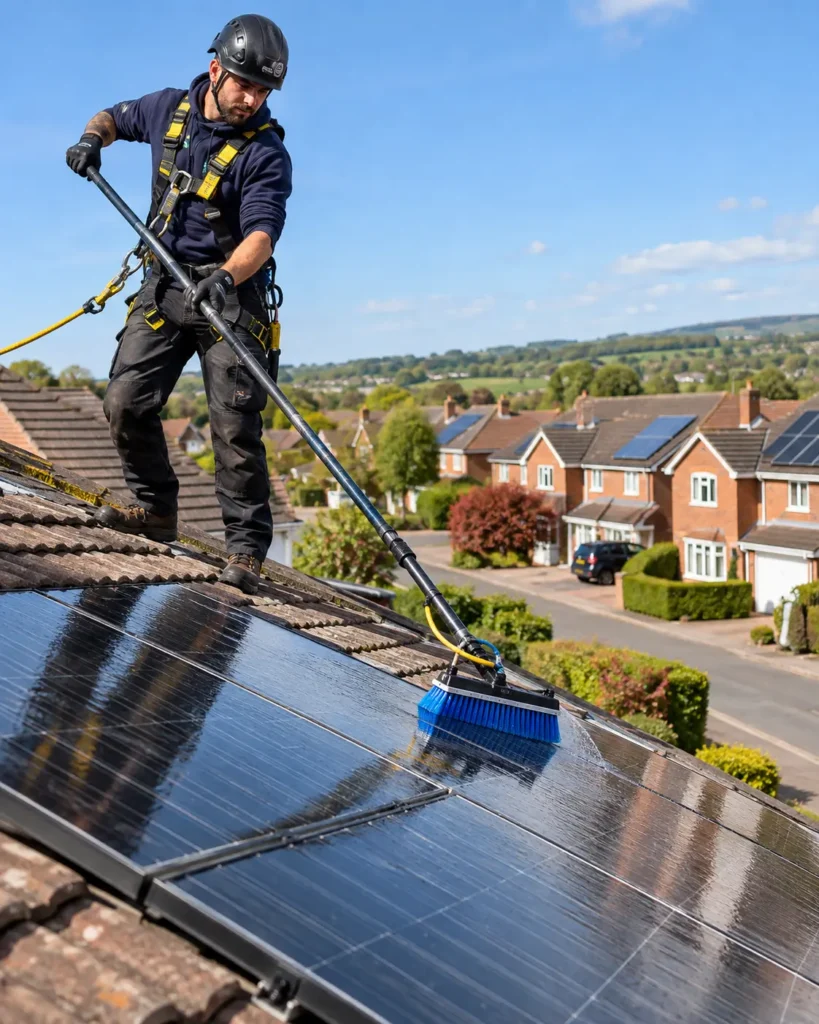
Roof height and access usually matter most. A bungalow reachable by a water-fed pole is normally cheaper than a steep two- or three-storey roof. Conservatories, extensions and narrow side access can make the job more complex.
Panel count matters, but not in a straight line. Minimum call-out charges mean ten panels may not cost half as much as twenty. Some cleaners quote per panel, while others price the complete visit.
The type of dirt changes the work. Loose dust is easier to remove than baked-on bird droppings, lichen, moss, tree sap or agricultural grime. Specialist treatment may cost more, and manufacturer restrictions can limit which products are safe.
Water quality matters too. Solar Energy UK’s current rooftop solar operations and maintenance guidance says water with very low mineral content is preferable because minerals can leave spots and streaks. Its guidance also says cleaning regimes should account for the individual installation and its conditions. Solar Energy UK
Do solar panels need cleaning in the UK?
Yes, sometimes, but not as often as some sales claims suggest.
Energy Saving Trust’s solar panel cleaning guidance recommends cleaning approximately every 12–18 months, while recognising that rainfall does much of the work on pitched rooftop arrays. Ground-mounted systems, panels near trees and properties exposed to dust or birds may require more attention. Energy Saving Trust
Solar Energy UK’s latest guidance takes a more explicitly site-specific approach. It says the appropriate cleaning frequency depends on factors including manufacturer requirements, local soiling, bird activity, array design, panel angle and access. Monitoring data can also help determine when cleaning is justified. Solar Energy UK
A steep roof in a rainy location may therefore need little intervention. A shallow array near trees, farmland or the coast can soil faster.
If generation looks unusually low, compare it with similar periods before blaming dirt. Weather, shading, inverter problems and normal degradation can also reduce output. The solar panel output UK guide explains those factors in more detail.
Is solar panel cleaning worth the cost?
It is worth paying for when the likely value of restored generation or reduced persistent soiling justifies the fee. It is less compelling when panels are already visibly clean and performing normally.
A simple break-even calculation helps.
Suppose your solar electricity is worth £700 a year through avoided imports and export payments. A £100 clean would need to restore about 14% of that annual value to pay for itself within one year.
If light dirt is causing only a small loss, professional cleaning may therefore not recover its cost through additional electricity alone.
The calculation changes when contamination is heavy or localised. Bird droppings, lichen and stubborn deposits can block light over individual sections of the array. Solar Energy UK specifically identifies soiling, lichen and bird activity as issues that can require corrective cleaning. Solar Energy UK
The case for cleaning is strongest when you have:
- visible bird fouling, moss, lichen or heavy dirt
- a shallow or flat array that does not rinse well
- nearby trees, construction, farmland, busy roads or salt exposure
- a persistent output drop that cannot be explained by weather or shading
- manufacturer guidance that specifies cleaning.
For broader system checks, keep cleaning separate from electrical inspection and fault-finding. The solar panel installation aftercare guide explains what good post-installation support should include.
How often should solar panels be cleaned?
For many UK homes, 12–18 months is a reasonable inspection point, not a compulsory paid-cleaning interval.
Look at the panels safely from ground level and review your monitoring data. If the glass remains reasonably clear and generation looks normal for the season, you may be able to wait.
Clean sooner when bird activity, pollen, dust, leaves or coastal residue build up quickly. Ground-mounted and low-angle arrays can also need more attention.
Solar Energy UK stresses that cleaning frequency should be decided site by site. Manufacturer instructions should take priority where they specify particular cleaning products, methods or intervals. Solar Energy UK
A useful rule is: clean because there is evidence of soiling, not merely because the calendar says so.
Can you clean solar panels yourself?
You may be able to clean panels from the ground if you can reach them safely with suitable equipment.
Energy Saving Trust recommends soft, non-abrasive equipment and warns against standing on panels or using a high-pressure power washer. High pressure can interfere with seals and wiring. Energy Saving Trust
Do not climb onto a roof simply to save the cleaning fee. The Health and Safety Executive says work at height should be avoided where reasonably practicable and recommends doing as much work from ground level as possible. HSE
Check the panel manufacturer’s manual before using detergents or chemicals. For example, LONGi’s module maintenance guidance warns against rough cleaning tools and notes that water with a high mineral content can leave deposits that reduce glass transmittance over time. Longi
If the job requires roof access, specialist equipment or work near damaged cabling, use a competent professional.
What should a professional solar panel clean include?
A good quotation should state what will be done. A straightforward domestic clean may include removal of loose debris, washing with suitable water and a soft non-abrasive system, plus a final check for remaining contamination.
Ask whether the cleaner will access the roof or work from the ground. Solar Energy UK recommends suitable insurance for solar O&M activity and specifically notes that, where a window-cleaning business carries out panel cleaning, its insurance should cover solar-related work. Solar Energy UK
Be cautious if someone proposes aggressive pressure washing, walking on modules or unapproved chemicals without checking the manufacturer’s guidance.
Cleaning is not the same as a solar service. Unless the quote says otherwise, do not assume it includes inverter diagnostics, electrical testing, mounting checks or repairs.
How to compare solar panel cleaning quotes
Get at least two or three written prices for the same scope. Give each cleaner the same information: panel count, number of storeys, roof type, access restrictions and visible contamination.
Compare the method, access plan, insurance, treatment of stubborn deposits, and whether VAT or travel is included. Prefer a fixed job price where possible.
If you also need electrical checks, ask for cleaning and technical maintenance to be priced separately. This makes it much easier to compare like with like.
Get Your Free Air Source Heat Pump Quote
Find the right air source heat pump solution for your home. Tell us a few details and our team will help you explore suitable options at a competitive price.
Quick to complete. No obligation.
Get your quote
Enter your details below and one of our team will get back to you.
Frequently asked questions
Find clear answers to common questions about solar panel cleaning costs, cleaning frequency, rain, DIY cleaning, pressure washing, water quality, warranties and professional cleaning.
A typical domestic clean commonly costs around £60–£150, although Energy Saving Trust gives a broader professional-cleaning range of £20–£200. Difficult access, larger arrays and stubborn contamination can increase the price.
Current UK market guides commonly quote around £4–£15 per panel, although some providers quote more. Minimum call-out charges mean the effective price per panel can be higher for a small system.
It can be when panels have visible bird droppings, lichen, heavy dust or other persistent contamination. If a pitched array already looks clean and performs normally, paying for an unnecessary clean may provide little financial return.
Energy Saving Trust suggests around every 12–18 months, but the correct frequency depends on the site. Solar Energy UK recommends making the decision according to local soiling, panel angle, manufacturer requirements and system performance.
Rain removes much ordinary loose dirt from pitched rooftop panels. However, it may not completely remove bird droppings, lichen, tree residue or other stubborn contamination.
Potentially, if the panels can be reached safely from ground level with appropriate non-abrasive equipment. Avoid climbing onto a roof without suitable competence and equipment.
Energy Saving Trust advises against high-pressure power washing because it can interfere with seals and wiring. Use the cleaning method specified by your panel manufacturer instead.
It is better to follow the panel manufacturer's instructions. Energy Saving Trust warns that washing-up liquid can leave a film and some chemicals may affect panel coatings.
Follow the shutdown and cleaning instructions supplied with your particular installation. Energy Saving Trust advises switching the system off before cleaning and checking the manual if you are unsure.
Manufacturer requirements differ. Some permit mains water within defined water-quality limits, while high mineral content can leave deposits. Check the manual for your panel model before choosing the water or cleaning method.
Avoid cleaning very hot panels unless the manufacturer specifically permits the method. Solar Energy UK notes that manufacturers commonly recommend early morning or late afternoon to reduce thermal-shock risk.
Cleaning can restore generation lost through soiling, but the improvement depends on how dirty the panels were beforehand. A relatively clean UK rooftop array may show only a small difference.
Some can. Check that they use a panel-appropriate method and that their insurance specifically covers solar-related cleaning work. Solar Energy UK highlights this insurance point in its O&M guidance.
Potentially. Using unsuitable chemicals, equipment or cleaning methods may conflict with manufacturer requirements. Always check the module manual and warranty before cleaning.
They may. Panels at a lower angle can retain more dirt and water because rain does not drain from the surface as effectively. Cleaning frequency should still be based on actual site conditions rather than a fixed rule.
Conclusion: what should you budget?
For a typical UK home, £60–£150 is a useful 2026 planning range for solar panel cleaning, while easy jobs can cost less and difficult access can push the price beyond £200. Energy Saving Trust
Most importantly, do not assume you need a professional clean every year. Check the array, review its output and follow the manufacturer’s guidance. Pay for cleaning when there is a clear reason: persistent dirt, bird fouling, lichen, difficult low-pitch panels or evidence that soiling is affecting performance.
If you are considering a new system as well as future maintenance costs, you can compare solar panel installation quotes and ask installers what cleaning and aftercare they recommend for your roof.