Air Conditioning vs Fan UK: Costs & Best Choice 2026
Check Your Eligibility for Boiler Upgrade Scheme (BUS)
Complete your details below to check your eligibility.
Thank you
We've received your details and will be in touch shortly.
Quick answer: is air conditioning better than a fan in the UK?
Air conditioning is better if you need to reduce the actual temperature of a room. A fan is better if you mainly want inexpensive personal cooling.
Fans move air across your skin, helping sweat evaporate faster, but they do not remove heat from the room. Air conditioners use a refrigeration cycle to absorb heat indoors and release it outside.
The difference in running cost can be substantial. Energy Saving Trust currently estimates typical fans at around 14p–30p for 24 hours of use in Great Britain, compared with approximately £4.62–£5 for a portable air conditioner. Energy Saving Trust
For occasional warm days, start with a fan. For persistently hot bedrooms or living spaces, properly sized air conditioning can be worth considering.
Air Conditioning vs Fan UK: Which Is Better for Cooling Your Home?
If your home becomes uncomfortable during warm weather, the choice between air conditioning and a fan comes down to one fundamental difference: a fan cools you, while air conditioning can actually cool the room.
For many UK homes, a good fan is still the sensible first choice. It costs very little to run, needs no installation and can make warm conditions much more comfortable. However, a fan cannot remove heat from a room. If you have a south-facing flat, converted loft, conservatory-style glazing or bedroom that stays hot overnight, air conditioning can provide a level of temperature control that a fan cannot.
This guide compares air conditioning vs fan use in UK homes, including cooling performance, electricity costs, noise, installation and which option makes most sense in different situations.
If you already know that you need active cooling, you can also compare UK air-conditioning options before deciding on a system.
Considering installed air conditioning? You can compare home-improvement quotes through Get Free Quote after assessing what type of system your property actually needs.
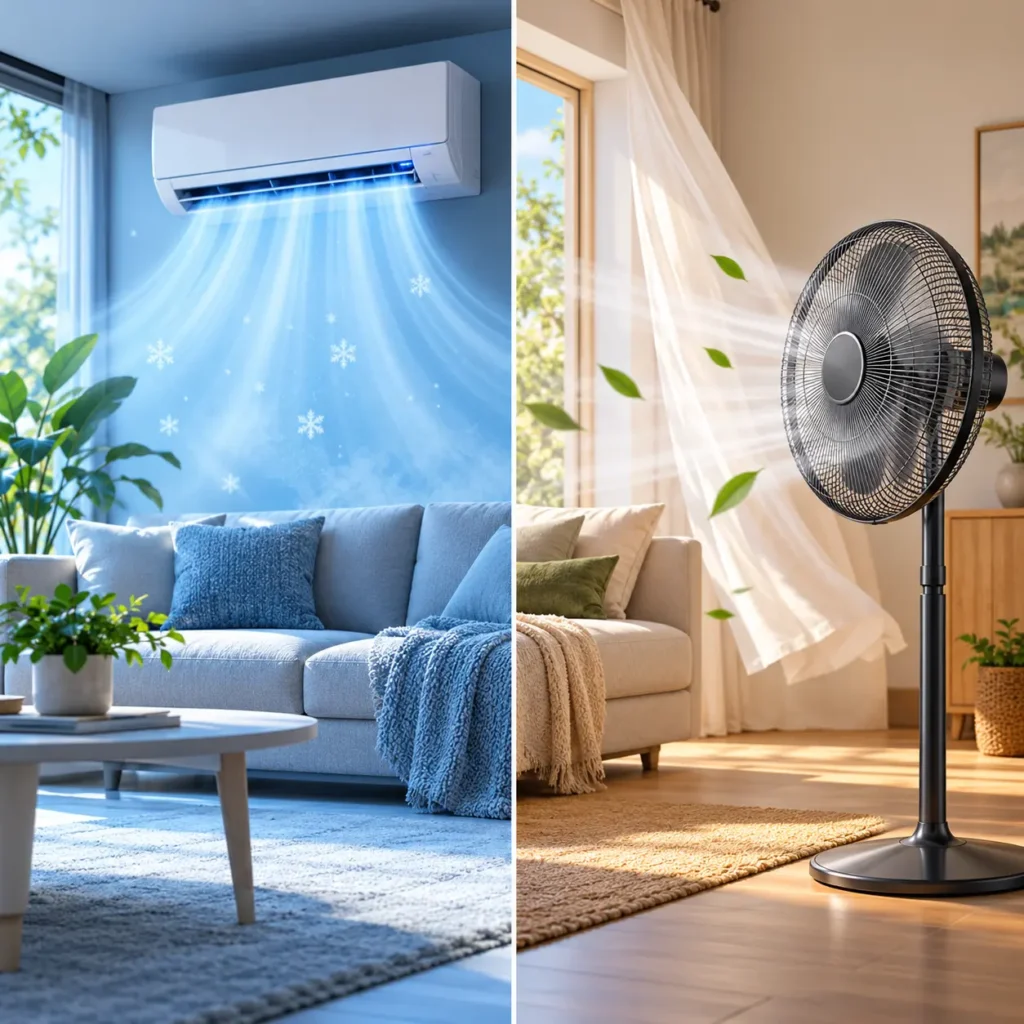
Air conditioning vs fan: quick comparison
| Factor | Fan | Portable air conditioner | Fixed split air conditioning |
|---|---|---|---|
| Actually lowers room temperature? | No | Yes | Yes |
| Running cost | Very low | High | Higher than a fan; varies with load and efficiency |
| Upfront cost | Low | Moderate | Highest |
| Installation | None | Exhaust hose/window arrangement | Professional installation |
| Noise | Usually low | Often noticeable | Indoor unit can be relatively quiet |
| Dehumidifies | No | Usually | Usually |
| Best for | Personal cooling | Occasional room cooling | Regular, controlled cooling |
| Heating available | No | Some models | Common on reversible systems |
Energy Saving Trust confirms that fans are considerably cheaper to operate than portable air conditioners and that portable units need effective exhaust arrangements to stop warm outside air leaking back into the room.
How does a fan cool you?
A fan does not produce cold air.
Instead, it increases airflow over your skin. That encourages sweat to evaporate, removing heat from your body and making you feel cooler.
This distinction matters. Switching on a fan in an empty room will not meaningfully reduce the room temperature. In fact, its motor introduces a small amount of heat.
Fans therefore work best when someone is actually in front of, or close to, the airflow.
The NHS advises that electric fans can help when temperatures are below 35°C, alongside measures such as closing curtains and windows when it is hotter outside and ventilating when outside temperatures fall. nhs.uk
How does air conditioning cool a room?
Air conditioning removes heat instead of simply moving air around.
Warm indoor air passes across a cold heat exchanger. Refrigerant absorbs that heat and carries it through the refrigeration circuit. A compressor raises the refrigerant pressure before the system releases the unwanted heat outdoors.
That is why a genuine air conditioner needs somewhere to reject heat.
A portable system normally uses an exhaust hose through a window. A split system puts the compressor and outdoor heat exchanger outside while an indoor unit circulates conditioned air.
This is closely related to heat-pump technology. Readers interested in the refrigeration cycle can see Get Free Quote’s guide explaining how air source heat pumps work rather than duplicating that technical explanation here.
Air conditioning vs fan UK running costs
Electricity consumption is one of the biggest differences.
From 1 October to 31 December 2026, Ofgem’s average electricity price-cap unit rate for a Direct Debit customer in Great Britain is 26.32p/kWh. Your actual tariff and regional rate may differ.
| Example | Indicative electricity use/cost | What this means |
|---|---|---|
| Typical fan | About 14p–30p per 24 hours | Extremely cheap for prolonged use |
| Portable air conditioner | About £4.62–£5 per 24 hours | Much more expensive than a fan |
| 2.5kW Mitsubishi split AC example | 600W rated cooling input; about 15.8p/hour at 26.32p/kWh | Illustration only; inverter consumption changes with conditions |
The fan and portable-AC figures come from Energy Saving Trust’s October 2026 guidance. Energy Saving Trust Mitsubishi Electric’s technical data gives a rated 600W cooling input for one 2.5kW split system under specified test conditions. Mitsubishi Electric Document Library
The split-system figure should not be read as a guaranteed running cost. Modern inverter air conditioners adjust compressor output as the cooling requirement changes. Room temperature, insulation, glazing, system size, thermostat setting and outdoor temperature all affect consumption.
Which costs less to run?
The fan wins easily.
If a fan provides enough comfort, there is little financial justification for using air conditioning instead.
However, the comparison changes when a room itself needs cooling. A £20–£60 fan that leaves a bedroom uncomfortably hot is not performing the same job as an air conditioner that removes heat and moisture.
Which is better for sleeping?
For slightly warm bedrooms, a quiet fan is usually the first option to try.
It is inexpensive and can provide enough air movement to improve comfort without changing the room temperature.
Air conditioning becomes more useful when the bedroom has stored significant heat during the day and remains hot after sunset. This is common in loft conversions, top-floor flats and rooms with large areas of west- or south-facing glazing.
Portable air conditioners can work well here, but compressor noise may make them difficult to run while sleeping. One recurring theme in UK homeowner discussions is using portable AC before bedtime, then switching to a fan overnight. Reddit
Fixed split systems move the main compressor outdoors, which can make the indoor environment considerably more suitable for regular bedroom cooling.
Portable or fixed air conditioning?
Portable air conditioning makes sense when you rent, cannot alter the building or only need cooling for occasional heatwaves.
The disadvantages are bulk, compressor noise and the need to exhaust hot air outdoors. A poorly sealed open window can also allow heat back inside. Energy Saving Trust specifically recommends sealing gaps around the exhaust arrangement. Energy Saving Trust
A fixed split system makes more sense when cooling is a recurring requirement. It can also offer heating through the same equipment where a reversible air-to-air heat pump is installed.
Recent UK price guides commonly place a straightforward single-room split installation at roughly £1,500–£3,000, although specification, location, access, electrical work and pipe runs can push quotations outside that range. A property survey is needed for reliable pricing. EnergyPlus
For the installation process itself, see the dedicated guide to air-conditioning installation in the UK.
Which cooling option is right for your home?
Use this simple decision process.
- Try passive cooling first. Keep direct sunlight out with curtains or blinds and ventilate once outdoor air becomes cooler. Energy Saving Trust recommends stopping heat entering before trying to remove it afterwards. Energy Saving Trust
- Use a fan if personal comfort is the problem. For ordinary warm days, it is the lowest-cost mechanical option.
- Consider portable AC if one room regularly becomes excessively hot. It is particularly practical for renters and occasional use.
- Consider fixed split air conditioning if overheating is predictable every summer. Bedrooms, loft rooms, home offices and heavily glazed spaces can justify the extra investment.
- Get the cooling requirement assessed rather than buying by room size alone. Glazing, orientation, insulation, occupancy and equipment all contribute to heat gain.
Buying an oversized system is not automatically better. Correct sizing helps the system control temperature efficiently while avoiding unnecessary cost.
Can you run air conditioning and a fan together?
Yes.
They perform different jobs, so there is no technical reason they must be alternatives.
The air conditioner removes heat. A fan can then improve circulation and create extra air movement across occupants. That may allow some people to remain comfortable with a less aggressive thermostat setting.
However, you should not assume a particular percentage saving. The result depends on room layout, controls, equipment and how the appliances are used.
Do you need permission or a qualified installer?
Fixed air conditioning containing F-gas refrigerants requires appropriately qualified people to install and work on the refrigerant circuit. GOV.UK states that individuals working with F-gas need the relevant qualifications, while companies carrying out applicable stationary air-conditioning work for others also require certification. GOV.UK
Planning also deserves checking. Rules vary across the UK. In England, Planning Portal says some heating-and-cooling systems can fall within permitted-development rules when the relevant conditions are satisfied. Cooling-only systems do not receive those particular heat-pump permitted-development rights, and listed buildings, conservation areas and flats can introduce further restrictions. Planning Portal
There is also a significant 2026 change: eligible residential air-to-air heat pumps can receive £2,500 through the Boiler Upgrade Scheme in England and Wales. This is not a general grant for installing a bedroom air conditioner. The BUS-funded heat pump must meet scheme requirements, including having sufficient capacity for the property’s full space-heating demand. Ofgem
Get Free Quote’s Boiler Upgrade Scheme 2026 guide explains the wider grant changes.
Get Your Free Air Source Heat Pump Quote
Find the right air source heat pump solution for your home. Tell us a few details and our team will help you explore suitable options at a competitive price.
Quick to complete. No obligation.
Get your quote
Enter your details below and one of our team will get back to you.
Frequently asked questions
Find clear answers to common questions comparing air source and ground source heat pumps, including efficiency, installation and running costs, winter performance, noise, land requirements and borehole depth.
No. A normal electric fan moves air rather than removing heat. It makes people feel cooler by increasing airflow over the skin.
Yes. Genuine air conditioning absorbs heat indoors and transfers it outside.
Yes, substantially. Energy Saving Trust currently estimates around 14p–30p for 24 hours of typical fan use versus approximately £4.62–£5 for portable air conditioning in Great Britain. Energy Saving Trust
It can be if your property experiences persistent summer overheating. For occasional warm days, a fan and sensible shading may be sufficient.
It is better at lowering room temperature. A fan is far cheaper and may be enough when you only need personal cooling.
A quiet fan often works well for moderately warm bedrooms. Air conditioning is more useful when the room itself remains excessively hot overnight.
Many people do, but follow the manufacturer's safety instructions, keep the appliance stable and maintained, and avoid using damaged electrical equipment.
Suitable systems can operate overnight, although energy use, noise and thermostat settings should be considered. Follow the manufacturer's instructions.
Generally no. Fans use much less electricity than refrigerant-based air-conditioning systems.
It normally needs a route for its hot exhaust air. Most domestic portable units use a hose vented through a window or another suitable opening.
Usually yes. Allowing warm outside air to enter makes the system work harder. Any gap around a portable AC exhaust should also be sealed effectively. Energy Saving Trust
Only when the outside air will help. During very hot daytime conditions, opening windows can let hotter air inside. Opening them later when outside temperatures fall can be more effective. Energy Saving Trust
Not necessarily. The best choice depends on airflow, noise, power consumption, room layout and personal preference rather than the shape alone.
Usually the main advantage is that the compressor sits outdoors rather than in the room. Actual sound levels vary by model and operating mode.
Many modern split systems are reversible air-to-air heat pumps and can provide both heating and cooling.
There is no blanket grant simply for installing cooling. However, qualifying residential air-to-air heat-pump installations in England and Wales can currently receive £2,500 through BUS, subject to the full eligibility rules. Ofgem
It depends on the property, location, system and UK nation. In England, some heating-capable systems can qualify as permitted development subject to conditions, while cooling-only installations do not benefit from those specific rights. Planning Portal
Yes. Air conditioning removes heat while the fan can improve air circulation and increase the cooling sensation across your skin.
Air conditioning vs fan: which should you choose?
Choose a fan if you want the cheapest way to feel cooler, only struggle during occasional warm weather or cannot justify active room cooling.
Choose portable air conditioning if one room genuinely overheats but you need something removable.
Choose a fixed split system when overheating is frequent, predictable and affects sleep, work or day-to-day comfort. The greater upfront cost buys actual temperature control rather than simply increased airflow.
For many households, the best sequence is therefore passive cooling first, fan second and air conditioning where those measures are no longer enough.
If fixed cooling appears justified, compare system sizing, installation scope, warranty, noise and total quoted cost rather than choosing equipment solely by headline price.
Ready to compare your options? Get property-specific quotations through Get Free Quote before committing to an installation.