Air Conditioning vs Heat Pump: UK Guide 2026
Check Your Eligibility for Boiler Upgrade Scheme (BUS)
Complete your details below to check your eligibility.
Thank you
We've received your details and will be in touch shortly.
Quick Answer
Choose reversible air conditioning, also called an air-to-air heat pump, if your priority is cooling one or more rooms while gaining efficient room heating in winter. Choose an air-to-water heat pump if your priority is replacing a boiler and heating the whole home through radiators or underfloor heating while also producing stored hot water. Neither option is automatically better. The central question is whether you need room-by-room heating and cooling or a whole-home central-heating replacement.
Air Conditioning vs Heat Pump: Which Is Better for UK Homes in 2026?
If you are comparing air conditioning vs heat pump systems, the first thing to understand is that the terms overlap.
Most modern fixed split air conditioners that can both cool and heat are already air-to-air heat pumps. They use electricity to move heat from one place to another rather than generating heat directly.
The more useful UK comparison is therefore air-to-air vs air-to-water heat pumps.
An air-to-air system delivers warm or cool air directly into rooms. An air-to-water heat pump warms water for radiators, underfloor heating and usually a hot-water cylinder.
That difference affects almost every buying decision: summer cooling, whole-home heating, hot water, installation cost, grants, property suitability and disruption.
Compare free quotes: Getfreequote.co.uk can help you compare property-specific options rather than choosing from headline prices alone.
Air Conditioning vs Heat Pump at a Glance
| Feature | Reversible air conditioning / air-to-air heat pump | Air-to-water heat pump |
|---|---|---|
| Main purpose | Heat and cool rooms or zones | Whole-home central heating |
| Summer cooling | Yes | Usually not in a standard UK installation |
| Winter heating | Yes | Yes |
| Domestic hot water | Usually no | Yes, normally via a cylinder |
| Heat delivery | Warm air from indoor units | Warm water to radiators or underfloor heating |
| Current typical cost benchmark | About £1,900 for one room; around £3,700 for a three-bed semi | Around £12,000 before grants |
| Current BUS support in England and Wales | £2,500 for eligible systems | £7,500 for eligible standard systems |
| Best suited to | Bedrooms, lofts, flats, extensions and zoned comfort | Boiler replacement and whole-home heating |
The cost figures above come from current Energy Saving Trust air-to-air heat pump guidance and its air source heat pump guidance. They are indicative figures rather than quotations.
Current government rules also provide Boiler Upgrade Scheme support for eligible air-to-air and air-to-water installations in England and Wales.
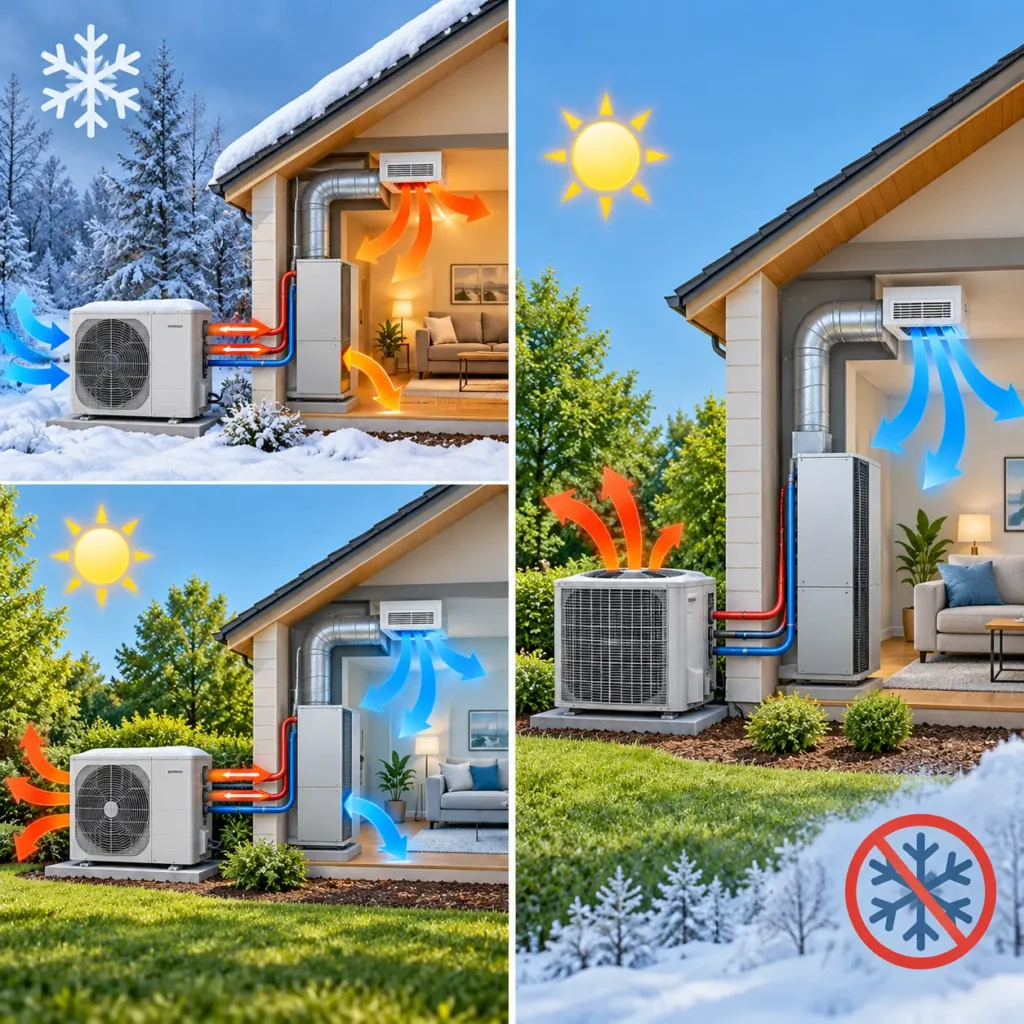
Visual suggestion: a simple house cutaway showing air-to-air indoor units on one side and an air-to-water system feeding radiators and a cylinder on the other.
Are Air Conditioning and Heat Pumps Actually Different?
Sometimes, but not in the way many homeowners expect.
A cooling-only air conditioner transfers heat from inside the building to the outdoors. A reversible split system can reverse that process.
During winter, it absorbs heat from outside air and transfers that heat indoors. This makes it an air-to-air heat pump.
An air-to-water heat pump uses the same broad principle but sends the captured heat into water instead. That water circulates through radiators or underfloor heating and can also heat a domestic hot-water cylinder.
This distinction matters because homeowners often compare “air conditioning” with “a heat pump” as though they are completely separate technologies.
Current UK search results increasingly clarify this point: the practical comparison is usually air-to-air versus air-to-water, not two completely unrelated machines.
If you are considering a room-based system, the air conditioning installation guide explains the installation side in more detail. The air conditioning sizing guide covers capacity and room requirements.
How Does the Refrigeration Cycle Work?
Air conditioning and heat pumps both rely on a refrigeration cycle.
The individual components work together to absorb heat at a low temperature, increase its temperature and release it somewhere useful.
1. The evaporator absorbs heat
In heating mode, cold refrigerant passes through the outdoor evaporator.
Even when outdoor air feels cold, it still contains thermal energy. The refrigerant absorbs some of this energy and evaporates.
2. The compressor raises its temperature
The compressor squeezes the refrigerant vapour.
Increasing its pressure also increases its temperature, creating hot, high-pressure refrigerant.
3. The condenser releases the heat
The hot refrigerant reaches the condenser.
With an air-to-air system, the heat ultimately warms indoor air. With an air-to-water system, the heat transfers into water used for space heating and usually hot-water production.
4. The expansion valve resets the cycle
Finally, the refrigerant passes through an expansion valve.
Its pressure and temperature fall, allowing it to absorb heat again. The cycle then repeats.
Get Free Quote already has a detailed guide explaining how air source heat pumps work, so this article does not need to duplicate the complete technical explanation.
Visual suggestion: an annotated refrigeration-cycle diagram showing the evaporator, compressor, condenser, expansion valve and direction of heat flow.
Air-to-Air vs Air-to-Water in a Real Home
The biggest practical difference is what happens after the system captures heat.
Air-to-air heats or cools rooms directly
Air-to-air systems use indoor fan units to condition the air.
A single-split system normally serves one room. A multi-split system can connect several indoor units to one outdoor unit.
This makes air-to-air particularly useful for bedrooms, home offices, loft conversions, extensions and homes where occupants want independent room control.
Cooling is also built into the concept. Reverse the refrigeration cycle and the system removes heat from the room.
The main limitation is hot water. Energy Saving Trust notes that most air-to-air systems do not provide domestic hot water, although some newer products can.
Air-to-water works like central heating
Air-to-water systems normally replace a boiler.
Instead of blowing warm air into individual rooms, they heat water that circulates through radiators or underfloor heating.
They also usually work with a hot-water cylinder.
Existing radiators do not automatically need replacing. However, each radiator must provide enough output at the proposed water temperature. Get Free Quote’s heat pump radiator guide explains why some homes can retain existing emitters while others need larger models.
Efficiency, CoP and Winter Performance
Heat pumps can deliver several units of heat for each unit of electricity consumed because they move heat rather than create it through electrical resistance.
What does CoP mean?
The coefficient of performance, or CoP, measures performance under a specific set of conditions.
A CoP of 3 means the heat pump delivers three units of heat for every unit of electricity used.
For annual comparisons, seasonal CoP or SCOP is more useful because outdoor temperatures and operating conditions change through the year.
Do heat pumps work when it is freezing?
Yes.
Cold outdoor air still contains usable thermal energy. However, efficiency generally falls as outdoor temperatures drop because the compressor must work harder.
Cold, damp conditions can also cause frost to form on the outdoor heat exchanger. The heat pump then periodically enters a defrost cycle to clear the coil.
The occasional defrost cycle is normal. The more important question is whether the system has enough output to meet the property’s calculated heat loss during local winter design conditions.
Air Conditioning vs Heat Pump Costs, Grants and Running Costs
Energy Saving Trust currently estimates an air-to-air heat pump at around £1,900 for one room and roughly £3,700 for a three-bedroom semi-detached house.
Its current typical benchmark for an air-to-water air source heat pump is around £12,000 before grants.
Actual quotations can differ considerably because of capacity, property layout, pipework, electrical work, emitter upgrades, hot-water requirements and installation complexity.
What grants are available in 2026?
Under the Boiler Upgrade Scheme in England and Wales, current approved grant values include:
£2,500 for eligible air-to-air heat pumps
£7,500 for eligible standard air-to-water heat pumps
Some qualifying off-gas properties can receive higher support for certain air-to-water installations under the current grant structure. Always check the current eligibility rules before budgeting around a grant.
Which is cheaper to run?
Running cost depends heavily on electricity price ÷ seasonal efficiency.
From 1 October to 31 December 2026, Ofgem’s average Direct Debit price-cap rates are 26.32p/kWh for electricity and 7.97p/kWh for gas. See Ofgem’s current price-cap unit rates
For illustration, a heat pump achieving a seasonal CoP of 3.0 produces useful heat at roughly 8.8p/kWh before standing charges.
A gas boiler operating at 90% efficiency produces useful heat at roughly 8.9p/kWh at the same current capped gas rate.
That is why a claim such as “heat pumps are three times as efficient” does not automatically guarantee a lower bill. Your tariff, seasonal performance and existing heating system all matter.
Visual suggestion: a simple graphic comparing indicative purchase cost, available grant and cost per useful kWh at several SCOP levels.
Which System Suits Your Home?
Use the job you need the system to perform as your starting point.
Choose reversible air conditioning / air-to-air if summer cooling is the main priority. It is particularly useful for bedrooms, lofts, offices, extensions and selected living areas.
Choose air-to-water if you want to replace your boiler and retain a wet central-heating system using radiators or underfloor heating.
Consider air-to-air carefully for flats and smaller homes. Installation can be simpler because no new wet heating circuit is required, but you still need a suitable domestic-hot-water solution.
Consider separate heating and cooling requirements if you want both full central-heating replacement and powerful bedroom cooling. Standard air-to-water installations do not automatically provide the same cooling experience as split air conditioning.
Never choose either system purely from its advertised kW rating. Room cooling needs a proper cooling-load assessment. Whole-home heating needs a room-by-room heat-loss calculation.
Planning also deserves an early check.
In England, an air source heat pump can qualify as permitted development when all relevant limits and conditions are satisfied. Current rules specifically state that equipment using this route must not be used solely for cooling. Flats, listed properties, conservation areas and other restricted properties can require additional consideration. Check current Planning Portal heat-pump guidance
Get Your Free Air Source Heat Pump Quote
Find the right air source heat pump solution for your home. Tell us a few details and our team will help you explore suitable options at a competitive price.
Quick to complete. No obligation.
Get your quote
Enter your details below and one of our team will get back to you.
Frequently asked questions
Find clear answers to common questions comparing air source and ground source heat pumps, including efficiency, installation and running costs, winter performance, noise, land requirements and borehole depth.
A reversible air-conditioning system is a type of heat pump. More specifically, it is an air-to-air heat pump because it transfers heat between outdoor air and indoor air.
Air-to-air systems deliver heated or cooled air directly into rooms. Air-to-water systems heat water for radiators, underfloor heating and usually a hot-water cylinder.
Air-to-air is normally substantially cheaper. Energy Saving Trust currently cites about £1,900 for one room and £3,700 for a three-bed semi, compared with around £12,000 for a typical air-to-water installation.
If you are comparing the same reversible air-to-air machine, there is no separate “air-conditioning” versus “heat-pump” running cost. Heating costs depend on its efficiency, electricity tariff and heating demand.
Potentially, yes. A suitably designed multi-split or ducted air-to-air system can provide whole-home space heating, but domestic hot water normally needs another solution.
Some equipment can technically provide cooling when the system is designed for it. However, many standard UK residential air-to-water installations focus on heating and hot water, so cooling should never be assumed.
An air-to-water heat pump can replace a boiler for central heating and domestic hot water when the property and heating system are suitable. An air-to-air system can replace space heating in some homes but normally needs a separate hot-water solution.
Yes. Air source heat pumps can continue extracting energy from outdoor air below 0°C, although efficiency usually falls as the outdoor temperature decreases.
A defrost cycle temporarily warms the outdoor heat exchanger to remove frost. It is a normal part of air-source heat-pump operation during suitable cold and damp conditions.
CoP means coefficient of performance. A CoP of 3 means a heat pump delivers approximately three units of heat for each unit of electricity consumed under the stated test conditions.
SCOP is seasonal coefficient of performance. It gives a better indication of heating efficiency across changing seasonal conditions than a single-point CoP figure.
Not necessarily. Existing radiators can remain if they provide enough heat at the proposed flow temperature. A room-by-room heat-loss and emitter calculation should determine this.
Usually, yes. Unlike a combi boiler, most domestic air-to-water heat-pump installations store hot water in a suitable cylinder.
Eligible installations in England and Wales can currently receive £2,500 for air-to-air heat pumps and £7,500 for standard air-to-water systems under the Boiler Upgrade Scheme. Eligibility conditions apply.
Not always. Many domestic installations in England can qualify as permitted development when the relevant limits and conditions are met. Property type, unit size, location, noise requirements and planning restrictions can change the position.
Air Conditioning vs Heat Pump: Final Recommendation
For most homeowners asking “air conditioning vs heat pump?”, the answer becomes much easier once the terminology is corrected.
If you want to cool and heat selected rooms with relatively little disruption, a reversible air-to-air system is usually the more direct option.
If you want to replace a boiler, heat the whole property through radiators or underfloor heating and provide domestic hot water, an air-to-water heat pump is usually the stronger fit.
Neither decision should be made from an online price or efficiency figure alone.
The right system depends on the property’s actual heating or cooling demand, hot-water requirements, available space, existing heating system, electricity tariff and budget.
Next step: compare complete, property-specific quotations. A good proposal should tell you what the system serves, what installation work is included and what performance the designer expects in your home.