Air-to-Air Heat Pump vs Air Conditioning: UK Guide
Check Your Eligibility for Boiler Upgrade Scheme (BUS)
Complete your details below to check your eligibility.
Thank you
We've received your details and will be in touch shortly.
Quick answer
If you are comparing an air-to-air heat pump vs air conditioning, the first thing to know is that the terms often describe almost the same equipment. A modern fixed split air conditioner that can both cool and heat is, technically, an air-to-air heat pump. It uses refrigerant to move heat between the room and outside.
The real difference appears when you compare a reversible air-to-air heat pump with cooling-only air conditioning or with an air-to-water heat pump. Those systems do different jobs.
For UK homeowners, the best choice depends on whether you want summer cooling only, year-round room heating and cooling, or a replacement for a boiler and wet central heating.
Compare options before you buy: Get Free Quote can help you compare free, no-obligation home-improvement quotations based on your property and priorities.
Air-to-Air Heat Pump vs Air Conditioning: What’s the Difference in the UK?
If you are comparing an air-to-air heat pump vs air conditioning, the first thing to know is that the terms often describe almost the same equipment. A modern fixed split air conditioner that can both cool and heat is, technically, an air-to-air heat pump. It uses refrigerant to move heat between the room and outside.
The real difference appears when you compare a reversible air-to-air heat pump with cooling-only air conditioning or with an air-to-water heat pump. Those systems do different jobs.
For UK homeowners, the best choice depends on whether you want summer cooling only, year-round room heating and cooling, or a replacement for a boiler and wet central heating.
Compare options before you buy: Get Free Quote can help you compare free, no-obligation home-improvement quotations based on your property and priorities.
Air-to-Air Heat Pump vs Air Conditioning at a Glance
| Feature | Reversible air-to-air heat pump / split AC | Cooling-only air conditioner | Air-to-water heat pump |
|---|---|---|---|
| Cools rooms | Yes | Yes | Usually not its main purpose |
| Heats rooms | Yes, by blowing warm air | No | Yes, through radiators or underfloor heating |
| Domestic hot water | Usually no | No | Usually yes, via a cylinder |
| Heat distribution | Indoor fan units | Indoor fan units | Water-based central heating |
| Best suited to | Year-round room comfort | Cooling-only applications | Whole-home boiler replacement |
| Typical UK cost reference | About £1,900 for one room; £3,700 for a three-bed semi | Varies | Around £12,000 typical installation |
| Current BUS support | £2,500 category for eligible residential systems | No | £7,500 standard grant, subject to eligibility |
Energy Saving Trust currently gives the air-to-air figures above and a typical air-to-water installation cost of around £12,000. Published figures are budgeting guides rather than guaranteed quotations. Energy Saving Trust
Are air-to-air heat pumps and air conditioning actually the same?
Often, yes.
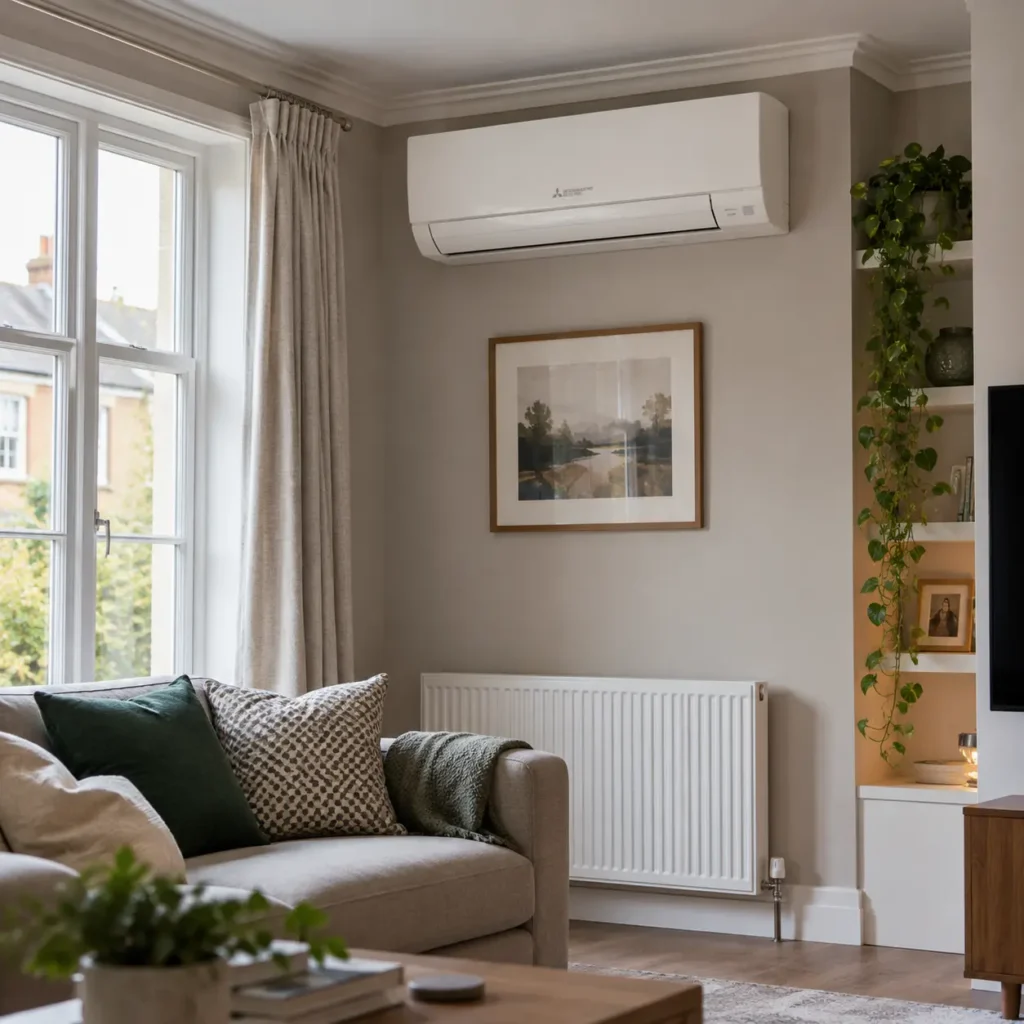
According to Energy Saving Trust’s current air-to-air heat-pump guidance, air-to-air heat pumps use indoor and outdoor units to heat and cool rooms and operate in much the same way as many air-conditioning systems. Energy Saving Trust
The key word is reversible. A reversible split system can move heat in either direction. In summer, it removes heat from your home. In winter, it reverses the process and brings useful heat indoors.
A cooling-only air conditioner cannot reverse the cycle. Before comparing quotations, check whether each system includes heating as well as cooling.
For a broader overview of the choices available, see Get Free Quote’s guide to air con in the UK.
Do not confuse air-to-air with air-to-water
An air-to-water heat pump also extracts heat from outside air, but transfers that heat into water. The water then circulates through radiators or underfloor heating and can usually heat a cylinder for taps and showers.
Air-to-air systems normally heat and cool rooms directly through fan units and need a separate hot-water solution. That makes them far closer to fixed split air conditioning than to a conventional boiler replacement. Energy Saving Trust
How does the same system heat and cool?
Both modes rely on the refrigeration cycle.
In cooling mode, the indoor evaporator absorbs heat from room air. Refrigerant carries that heat to the compressor, which raises its pressure and temperature. The outdoor condenser releases the heat outside. The refrigerant then passes through an expansion valve, cools and repeats the cycle.
In heating mode, a reversing valve changes refrigerant flow. The outdoor heat exchanger absorbs heat from the air. The compressor raises the refrigerant temperature, and the indoor heat exchanger releases that heat into the room.
This still works in cold weather because outdoor air contains thermal energy. However, heating efficiency can fall as temperatures drop. Frost may also form on the outdoor coil, so the unit periodically defrosts. Energy Saving Trust describes evaporation, compression, condensation and expansion as the four main stages of the heat-pump refrigeration cycle. Energy Saving Trust
For a deeper technical explanation, read Get Free Quote’s guide to how air source heat pumps work.
Suggested visual: a reversible refrigeration-cycle diagram showing cooling mode in one direction and heating mode in the other.
Which is better for a UK home?
For most homeowners choosing between a reversible split system and cooling-only fixed air conditioning, the reversible system offers more flexibility. It cools in summer and can provide efficient room heating in colder weather.
Air-to-air can suit flats, smaller homes, loft conversions, extensions and properties without wet central heating. Energy Saving Trust specifically identifies smaller homes and flats as situations where air-to-air systems can make sense. Energy Saving Trust
Cooling-only air conditioning still makes sense where heating is genuinely unnecessary. If your goal is to remove a gas or oil boiler while keeping radiators, however, an air-to-water system is usually the more direct comparison.
Get Free Quote’s air-conditioning installation guide covers the practical considerations for fixed split systems.
Single-split or multi-split?
A single-split system connects one indoor unit to one outdoor unit. It often suits one bedroom, lounge or office.
A multi-split system connects several indoor units to one outdoor unit. This can reduce the number of external units, although pipework and design become more complex.
Neither arrangement automatically makes a system “air conditioning” or a “heat pump”. The important point is whether it is reversible and properly designed for the heating load.
Costs, running costs and efficiency
Energy Saving Trust gives typical air-to-air heat-pump costs of about £1,900 for one room and around £3,700 for a three-bedroom semi-detached home. These are budgeting figures, not quotations. Access, electrical work, pipe routes, capacity and the number of indoor units can all change the price. Energy Saving Trust
For running costs, compare electrical input and seasonal efficiency rather than headline heating or cooling output.
SCOP, or Seasonal Coefficient of Performance, describes seasonal heating efficiency. SEER, or Seasonal Energy Efficiency Ratio, measures seasonal cooling efficiency. Both account for performance over seasonal operating conditions rather than one test point. Legislation.gov.uk
A SCOP of 4 means the system delivers roughly four units of useful heat for each unit of electricity used over the relevant test season. Much of that heat comes from the outside environment rather than the electricity itself.
From 1 October to 31 December 2026, Ofgem’s average capped electricity unit rate for a standard-variable Direct Debit customer in Great Britain is 26.32p/kWh. Your tariff may differ, so use your actual rate when estimating running costs. Check Ofgem’s current price-cap unit rates Ofgem
Is there a £2,500 air-to-air heat-pump grant?
The Boiler Upgrade Scheme now includes a £2,500 grant category for eligible residential air-to-air heat pumps in England and Wales. Ofgem and GOV.UK both list the category. See the current Boiler Upgrade Scheme grants on Ofgem Ofgem
However, practical access is still developing.
Energy Saving Trust’s guidance, updated 16 October 2026, says there are currently no MCS-certified installers for air-to-air heat pumps. It advises households wanting BUS funding to wait until certified installers and eligible systems become available. Energy Saving Trust
Therefore, do not automatically deduct £2,500 from a quotation. Check the live MCS and Ofgem position before signing a contract.
Get Free Quote’s Boiler Upgrade Scheme 2026 update provides more detail on the wider scheme.
Planning and installation rules
Planning can differ between cooling-only and reversible systems.
In England, permitted-development rights for domestic air source heat pumps include a condition that the heat pump must not be solely used for cooling. Other conditions still apply, while Scotland, Wales and Northern Ireland have their own planning frameworks. Read the relevant England planning amendment on Legislation.gov.uk Legislation.gov.uk
Flats, listed buildings, conservation areas and leasehold properties can require extra checks. Ask the local planning authority if the position is unclear.
Refrigerant work also matters. GOV.UK’s F-gas guidance states that people working on stationary refrigeration, air-conditioning and heat-pump systems containing regulated F-gas need appropriate qualifications. Fixed split systems should therefore be treated as specialist refrigeration work. GOV.UK
Suggested visual: a decision graphic comparing reversible split, cooling-only AC and air-to-water heat pump.
How to choose between an air-to-air heat pump and air conditioning
- Need cooling and heating in one or more rooms? Choose a reversible air-to-air system.
- Need cooling only? Cooling-only equipment may be enough, but compare the value of heating capability first.
- Need to replace a boiler, keep radiators and heat domestic water? Compare air-to-water heat pumps.
- Need several rooms conditioned? Compare single-split, multi-split and, where suitable, ducted designs.
- Want Boiler Upgrade Scheme funding? Confirm current MCS installer and product eligibility before relying on the grant.
- Concerned about bills? Compare SEER, SCOP, expected annual use and your electricity tariff.
- Unsure about system size? Ask for a room-by-room heating and cooling load assessment.
Get Your Free Air Source Heat Pump Quote
Find the right air source heat pump solution for your home. Tell us a few details and our team will help you explore suitable options at a competitive price.
Quick to complete. No obligation.
Get your quote
Enter your details below and one of our team will get back to you.
Frequently asked questions
Find clear answers to common questions comparing air source and ground source heat pumps, including efficiency, installation and running costs, winter performance, noise, land requirements and borehole depth.
A reversible fixed air-conditioning system is effectively an air-to-air heat pump. It can move heat outside for cooling or reverse the cycle to provide heating. Energy Saving Trust
Yes. Reversible air-to-air systems can remove heat from indoor air and release it outside, providing conventional air-conditioning cooling.
No. Cooling-only air conditioners cannot provide space heating. The system must have a reversible refrigeration cycle to operate as an air-to-air heat pump.
It can replace space heating in a suitably designed property, but it normally does not provide domestic hot water. A separate hot-water solution is usually required. Energy Saving Trust
Normally not. Air-to-air systems distribute heat through indoor fan units. Air-to-water heat pumps supply heated water to radiators and underfloor heating.
Most do not. Energy Saving Trust says households normally need another way to heat water for taps, showers and baths. Energy Saving Trust
Yes. They can extract heat from cold outdoor air, although performance changes as temperatures fall and defrost cycles may occasionally be required.
When comparing the same reversible equipment, there is no separate technology to compare: heating and cooling are two operating modes of the same system. Actual costs depend on usage, efficiency and your electricity tariff.
Not automatically. The answer depends on the unit's seasonal efficiency, electricity and gas prices, the heating system being replaced and how the property uses heat.
The Boiler Upgrade Scheme includes a £2,500 air-to-air category in England and Wales. However, Energy Saving Trust said on 16 October 2026 that MCS-certified air-to-air installers were not yet available, so practical access remained limited. Check the position before relying on the grant. Ofgem
Do not assume it will. Ofgem states that a BUS-funded heat pump must be sized to meet the full space-heating needs of the property, subject to the scheme's detailed rules. Ofgem
Not always. Qualifying systems can fall within permitted-development rules, but conditions apply. In England, equipment relying on the domestic air-source heat-pump right must not be solely used for cooling. Legislation.gov.uk
Relevant work on equipment containing regulated F-gas requires the appropriate qualifications. Company certification may also apply. GOV.UK
Single-split usually makes sense for one room. Multi-split can suit several rooms where you want multiple indoor units connected to fewer outdoor units.
Most domestic split systems do not. They recirculate indoor air, so normal ventilation is still required.
Conclusion
For most UK homeowners, air-to-air heat pump vs air conditioning is not a choice between two completely different technologies. A modern reversible split air conditioner is effectively an air-to-air heat pump.
The meaningful choice is between cooling only, reversible room heating and cooling, and air-to-water whole-home heating.
If you want year-round comfort in selected rooms, a reversible air-to-air system is usually the most versatile option. If you want to replace a boiler and keep radiators, look at air-to-water instead.
Before committing, compare the system design, seasonal efficiency, planning position, installer qualifications and current grant eligibility. You can compare free, no-obligation quotations through Get Free Quote before deciding.