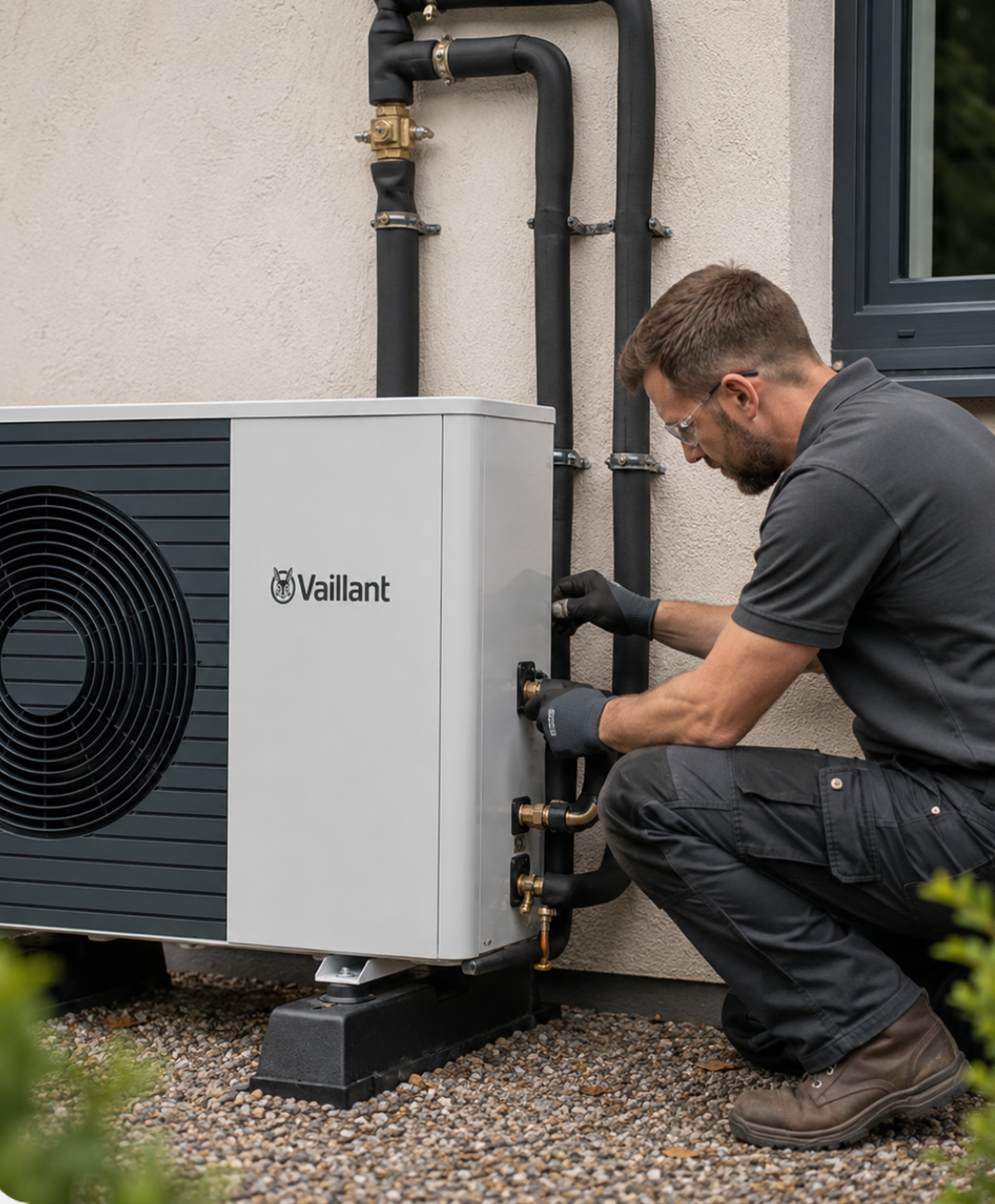
Air Con Installers Near Me: Find Qualified UK Installers
Check Your Eligibility for Boiler Upgrade Scheme (BUS)
Complete your details below to check your eligibility.
Thank you
We've received your details and will be in touch shortly.
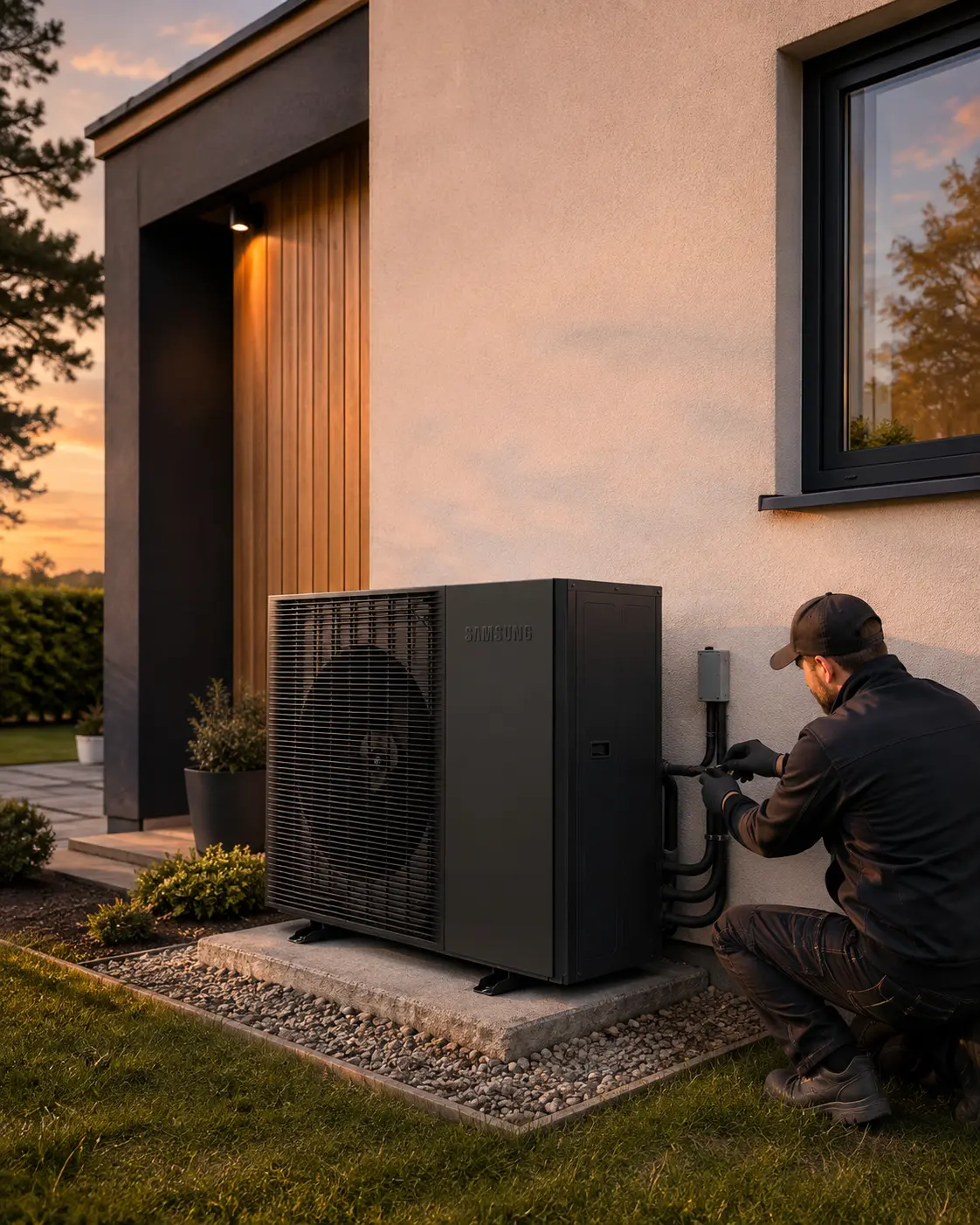
Quick Answer: How Do I Find a Good Air Con Installer Near Me?
Start by shortlisting at least three local air conditioning installers rather than accepting the first quote. For systems containing regulated F-gases, check both the engineer’s relevant personal qualification and the air conditioning company’s required company certification.
A good installer should survey your property, calculate the cooling requirement, specify the exact equipment, explain pipework and drainage routes, identify electrical work and provide a written warranty and commissioning details.
Compare reviews and examples of previous work, but do not choose on star ratings or price alone. In England, also check whether planning rules affect the proposed outdoor unit.
The best installer is the one offering a properly designed, clearly documented solution — not simply the nearest or cheapest.
Air Con Installers Near Me: How to Find a Qualified Local Installer
Searching for air con installers near me usually means you are ready to move beyond comparing products. You need someone who can assess your property, recommend the right system and provide a reliable installation price.
However, the closest installer is not automatically the best choice. Qualifications, system design, survey quality, warranty support and the detail in the quotation matter more than distance alone.
A good air conditioning installer should explain what capacity your rooms need, where the indoor and outdoor units can go, how condensate will drain, what electrical work is required and exactly what the quoted price includes.
If you want to compare suitable local options, you can compare free air con quotes through Get Free Quote before deciding which installer to use.
What Should You Check Before Booking an Air Con Installer?
Use location to create your shortlist, then assess each company on the quality of its proposed installation.
| Check | What good looks like | Why it matters |
|---|---|---|
| F-Gas competence | Relevant individual qualification plus required company certification | Refrigerant work is regulated |
| Property survey | Room loads, glazing, layout, drainage, electrics and unit positions assessed | Prevents poor sizing and impractical designs |
| Written specification | Exact manufacturer, model and capacity stated | Lets you compare quotes properly |
| Installation scope | Pipework, drainage, electrical work and commissioning clearly listed | Reduces unexpected extras |
| Warranty and aftercare | Equipment and workmanship cover explained in writing | Important if a fault develops later |
| Evidence of work | Relevant reviews, photographs or comparable installations | Helps assess workmanship and service |
Do not rely only on website badges or an overall review score. Read recent reviews, look at installation photographs and ask who will actually complete the refrigerant and electrical work.
Recent UK homeowner discussions also show that workmanship, communication and aftercare often matter as much as the equipment itself.
Do Air Con Installers Need F-Gas Certification?
Where an air-conditioning system contains regulated fluorinated greenhouse gases, the people carrying out relevant refrigerant work need the appropriate qualification.
There is an important distinction that homeowners can easily miss.
The individual engineer needs suitable personal qualifications for the activities they perform. Separately, a business — including a sole trader where applicable — carrying out installation, servicing, maintenance or decommissioning of stationary F-Gas air-conditioning equipment for other people requires company certification.
You can check the current requirements in GOV.UK’s F-Gas qualification guidance and GOV.UK’s company certification guidance.
REFCOM is one approved company-certification body, but it is not the only one. GOV.UK also lists the F-Gas Register operated by Quidos and Bureau Veritas.
Ask two simple questions before booking:
What F-Gas qualification will the engineer working on my system hold?
Which approved certification body covers the company?
A professional installer should be comfortable answering both.
What Should Happen During an Air Conditioning Survey?
A permanent air-conditioning system should not be chosen from room floor area alone.
The installer should consider room dimensions, ceiling height, glazing, window orientation, shading, insulation, occupancy and heat-producing equipment. A sunny loft bedroom may require a very different system from a shaded bedroom of the same size.
The survey should also examine:
suitable indoor-unit positions;
outdoor-unit airflow and servicing access;
refrigerant pipe routes;
condensate drainage;
electrical supply and isolation;
wall construction and drilling requirements;
potential indoor and outdoor noise.
If you want to understand the sizing principles before comparing quotations, see the air conditioning sizing guide and the more detailed air conditioning heat-load calculation guide.
Ask the installer to explain why the proposed capacity suits your room. A useful answer should refer to the property, not simply say that a certain unit is “normally enough”.
How Much Does Air Con Installation Cost Near Me?
Local prices vary, so national cost figures should only be used for initial budgeting.
Energy Saving Trust currently gives around £1,900 for a typical one-room air-to-air heat-pump installation and approximately £3,700 for a three-bedroom semi-detached home. The real quotation depends on the equipment and property.
Costs can increase because of:
long or difficult refrigerant pipe runs;
high-level or awkward outdoor-unit positions;
condensate pumps;
new electrical circuits or other electrical work;
several indoor units;
difficult drilling or access;
additional making good;
equipment brand, capacity and specification.
Published local-installation guides also show considerable variation, which is another reason to compare the scope behind the price rather than one headline number.
For a fuller explanation of what the work involves, use the air con installation guide.
An online estimate can help with budgeting. However, the final quotation should reflect the actual property and proposed installation.
How Should You Compare Air Con Quotes?
Energy Saving Trust recommends obtaining at least three quotations for home energy installations and warns against making the decision on price alone.
Make sure each installer is pricing broadly the same job.
Your written quotation should ideally identify:
indoor and outdoor model numbers;
heating and cooling capacity;
SEER and SCOP where relevant;
indoor and outdoor sound figures;
refrigerant pipework allowance;
condensate drainage arrangements;
electrical work;
outdoor mounting or brackets;
commissioning;
warranty registration;
waste removal;
making-good work;
VAT treatment;
clearly stated exclusions.
For several rooms, ask whether the installer recommends separate single-split systems or one multi-split arrangement and why. The single-split vs multi-split air conditioning guide explains the practical differences.
A cheaper quote may still be good value. The problem is a quote that is cheaper because important work, warranty support or commissioning has been omitted.
Do I Need Planning Permission for Air Conditioning?
Planning depends on the equipment, property and location.
In England, qualifying domestic air-source heat pumps can fall within permitted-development rights when all relevant conditions are satisfied. Importantly, the heat-pump permitted-development route does not cover equipment used solely for cooling. Size, siting, number of units and property status can also affect the position.
You can review the Planning Portal’s current air-source heat-pump guidance.
Listed buildings, flats and properties in sensitive or designated locations need particular care. A leasehold property may also require consent from a landlord or freeholder independently of planning permission.
Planning rules differ across the UK, so do not assume guidance for England automatically applies in Scotland, Wales or Northern Ireland.
A competent installer should identify obvious issues, but the property owner should confirm the position with the relevant planning authority when necessary.
Warning Signs When Choosing an Air Con Installer
Be cautious if an installer:
recommends a permanent system without gathering meaningful property information;
will not provide evidence of relevant F-Gas competence;
quotes without identifying the actual equipment;
says a bigger unit is always safer;
provides a vague cash price with no written scope;
cannot explain the warranty;
gives no clear answer about commissioning or aftercare;
pressures you to sign immediately.
A remote estimate is not automatically a problem. Photographs, plans and room measurements can support an early budget.
However, the final design still needs enough information to confirm capacity, equipment positions, pipework, drainage, electrical requirements and access.
How to Choose the Right Air Con Installer Near You
Follow this seven-step process.
1. Decide what you actually need
Identify which rooms need cooling and whether you also want winter heating. Mention future rooms if you expect to expand the system later.
2. Shortlist at least three installers
Search locally, ask for recommendations or use a quotation-comparison service. Do not restrict the shortlist to whoever appears geographically closest.
3. Verify qualifications
Check the relevant individual F-Gas qualification and, where required, the company’s certification.
4. Compare the surveys
A stronger installer asks about glazing, solar gain, insulation, occupancy, equipment, pipe routes, drainage, noise and electrics.
5. Compare the written specifications
Make sure model numbers, capacities, installation scope, warranty and exclusions are clear enough for a like-for-like comparison.
6. Check permissions and aftercare
Resolve planning, leasehold or freeholder questions where applicable. Establish who handles servicing, warranty claims and installation faults.
7. Choose the complete proposal
Balance design quality, competence, price, warranty, communication and aftercare.
The best quotation is not necessarily the cheapest. It is the one that most clearly demonstrates how the proposed system will work in your property.
Get Your Free Air Source Heat Pump Quote
Find the right air source heat pump solution for your home. Tell us a few details and our team will help you explore suitable options at a competitive price.
Quick to complete. No obligation.
Get your quote
Enter your details below and one of our team will get back to you.
Frequently asked questions
Find clear answers to common questions comparing air source and ground source heat pumps, including efficiency, installation and running costs, winter performance, noise, land requirements and borehole depth.
Search locally or use a quotation-comparison service, then shortlist at least three installers. Compare qualifications, survey quality, specifications, warranties, reviews and aftercare rather than choosing solely by distance.
For regulated F-Gas systems, anyone carrying out relevant refrigerant work needs an appropriate individual qualification. The business may also require separate company certification.
Company certification is required for covered F-Gas activities, but REFCOM is not the only approved certification body. GOV.UK also lists the F-Gas Register operated by Quidos and Bureau Veritas.
Ask for the engineer's relevant qualification and the company's certification details. You can then verify which recognised certification body provides the company certificate.
Energy Saving Trust currently gives about £1,900 as a typical one-room air-to-air heat-pump installation cost. Your actual quotation can be higher or lower depending on equipment, access and installation work.
At least three is a sensible target. Energy Saving Trust recommends obtaining at least three quotations and comparing more than the headline cost.
An installer may provide an initial estimate from measurements, photographs or plans. The final specification still needs enough property information to confirm sizing, equipment positions, drainage, pipework and electrics.
It should consider room dimensions, glazing, orientation, shading, insulation, occupancy, internal heat gains, unit locations, pipe routes, drainage, electrics, access and noise.
A straightforward single-split installation can often be completed within a working day. Multi-room or complex projects can take longer because of additional pipework, electrical work and access requirements.
Possibly. In England, some qualifying heating-capable air-source heat pumps can be permitted development, subject to conditions. Equipment used solely for cooling does not qualify under those heat-pump permitted-development rights.
Potentially, but planning rules and property permissions require extra attention. You may also need approval from a landlord, freeholder or managing agent before altering the building.
One indoor unit works best in the room or open-plan zone it directly serves. Separate rooms normally need several indoor units or a suitably designed ducted system.
A competent installer considers the room's cooling load, including dimensions, glazing, solar gain, insulation, occupancy and heat-generating equipment. Floor area alone is not a complete calculation.
A single split is usually simplest for one room. A multi-split can reduce the number of outdoor units where several rooms need conditioning. Pipe routes, room use, resilience and cost should decide the final arrangement.
Relevant work on stationary systems containing regulated F-Gases requires appropriately qualified people. A permanent installation can also involve electrical work, condensate drainage and commissioning.
Find and Compare Air Con Installers Near You
Searching for air con installers near me is a useful starting point, but proximity should only create the shortlist.
Before appointing anyone, check F-Gas competence, insist on an adequately assessed design and compare detailed written quotations. Look closely at what each installer includes, how the system has been sized and what happens if you need support afterwards.
For most homeowners, three well-specified quotations provide a much stronger basis for deciding than dozens of directory listings.
Next step: compare free, no-obligation air conditioning quotes and assess each proposal on specification, installation quality, warranty and total value.