Mitsubishi Electric Air Conditioning UK: 2026 Guide
Check Your Eligibility for Boiler Upgrade Scheme (BUS)
Complete your details below to check your eligibility.
Thank you
We've received your details and will be in touch shortly.
Quick Answer
Mitsubishi Electric is a strong premium air-conditioning choice for UK homes, particularly if quiet operation, efficient inverter control, winter heating and a broad choice of indoor units matter to you. Its current domestic range includes the value-focused MSZ-HR, mid-range MSZ-AY/AP, design-led MSZ-EF Zen, premium MSZ-LN and newer MSZ-RZ R290 system.
The best option depends on the room heat load, unit position, noise expectations, appearance, controls and budget. Do not choose capacity from floor area alone. Glazing, insulation, orientation and solar gain can materially change the cooling requirement.
Mitsubishi Electric Air Conditioning UK: A Homeowner’s Guide for 2026
If you are comparing Mitsubishi Electric air conditioning in the UK, the key questions are which system suits your room, what it costs, how quietly and efficiently it runs, and whether you need one room or several.
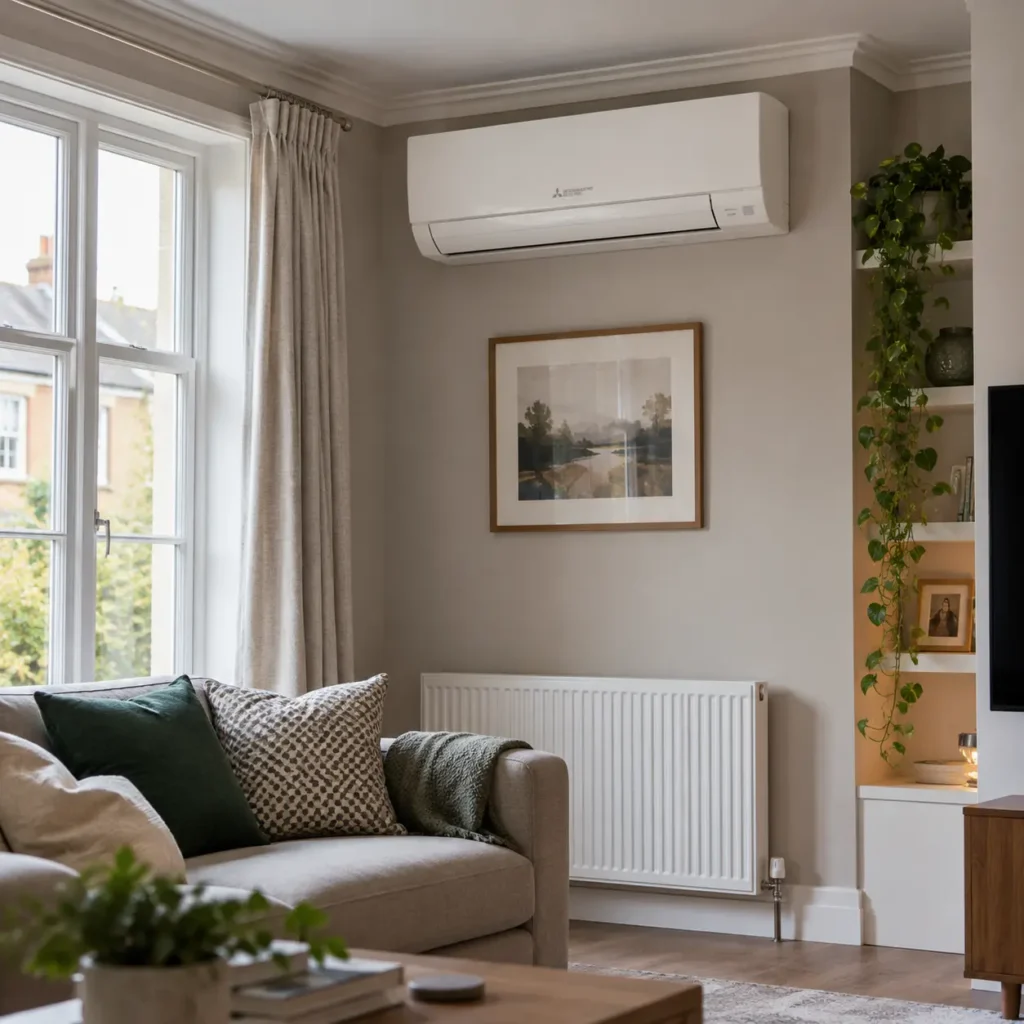
Mitsubishi Electric’s domestic M Series covers straightforward wall-mounted systems, design-led models and premium options. Most are reversible inverter heat pumps, so they can cool in summer and heat in winter. Mitsubishi Electric’s current UK residential range includes established R32 systems alongside its newer MSZ-RZ model using R290 refrigerant.
One point is worth clearing up immediately: Mitsubishi Electric and Mitsubishi Heavy Industries are separate companies. If a quotation simply says “Mitsubishi”, ask for the exact model number. Mitsubishi Electric domestic wall units normally use the MSZ prefix. Mitsubishi Heavy Industries confirms that the two businesses compete separately in the split air-conditioning market.
For a broader introduction before choosing a manufacturer, see our UK air conditioning guide.
Ready to compare systems? Get Free Quote can help you compare no-obligation quotations for your property.
Mitsubishi Electric Air Conditioning Ranges Compared
| Range | Best For | Main Strengths | Main Consideration |
|---|---|---|---|
| MSZ-HR Classic | Budget-conscious rooms | Simple inverter operation, compact design, optional Wi-Fi | Fewer premium comfort features |
| MSZ-AY / AP | Most homes | Strong all-round specification, low-noise design and Wi-Fi on relevant models | Conventional white appearance |
| MSZ-EF Zen | Design-conscious rooms | Black, white and silver finishes with quiet operation | Usually costs more than basic models |
| MSZ-LN Premium | Bedrooms and premium interiors | 3D i-see sensor, Wi-Fi, enhanced filtration and multiple finishes | Premium price |
| MSZ-RZ Premium Plus | Buyers prioritising newer refrigerant technology and winter heating | R290 refrigerant, low-temperature heating capability and smart controls | Newer product range |
Mitsubishi Electric also offers floor-mounted indoor units for rooms where high wall space is restricted. Its MXZ multi-split range can connect several indoor units to one outdoor unit. See Mitsubishi Electric’s current UK home air-conditioning range for current manufacturer information.
Which Mitsubishi Electric Range Is Best?
Best all-rounder: MSZ-AY / AP
For many UK homes, the AY/AP range provides a sensible middle ground. Mitsubishi Electric describes it as a wall-mounted range combining energy-efficient operation, low noise and Wi-Fi functionality on relevant models. Current versions use R32 refrigerant.
It is well suited to bedrooms, home offices and living spaces where the priority is dependable fixed heating and cooling rather than flagship styling.
Best premium choice: MSZ-LN
The MSZ-LN is worth considering when comfort features and appearance matter.
Mitsubishi Electric lists a 3D i-see sensor, built-in Wi-Fi, Dual-Barrier Coating and filtration features. The sensor monitors occupancy and room conditions to help manage comfort and airflow.
This makes the LN particularly relevant to bedrooms, living rooms and higher-spec interiors.
Best design option: MSZ-EF Zen
The Zen range suits homeowners who want more choice than a conventional white wall unit.
Mitsubishi Electric currently offers Zen models in black, white and silver, positioning the range around quiet performance and interior-friendly styling.
Best value choice: MSZ-HR
The MSZ-HR is the simpler wall-mounted option.
It retains inverter-controlled heating and cooling but strips away some premium features. Mitsubishi Electric describes the HR around energy efficiency, compact styling, low noise and optional Wi-Fi.
For a spare bedroom, office or less design-sensitive room, that can be a sensible use of budget.
New option: MSZ-RZ R290
The MSZ-RZ is an important addition for a current 2026 guide.
Mitsubishi Electric describes it as a Premium Plus wall-mounted inverter heat pump using R290, a lower-GWP refrigerant, with Wi-Fi control and strong heating performance at low outdoor temperatures.
It is particularly interesting if you expect the system to provide meaningful room heating through winter as well as summer cooling.
How Does Mitsubishi Electric Air Conditioning Work?
A split air conditioner moves heat rather than simply “making cold air”.
In cooling mode, refrigerant absorbs heat from room air through the indoor heat exchanger. The compressor raises the refrigerant pressure, and the outdoor unit releases that heat outside. An expansion device then lowers the pressure so the cycle can begin again.
In heating mode, the refrigeration cycle reverses. Heat is absorbed from outdoor air and transferred inside.
Mitsubishi Electric therefore describes its M Series units as inverter heat pumps.
The inverter adjusts compressor output rather than repeatedly running at full power and stopping. Once the room approaches its target temperature, output can reduce to maintain a steadier indoor temperature.
Importantly, these systems are air-to-air heat pumps. They heat or cool room air directly.
They are not the same product as Mitsubishi Electric Ecodan air-to-water heat pumps. A standard M Series air-conditioning system does not heat conventional radiators, underfloor heating or a domestic hot-water cylinder.
Single Split or Multi-Split Mitsubishi Air Conditioning?
A single-split system connects one indoor unit to one outdoor unit. It often makes sense for one bedroom, loft room, conservatory or home office.
A multi-split system connects several indoor units to one outdoor condenser.
Mitsubishi Electric states that its MXZ-F range can operate up to six indoor units from one outdoor unit, depending on the specific system selected.
That can reduce the number of outdoor condensers around the property. However, pipe routing and overall system sizing become more important.
For two or more rooms, compare both configurations rather than assuming one approach will always cost less. Our single-split vs multi-split air-conditioning guide explains the practical differences in more detail.
Correct Sizing Matters More Than the Badge
Even premium equipment can perform poorly when incorrectly sized.
An installer should consider:
Room dimensions
Ceiling height
Window area and glazing
Orientation
Solar gain
Insulation
Occupancy
Lighting and appliances
Expected usage
A south-facing loft bedroom can require very different cooling capacity from a shaded ground-floor room of the same size.
Oversizing is not automatically safer either. An unnecessarily large unit can cycle poorly and may control humidity less effectively.
Use a proper calculation rather than relying only on a rough “square metres equals kilowatts” rule. See our guide to air conditioning sizing in the UK before comparing equipment quotations.
Mitsubishi Electric Air Conditioning Installation Cost UK
Public 2026 pricing suggests a straightforward Mitsubishi Electric single-room installation commonly falls somewhere around £1,800–£3,000 for mainstream residential capacities. Premium models, difficult access, longer pipe runs, electrical upgrades and more complex condensate arrangements can raise the price.
| Installation | Indicative 2026 UK Budget |
|---|---|
| Straightforward single room | Around £1,800–£3,000 |
| Premium/designer single room | Often £2,500+ |
| Two-room multi-split | Commonly £3,500+ |
| Larger multi-room installation | Often £6,000+ depending on design |
Broader 2026 market pricing places mainstream one-room split installations at roughly £1,500–£3,000, with designer systems and multi-room installations extending considerably higher.
These figures are for budgeting only. They are not guaranteed quotations.
Long refrigerant runs, scaffolding, condensate pumps, upgraded electrical circuits, difficult external access and decorative pipe concealment can all change the final price. Our UK air-conditioning installation guide explains the installation process in more detail.
How Much Does Mitsubishi Electric Air Conditioning Cost to Run?
Running cost depends on power input, room load, outside temperature, set point, operating hours and your electricity tariff.
From 1 October to 31 December 2026, Ofgem’s average electricity unit rate for a standard-variable-tariff customer paying by Direct Debit is 26.32p/kWh across England, Scotland and Wales.
See the current Ofgem energy price-cap rates before calculating your own figures.
For illustration, if a small air-conditioning unit draws around 0.6kW at a given operating point:
0.6kW × 26.32p = about 15.8p per hour.
That does not mean the system will continuously use 0.6kW. An inverter unit normally reduces output as the room approaches its target temperature.
When comparing heating performance, look at SCOP, or Seasonal Coefficient of Performance. This measures seasonal heat output relative to electricity input and is more useful than judging a heat pump as though it were a conventional electric resistance heater.
Do You Need Planning Permission?
Do not assume every outdoor air-conditioning unit can simply be fitted without checking.
In England, permitted-development rights exist for qualifying air-source heat pumps subject to conditions under Class G. Rules differ across the UK, and restrictions can also apply to flats, listed buildings, conservation areas and particular outdoor-unit locations.
Check the relevant local rules before work starts, particularly if the condenser will be visible from a highway or close to neighbouring property.
Refrigerant and Installer Requirements
Many Mitsubishi Electric domestic systems use R32, which is a fluorinated greenhouse gas. UK rules require appropriately qualified people to carry out relevant work on equipment containing F gas.
You can check the Government’s guidance on working with F gas.
The newer MSZ-RZ uses R290 rather than R32. R290 is a flammable hydrocarbon refrigerant, so appropriate product-specific competence and installation procedures remain essential even though it is not an F gas.
How to Choose Mitsubishi Electric Air Conditioning
Start with heat load. Work out the capacity the room genuinely needs.
Decide how many rooms you want to condition. This determines whether single or multi-split deserves consideration.
Set a noise requirement. Bedrooms usually deserve particular attention.
Consider appearance. Zen and LN provide more design choice than entry-level units.
Compare controls you will actually use. Wi-Fi and scheduling can be useful; unnecessary features should not drive the purchase.
Consider winter heating. If heating matters, compare seasonal efficiency and low-temperature performance.
Ask for exact model numbers. Do not accept “Mitsubishi 2.5kW” as a full specification.
Check the full installation scope. Ask about pipework, electrics, condensate disposal, access, commissioning and warranty registration.
Compare several like-for-like quotations. The cheapest headline figure may not include the same work.
Get Your Free Air Source Heat Pump Quote
Find the right air source heat pump solution for your home. Tell us a few details and our team will help you explore suitable options at a competitive price.
Quick to complete. No obligation.
Get your quote
Enter your details below and one of our team will get back to you.
Frequently asked questions
Find clear answers to common questions comparing air source and ground source heat pumps, including efficiency, installation and running costs, winter performance, noise, land requirements and borehole depth.
Yes. Mitsubishi Electric offers an established UK range covering entry-level, mid-range, design-led and premium residential systems. The strongest reason to consider it is the breadth of choice rather than one particular headline feature.
No. They are separate companies with different air-conditioning products, parts, controls and support arrangements. Mitsubishi Heavy Industries confirms the distinction in its own guidance.
The MSZ-AY/AP is a strong all-round starting point. The best final choice still depends on heat load, budget, noise requirements and installation layout.
It can be if you value premium finishes, occupancy sensing, Wi-Fi control and enhanced filtration. If those features are not important, AY/AP or HR may offer better value.
Yes. Mitsubishi Electric’s domestic M Series includes reversible inverter heat-pump systems capable of heating as well as cooling.
It can provide efficient room heating, but standard air-to-air units do not normally provide domestic hot water or heat conventional radiators. Whether they can replace other heating depends on the property and system design.
A straightforward single-room Mitsubishi Electric installation is commonly budgeted at roughly £1,800–£3,000 in the 2026 UK market. More complex or premium installations can cost significantly more.
Not necessarily. Running cost depends on model efficiency, weather, temperature settings and electricity prices. Inverter systems can reduce power once the room approaches the target temperature.
Many models are designed for low-noise operation and Mitsubishi Electric specifically promotes its domestic range for bedroom use. Always compare the sound-pressure rating of the exact model you are buying.
MSZ-HR is the simpler, value-focused range. MSZ-AY/AP adds more comfort and control features and sits higher in Mitsubishi Electric’s domestic wall-mounted range.
Zen refers to the MSZ-EF design-led wall-mounted range. Mitsubishi Electric offers it in black, white and silver finishes.
Yes. Mitsubishi Electric’s MXZ-F multi-split range can support several indoor units, with some systems allowing up to six.
Single split is often simpler for one room. Multi-split can reduce the number of outdoor units when serving several rooms. The best option depends on capacity, pipe routes, outside space and total cost.
Sometimes. In England, qualifying heat-pump installations can fall within permitted-development rules, but conditions apply. Other UK nations have their own rules, and flats, listed buildings and conservation areas need particular care.
Many established domestic models use R32. Mitsubishi Electric has also introduced the newer MSZ-RZ using R290 refrigerant.
R290 has a much lower global-warming impact than conventional HFC refrigerants. Mitsubishi Electric uses it in the MSZ-RZ, alongside features aimed at efficient low-temperature heating.
Cooling naturally removes moisture from indoor air as water condenses on the indoor heat exchanger. Mitsubishi Electric also promotes humidity reduction as part of home-comfort operation.
Keep filters clean and ensure indoor and outdoor airflow remains unobstructed. The system should also receive professional inspection and servicing in line with its installation and manufacturer requirements.
Is Mitsubishi Electric Air Conditioning Worth It?
For UK homeowners who want quiet, efficient fixed heating and cooling, Mitsubishi Electric deserves serious consideration.
Its advantage is choice. You can move from the straightforward MSZ-HR through the AY/AP and design-led Zen range to premium LN and newer R290 technology without leaving the same manufacturer ecosystem.
However, the badge alone cannot make an installation successful.
Correct sizing, sensible unit positioning, proper refrigerant work and a clearly specified quotation matter just as much as the indoor unit you choose.
If you are ready to compare systems, request quotations based on your actual rooms and property rather than choosing purely from an online equipment price.