F-Gas Air Conditioning Installer: UK Guide 2026
Check Your Eligibility for Boiler Upgrade Scheme (BUS)
Complete your details below to check your eligibility.
Thank you
We've received your details and will be in touch shortly.

Quick answer: does an air conditioning installer need F-Gas certification?
Yes, when the work involves stationary air-conditioning equipment containing or designed to contain regulated F-gases. GOV.UK says individuals need the relevant qualification to install, service, maintain, leak-check, recover gas from or decommission applicable refrigeration, air-conditioning and heat-pump systems. A business carrying out relevant work for other people also requires company certification, including a sole trader.
For a homeowner, check both levels. Ask which certification body covers the business, request its certificate details and confirm that the engineer doing the refrigerant work has the appropriate personal qualification. Check before work starts rather than relying on an “F-Gas registered” logo alone.
F-Gas Air Conditioning Installer: UK Certification Guide 2026
If you are choosing someone to fit, service or repair fixed air conditioning, F-Gas certification is one of the first checks to make. It is not a premium badge or an optional manufacturer endorsement. It forms part of the legal framework for working on stationary air-conditioning systems containing regulated fluorinated refrigerants.
For homeowners, there are two separate credentials to understand: the engineer’s personal qualification and the business’s company certification. A professional-looking van, electrical qualification or Gas Safe registration does not replace the relevant F-Gas credentials.
This guide explains what an F-Gas air conditioning installer needs, how to verify the company and engineer, what the qualification categories mean and what to check before accepting a quote.
For a wider explanation of costs, system choices and the installation process, read our air conditioning installation UK guide.
Ready to compare your options? You can also compare free home-improvement quotes through Get Free Quote without obligation.

What does F-Gas certification mean for air conditioning?
“F-Gas” refers to fluorinated greenhouse gases. Many air-conditioning systems use hydrofluorocarbon refrigerants, including R32 and R410A.
These gases can have a significant climate impact if released, so the regulations control how they are handled and who can carry out certain work.
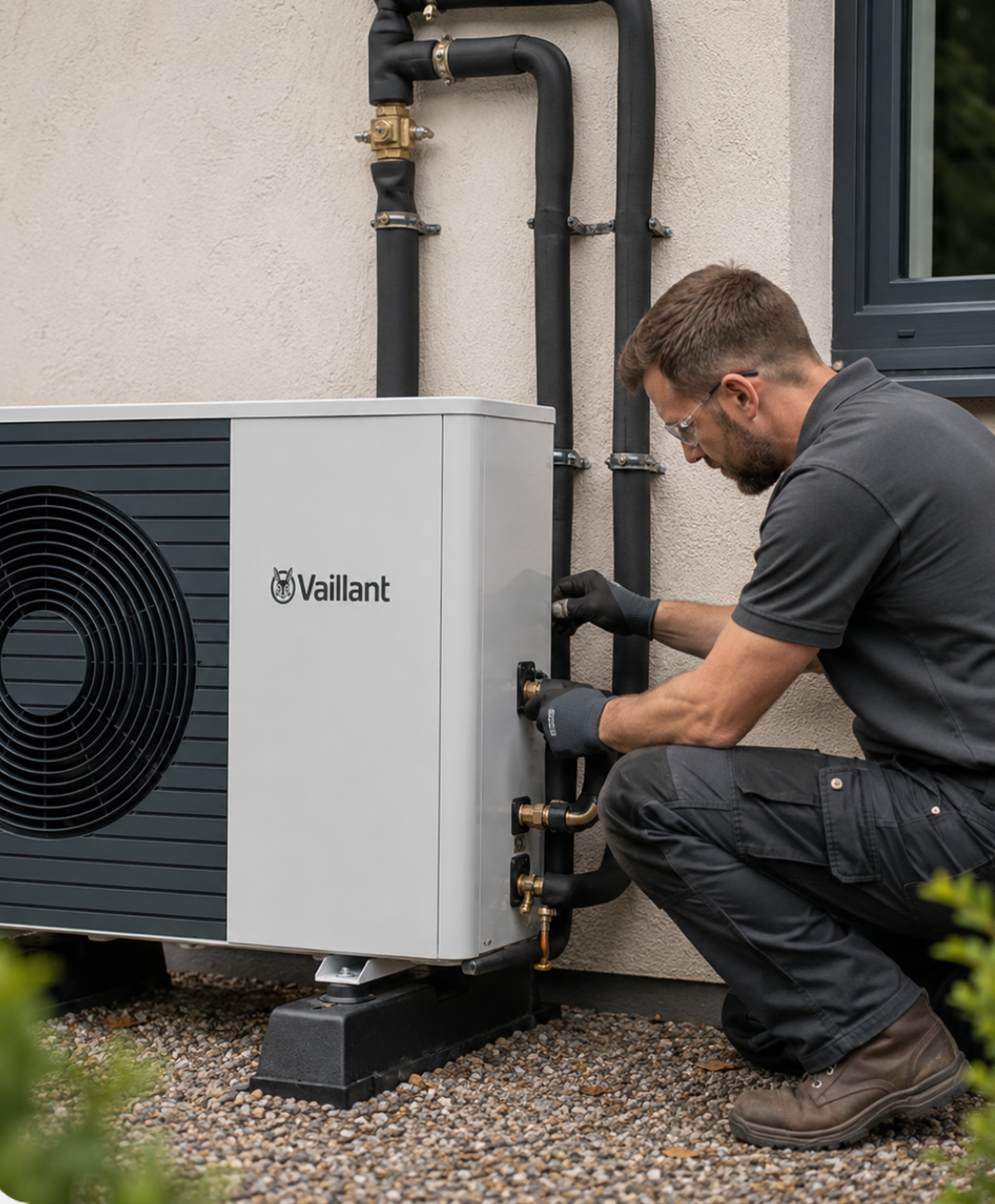
The requirement therefore relates particularly to the refrigerant circuit. Installation quality involves more than certification, though. A competent contractor should also calculate the required capacity, plan drainage and pipe routes, position the outdoor unit correctly and commission the equipment.
If you are still working out the required capacity, our UK air-conditioning sizing guide explains why floor area alone is not enough.
Company certification and engineer qualifications are different
For homeowners, this is the most important distinction.
| Check | Who it applies to | What it tells you |
|---|---|---|
| Personal F-Gas qualification | Individual engineer carrying out regulated work | The engineer holds a qualification covering specified F-Gas activities |
| Company F-Gas certification | Business undertaking relevant work for another party, including a sole trader | The business meets company-certification requirements and employs appropriately qualified personnel |
GOV.UK currently lists REFCOM Certification Ltd, F-Gas Register (Quidos) and Bureau Veritas UK Ltd as company certification bodies for stationary refrigeration, air conditioning and heat pumps. Company certification must be renewed every three years.
For individuals, the current GOV.UK F-Gas qualification guidance lists City & Guilds, BESA and LCL Awards among the organisations providing relevant stationary refrigeration, air-conditioning and heat-pump qualifications.
Do not accept “all our engineers are qualified” as the only evidence. Equally, seeing a company certificate does not by itself tell you which qualification category the engineer attending your property holds.
What air-conditioning work requires the right F-Gas qualification?
GOV.UK identifies activities including:
installing new systems;
servicing and maintenance;
leak checking;
recovering refrigerant; and
decommissioning and disposal.
Those requirements are relevant to the refrigerant work involved in a normal split-system installation. The job can include connecting refrigerant pipework, testing the circuit, evacuating it and commissioning the equipment.
F-Gas compliance therefore matters after installation too. If the system later develops a refrigerant leak or needs work on its sealed circuit, the person carrying out that regulated work must have the appropriate qualification.
How to check an F-Gas air conditioning installer
Start with the legal business name shown on your quotation. A trading name on a van or website may differ from the name appearing on its certification.
Ask for the company’s F-Gas certificate number and issuing body.
Quidos provides a public F-Gas company lookup that lets customers search certified businesses. REFCOM also provides company-verification facilities.
Next, ask who will actually work on the refrigerant circuit. Request evidence of that person’s relevant qualification and category.
Check that names and dates match. The certification should correspond with the business you are contracting, and the company certificate should be current.
If an online directory does not return a result, ask for the certificate itself and contact the issuing body where necessary rather than immediately assuming the contractor is uncertified.
Finally, compare the wider quality of the quotation. F-Gas certification is a legal compliance check, not proof that one contractor offers the best design, equipment or workmanship.
Our guide to finding air-con installers near you covers the broader contractor-selection process.
Category 1 versus Category 2: what should homeowners know?
GOV.UK states that a Category 1 certificate allows the holder to carry out all covered activities on stationary refrigeration, air-conditioning and heat-pump systems.
Category 2 is more limited. It covers installation, maintenance, servicing and refrigerant recovery on systems containing less than 3kg of F-Gas, or less than 6kg where equipment is hermetically sealed.
Some small domestic systems have refrigerant charges below the Category 2 limit. However, do not try to determine the required qualification simply from room size or advertised cooling capacity.
Ask the contractor to confirm that the engineer’s qualification covers the specific equipment and work being undertaken.
Does R32 air conditioning still require an F-Gas installer?
Yes.
R32 is HFC-32, a fluorinated greenhouse gas. GOV.UK currently gives it a global warming potential, or GWP, of 675. R410A has a considerably higher listed GWP of 2,088.
A lower GWP does not automatically take a refrigerant outside the F-Gas rules.
This distinction is particularly important because R32 is widely associated with newer split systems.
In Great Britain, since 2025, new single-split systems containing less than 3kg of refrigerant are subject to a prohibition on F-gases with a GWP above 750, subject to listed exceptions.
That does not mean an existing R410A system suddenly became illegal to own. It does mean refrigerant choice is an increasingly important part of buying new equipment and planning future servicing.
If you are comparing manufacturers and equipment, see our guide to the best air-conditioning brands in the UK.
Can you buy a pre-charged split system and install it yourself?
Buying an air-conditioning unit and legally completing the refrigerant installation are different matters.
GOV.UK states that before selling non-hermetically sealed equipment containing F-Gas to an end user, the seller must obtain details of the qualified technician who will install it and check that those details are valid.
That makes online “DIY air conditioning” offers worth treating carefully.
Having refrigerant already inside the outdoor unit does not automatically make refrigerant pipework and commissioning unrestricted work. If the installation involves activities covered by F-Gas requirements, use appropriately qualified personnel and a correctly certified business.
What should you check before installation?
A good quotation should make both the legal compliance and practical scope clear.
| Before you book | What to check |
|---|---|
| Business identity | Legal name and details correspond with the quotation and certification |
| Company certification | Current F-Gas company certification and issuing body |
| Engineer competence | Relevant personal qualification and category |
| Equipment | Exact manufacturer, model, refrigerant and capacity |
| Installation | Pipework, drainage, electrics and outdoor mounting clearly defined |
| Commissioning | Testing and commissioning included |
| Warranty | Manufacturer requirements and installer aftercare explained |
Do not assume that the cheapest quote covers the same work as the others. Missing electrical work, condensate pumps, long pipe routes or commissioning can materially change what you actually receive.
Does every home air conditioner need annual F-Gas leak checks?
No.
In Great Britain, statutory F-Gas record keeping applies to relevant equipment containing 5 tonnes CO2-equivalent or more. GOV.UK requires qualifying records to cover matters such as refrigerant quantity, refrigerant added during maintenance, mandatory leak checks and companies used to install, service or decommission equipment.
The standard leak-check threshold also starts at 5 tonnes CO2-equivalent, with special provisions for hermetically sealed equipment and larger systems.
Many small modern domestic systems can sit below those statutory thresholds. Therefore, do not assume that every wall-mounted home unit legally requires an annual F-Gas leak check.
That is separate from ordinary servicing. Follow the manufacturer’s maintenance schedule and ask the installer what servicing is appropriate for your system.
What about F-Gas installers in Northern Ireland?
Do not assume the regulatory position is identical across the whole UK.
DAERA states that the newer EU F-Gas Regulation 2024/573 has applied directly in Northern Ireland since 11 March 2024.
If your property is in Northern Ireland, check current DAERA F-Gas guidance and ask the proposed contractor to confirm which certification requirements apply to the work.
Get Your Free Air Source Heat Pump Quote
Find the right air source heat pump solution for your home. Tell us a few details and our team will help you explore suitable options at a competitive price.
Quick to complete. No obligation.
Get your quote
Enter your details below and one of our team will get back to you.
Frequently asked questions
Find clear answers to common questions about F-Gas air conditioning installers, including legal certification requirements, REFCOM, installer qualifications, R32, R410A, company certification and buying pre-charged equipment.
An F-Gas air conditioning installer is an installer appropriately qualified to carry out regulated work on air-conditioning equipment containing fluorinated greenhouse gases. The business may also require company certification.
For regulated work on applicable stationary air-conditioning equipment containing F-Gas, relevant individual qualifications and, where applicable, company certification are legal requirements.
Ask for the legal business name, company certificate number and issuing body. You can use public facilities such as the Quidos F-Gas Register lookup and REFCOM verification services where available.
REFCOM is one approved company certification body. GOV.UK also currently lists F-Gas Register (Quidos) and Bureau Veritas UK Ltd for stationary refrigeration, air conditioning and heat pumps.
Where the rules apply, the individual carrying out the regulated work needs the relevant personal qualification, while a business carrying out specified work for other parties needs company certification.
Yes, when carrying out work covered by the company-certification requirements for other parties. GOV.UK expressly includes sole traders.
GOV.UK states that Category 1 certificate holders can carry out all covered activities on stationary refrigeration, air-conditioning and heat-pump systems.
Category 2 covers specified installation, maintenance, servicing and recovery work on systems containing less than 3kg of F-Gas, or less than 6kg where hermetically sealed.
Yes, where the work falls within regulated F-Gas activities. R32 is HFC-32 and GOV.UK lists its GWP as 675.
Great Britain has prohibited affected new single-split systems containing less than 3kg of F-Gas where the refrigerant GWP is above 750, subject to listed exceptions. R410A has a GWP of 2,088, so check the precise equipment and current rules before purchase.
You should not carry out regulated F-Gas work without the appropriate qualification. Fixed split-system installation commonly involves refrigerant work covered by F-Gas requirements.
For non-hermetically sealed equipment containing F-Gas, GOV.UK says sellers must obtain details of the qualified technician who will install the equipment and validate them before sale to the end user.
No. Gas Safe relates to regulated gas-appliance work. F-Gas qualifications and company certification cover different regulated activities involving fluorinated refrigerants.
GOV.UK states that F-Gas company certification must be renewed every three years.
Not necessarily. DAERA states that EU Regulation 2024/573 has applied directly in Northern Ireland since 11 March 2024, so contractors and property owners should check current Northern Ireland requirements.
How to choose an F-Gas air conditioning installer
F-Gas certification should be your first compliance check, but it should not be your only buying criterion.
Once you have verified the business and engineer, compare how each installer approaches system sizing, noise, outdoor-unit positioning, pipe routes, condensate drainage, electrical work, commissioning, warranties and future servicing.
Ask for the proposed equipment and full installation scope in writing.
Then make one final check: does the F-Gas certification actually relate to the business you are paying and the engineer carrying out the refrigerant work?
That simple verification provides much stronger protection than relying on a logo or an unsupported “fully qualified” claim.