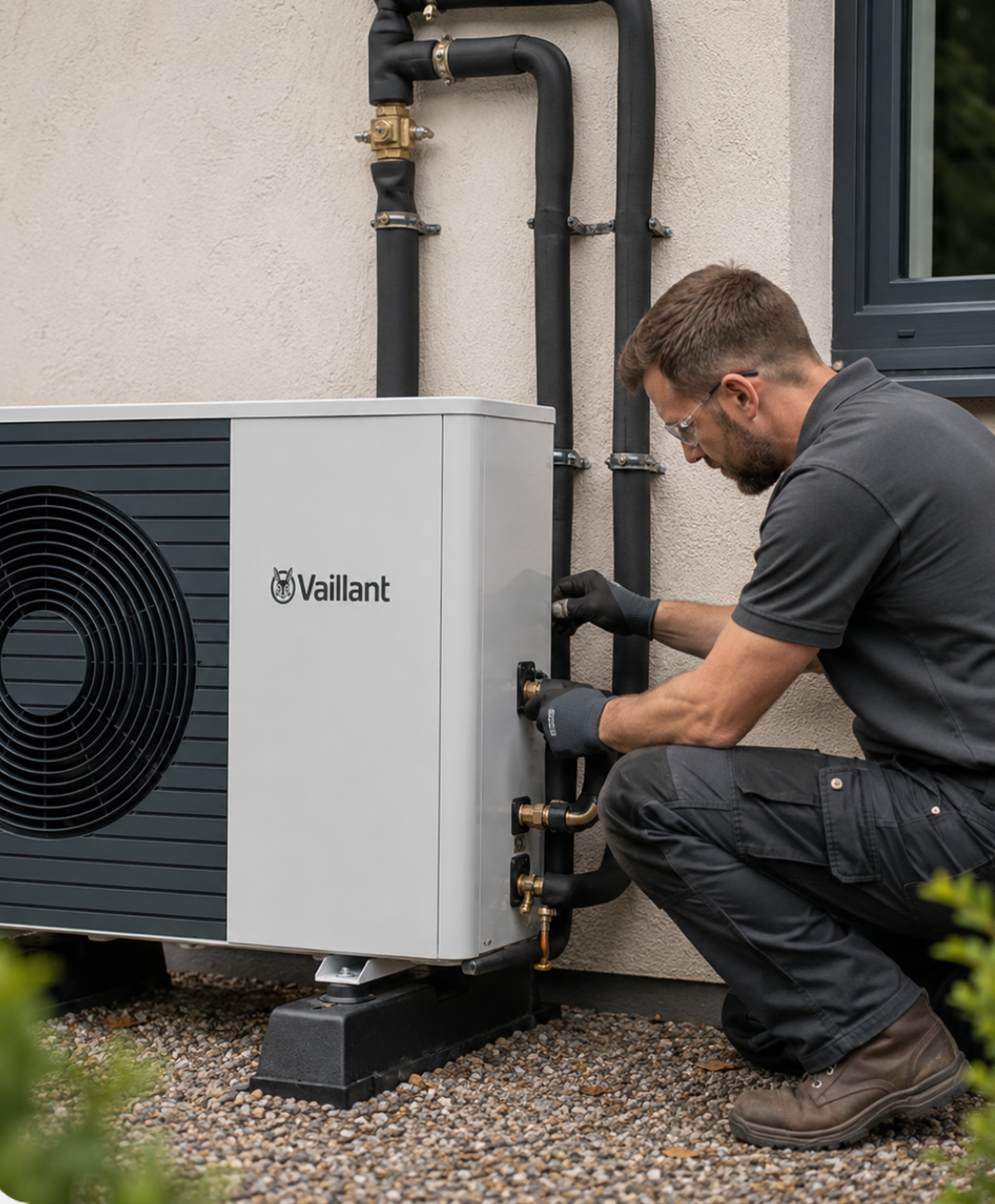
Air Conditioning Engineers UK: How to Choose in 2026
Check Your Eligibility for Boiler Upgrade Scheme (BUS)
Complete your details below to check your eligibility.
Thank you
We've received your details and will be in touch shortly.

Quick Answer: How Do You Choose an Air Conditioning Engineer in the UK?
Choose an air conditioning engineer who can demonstrate the correct refrigerant qualifications, works for an appropriately certified business where F-Gas rules apply, and carries out a meaningful property assessment before recommending equipment.
A good engineer should calculate the required capacity, explain indoor and outdoor unit positions, plan pipework and condensate drainage, identify electrical requirements and provide exact model numbers in a written quotation.
Compare at least three proposals where practical. Check the equipment specification, warranty, installation scope, commissioning, aftercare and exclusions rather than choosing purely on headline price.
For heating-capable air-to-air heat pumps, also check whether MCS certification matters to your project, particularly if you intend to use government funding.
Air Conditioning Engineers UK: How to Choose a Qualified Engineer in 2026
Finding good air conditioning engineers in the UK involves more than searching for the closest company or comparing the lowest installation price.
A competent air conditioning engineer should be able to assess your property, calculate the required cooling or heating capacity, recommend suitable equipment, plan refrigerant pipework and drainage, identify electrical requirements, install and commission the system correctly, and explain how it should be maintained.
Qualifications matter too. Most modern split systems contain refrigerants that are regulated under UK F-Gas rules. Where those rules apply, both the person carrying out the refrigerant work and the business undertaking covered activities must meet the relevant certification requirements.
This guide explains what air conditioning engineers do, which credentials to check, what a professional survey should include, how much installation may cost and how to compare quotations without judging them on price alone.
If you are ready to explore your options, you can compare home-improvement quotes through Get Free Quote after deciding what you want from your system.
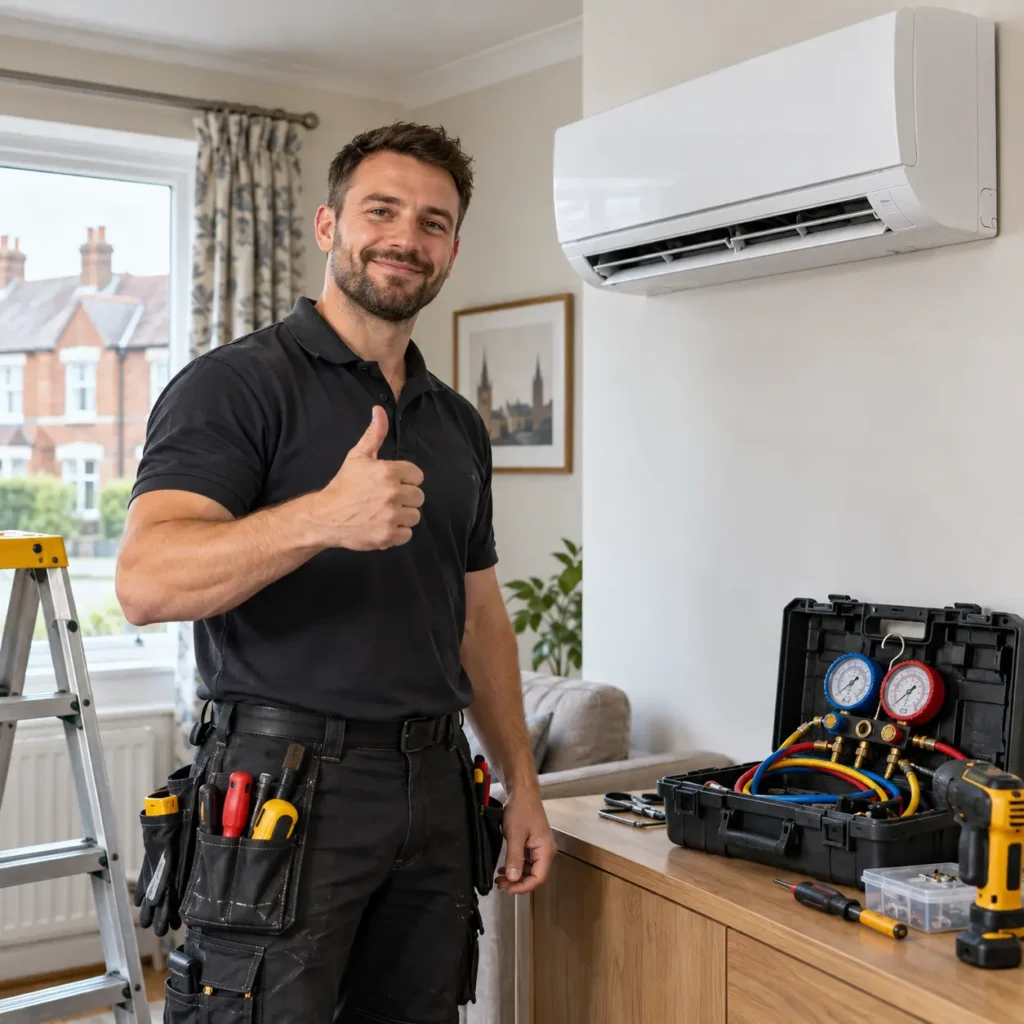
Air Conditioning Engineer Checks at a Glance
| Check | What to Look For | Why It Matters |
|---|---|---|
| Refrigerant competence | Relevant personal F-Gas qualification where applicable | Refrigerant work is regulated |
| Company certification | Certification through an approved body for covered F-Gas work | Separate requirement from the engineer's qualification |
| Proper survey | Sizing, glazing, orientation, drainage, pipework and access considered | Reduces the risk of poor design |
| Detailed quotation | Exact models, capacities, scope and exclusions | Allows like-for-like comparison |
| Commissioning | Testing and commissioning included | Confirms the system operates as designed |
| Warranty and aftercare | Written equipment and workmanship terms | Important if problems develop later |
What Does an Air Conditioning Engineer Do?
An air conditioning engineer may install, commission, service, diagnose and repair fixed cooling and heat-pump systems.
For a domestic installation, the job should begin before anyone drills a wall. The engineer first needs to understand which rooms require conditioning and how much heating or cooling each space needs.
That normally means considering room dimensions, glazing, orientation, insulation, occupancy and internal heat sources. The engineer must then decide where indoor units can operate effectively and where outdoor units can achieve suitable airflow without creating unnecessary noise or access problems.
Pipe routes, condensate drainage and electrical supplies also need planning.
If you want a detailed explanation of the physical installation itself, see the UK air conditioning installation guide. This page focuses instead on assessing the engineer responsible for that work.
What Qualifications Should UK Air Conditioning Engineers Have?
There is no single badge that proves an engineer is suitable for every air conditioning project.
However, refrigerant certification is one of the most important checks.
Check the Engineer’s F-Gas Qualification
GOV.UK states that people carrying out covered activities on stationary refrigeration, air conditioning and heat-pump systems containing regulated F gases need appropriate qualifications. That includes installation, servicing, maintenance, leak checking and refrigerant recovery, depending on the qualification category. GOV.UK F-Gas qualification guidance
This requirement applies to the person doing the regulated work.
Do not simply ask, “Are you F-Gas registered?” Ask what qualification the engineer who will actually attend your property holds.
Check the Company’s Certification Too
Personal qualifications and company certification are not the same thing.
GOV.UK states that businesses, including sole traders where applicable, carrying out covered installation, repair, maintenance or decommissioning work on stationary F-Gas equipment for other people must hold company certification through an approved certification body. GOV.UK company F-Gas certification guidance
REFCOM is one recognised certification body, but it is not the only approved route.
A useful pair of questions is therefore:
What qualification does the engineer working on my refrigerant circuit hold?
Which approved body provides your company certification?
Note that F-Gas rules relate to regulated fluorinated refrigerants. They should not be treated as a universal certification rule for every possible refrigerant technology.
What Should an Air Conditioning Survey Include?
A professional engineer should not size a permanent system from floor area alone.
Glazing can transform the cooling requirement of a room. A west-facing bedroom with large windows can experience substantially different heat gains from a shaded room of identical floor area.
The survey should consider dimensions, ceiling height, window area, orientation, shading, insulation, occupancy and heat-generating equipment.
You can read more about these principles in the air conditioning sizing guide and air conditioning heat-load calculation guide.
The engineer should also explain:
why the proposed capacity suits each room;
where indoor and outdoor units will go;
how refrigerant pipes will be routed;
where condensate water will drain;
how the system will be electrically supplied;
whether pumps, trunking or additional building work are needed;
how future servicing access will be maintained.
Oversizing is not automatically safer. A correctly selected system should match the property and intended use.
What Should an Air Conditioning Quote Include?
Two quotes showing the same total price may cover very different jobs.
| Item | What the Quote Should Make Clear |
|---|---|
| Equipment | Manufacturer, exact model numbers and capacities |
| Installation | Pipework, trunking, supports and labour included |
| Drainage | Gravity drain or condensate pump |
| Electrical work | Included work and any exclusions |
| Commissioning | Testing, setup and handover |
| Warranty | Equipment and workmanship terms |
| Finishing | Making good and waste removal |
| Costs | VAT treatment and potential additional charges |
Exact model numbers matter. “3.5kW Daikin unit” is much less useful than a quotation identifying the precise indoor and outdoor models.
Ask who will register the manufacturer’s warranty and whether ongoing servicing is required to maintain it.
How Much Do Air Conditioning Engineers Cost in the UK?
Installation is usually quoted as a complete project rather than simply an engineer’s hourly rate.
Current 2026 cost guides commonly place a straightforward single-room split-system installation at around £1,500–£3,000, although the specification and property can move the price significantly.
Energy Saving Trust currently gives approximately £1,900 as an indicative cost for a one-room air-to-air heat pump.
Treat these as budgeting figures, not guaranteed quotations.
Long refrigerant runs, awkward outdoor-unit positions, new electrical circuits, condensate pumps, scaffolding or access equipment, multiple rooms and premium equipment can all increase the price.
For local comparison shopping, the site’s dedicated air con installers near me guide covers the local-search process in more detail.
How to Compare Air Conditioning Engineers
Start with three quotations where practical, but make sure each contractor has received broadly the same brief.
Then compare the engineering behind the proposal.
First, compare sizing. Ask why each capacity has been selected. If one engineer proposes 2.5kW and another proposes 5kW for the same bedroom, find out what assumptions differ.
Next, compare equipment. Check exact models, seasonal efficiency, noise levels, controls and warranty rather than brand name alone.
Then compare installation design. Pipe routing, outdoor-unit positioning and condensate drainage can have a major effect on appearance, noise and reliability.
Check qualifications independently. Do not rely solely on logos displayed on a website.
Finally, compare aftercare. Establish who deals with commissioning problems, warranty claims, servicing and repairs.
A well-designed £2,400 installation can represent better value than a £2,000 installation that omits electrical work, commissioning detail or meaningful aftercare.
Do Planning Permission and Property Rules Matter?
They can.
In England, some heating-capable air-source heat pumps can fall within permitted-development rules if the relevant conditions are met. The Planning Portal notes that the applicable rights require a heating function; cooling-only equipment does not qualify through that particular route. Protected locations and listed buildings require additional care. Planning Portal air-conditioning guidance
Planning frameworks differ across the UK, so advice for England should not automatically be applied to Scotland, Wales or Northern Ireland.
Flats and leasehold properties may also require approval from a landlord, freeholder or managing agent.
Ask the engineer to flag potential issues, but obtain formal permission where required rather than relying on an informal assurance.
Does MCS Certification Matter for Air Conditioning?
Not for every ordinary air-conditioning installation.
However, it becomes important where a heating-capable air-to-air heat pump is being installed under the Boiler Upgrade Scheme.
The scheme now provides £2,500 towards qualifying air-to-air heat pumps in England and Wales, and Ofgem states that participating installers must meet the relevant MCS requirements. Boiler Upgrade Scheme information from Ofgem
This area is changing quickly. Energy Saving Trust’s guidance updated on 16 October 2026 said air-to-air MCS installer certification was still becoming available. Check the current position before ordering equipment if grant eligibility affects your decision.
Warning Signs When Choosing an Engineer
Be cautious when an engineer or company:
recommends a system without asking meaningful questions about the room;
cannot explain how the required capacity was calculated;
refuses to provide relevant certification details;
gives no exact model numbers;
says the largest possible unit is automatically best;
provides a vague price without a written scope;
cannot explain condensate drainage or pipe routing;
offers no clear commissioning or warranty process;
pressures you to accept immediately.
A remote preliminary estimate can be perfectly reasonable. A final specification should still be based on enough property information to design the installation properly.
Get Your Free Air Source Heat Pump Quote
Find the right air source heat pump solution for your home. Tell us a few details and our team will help you explore suitable options at a competitive price.
Quick to complete. No obligation.
Get your quote
Enter your details below and one of our team will get back to you.
Frequently asked questions
Find clear answers to common questions about air conditioning engineers, including F-Gas qualifications, installer checks, quotations, system sizing, installation costs, warranties, servicing, planning permission and government grants.
Engineers carrying out covered work on systems containing regulated F gases need an appropriate personal qualification. The business carrying out covered activities may also require separate company certification.
Covered businesses need certification through an approved certification body. REFCOM is one recognised provider, but GOV.UK lists other approved certification bodies too.
The terms overlap. An engineer may survey, design, install, commission, maintain, diagnose and repair systems, while “installer” often describes the installation function specifically.
Ask for the qualification held by the engineer carrying out refrigerant work and the certification details of the business. Verify the details through the relevant certification body where possible.
Three is a sensible target for most domestic projects. It gives you enough information to compare system design, equipment, installation scope, warranties and price.
An initial estimate can often be prepared using plans, measurements, photographs and property information. The final specification still needs enough detail to confirm sizing, access, pipework, drainage and electrical requirements.
The assessment should consider room dimensions, glazing, orientation, shading, insulation, occupancy and internal heat gains. Floor area alone provides an incomplete picture.
A straightforward single-room split system often falls around £1,500–£3,000 in current 2026 UK cost guides. Your actual price depends on equipment, capacity, pipework, access and electrical work.
A straightforward single-split installation can often be completed within a working day. Multi-room, ducted or difficult-access projects can require considerably longer.
The quotation should explain both manufacturer warranty terms and any workmanship guarantee offered by the installer. Also ask who registers the equipment warranty.
Follow the manufacturer's service schedule and warranty requirements. Filters may require regular homeowner cleaning, while refrigerant circuits and other technical components should be checked by competent personnel where necessary.
Many installation companies also provide diagnostics, repair and maintenance, but confirm this before choosing an installer if long-term aftercare matters to you.
Possibly. The answer depends on the system, location, property and UK nation. Flats, listed buildings, conservation areas and cooling-only equipment may require additional checks.
Potentially, but external alterations can require planning approval or permission from the landlord, freeholder or managing agent. Check before committing to equipment.
Many modern split systems are reversible air-to-air heat pumps. They can move heat outdoors for cooling and reverse the refrigeration cycle to deliver heat indoors.
The Boiler Upgrade Scheme currently includes a £2,500 grant category for eligible air-to-air heat pumps in England and Wales. Technical, property and installer requirements apply, so confirm eligibility before ordering.
In England and Wales, air-conditioning systems with an effective rated output above 12kW fall within statutory energy-inspection requirements. Separate requirements apply in Scotland and Northern Ireland.
Not automatically. Compare equipment, sizing, installation design, certification, warranty, commissioning and aftercare. A lower quote may simply exclude work included elsewhere.
Choosing the Right Air Conditioning Engineer
The best air conditioning engineer is not necessarily the nearest, cheapest or the person offering the most expensive equipment.
Look for evidence that the contractor understands the property, can explain the required capacity, holds the necessary credentials and is willing to document what is included.
A good quotation should leave you knowing exactly what equipment you are buying, where it will go, how the system will be installed and what happens after commissioning.
Next step: compare several properly specified proposals and choose on competence, design, warranty, aftercare and total value — not headline price alone.