Air Source Heat Pump vs Gas Boiler: Which Is Better? UK 2026
August 14, 2026
Check Your Eligibility for Boiler Upgrade Scheme (BUS)
Complete your details below to check your eligibility.
Thank you
We've received your details and will be in touch shortly.
Quick Answer: Is an Air Source Heat Pump Better Than a Gas Boiler?
For homeowners who want lower-carbon heating and can accommodate an outdoor unit and hot-water cylinder, an air source heat pump is generally the better long-term technology.
Heat pumps can deliver roughly three to four units of heat for every unit of electricity consumed, whereas an A-rated gas boiler converts around 90% of its fuel into usable heat. A new gas boiler is usually cheaper to install and can still be cheaper to run if the heat pump performs poorly or electricity is expensive. Eligible households in England and Wales can currently receive £7,500 towards an air-to-water heat pump through the Boiler Upgrade Scheme.
Source: https://www.edfenergy.com/energywise/air-source-heat-pumps-vs-gas-boilers
Air Source Heat Pump vs Gas Boiler: Which Is Better in the UK?
If you are choosing between an air source heat pump vs gas boiler, the better option depends on your home, budget and priorities. For many UK homeowners planning long term, a well-designed air source heat pump is the stronger future-facing choice: it is much more energy efficient, produces lower operational carbon emissions and can qualify for government support.
A gas boiler still has important advantages when your priority is the lowest upfront cost, on-demand hot water from a combi boiler or a straightforward like-for-like replacement.
The key is to compare the whole heating system, not simply the appliance price. Heat-pump performance depends heavily on heat loss, radiator sizing, flow temperature, controls, installation quality and your electricity tariff.
This guide compares installation and running costs, efficiency, comfort, winter performance, hot water and property suitability to help you make an informed decision.
Considering replacing your heating system? Get a free quote and compare properly surveyed options before committing.
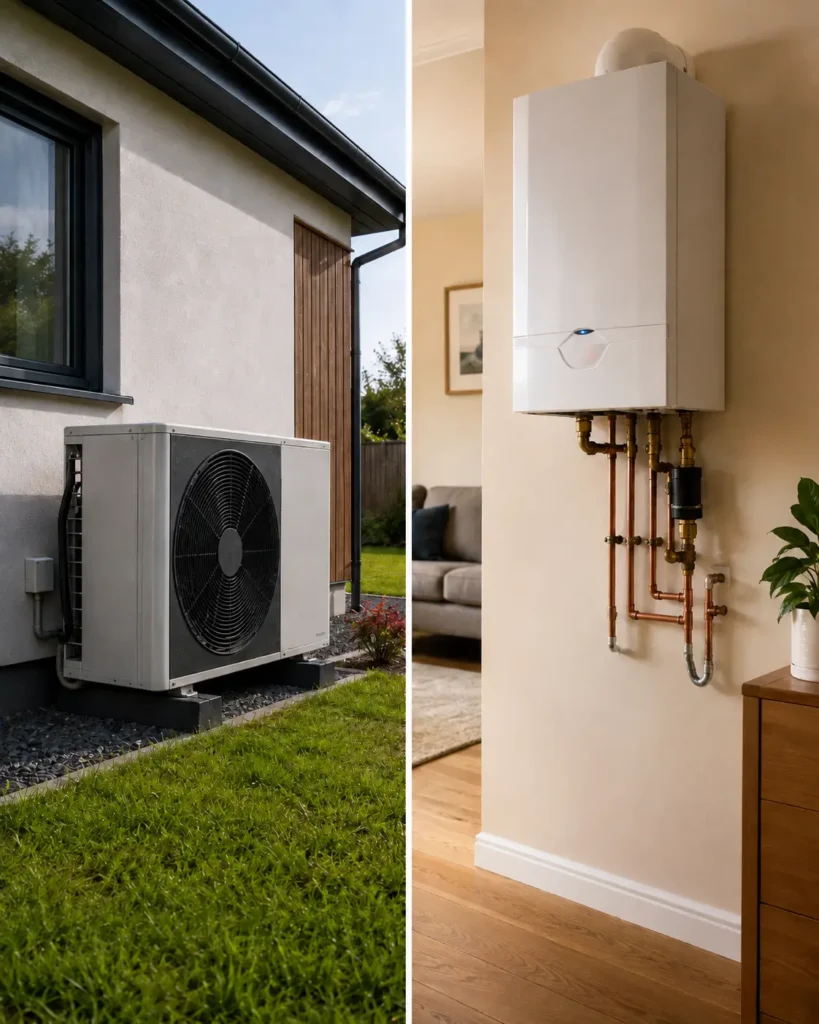
Air Source Heat Pump vs Gas Boiler: Quick Comparison
| Factor | Air Source Heat Pump | Gas Boiler |
|---|---|---|
| Efficiency | Often around 300–400% | Around 90% for an A-rated boiler |
| Typical installation cost | Around £12,000 before grants | Around £3,500 for a replacement |
| Government support | £7,500 BUS grant for eligible air-to-water systems in England and Wales | No BUS grant for a standard replacement |
| Running costs | Can match or beat gas with good efficiency and tariff | Can beat a poorly performing heat pump |
| Heating style | Lower-temperature, steady heating | Higher-temperature, faster bursts |
| Hot water | Usually requires a cylinder | Combi models can heat water on demand |
| Best for | Long-term, low-carbon upgrades | Lower-cost, straightforward replacements |
Energy Saving Trust currently gives typical installation figures of around £12,000 for an air source heat pump and around £3,500 for replacing an older gas boiler with an A-rated model. Actual quotations depend on the property and specification.
Air Source Heat Pump: Who Is It Best For?
Overview: An air-to-water heat pump transfers heat from outdoor air into water for radiators, underfloor heating and stored hot water. For the technical process, read our guide to how air source heat pumps work.
Best for: Homeowners replacing an ageing boiler, renovating a property or planning a long-term low-carbon heating upgrade.
Key features: High seasonal efficiency, lower-temperature heating, weather-compensated controls and compatibility with solar panels and smart electricity tariffs.
Pros: High efficiency, no gas burned inside the property and government grant support where eligible.
Things to consider: You will normally need outdoor space and a hot-water cylinder. Some radiators or pipework may require upgrading.
Suitable property types: New builds, modern homes and many older properties where a proper heat-loss calculation confirms the heating system can meet demand.
Example UK use case: A three-bedroom semi-detached house with an ageing boiler, reasonable insulation, cylinder space and a suitable location for the outdoor unit.
Expert recommendation: Judge the proposal by heat loss, design flow temperature and predicted seasonal efficiency—not simply the heat-pump brand. See our detailed air source heat pump pros and cons guide for the wider trade-offs.
Gas Boiler: Who Is It Best For?
Overview: A gas boiler burns mains gas to heat water for radiators and domestic hot water.
Best for: Homes needing a relatively inexpensive replacement or where installing an outdoor heat-pump unit or hot-water cylinder would be difficult.
Key features: High-temperature heating, familiar controls, compact combi-boiler options and widespread installer availability.
Pros: Lower initial cost, relatively quick replacement and convenient hot-water performance.
Things to consider: Gas is a fossil fuel, standing charges may apply and future fuel prices remain uncertain.
Suitable property types: Most gas-connected homes, particularly where significant heating-system alterations are undesirable.
Example UK use case: A small flat with no practical outdoor-unit position and insufficient space for a hot-water cylinder.
Expert recommendation: A gas boiler can still be a rational short-term choice, but compare lifetime value rather than choosing solely on installation price.
Which Is Cheaper to Run: a Heat Pump or Gas Boiler?
This is where the comparison becomes particularly property-specific.
From 1 July to 30 September 2026, Ofgem’s energy price-cap rates average 26.11p/kWh for electricity and 7.33p/kWh for gas for Direct Debit customers.
At those prices, a 90%-efficient gas boiler costs roughly 8.14p for each kWh of useful heat.
A heat pump reaches approximately the same cost per useful kWh when it achieves a seasonal COP of around 3.2.
That creates a useful decision rule:
- At an annual COP of 3.5, the heat pump is cheaper on those unit rates.
- At an annual COP of 3.2, the systems are broadly comparable.
- At an annual COP of 2.8, the gas boiler is cheaper.
A specialist heat-pump tariff can improve the calculation considerably. Completely disconnecting from gas can also remove the gas standing charge.
Energy Saving Trust’s air source heat pump guidance notes that heat pumps on standard electricity tariffs can cost slightly more than new gas boilers, while time-of-use tariffs can make them cheaper to operate.
Installation Costs, Grants and Payback
| Cost Item | Air Source Heat Pump | Gas Boiler |
|---|---|---|
| Typical installation | Around £12,000 | Around £3,500 |
| Standard 2026 support | £7,500 BUS grant for eligible air-to-water systems in England and Wales | None under BUS |
| Illustrative cost after standard BUS | Around £4,500 on a £12,000 installation | Around £3,500 |
| Main cost variables | Heat loss, radiators, cylinder, pipework, electrics and siting | Boiler type, flue, controls and pipework |
| Accurate price | Property survey required | Property survey required |
The standard Boiler Upgrade Scheme grant is currently £7,500 for eligible air-to-water heat pumps in England and Wales. A temporary £9,000 grant applies until 31 March 2027 to qualifying off-gas properties replacing oil or LPG heating; it does not normally apply to a home replacing a mains-gas boiler.
For the detailed eligibility rules, see our Boiler Upgrade Scheme 2026 update.
There is no responsible universal heat-pump payback period. It depends on the boiler you would otherwise buy, available grants, radiator and electrical upgrades, annual heat demand, seasonal efficiency and energy tariff.
For a deeper financial assessment, read are air source heat pumps worth it?.
Comfort, Hot Water and Winter Performance
Gas boilers typically heat radiators at higher temperatures and can respond quickly when heating is switched on.
Heat pumps generally perform most efficiently by maintaining a steadier temperature for longer periods using lower heating-water temperatures. Radiators may feel warm rather than extremely hot, but a correctly designed system should still maintain the required room temperature.
Hot water is another important difference.
A combi boiler can heat water on demand. Most air-to-water heat pumps instead use a hot-water cylinder, meaning cylinder capacity should be designed around how many showers, baths and other hot-water demands your household has.
Do air source heat pumps work in winter?
Yes.
Real-world monitoring by Energy Systems Catapult found that air source heat pumps continued operating effectively during cold conditions, including days with mean temperatures as low as around -6°C, although efficiency reduced as outside temperatures fell.
The better question is therefore not “Will it work below freezing?” but “Has this particular system been correctly sized for my property’s winter heat loss?”
How to Choose the Right Heating System: 7 Steps
- Calculate the property’s heat loss. A room-by-room assessment should happen before equipment is selected.
- Check your radiators and pipework. Establish what can remain and what genuinely requires upgrading.
- Plan your hot water. Make sure cylinder capacity suits the household rather than simply accepting a standard size.
- Compare total installed cost. Include grants, controls, electrical work, radiators and other remedial work.
- Challenge running-cost estimates. Ask which electricity price and seasonal COP have been used.
- Compare warranties and servicing. Consider equipment warranties, workmanship cover, spare parts and ongoing maintenance.
- Check installer credentials. Gas work requires an appropriately registered Gas Safe engineer. BUS-funded heat-pump installations must meet the scheme’s MCS certification requirements.
If you are still learning the terminology, our air source heat pump explained guide covers the fundamentals without duplicating this comparison.
Get Your Free Air Source Heat Pump Quote
Find the right air source heat pump solution for your home. Tell us a few details and our team will help you explore suitable options at a competitive price.
Quick to complete. No obligation.
Get your quote
Enter your details below and one of our team will get back to you.
Why the Installer Matters
Installation quality affects both heating technologies, but heat pumps are especially design-sensitive.
An oversized unit, undersized radiators, unnecessarily high flow temperatures, unsuitable controls or poor commissioning can increase electricity consumption and reduce comfort.
A strong heat-pump quotation should clearly state:
- Room-by-room heat loss.
- Proposed flow temperature.
- Radiators that need upgrading.
- Hot-water cylinder specification.
- Predicted seasonal performance.
- Control strategy.
- Product and workmanship warranties.
- Commissioning and aftercare.
You can independently check heat-pump installers using the official MCS Find an Installer service.
Installation quality can ultimately matter more than choosing between two well-known equipment brands.
Which Option Is Best for Different Buyers?
Best for lowest upfront cost: Gas boiler.
Best for long-term low-carbon heating: Air source heat pump.
Best for a major renovation: Air source heat pump, because radiators, underfloor heating and pipework can be designed around lower temperatures from the beginning.
Best for a small property with no cylinder space: A gas combi boiler may remain more practical.
Best for homes with solar panels, batteries or flexible tariffs: Air source heat pump, because homeowners have greater opportunity to optimise when and where their electricity comes from.
Best for landlords: Property-specific. Balance installation cost, reliability, tenant comfort, maintenance and available space.
Best for EV owners: A heat pump can complement an increasingly electrified home, particularly where solar generation and smart electricity tariffs are already being considered.
Conclusion: Air Source Heat Pump or Gas Boiler?
For many UK homeowners, an air source heat pump is the better long-term heating system because of its high efficiency, lower operational carbon emissions and government grant support.
A gas boiler still wins on simplicity, initial cost, compact combi-boiler hot water and ease of straightforward replacement.
The deciding factor should therefore be your property rather than a headline efficiency claim.
Compare a fully designed heat-pump proposal against a complete boiler quotation. Include installation work, expected seasonal efficiency, projected running costs, warranties and any radiator, pipework or electrical changes.
Want to know which option suits your home? Get a free, no-obligation quote and compare suitable heating solutions before deciding.
Frequently asked questions
Find clear answers to common questions about air source heat pumps, including running costs versus gas boilers, winter performance, radiators, insulation, hot water, 2026 installation costs and Boiler Upgrade Scheme grants.
It can be. Against a modern efficient gas boiler, the result depends heavily on electricity prices and the heat pump's seasonal COP. At current July–September 2026 price-cap rates, the approximate break-even COP is around 3.2.
Yes. A correctly designed air-to-water heat pump can provide both space heating and stored domestic hot water, so keeping a gas boiler is not normally necessary.
Yes. Modern air source heat pumps continue operating below 0°C. Efficiency usually falls as outdoor temperatures decrease, which is why cold-weather output must be considered during system design.
Not automatically. Each radiator should be assessed against the room's calculated heat loss and proposed flow temperature. Some may already be large enough.
No. Better insulation reduces heat demand and can improve running costs, but older homes are not automatically unsuitable for heat pumps. A heat-loss assessment is more useful than judging a property purely by age.
Yes, but hot water normally works differently. Instead of heating domestic hot water instantaneously, most air-to-water heat-pump systems use a storage cylinder.
Energy Saving Trust currently gives around £12,000 as a typical installation figure. The final price depends on capacity, radiators, hot-water storage, electrical work and installation complexity.
Eligible air-to-water heat pumps in England and Wales currently receive £7,500 under the standard Boiler Upgrade Scheme.
Normally, no. The temporary £9,000 uplift applies to qualifying off-gas-grid properties replacing eligible oil or LPG heating until 31 March 2027.
They produce sound from the fan and compressor, but modern systems can be relatively quiet. Product selection, positioning, vibration control and compliance with applicable planning and MCS requirements all matter.