Air Source vs Ground Source Heat Pump: Which Is Better for UK Homes in 2026?
August 12, 2026
Check Your Eligibility for Boiler Upgrade Scheme (BUS)
Complete your details below to check your eligibility.
Thank you
We've received your details and will be in touch shortly.
Quick Answer
For most existing UK homes, air source is the better all-round choice because it combines good efficiency with a much lower installation cost.
Ground source is usually more efficient across a full heating season because underground temperatures remain more stable during winter. However, that extra efficiency comes at a price.
Energy Saving Trust currently puts a typical air source installation at around £11,000, compared with around £29,000 for ground source using trenches. A system that needs boreholes can cost considerably more.
Therefore, ground source tends to make most sense for rural properties, self-builds, large homes and projects where groundworks are already planned.
Source: https://www.edfenergy.com/energywise/ground-source-vs-air-source-heat-pumps
Air Source vs Ground Source Heat Pump: Which Is Better for UK Homes in 2026?
Choosing between an air source vs ground source heat pump is not simply a case of picking the most efficient system. For most UK homeowners, the better choice depends on installation cost, available land, expected running costs and how long they plan to stay in the property.
In most existing homes, an air source heat pump is the more practical option. It costs less to install, requires far less outside space and causes less disruption.
Ground source can offer higher seasonal efficiency. However, it needs underground pipes or boreholes, which can make installation much more expensive.
This guide compares both options on the points that matter when making a buying decision: cost, efficiency, running costs, space, disruption, noise, grants and long-term value.
Want figures based on your property rather than national averages? Get a free heat pump quote and compare your options.
This guide explains the Boiler Upgrade Scheme 2026 updates, current grant amounts, eligibility, installation costs, application process and the questions to ask before committing.
Looking at replacing your heating system? Compare suitable systems and installation quotations through Getfreequote.co.uk before deciding.
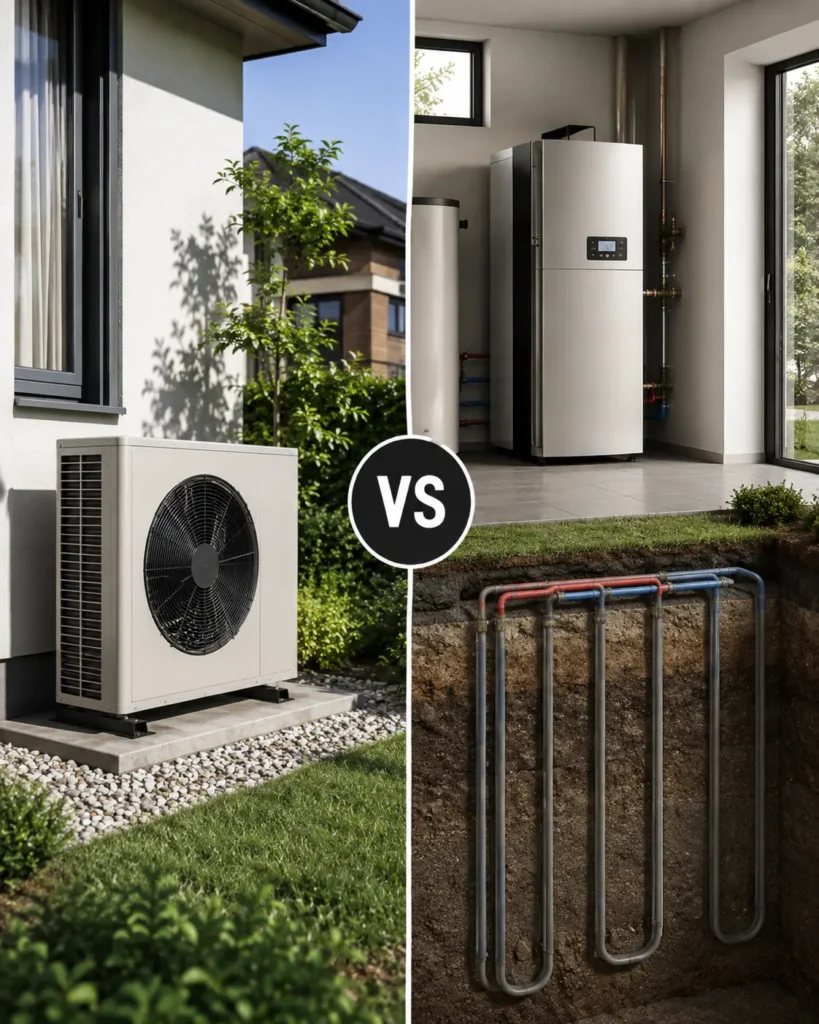
Air Source vs Ground Source Heat Pump: Quick Comparison
| Factor | Air source heat pump | Ground source heat pump |
|---|---|---|
| Typical UK benchmark | Around £12,000 | Around £15,000 with trenches; more with boreholes |
| Upfront value | Better for most retrofits | Best where groundwork is economical |
| Seasonal efficiency | High; varies more with air temperature | Usually higher across the year |
| Winter performance | Effective, but efficiency falls as air gets colder | More stable due to ground temperature |
| Outside space | Relatively small | Significant land or borehole access |
| Installation disruption | Lower | Higher |
| Outdoor noise | Fan and compressor create some sound | Usually quieter outdoors |
| Best fit | Suburban homes and tighter budgets | Rural homes, self-builds, large plots |
For most homeowners, the biggest difference is therefore not whether either system can heat the property. Both can.
Instead, the key question is whether the extra efficiency of ground source is worth the higher upfront cost.
Which Is More Efficient?
Ground source usually has the advantage when efficiency is measured across a full heating season.
An air source system takes heat from outside air. Consequently, its efficiency changes as outdoor temperatures rise and fall. It can still operate during freezing weather, although colder air makes the system work harder.
Ground source systems use heat stored underground. Because ground temperatures change less than air temperatures, the heat pump has a more stable heat source during winter.
The Energy Saving Trust comparison of air and ground source heat pumps explains this seasonal advantage in more detail.
Look at Seasonal Efficiency, Not One COP Figure
When comparing quotations, pay attention to the Seasonal Coefficient of Performance (SCOP).
SCOP shows how efficiently the system is expected to perform across a heating season. In simple terms, a higher number means the heat pump should produce more useful heat from each unit of electricity.
For example:
- A SCOP of 3.5 means around 3.5 units of heat for each unit of electricity.
- A SCOP of 4.0 means around 4 units of heat for each unit of electricity.
However, efficiency figures should always be considered alongside installation cost.
Will Ground Source Cost Less to Run?
Usually, yes — provided both systems have been designed correctly for the same property.
The important question is how much less.
For example, imagine a home needs 15,000kWh of useful heat each year.
At a SCOP of 3.5, a heat pump would use about 4,286kWh of electricity. By comparison, a system achieving a SCOP of 4.0 would use about 3,750kWh.
That is a difference of roughly 536kWh per year.
Therefore, although ground source may cost less to run, the annual saving must be compared with its much higher installation cost.
When Does the Efficiency Advantage Matter Most?
Ground source becomes more attractive when:
- The property has high annual heat demand.
- You plan to stay in the property for many years.
- Groundworks are already part of a renovation or new build.
- A suitable ground loop can be installed without expensive drilling.
- You value stable winter performance more than a lower upfront price.
On the other hand, a typical suburban homeowner may find that the extra installation cost takes too long to recover through electricity savings alone.
If you are mainly deciding whether switching to a heat pump makes financial sense at all, read our guide on whether air source heat pumps are worth it.
Air Source vs Ground Source Heat Pump Cost
Installation cost is one of the biggest differences between the two systems.
| Cost item | Air source | Ground source |
|---|---|---|
| Typical benchmark before grants | About £12,000 | About £15,000 with trenches |
| Borehole impact | Not applicable | Can raise costs substantially; EST cites examples around £57,000 |
| Standard BUS support in England and Wales | £7,500 if eligible | £7,500 if eligible |
| Temporary enhanced BUS support | Up to £9,000 for qualifying off-gas oil/LPG replacements until 31 March 2027 | Same qualifying basis |
| Accurate price requires | Property survey | Property and ground assessment |
Energy Saving Trust currently estimates that a ground source system requiring boreholes can cost around £57,000, although every property is different.
Meanwhile, the government’s Boiler Upgrade Scheme currently provides £7,500 towards eligible air-to-water or ground source heat pumps in England and Wales.
Eligible off-gas-grid properties replacing certain oil or LPG systems can receive £9,000 until 31 March 2027.
For more information about the latest rules, read our Boiler Upgrade Scheme 2026 guide.
Importantly, these figures are guides rather than quotations. Property size, heat loss, electrical work, hot-water requirements and ground conditions can all affect the final price.
How Much Space Do You Need?
Space is often the factor that rules ground source in or out.
Air Source Works Better When Space Is Limited
An air source heat pump needs a suitable position for the outdoor unit. As a result, it can work for many suburban and smaller properties where installing underground collectors would not be practical.
It is also much easier to add during a retrofit because there is usually no need to excavate a large part of the garden.
However, the outdoor unit still needs sensible positioning for airflow, servicing and noise.
For a broader look at the advantages and limitations, see our air source heat pump pros and cons guide.
Ground Source Needs Land or Drilling Access
Ground source systems collect heat through buried pipework.
Horizontal loops require enough accessible land for trenches. Alternatively, vertical boreholes can reduce the surface area needed, although drilling makes the project more expensive.
Energy Saving Trust says domestic boreholes can typically reach around 75 to 200 metres deep, depending on the property and local ground conditions.
Consequently, ground source often suits:
- Detached rural homes
- Properties with large gardens or land
- Farms and estates
- Self-build projects
- Major renovations
- Larger buildings with steady heating demand
For these properties, the extra groundwork may be easier to justify.
Which Causes More Installation Disruption?
Air source wins clearly on this point.
Most of the work takes place around the house and heating system. Therefore, landscaping disruption is normally limited.
Ground source is different. Horizontal collectors require trenches to be dug, while borehole systems need specialist drilling equipment.
As a result, ground source is often easiest to install before landscaping is finished.
A self-builder who already has excavators on site may view trenching as a manageable extra job. In contrast, digging up an established garden purely to install heating can make the same system much less attractive.
Which Heat Pump Is Quieter?
Ground source usually has the advantage outdoors.
An air source heat pump uses an outdoor fan and compressor. Modern units can be quiet, but they still produce sound while operating.
Ground source does not need the same outdoor fan unit. Therefore, there is normally less external noise once the underground system has been installed.
This can matter on smaller plots or where neighbouring properties are close.
MCS includes heat-pump design and noise requirements within its heat pump standards, which are useful when assessing a proposed installation.
Get Your Free Air Source Heat Pump Quote
Find the right air source heat pump solution for your home. Tell us a few details and our team will help you explore suitable options at a competitive price.
Quick to complete. No obligation.
Get your quote
Enter your details below and one of our team will get back to you.
Which Heat Pump Is Best for Your Type of Property?
Typical Suburban Home
Air source is usually the stronger choice.
The lower installation cost and smaller space requirement normally outweigh the seasonal efficiency advantage of ground source.
Rural Home With a Large Plot
Compare both options.
Ground source becomes more realistic when there is enough accessible land and annual heating demand is high.
Self-Build or Major Renovation
Ground source deserves serious consideration.
If groundwork is already taking place, installing loops can be far less disruptive than returning later to excavate a completed garden.
Landlord or Rental Property
Air source will often be easier to justify.
The lower capital cost can make the investment simpler, especially where the landlord does not expect to benefit directly from every future electricity saving.
Large Home With High Heat Demand
Ground source may offer stronger long-term value.
Because the property uses more heat each year, even a modest efficiency gain can produce a larger annual saving.
If you are replacing mains gas, also compare the wider economics in our air source heat pump vs gas boiler guide.
How to Choose Between Air Source and Ground Source
Use the following seven checks before making a decision.
1. Check Whether Ground Source Is Realistic
Start with your land, access and ground conditions. If suitable trenches or boreholes are not practical, air source becomes the obvious option.
2. Find Your Property’s Heat Demand
Next, use a proper room-by-room heat-loss calculation. Larger heat demand can make higher seasonal efficiency more valuable.
3. Compare Total Installation Costs
Do not compare heat-pump unit prices alone. Instead, include groundworks, electrical upgrades, hot-water storage and any heating-system changes.
4. Compare Predicted SCOP
Ask what seasonal efficiency each proposed system is expected to achieve in your property.
5. Convert Electricity Use Into Pounds
A small difference in SCOP may sound impressive. However, converting the predicted electricity use into an annual cost makes the comparison much easier to understand.
6. Consider How Long You Will Own the Property
Ground source’s higher upfront cost becomes easier to justify over a long ownership period. Conversely, it may offer poor value if you expect to move soon.
7. Judge Whole-Life Value
Finally, consider cost, efficiency, noise, disruption and practical fit together.
The best heat pump is not necessarily the one with the highest efficiency figure. It is the system that makes the most sense for the property and the homeowner.
Air Source vs Ground Source Heat Pump: Final Verdict
For most existing UK homes, air source is the better default choice.
It costs far less to install, needs less space and causes less disruption. At the same time, a well-designed system can still deliver strong seasonal efficiency.
Ground source can outperform it on annual efficiency and outdoor noise. However, the extra cost of trenches or boreholes means those benefits need to deliver real value.
Therefore, ground source is strongest where the property gives it a clear advantage: a large plot, high heating demand, planned groundworks or a long ownership period.
For everyone else, air source will usually offer the better balance of cost, performance and practicality.
Before choosing either system, compare predicted annual electricity use as well as the installation price. Get a free, no-obligation heat pump quote based on your property.
Frequently asked questions
Find clear answers to common questions comparing air source and ground source heat pumps, including efficiency, installation and running costs, winter performance, noise, land requirements and borehole depth.
Air source is usually the more practical choice for existing UK homes because installation is cheaper and requires less land. Ground source can be better where space, budget and long-term heating demand justify the groundworks.
Usually across a complete heating season. Ground temperatures fluctuate less than outside air temperatures, giving ground source an advantage during colder weather.
Air source. Energy Saving Trust currently estimates roughly £12,000 for a typical air source installation compared with about £15,000 for ground source using trenches, before considering more expensive boreholes.
Ground source can use less electricity because of its higher seasonal efficiency, but actual running costs depend on heat demand, system design, flow temperature, controls and your electricity tariff.
It can be for large homes, rural properties, self-builds and projects where groundwork is already taking place. For many ordinary retrofits, its running-cost advantage may not justify substantially higher installation costs.
Yes. Modern air source systems continue operating below freezing, although efficiency usually falls as outside temperatures decrease.
Ground source generally has an efficiency advantage during colder conditions because underground temperatures remain more stable than outside air temperatures.
Ground source is normally quieter outside because it does not require an outdoor fan unit. Air source heat pumps produce sound from their fan and compressor.
There is no reliable one-size-fits-all figure. Required ground-loop size depends on property heat demand, soil conditions and collector design, so it should be calculated for the individual site.
Energy Saving Trust says domestic boreholes can typically be around 75–200 metres deep, depending on the heating requirement and local geology.