
Heat Pump vs Gas Boiler Running Costs UK (2026)
Check Your Eligibility for Boiler Upgrade Scheme (BUS)
Complete your details below to check your eligibility.
Thank you
We've received your details and will be in touch shortly.

Quick Answer
Yes, it can be. On current July–September 2026 Ofgem price-cap averages, a 90%-efficient gas boiler costs about 8.14p per kWh of useful heat. A heat pump costs about 8.70p at SPF 3.0, 7.46p at SPF 3.5 and 6.53p at SPF 4.0.
So a well-performing heat pump can undercut gas, while a lower-performing system may cost more. From 1 October 2026, the break-even SPF falls to about 2.97. A specialist tariff and removal of the gas supply can improve the case further.
Energy Saving Trust similarly notes that heat pumps on standard tariffs can cost slightly more than efficient gas boilers, while suitable time-of-use tariffs can make them cheaper.
Are Air Source Heat Pumps Cheaper to Run Than Gas Boilers? UK Running Costs in 2026
If you are comparing heat pump vs gas boiler running costs, the short answer is: an air source heat pump can be cheaper to run than a gas boiler, but it is not automatically cheaper.
The result depends mainly on three numbers: your electricity price, gas price and the heat pump’s seasonal performance factor (SPF). In September 2026, Ofgem’s average Direct Debit price-cap rates are 26.11p/kWh for electricity and 7.33p/kWh for gas. At those rates, a heat pump needs an SPF of roughly 3.2 to match a 90%-efficient gas boiler on fuel cost.
From 1 October 2026, the break-even SPF falls to roughly 3.0 because gas rises to 7.97p/kWh while electricity rises only slightly to 26.32p/kWh.
See Ofgem’s latest energy price cap unit rates for the official figures.
This guide focuses only on running-cost maths and what changes the result. For the wider comparison, see our air source heat pump vs gas boiler guide.
Get a property-specific estimate: Get a free quote and compare expected annual running costs before deciding.
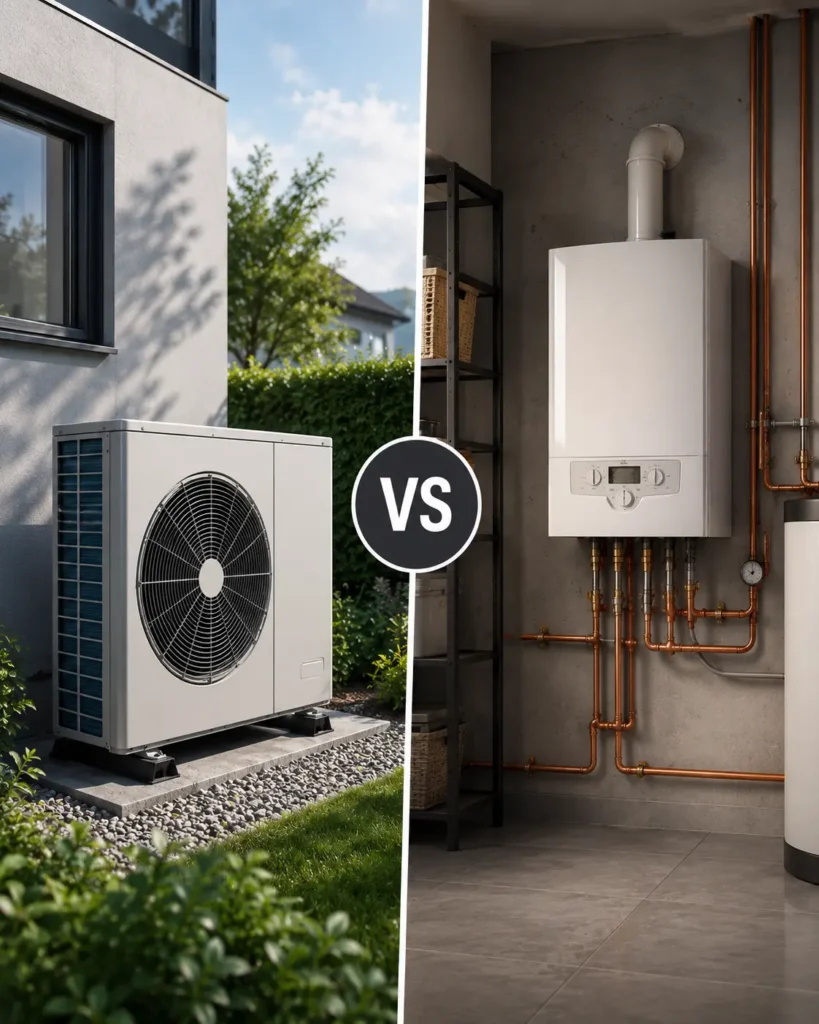
Heat Pump vs Gas Boiler Running Costs: Quick Comparison
| Running-cost factor | 90% efficient gas boiler | Air source heat pump |
|---|---|---|
| September 2026 unit rate used | 7.33p/kWh gas | 26.11p/kWh electricity |
| Cost per useful kWh of heat | ~8.14p | ~8.70p at SPF 3.0; ~7.46p at SPF 3.5; ~6.53p at SPF 4.0 |
| September 2026 break-even point | Baseline | Around SPF 3.2 |
| From October 2026 | ~8.86p/kWh useful heat | Break-even falls to around SPF 3.0 |
| Standing charge | Gas standing charge usually applies | Can disappear if the home goes fully electric |
Ofgem’s average Direct Debit rates are 26.11p/kWh electricity and 7.33p/kWh gas until 30 September 2026. From 1 October, they become 26.32p and 7.97p respectively. Electricity VAT is also temporarily removed from 1 October 2026 to 31 March 2027.
The Number That Decides It: Your Heat Pump’s SPF
The fairest comparison is cost per kWh of useful heat, not electricity versus gas.
A 90%-efficient boiler needs about 1.11kWh of gas to deliver 1kWh of heat. A heat pump with an SPF of 3.5 needs only about 0.286kWh of electricity to deliver the same heat.
The break-even calculation is:
Break-even SPF = electricity unit price × boiler efficiency ÷ gas unit price
Using September 2026 rates:
26.11 × 0.90 ÷ 7.33 = 3.21
Therefore:
- Below roughly SPF 3.2, gas is cheaper on fuel cost.
- Around SPF 3.2, costs are broadly similar.
- Above SPF 3.2, the heat pump becomes cheaper.
- From October 2026, the break-even point drops to about SPF 2.97.
This is why saying “heat pumps are three to four times more efficient” does not mean they are three to four times cheaper. Electricity and gas have very different unit prices.
SPF is also more useful for household running-cost comparisons than a single laboratory COP because it represents performance across a heating season.
What Could You Pay Per Year?
This example assumes 10,000kWh of useful heat per year using September 2026 price-cap rates. It is illustrative, not a quotation.
| Heating scenario | Approx. annual energy cost |
|---|---|
| Gas boiler at 90% efficiency | £814 |
| Heat pump at SPF 2.5 | £1,044 |
| Heat pump at SPF 3.0 | £870 |
| Heat pump at SPF 3.2 | £816 |
| Heat pump at SPF 3.5 | £746 |
| Heat pump at SPF 4.0 | £653 |
The gas figure excludes its standing charge. If a heat pump allows you to remove the gas connection entirely, the current gas standing charge is worth roughly another £106 a year.
If you still use gas for cooking, a fire or another appliance, that saving does not apply. MCS guidance similarly recommends treating standing charges differently depending on whether the gas supply will actually remain in use.
When Is an Air Source Heat Pump Cheaper Than Gas?
A heat pump is most likely to win on running costs when four things line up.
1. Seasonal efficiency is above the break-even point
SPF matters more than a headline brochure COP. A system averaging SPF 3.5 has a much stronger cost position than one averaging 2.5.
This also explains why two households with similar properties can report very different heat-pump bills.
2. The electricity tariff suits a heat pump
Energy Saving Trust’s 2026 analysis of more than one million technology and tariff combinations found that heat pumps on standard flat-rate tariffs often cost the same as, or more than, an efficient gas boiler.
Dedicated heat-pump and dynamic tariffs performed better, with heating-bill savings of up to about £330 a year in the scenarios modelled.
Read Energy Saving Trust’s 2026 heat-pump tariff research.
This is an important buyer consideration: changing the heating technology but ignoring the electricity tariff may mean missing a substantial part of the potential saving.
3. You can remove the gas standing charge
If gas heating and cooking are both replaced, removing the gas connection can save around £105 a year at July 2026 prices.
That saving should not be included in calculations where the gas meter remains active.
4. The system can operate efficiently at lower flow temperatures
Lower flow temperatures generally improve heat-pump efficiency. What matters is whether the heating system can still meet the room-by-room heat demand comfortably.
For wider practical considerations rather than running-cost calculations, see our air source heat pump pros and cons.
When Can a Gas Boiler Still Be Cheaper?
Gas can still win if the heat pump has low seasonal efficiency, electricity is expensive or the system regularly needs high flow temperatures.
A newer condensing boiler may also outperform the “typical boiler” used in generic comparisons, so use your real gas consumption where possible.
For example, at current September rates a heat pump operating at SPF 2.5 would cost approximately 10.44p per kWh of useful heat, compared with about 8.14p from a 90%-efficient gas boiler.
That is a meaningful difference.
This is also why unusually high electricity-bill estimates should not simply be dismissed. The right response is to check the expected heat demand, SPF, design temperatures and tariff assumptions behind the calculation.
If your question is whether the whole investment stacks up after installation cost, grants and lifetime value, read are air source heat pumps worth it?.
How Much Difference Can a Smart Heat-Pump Tariff Make?
Potentially a lot.
The number to compare is your average electricity price for heat-pump consumption, not the cheapest advertised off-peak rate.
At SPF 3.5 and a 90%-efficient gas boiler using current gas prices, the electricity break-even rate is roughly 28.5p/kWh.
If your heat pump’s weighted average electricity cost is below that, it beats gas on unit fuel cost. The lower that average falls, the larger the saving.
Time-of-use tariffs can also allow some hot-water heating and household electricity consumption to be shifted towards cheaper periods.
Solar panels and batteries can help, but winter heat demand and solar generation do not perfectly overlap. Model the electricity your heat pump is likely to import rather than assuming solar will cover it.
How to Compare Running Costs for Your Own Home
Before accepting any “you will save £X per year” claim, use this five-step check:
- Start with annual heat demand. Historic gas use is useful, but adjust for boiler efficiency.
- Use a realistic SPF. Ask for predicted seasonal performance for your specific system, not only the manufacturer’s laboratory COP.
- Use your actual tariff. Compare a standard tariff with suitable heat-pump or time-of-use options.
- Handle standing charges correctly. Count the gas standing-charge saving only if the gas connection will genuinely be removed.
- Model more than one scenario. Compare a cautious SPF, expected SPF and strong-performance SPF.
This creates a far more useful forecast than relying on a single national “average running cost”.
For the performance factors behind those numbers, see how an air source heat pump heats your home.
Does the Boiler Upgrade Scheme Affect Running Costs?
Not directly. The grant reduces upfront installation cost, not electricity prices.
The Boiler Upgrade Scheme currently provides £7,500 towards eligible air-to-water heat pumps. A temporary £9,000 level applies to certain eligible off-gas-grid homes replacing oil or LPG until 31 March 2027.
Check the current Boiler Upgrade Scheme grant levels on GOV.UK.
Homes replacing mains gas should not assume the £9,000 figure applies.
See our Boiler Upgrade Scheme 2026 update for the current eligibility details.
Get Your Free Air Source Heat Pump Quote
Find the right air source heat pump solution for your home. Tell us a few details and our team will help you explore suitable options at a competitive price.
Quick to complete. No obligation.
Get your quote
Enter your details below and one of our team will get back to you.
Frequently asked questions
Find clear answers to common questions comparing air source and ground source heat pumps, including efficiency, installation and running costs, winter performance, noise, land requirements and borehole depth.
They can be. At September 2026 energy prices, a heat pump needs an SPF of roughly 3.2 to match a gas boiler operating at 90% efficiency. Therefore, systems performing above that level can cost less to run.
Using September 2026 Ofgem rates, the break-even SPF is approximately 3.2 against a 90%-efficient gas boiler. However, from October 2026 it falls to roughly 3.0.
There is no reliable single figure because heat demand varies between homes. For example, a property needing 10,000kWh of useful heat would spend about £746 at SPF 3.5 using September 2026 capped electricity rates.
An SPF of 3 means the system provides about three units of heat for each unit of electricity used. However, at September 2026 standard rates, that is slightly below the approximate break-even point against efficient gas.
Yes. An SPF of 3.5 represents strong seasonal performance. As a result, it would beat a 90%-efficient gas boiler on fuel cost using September 2026 capped energy prices.
They use more electricity in winter because homes need more heating. In addition, efficiency can fall as outdoor temperatures drop. However, annual SPF takes seasonal changes into account.
Yes. A suitable tariff can reduce the average price paid for the electricity used by the heat pump. Therefore, compare specialist tariffs as well as your existing standard tariff.
Potentially. If you no longer use gas anywhere in the property, removing the supply can eliminate the gas standing charge. However, do not include this saving if the gas connection remains active.
Not necessarily. Heat pumps often work efficiently by maintaining steady indoor temperatures. Therefore, long operating periods do not automatically mean high running costs.
Solar panels can reduce the amount of electricity imported from the grid. However, winter solar output is lower when heating demand is highest, so savings vary between properties.
It can. For example, a battery may store cheaper off-peak electricity for use later. However, the saving depends on the tariff, battery size and household electricity use.
They can help in some homes because larger radiators may provide enough heat at lower flow temperatures. As a result, the heat pump may operate more efficiently.
Yes. Property age alone does not determine running costs. Instead, heat demand, system temperatures, heating design, efficiency and tariff choice matter more.
Yes. Historic gas consumption is a useful starting point. However, adjust it for boiler efficiency so that you compare useful heat rather than raw fuel consumption.
No. The grant reduces eligible installation costs rather than electricity prices. However, it can improve the overall financial case for switching to a heat pump.
Final Verdict: Are Heat Pumps Cheaper to Run Than Gas Boilers?
Sometimes — and increasingly often when the system performs well and the tariff is right.
At September 2026 capped rates, a 90%-efficient gas boiler is roughly matched by a heat pump at SPF 3.2.
A heat pump around SPF 3.5 is cheaper on unit fuel cost; one around SPF 3.0 is slightly more expensive. From October 2026, the break-even SPF falls to around 3.0.
The most useful question is therefore not simply:
“Is a heat pump cheaper than gas?”
Ask:
“What SPF is this system predicted to achieve in my home, and what will I actually pay per kWh of electricity?”
Get those two numbers right and the running-cost comparison becomes much clearer.
Want a property-specific comparison? Get a free, no-obligation quote and ask for the expected seasonal performance and annual running-cost assumptions in writing.


