
Heat Pump Cost for 3 Bedroom House UK | 2026 Guide
Check Your Eligibility for Boiler Upgrade Scheme (BUS)
Complete your details below to check your eligibility.
Thank you
We've received your details and will be in touch shortly.

Quick answer: how much does a heat pump cost for a 3 bedroom house?
For a typical three-bedroom UK house, allow roughly £10,000–£14,000 for a professionally designed air-to-water heat pump installation before government support. The Energy Saving Trust’s current general benchmark is around £12,000.
In England and Wales, the standard Boiler Upgrade Scheme grant is £7,500, which could reduce an illustrative £10,000–£14,000 installation to around £2,500–£6,500. Qualifying off-gas-grid homes replacing oil or LPG can currently receive £9,000, reducing the same illustrative range to about £1,000–£5,000. The £9,000 rate runs until 31 March 2027.
These are budgeting figures, not quotations. A survey and heat-loss calculation are needed for an accurate price.
Heat Pump Cost for a 3 Bedroom House: 2026 UK Air Source Heat Pump Guide
If you are budgeting for an air source heat pump in a three-bedroom house, a sensible starting point in 2026 is around £10,000–£14,000 before grants. The actual price can be lower or higher because bedrooms do not determine the size of a heat pump. Your home’s heat loss, radiators, hot-water requirements and installation work matter much more.
For context, the Energy Saving Trust’s current air source heat pump guidance puts a typical UK installation at around £12,000. Current market guides focused specifically on three-bedroom homes generally cluster around that figure.
Eligible households in England and Wales can reduce the cost substantially through the Boiler Upgrade Scheme. However, the amount you personally pay still depends on what your property needs.
Considering a heat pump? Get a properly surveyed quotation and compare the complete system rather than choosing on the heat-pump price alone.
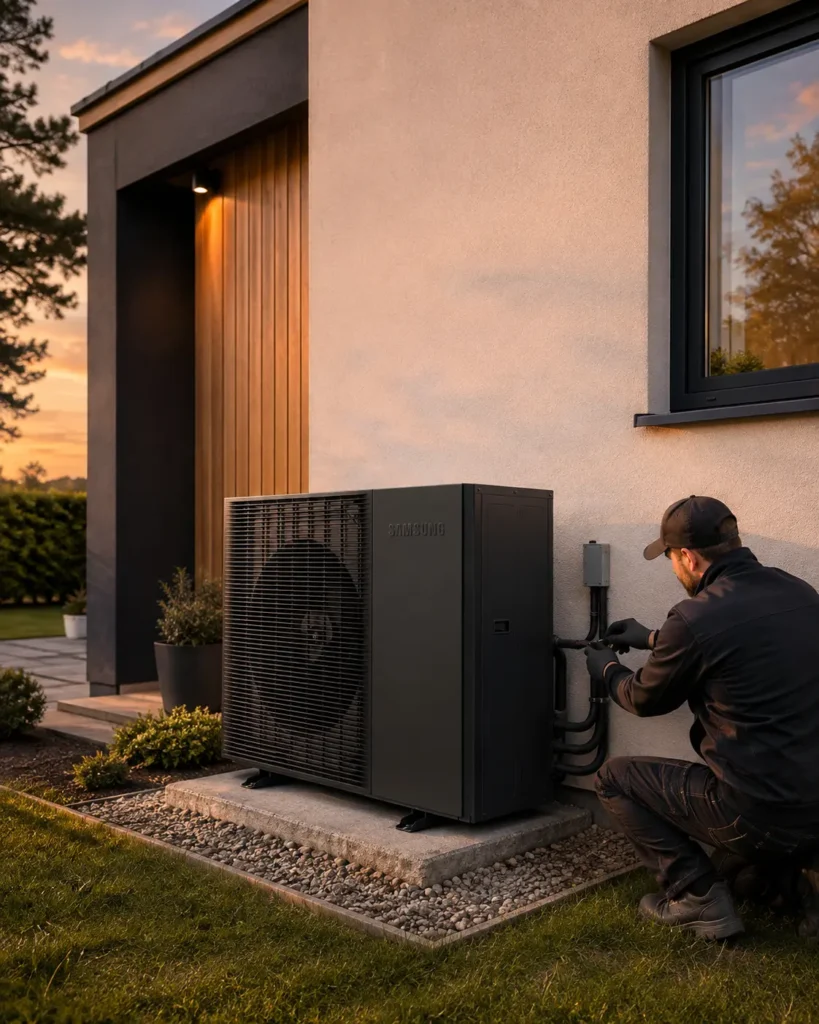
Heat pump cost for a three-bedroom house at a glance
| Cost or support | Indicative 2026 figure | What it means |
|---|---|---|
| Typical 3-bed budgeting range | £10,000–£14,000 | Before grants; property-specific |
| Energy Saving Trust general benchmark | Around £12,000 | Typical air source installation |
| Standard BUS grant | £7,500 | Eligible England and Wales installations |
| Illustrative balance after £7,500 | £2,500–£6,500 | Based on £10,000–£14,000 installation |
| Eligible off-gas oil/LPG grant | £9,000 | Available until 31 March 2027 |
| Illustrative balance after £9,000 | £1,000–£5,000 | For qualifying properties only |
The government grant does not set the price of the installation. It reduces the eligible cost after your system has been properly specified.
What determines the final heat pump installation cost?
A three-bedroom semi-detached house and a three-bedroom detached house can need very different systems.
The biggest cost drivers are the building’s heat loss and the work required to make the complete heating system operate effectively.
| Cost factor | Why it matters | What to check in the quote |
|---|---|---|
| Heat loss and heat-pump size | Higher heat demand may require different equipment | Room-by-room heat-loss calculation |
| Radiators or underfloor heating | Existing emitters may not deliver enough heat at lower water temperatures | Which radiators change, and why |
| Hot-water cylinder | Many boiler replacements need a suitable cylinder | Capacity, location and included controls |
| Pipework | Existing pipes may need alterations in some homes | Exactly what pipework is included |
| Electrical work | Supply, cabling or protection may require upgrading | Electrical scope and exclusions |
| Access and positioning | Difficult outdoor or indoor locations add labour | Base, drainage and access work |
| Controls and commissioning | System settings affect comfort and efficiency | Controls, weather compensation and handover |
This is why comparing two headline prices without comparing their scope can be misleading.
How much can the Boiler Upgrade Scheme reduce the price?
The Boiler Upgrade Scheme currently provides £7,500 towards an eligible air-to-water heat pump in England and Wales. From 21 July 2026 until 31 March 2027, qualifying properties without a mains gas connection that replace oil or LPG heating can receive £9,000.
The scheme is installer-led. An eligible MCS-certified installer applies on the property owner’s behalf and the grant should appear as an upfront discount rather than money you reclaim afterwards.
Read our Boiler Upgrade Scheme 2026 updates for the current eligibility rules and grant changes.
There is another cost advantage at present. Qualifying installed air source heat pumps are subject to 0% VAT until 31 March 2027 under the current energy-saving materials rules. GOV.UK’s VAT guidance for energy-saving materials confirms the relief.
Why heat loss matters more than the number of bedrooms
Do not choose a heat pump simply because an online guide says a three-bedroom house needs a particular number of kilowatts.
Two three-bedroom houses can lose heat at very different rates because of their floor area, wall construction, glazing, loft insulation, extensions and draughts.
A proper design therefore starts with a room-by-room heat-loss calculation. The MCS Heat Load Calculator guidance is based on the relevant heat-pump design standard and BS EN 12831 methodology.
Correct sizing also helps avoid paying for unnecessary capacity.
How does an air source heat pump actually heat a three-bedroom home?
An air source heat pump does not simply convert electricity directly into heat.
A fan pulls outdoor air across an evaporator containing cold refrigerant. The refrigerant absorbs heat and evaporates. A compressor then raises its pressure and temperature.
Next, the hot refrigerant passes through a condenser, transferring heat into the home’s heating water. That water circulates through radiators or underfloor heating and can also heat water stored in a cylinder.
Finally, an expansion valve lowers the refrigerant’s pressure and temperature so the cycle can begin again.
For a deeper explanation of the refrigeration cycle, see how air source heat pumps work.
Because heat pumps move environmental heat rather than producing every unit of heat electrically, they can deliver several units of useful heat for each unit of electricity consumed.
How much does a heat pump cost to run in a three-bedroom house?
There is no reliable universal annual figure.
Running cost depends mainly on:
- the amount of heat your home needs;
- the heat pump’s seasonal efficiency;
- electricity prices and your tariff;
- flow temperature;
- hot-water use;
- controls and household temperatures.
A useful calculation is:
Annual heat-pump electricity = annual useful heat demand ÷ seasonal efficiency.
For example, suppose a home needs 9,500kWh of useful heat and the system achieves a seasonal efficiency of 3.0. It would use about 3,167kWh of electricity.
At Ofgem’s average capped Direct Debit electricity rate of 26.11p/kWh for 1 July to 30 September 2026, that electricity would cost about £827. This is an illustration, not a forecast for a particular property.
A good heat-pump tariff can materially alter the calculation. So can the system’s real seasonal performance.
For a fuller explanation, see our guide to air source heat pump running costs.
Will a heat pump be cheaper to run than gas?
Not automatically.
Under the same July–September 2026 Ofgem price cap, average gas costs 7.33p/kWh. Electricity costs considerably more per purchased kWh, so the heat pump needs its efficiency advantage to compensate.
A well-designed heat pump, suitable tariff and removal of the gas standing charge can improve the comparison. Conversely, high flow temperatures and poor system performance can make electricity consumption more expensive.
Our air source heat pump vs gas boiler comparison covers that decision in more detail.
Do radiators need replacing?
Sometimes, but not automatically.
Heat pumps commonly operate with cooler heating water than traditional boilers. A radiator therefore needs enough surface area to deliver the required room heat at the proposed flow temperature.
One three-bedroom home might need only a few radiator changes. Another may need considerably more work.
Ask your installer to show which emitters pass the design calculation and which do not. Do not accept a blanket assumption that every radiator must be replaced without supporting calculations.
What about hot water?
Most air-to-water installations use a hot-water cylinder.
If your three-bedroom house currently has a combi boiler, finding space for the cylinder may affect both design and price. Household size and hot-water habits matter more than bedroom count alone.
The cylinder, controls and associated plumbing should be clearly included or excluded in each quotation.
How to compare heat-pump quotes for a three-bedroom house
Start with the design rather than the brand.
Ask each installer for the calculated design heat loss, proposed heat-pump output, expected flow temperature and assumed seasonal performance. Then compare radiator changes, cylinder specification, electrical work, controls, warranties and exclusions.
Also check whether the price shown is before or after BUS funding. A cheap-looking quote can become expensive if necessary building or heating-system work sits outside it.
Finally, compare expected running costs using the same assumptions. If two installers predict very different electricity use, ask why.
Is a heat pump worth it for a three-bedroom house?
It can be, particularly when you are already replacing an ageing heating system and qualify for substantial grant support.
However, value should be judged against your actual alternative. Compare the net heat-pump installation cost with the cost of replacing your existing boiler or heating system, then consider expected energy use, tariffs and how long you plan to remain in the property.
The Energy Saving Trust also cautions that replacing a newer gas or oil boiler does not automatically guarantee lower running costs.
For the broader financial decision, read are air source heat pumps worth it?.
Get Your Free Air Source Heat Pump Quote
Find the right air source heat pump solution for your home. Tell us a few details and our team will help you explore suitable options at a competitive price.
Quick to complete. No obligation.
Get your quote
Enter your details below and one of our team will get back to you.
Frequently asked questions
Find clear answers to common questions comparing air source and ground source heat pumps, including efficiency, installation and running costs, winter performance, noise, land requirements and borehole depth.
Budget roughly £10,000–£14,000 before grants in 2026. This is an indicative range; the Energy Saving Trust's general UK benchmark is around £12,000.
Using a £10,000–£14,000 illustrative installation range, the balance would be about £2,500–£6,500 after a £7,500 BUS grant.
Qualifying off-gas-grid properties in England and Wales replacing oil or LPG can receive £9,000 for an eligible air-to-water heat pump until 31 March 2027.
There is no standard size based solely on bedroom count. The installer should calculate the property's design heat loss before selecting heat-pump capacity.
Equipment capacity can affect price, but it is only one factor. Radiators, cylinders, pipework, electrical work and installation complexity can have a major effect too.
Not necessarily. Each radiator should be checked against the room's calculated heat requirement and proposed heating-water temperature.
Most domestic air-to-water systems use stored hot water, so homes replacing a combi boiler will commonly need a suitable cylinder.
There is no fixed annual figure. Running costs depend on heat demand, seasonal efficiency, electricity tariff, controls and hot-water use.
They can be, but it is not guaranteed. Electricity costs more per kWh than gas, while heat pumps compensate by delivering multiple units of heat per unit of electricity.
Reducing heat loss can lower the amount of heat the property needs. In some cases, that can influence system sizing and ongoing electricity consumption.
Yes. Air source heat pumps continue operating below freezing, although efficiency normally falls as outdoor temperatures decrease. They may also use automatic defrost cycles in cold, damp conditions.
Coefficient of Performance, or CoP, describes heat output relative to electricity input at a particular operating point. A CoP of 3 means three units of heat are delivered for each unit of electricity consumed.
Seasonal efficiency considers performance over a longer period rather than one test condition. It is therefore more useful when estimating annual electricity consumption.
Qualifying installed air source heat pumps are currently zero-rated for VAT until 31 March 2027.
Yes. BUS is installer-led. The eligible installer applies on behalf of the property owner and the grant should be reflected as an upfront discount.
Yes. Underfloor heating can work particularly well with heat pumps because its large surface area can deliver useful heat at relatively low water temperatures.
Potentially. Age alone does not determine suitability. The important factors include heat loss, heating emitters, available space and the required operating temperature.
No. Compare the complete design, included building work, expected performance, warranties and assumptions as well as the final price.
Conclusion:
For a typical three-bedroom home, £10,000–£14,000 before grants is a useful 2026 budgeting range, with the Energy Saving Trust’s wider UK benchmark sitting around £12,000. The standard £7,500 BUS grant can reduce that significantly, while eligible off-gas oil or LPG properties can currently receive £9,000.
The key point is that bedroom count does not determine your final price.
Heat loss, radiator requirements, hot-water provision, pipework, electrics and installation complexity all matter. A proper survey is therefore more valuable than an online headline price.


