
Hidden Costs of Heat Pump Installation | UK Guide 2026
Check Your Eligibility for Boiler Upgrade Scheme (BUS)
Complete your details below to check your eligibility.
Thank you
We've received your details and will be in touch shortly.

Quick Answer: What Are the Hidden Costs of Heat Pump Installation?
The main hidden costs of installing an air source heat pump can include larger radiators, a new hot-water cylinder, pipework changes, a dedicated electrical circuit or consumer-unit work, outdoor-unit bases and drainage, planning or acoustic assessments, removal of old heating equipment and redecoration after pipe runs.
Not every home needs all of these. A properly itemised quote should identify them before work starts. The key is to compare complete system designs, not just the heat-pump unit price. In England and Wales, the Boiler Upgrade Scheme can reduce the upfront cost, but the grant does not remove the need to understand exactly what the quotation includes.
Hidden Costs of Heat Pump Installation: What UK Homeowners Should Budget For
The hidden costs of heat pump installation are usually not surprise fees. They are property-specific works needed to make an air source heat pump perform properly, such as radiator changes, a hot-water cylinder, pipework alterations, electrical upgrades, groundwork, planning-related work and making good after installation.
That matters because headline prices can describe very different scopes. Energy Saving Trust’s current air source heat pump guidance puts a typical installation at around £12,000, although the final price depends on the property, system size and radiator requirements. A cheaper quote can still be good value, but only if it includes the same work as a more expensive one.
This guide explains the costs that are easiest to overlook and how to compare quotes without paying for upgrades your home does not need. If you want the technical background first, see how air source heat pumps work.
Get a Free Quote: Compare property-specific heat-pump quotations after a proper survey, rather than choosing from headline prices alone.
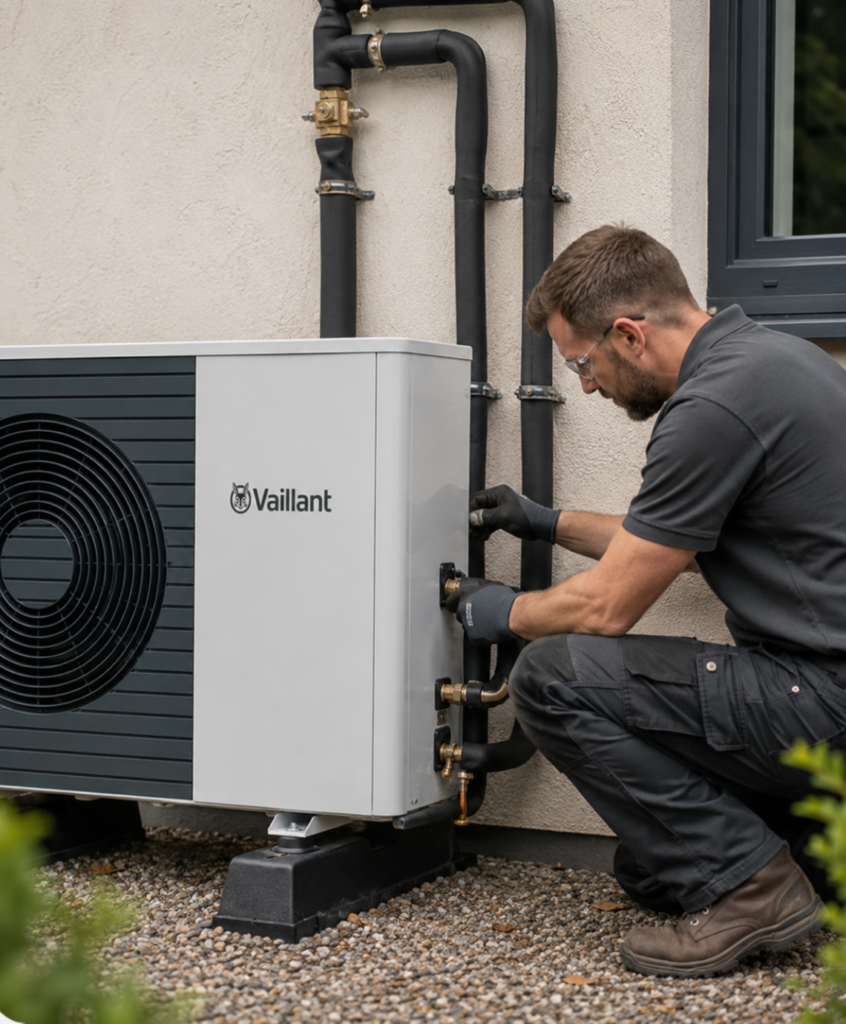
How Much Does an Air Source Heat Pump Really Cost?
Energy Saving Trust currently estimates a typical air source heat pump installation at around £12,000. Government analysis has separately reported a median air-to-water heat-pump installation cost of approximately £12,500 in 2024/25.
These are benchmarks rather than quotations. A relatively simple installation in a heat-pump-ready home can cost less. A larger or more complicated property needing extensive changes can cost considerably more.
The better question is therefore not, “How much is the heat pump?” It is, “What is the total cost of delivering the designed heating system for this property?”
The Main Hidden Costs of Heat Pump Installation
| Potential extra | Why it may be needed | Indicative cost position |
|---|---|---|
| Radiator upgrades | Lower flow temperatures can require larger emitters | Often a few hundred pounds per radiator |
| Hot-water cylinder | Many combi-boiler homes need stored hot water | Commonly around £900–£2,000 supplied and fitted |
| Pipework changes | Existing pipes may not provide the required flow | Property-specific |
| Electrical work | Dedicated circuits or consumer-unit changes may be required | Usually hundreds; major network work can cost more |
| Base, drainage and external pipework | Outdoor unit needs stable siting and water management | Property-specific |
| Planning/acoustic work | Applies where permitted-development rules are not met | Potentially hundreds or more |
| Making good and removal | Decorating and old-equipment disposal may be excluded | Property-specific |
These are indicative figures rather than guaranteed prices. Published UK cost guides show that component costs vary significantly by specification and property.
1. Radiator Upgrades Can Change the Quote Quickly
Heat pumps usually work most efficiently with lower heating-water temperatures than traditional boilers. An existing radiator may therefore produce less heat than it did on a high-temperature boiler system.
However, “heat pump” does not automatically mean “replace every radiator”.
The MCS Heat Load Calculator guidance emphasises room-by-room heat-loss calculations, while MCS heat-emitter guidance shows how radiator output must be matched to the proposed operating temperature. Some existing radiators may already be suitable.
Ask for the design flow temperature, calculated heat loss for each room and output of every proposed radiator. If one installer wants to replace ten radiators and another wants to replace three, that difference should be explainable.
2. A Hot-Water Cylinder May Be a New Expense
Most air-to-water heat-pump systems provide domestic hot water through a storage cylinder. If you currently use a combi boiler, you may not have one.
A heat-pump-compatible cylinder needs suitable capacity and heat-exchanger performance. Installing one in a new location can also mean longer pipe runs, drainage changes or carpentry work.
Space matters too. Losing an airing cupboard or creating a new cylinder location can affect the practicality of the project as well as the cost.
Check the cylinder model, volume and proposed location. Also confirm whether all associated plumbing and building work appears in the quotation.
3. Existing Pipework May Need Modification
Heat pumps often circulate more water at a lower temperature difference than boiler systems. Small or restrictive pipework can therefore limit the flow needed to deliver heat efficiently.
That does not mean every property with microbore pipe needs a complete repipe.
The installer should justify any proposed changes using system flow requirements and the actual pipe layout. A full repipe can add significant labour, materials and disruption, so it should not appear as an unexplained precaution.
Avoid vague wording such as “pipework upgrades if required”. Ask what has been assessed, what will remain and exactly what could trigger another charge.
4. Electrical Work Can Be More Than a New Isolator
An air source heat pump needs an appropriate electrical supply, controls and protection. Some properties only need a dedicated circuit. Older installations may require consumer-unit changes or other electrical improvements.
There can also be requirements involving the local Distribution Network Operator.
Nesta’s research into heat-pump installation barriers found that network or supply upgrades are necessary for a minority of properties. Major homeowner-funded work is much less common, but it can become expensive in unusual cases.
Electrical suitability should therefore be checked during the survey rather than after the plumbing installation begins.
5. Outdoor Siting, Drainage and Planning Can Add Cost
The outdoor unit needs stable support, unrestricted airflow and a sensible route for insulated pipework. Installers also need to manage water produced during normal operation and defrost cycles.
Extra work can include a base, wall brackets, drainage, long external pipe runs or more difficult access.
Planning rules deserve particular attention. In England, permitted-development rights were relaxed in May 2025. Among the changes was removal of the former one-metre boundary restriction for qualifying installations. Current government guidance on the 2025 planning changes
Conditions still apply. Listed properties and installations outside permitted-development rules may require additional permission.
Where a planning application is necessary, acoustic work may also be requested. Previous Nesta research estimated planning-related expenses in the hundreds of pounds and around £1,000 for some sound assessments.
6. Making Good and Old-System Removal Are Easy to Overlook
Heat-pump retrofits can involve lifting floors, drilling walls, moving radiators and running new pipes.
The heating system may be technically complete while plastering, flooring repairs or repainting remain your responsibility.
Ask what “making good” means in the contract. Does it cover plastering and filling? What about flooring and decoration?
This is not a minor concern. Which?’s 2026 consumer research into heat-pump adoption found that homeowners can struggle to establish the full upfront cost and worry about disruption and reinstatement after installation.
Old-system removal also needs clarification. A quotation might include taking out an oil boiler while excluding removal of the external oil tank. Redundant cylinders, storage heaters, flues and pipework may also fall outside the scope.
7. Insulation Is Not Automatically a Compulsory Heat-Pump Cost
Insulation can reduce heat loss. In turn, that may allow lower flow temperatures, smaller emitters or a smaller heat pump.
However, it is misleading to say every property must undergo extensive insulation work before a heat pump can operate successfully. The design should start with the home’s actual heat loss. Improvements can then be judged on their practical and financial merits.
Older Boiler Upgrade Scheme advice can also be out of date. The previous requirement relating to outstanding loft and cavity-wall insulation recommendations was removed earlier, and from 28 April 2026 a valid EPC stopped being a standing BUS eligibility requirement for new applications. Alternative evidence can now be used where necessary.
See our Boiler Upgrade Scheme 2026 updates guide for the current rules.
Do Not Forget Costs After Installation
The purchase price is only one part of the financial decision. You should also budget for servicing and understand the expected electricity consumption.
Running costs depend on your home’s heat demand, seasonal heat-pump efficiency, flow temperature, controls and electricity tariff.
A cheap installation that forces the system to operate inefficiently may cost more over its lifetime than a better-designed installation.
For a deeper comparison, see our guide to air source heat pump running costs.
How to Compare Quotes Without Getting Caught by Hidden Extras
Ask every installer to price the same scope.
A useful quotation should clearly identify the room-by-room heat-loss calculation, design flow temperature, heat-pump model, radiator changes, cylinder, pipework, electrical work, outdoor base and drainage, old-system removal, making good, commissioning and warranty arrangements.
Just as importantly, it should state what is excluded.
That is often where the biggest differences between quotations sit.
Property-size cost guides should only be treated as starting points. If you own a smaller property, our guide to heat pump cost for a 2-bedroom house explains which factors can move the final figure.
How the Boiler Upgrade Scheme Changes the Final Cost
As of September 2026, England and Wales homeowners can receive £7,500 towards an eligible air-to-water heat pump through the Boiler Upgrade Scheme.
Until 31 March 2027, qualifying properties without a mains gas connection that replace oil or LPG heating can receive £9,000. Eligible residential air-to-air installations have a separate £2,500 grant. Check the current Boiler Upgrade Scheme grant values on GOV.UK
The grant reduces the eligible installation price. It does not make every home cost the same. A property requiring extensive radiator, pipework or building changes can still require a larger customer contribution.
Qualifying installations also currently benefit from 0% VAT on energy-saving materials until 31 March 2027.
If you are weighing the overall investment rather than installation cost alone, read are air source heat pumps worth it?.
Get Your Free Air Source Heat Pump Quote
Find the right air source heat pump solution for your home. Tell us a few details and our team will help you explore suitable options at a competitive price.
Quick to complete. No obligation.
Get your quote
Enter your details below and one of our team will get back to you.
Frequently asked questions
Find clear answers to common questions about hidden heat pump installation costs, including radiators, cylinders, pipework, electrics, planning, noise assessments, insulation, grants, removal work, making good and quote comparisons.
The most common extras are radiator upgrades, a hot-water cylinder, pipework changes, electrical work, groundwork, drainage, making good and removal of the old heating system.
No. Each radiator should be checked against the room’s calculated heat loss and proposed flow temperature. Some existing radiators may already provide enough output.
Often, particularly if you currently have a combi boiler. The proposed cylinder should be sized for your household’s hot-water needs and designed to work effectively with the heat pump.
No. Existing pipework should be assessed against the flow required by the designed system. A blanket recommendation for a complete repipe should have a technical justification.
Possibly. It depends on your existing electrical installation and the requirements of the selected heat pump. An electrical assessment should identify this before installation.
Many domestic installations in England qualify as permitted development, provided they meet the relevant conditions. Listed buildings and unusual installations may still need additional permission.
Yes. If a proposed installation falls outside permitted-development requirements or the local planning authority requests acoustic evidence, a professional assessment can add to the project cost.
Not automatically. Insulation can reduce heat demand and improve the overall heating design, but the property should first be assessed using a proper heat-loss calculation.
For applications properly made from 28 April 2026, a valid EPC is no longer a standing eligibility requirement. Where there is no valid EPC, installers can provide alternative evidence.
The BUS grant is applied to the eligible heat-pump installation rather than operating as separate grants for individual radiators or components. Ask the installer exactly what their grant-adjusted quotation includes.
Often, but not always. Check whether the quote also covers associated items such as an oil tank, LPG equipment, old cylinders, storage heaters, flues or redundant pipework.
Only if the contract says so. “Making good” can mean different things between installers, so confirm responsibility for plastering, decorating and flooring before work begins.
It can if the quotation is provisional, important survey work has not been completed or the contract permits variations. A detailed final quote should minimise uncertainty by listing inclusions, exclusions and assumptions.
Compare the complete specifications rather than the final totals. Check radiators, cylinder, pipework, electrics, groundwork, controls, removal, making good, commissioning, warranty and grant treatment on a like-for-like basis.
Energy Saving Trust currently uses around £12,000 as a typical installation figure, but individual projects can fall above or below this depending on property size and required system changes.
Conclusion:
The biggest hidden cost of heat pump installation is usually incomplete scope.
Radiators, cylinders, pipework, electrics, siting, drainage, approvals, old-system removal and making good are all predictable once a property has been properly assessed.
A good quotation should therefore leave very little “hidden”. It should explain what the system needs, what the price includes, what it excludes and why.
Compare fully surveyed, itemised quotations rather than headline prices. The cheapest figure can represent excellent value when the scope is complete. It can become expensive when essential retrofit work appears later.
Compare Free Quotes: Get property-specific heat-pump quotations and check the complete installed scope before making your decision.


