
Heat Pump Installation Time: How Long Does It Take? UK
Check Your Eligibility for Boiler Upgrade Scheme (BUS)
Complete your details below to check your eligibility.
Thank you
We've received your details and will be in touch shortly.

Quick Answer: How Long Does an Air Source Heat Pump Installation Take?
Most straightforward domestic air source heat pump installations take about two to three working days on site. The Energy Saving Trust heat-pump installation guide describes fitting as taking “a few days”, while several UK installers currently quote around two to five days depending on the property and scope.
A simple job may include fitting the outdoor unit, replacing or connecting the hot-water cylinder, making plumbing and electrical connections, then commissioning the system. Installation takes longer when the home needs multiple radiator changes, major pipework alterations, an electrical upgrade, difficult access or associated building work.
The wider process from survey to switch-on is usually measured in weeks rather than days because design, paperwork, planning checks and scheduling happen before the physical installation.
How Long Does Air Source Heat Pump Installation Take? UK Heat Pump Installation Time Explained
If you are replacing a boiler with an air source heat pump, one practical question is how long the work will take inside your home.
For a straightforward UK air-to-water retrofit, the physical installation usually takes around two to three working days. More involved jobs can take four to five days or longer where several radiators need changing, pipework needs upgrading, a hot-water cylinder must be relocated or electrical work is required. Current UK installer guidance commonly falls within a two-to-five-day range, while the Energy Saving Trust describes the fitting itself as taking a few days.
The whole project takes longer. Before installation, the property normally needs a technical survey, heat-loss calculation, system design and quotation. Planning checks, grant administration and installer availability can also add time.
By the end of this guide, you will know what normally happens on each installation day, what can extend the programme and how to prepare for the disruption.
Considering a heat pump? Compare properly surveyed options through GetFreeQuote.co.uk before agreeing an installation date.
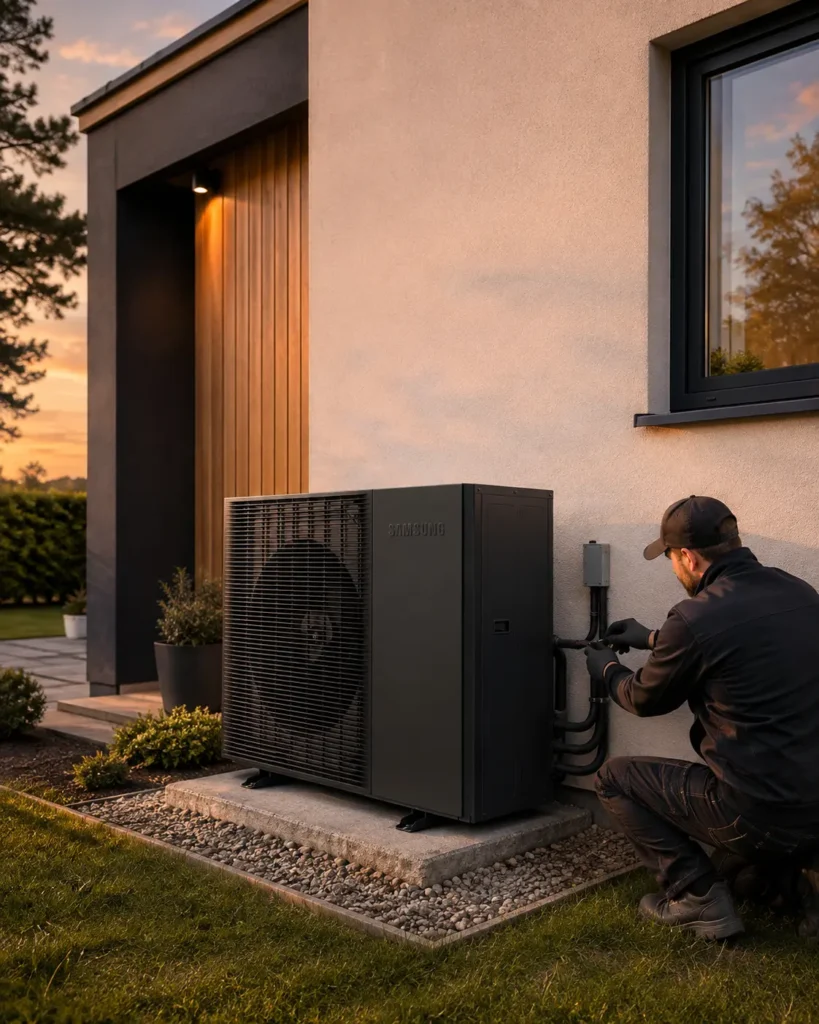
Typical Heat Pump Installation Time by Job Type
| Installation type | Typical on-site time | Main reason |
|---|---|---|
| Straightforward air-to-water retrofit | 2–3 working days | Outdoor unit, cylinder, plumbing, electrics and commissioning |
| Retrofit with several radiator changes | 3–4 working days | Extra emitter work, draining, refilling and balancing |
| Complex retrofit | 4–5+ working days | Major pipework, cylinder relocation, electrical upgrades or difficult access |
| Heat pump plus major heating-system alterations | Project-specific | Underfloor heating, building work or wider refurbishment |
These are practical planning ranges, not guaranteed completion times. The installer should confirm the expected programme after surveying your property.
What Happens During an Air Source Heat Pump Installation?
There is no universal day-by-day sequence because installers organise their teams differently. However, a typical domestic retrofit follows the same broad stages.
Day 1: Removal, preparation and outdoor-unit work
The existing boiler or heating appliance may be isolated and removed first. The installer can then prepare the outdoor-unit position, including a suitable base and drainage where required.
Pipe routes between the outside unit and the internal heating system are also created. The team may start replacing the hot-water cylinder or upgrading radiators at the same time. Energy Saving Trust confirms that installation can involve preparing an outdoor platform, fitting a cylinder and making changes to radiators and pipework.
Once operating, the outdoor unit draws air across a heat exchanger containing refrigerant. A compressor raises the refrigerant temperature before that heat is transferred into the home’s heating water. That is why the outdoor unit, pipework, radiators, cylinder and controls need to work as one system. For the full refrigeration-cycle explanation, see how air source heat pumps work.
Day 2: Cylinder, pipework, radiators and electrics
The heat pump is connected to the heating and hot-water system.
Many homes moving from a combi boiler need a hot-water cylinder. Existing cylinders may also need replacing if they are unsuitable for the proposed system.
The team may change radiators, alter pipework, flush the heating circuit and complete the electrical supply and controls. Energy Saving Trust says installers should connect the heat pump and cylinder to the heating system, replace unsuitable pipework where necessary and connect the equipment to the electricity supply.
Final day: Testing, commissioning and handover
Installation is not finished when the last pipe is connected.
The system must be filled, checked and commissioned. This normally includes checking for leaks, bleeding air, balancing radiators, configuring controls and confirming that heating and hot water operate correctly.
Energy Saving Trust identifies commissioning and homeowner handover as a separate stage after the equipment has been fitted. The installer should also explain the controls and provide relevant warranty, operating and installation documents.
What Can Make Heat Pump Installation Take Longer?
The biggest differences in heat pump installation time usually come from the work around the heat pump rather than simply fitting the outdoor unit.
Radiator upgrades
Heat pumps commonly use lower heating-water temperatures than conventional boilers. Some existing radiators may therefore need replacing with larger or higher-output models so each room still receives enough heat. Energy Saving Trust currently describes typical radiator flow temperatures of around 35–45°C for heat pumps.
Changing one or two accessible radiators may add little time. Replacing many radiators across a large property or dealing with awkward pipework can extend the installation.
Hot-water cylinder changes
Homes moving from a combi boiler normally need a way to store domestic hot water when installing a standard air-to-water heat pump.
The work is simpler where a suitable cylinder location already exists. It takes longer if pipework needs rerouting or the cylinder must move to another part of the property.
Pipework, electrics and access
Older heating systems can require additional plumbing work. A heat pump also needs a suitable electrical connection, so alterations may be required before commissioning.
Restricted side access, awkward lifting routes, unsuitable ground or additional drainage work can also increase installation time.
A good technical survey should identify these requirements before the installation date rather than discovering them once work has started.
Planning and outdoor-unit positioning
Outdoor-unit siting should also be resolved beforehand.
In England, permitted-development rights for domestic air source heat pumps were broadened in May 2025, including changes that allow greater flexibility over boundary distances and unit sizes. However, conditions still apply, and some installations may still require planning permission. Current government guidance on the changes explains the updated position.
Planning rules vary across the UK, so check the requirements that apply where the property is located.
Wider renovation work
Underfloor heating, major floor work, substantial insulation improvements or a complete heating-system redesign can turn a short heat-pump installation into one part of a larger renovation.
Where possible, complete agreed building or insulation work before the heat pump is fitted.
How Long Will You Be Without Heating?
Plan for your heating to be unavailable for much of the physical installation.
Energy Saving Trust advises that fitting normally takes a few days and that the heating system will be turned off for most of that period. It also notes that an installer may provide electric heaters during a winter installation.
Hot-water interruption depends on how the work is sequenced. If a cylinder is being replaced or existing hot-water equipment removed, there may be periods when normal hot water is unavailable.
Ask for a written programme before work starts, particularly where uninterrupted heating or hot water is important for the household.
How Long Does the Full Process Take Before Installation Day?
The on-site fitting period is only one part of the overall heat pump installation timeline.
Before installation, the installer normally needs to assess the property, calculate heat loss, select the heat-pump capacity, check radiator outputs, plan the hot-water cylinder and confirm electrical and outdoor-unit requirements. Major installers such as Octopus describe a home survey and heating-system design as distinct stages before the installation is booked.
For a broader explanation of what is fitted and how the process works, see the dedicated air source heat pump installation guide.
Grant administration can affect the pre-install timeline too. In England and Wales, the Boiler Upgrade Scheme is installer-led. Current GOV.UK Boiler Upgrade Scheme guidance says the installer must install and commission the heat pump within 120 days of applying for the grant for the installation to remain eligible.
For current grant values and 2026 eligibility changes, see Getfreequote’s Boiler Upgrade Scheme 2026 updates guide.
How to Keep Your Heat Pump Installation on Schedule
Most avoidable delays can be reduced by resolving design and access questions before the installation team arrives.
Before work starts, ask the installer to confirm:
- The expected number of installation days.
- Which radiators will be changed.
- Where the hot-water cylinder will go.
- Whether pipework or electrics need upgrading.
- When the existing heating will be switched off.
- Whether temporary heating will be available.
- When commissioning and handover will happen.
Clear access to the proposed cylinder position, radiators, consumer unit and outdoor-unit location. Complete any agreed building work first and confirm planning requirements where relevant.
Also check whether less obvious work sits outside the quotation. The guide to hidden heat pump installation costs can help identify items worth clarifying before the start date.
Do not treat commissioning as spare time at the end of the job. Testing, balancing and control setup form part of the installation itself.
Get Your Free Air Source Heat Pump Quote
Find the right air source heat pump solution for your home. Tell us a few details and our team will help you explore suitable options at a competitive price.
Quick to complete. No obligation.
Get your quote
Enter your details below and one of our team will get back to you.
Frequently asked questions
Find clear answers to common questions about how long an air source heat pump installation takes, heating and hot-water disruption, radiators, cylinders, electrical work, planning permission and commissioning.
A very simple installation may sometimes be completed quickly, but one day is not a sensible assumption for a normal whole-home air-to-water retrofit. Around two to three working days is more typical.
Allow approximately two to three working days for many straightforward domestic installations. More complex systems can take longer.
Yes. Four to five days or more can be reasonable where the job includes extensive radiator changes, difficult pipework, cylinder relocation, electrical alterations or access problems.
Energy Saving Trust says heating will normally be off for most of the few days required to fit the system. Ask your installer for the exact changeover programme.
Usually there will be some disruption if a hot-water cylinder or existing heating appliance is being changed. The duration depends on the installation sequence.
They can. Replacing several radiators adds plumbing, draining, refilling and balancing work, although an installation team may complete some of this alongside other tasks.
It can because a typical air-to-water heat pump normally uses stored hot water, meaning space and pipework for a suitable cylinder may need to be created.
Yes. However, because the heating may be off for much of the installation, discuss temporary electric heating with the installer beforehand.
It can where permission is required. Many domestic installations can use permitted-development rights, but applicable rules and exceptions should be checked before booking work.
It should not materially change the physical fitting period, but the grant application forms part of the wider pre-installation process. In England and Wales, the scheme is installer-led.
Usually, yes, but expect engineers to need access to radiators, pipework, the hot-water cylinder position, electrical equipment and the outdoor-unit area.
It can significantly increase the wider project time where floors need lifting or a new underfloor-heating system is being installed.
Yes. If alterations to the electrical installation are required, they need to be completed before the heat pump can be fully commissioned.
There is no universal fixed duration. Commissioning is the final technical stage and includes operating checks, leak checks, removing air, balancing the system and configuring controls. It should not be rushed.
Additional work to the existing home tends to have the greatest effect: radiator changes, cylinder positioning, pipework alterations, electrics, access and building work all influence the final schedule.
Conclusion: How Much Time Should You Allow?
For most straightforward UK air source heat pump retrofits, allow around two to three working days for the physical installation. A more complicated property may need four to five days or longer, particularly where the job includes several radiator changes, cylinder relocation, electrical upgrades or substantial pipework alterations.
The complete project takes longer because the survey, heat-loss calculations, system design, planning checks, grant administration and scheduling all happen before installation day.
The most useful figure is therefore the property-specific programme produced after a proper survey, not a generic promise.
If you are comparing quotations, ask each installer to separate the on-site installation time from the wider project timeline and explain exactly what work is included.


