
Air Source Heat Pump Installation: Step-by-Step UK Guide
Check Your Eligibility for Boiler Upgrade Scheme (BUS)
Complete your details below to check your eligibility.
Thank you
We've received your details and will be in touch shortly.

Quick Answer: What Happens During an Air Source Heat Pump Installation?
An air source heat pump installation normally starts with a detailed survey and room-by-room heat-loss calculation. The installer then designs the system, selects the heat pump, checks radiator outputs, pipework, hot-water demand, electrical capacity and outdoor-unit location, and confirms grant or planning requirements.
During installation, the old heating appliance may be removed, the outdoor unit is mounted, a suitable cylinder and controls are fitted, and radiators or pipework are upgraded where needed. The installer then fills, flushes, tests, balances and commissions the system before explaining the controls.
A straightforward air-to-water installation typically takes around three days, although complex radiator, pipework or underfloor-heating work can extend the programme.
Air Source Heat Pump Installation: Step-by-Step Guide
Air source heat pump installation is more involved than swapping one boiler for another. The installer is designing a complete low-temperature heating system around your property, not simply fitting an outdoor unit.
For most UK homes replacing a boiler, this means an air-to-water heat pump. It takes heat from outside air and transfers it into water for radiators or underfloor heating, while a hot-water cylinder usually supplies taps and showers.
A good installation starts before anyone lifts a tool. Your home needs a heat-loss assessment, correct system sizing, suitable radiators and pipework, and a practical outdoor-unit location. This guide explains what should happen from the first survey to commissioning and handover, including costs, disruption, planning, electrical work and current Boiler Upgrade Scheme support.
Get a free quote: Compare properly surveyed air source heat pump installation options for your property through Get Free Quote before choosing a system.
Air Source Heat Pump Installation at a Glance
| 2-bedroom property | Typical cost before BUS | £7,500 BUS grant | Potential homeowner cost |
|---|---|---|---|
| Straightforward small terrace or heat-pump-ready home | £7,500–£9,500 | -£7,500 | £0–£2,000 |
| Typical 2-bed terrace or semi | £9,000–£11,500 | -£7,500 | £1,500–£4,000 |
| More complex retrofit | £11,500–£12,500+ | -£7,500 | £4,000–£5,000+ |
What Should Happen Before Installation?
1. A proper heat-loss survey
System sizing should begin with the building, not the heat-pump catalogue.
An installer should calculate how much heat each room loses under winter design conditions. This considers the building fabric, insulation, ventilation and local design temperature.
MCS heat-pump design methodology uses room-by-room heat-load calculations rather than relying only on floor area or the previous boiler size. explains the methodology and its relationship with MIS 3005-D and BS EN 12831-1.
That calculation drives the heat-pump capacity and the output required from each radiator or underfloor-heating zone. Poor sizing can affect comfort, control and efficiency.
2. Heating system design
The installer should decide the lowest practical flow temperature that can still heat every room. Heat pumps generally perform more efficiently at lower water temperatures, so some radiators may need more surface area.
Existing radiators do not automatically need replacing. The real question is whether each one can meet that room’s calculated heat loss at the proposed flow temperature. Energy Saving Trust notes that existing radiators may already be sufficient, while undersized units can be replaced with higher-output alternatives.
For a deeper explanation, see the Getfreequote.co.uk air source heat pump temperature guide.
The design should also cover pipe diameters, hot-water cylinder size, controls, electrical demand and the outdoor-unit position.
3. Planning, noise, grant and electrical checks
Planning rules are devolved across the UK, so the exact requirements depend on where the property is located.
In England, many domestic air source heat pump installations can qualify as permitted development if all relevant conditions are met. Current guidance includes compliance with MCS 020a for the sound assessment. Listed buildings, designated sites and properties with other restrictions can require additional permission. Check the current rather than relying on an old rule of thumb about unit position.
Your installer should also determine whether the Distribution Network Operator, or DNO, needs to approve the electrical connection before installation or can simply be notified afterwards. GOV.UK distinguishes between an “apply to connect” route and “connect and notify”.
If you plan to use the Boiler Upgrade Scheme in England or Wales, establish the funding route before work starts. See the latest for the current Getfreequote.co.uk overview.
How Does an Air Source Heat Pump Work?
Outside air passes across an evaporator containing cold refrigerant. The refrigerant absorbs heat and evaporates. A compressor raises its pressure and temperature. A condenser then transfers that heat into the home’s heating water. Finally, an expansion valve reduces the refrigerant pressure so the cycle can begin again.
Daikin’s technical explanation identifies the evaporator, compressor, condenser and expansion valve as the core parts of this heat-transfer cycle.
For an air-to-water system, warmed water circulates through radiators or underfloor heating and can also heat a stored hot-water cylinder.
For more detail on the refrigeration cycle, CoP, winter performance and defrosting, read rather than repeating the full technical explanation here.
Step-by-Step Air Source Heat Pump Installation
Step 1: Prepare the property and remove the old system
The installer protects work areas, isolates heating and hot water, and prepares routes for pipework and electrical cables.
If a gas boiler is being removed, appropriately qualified engineers should deal with the gas work. Oil and LPG installations can involve separate arrangements for tanks and fuel lines.
Before installation day, check whether disposal, making good and repairs to the old flue opening are included in the quotation.
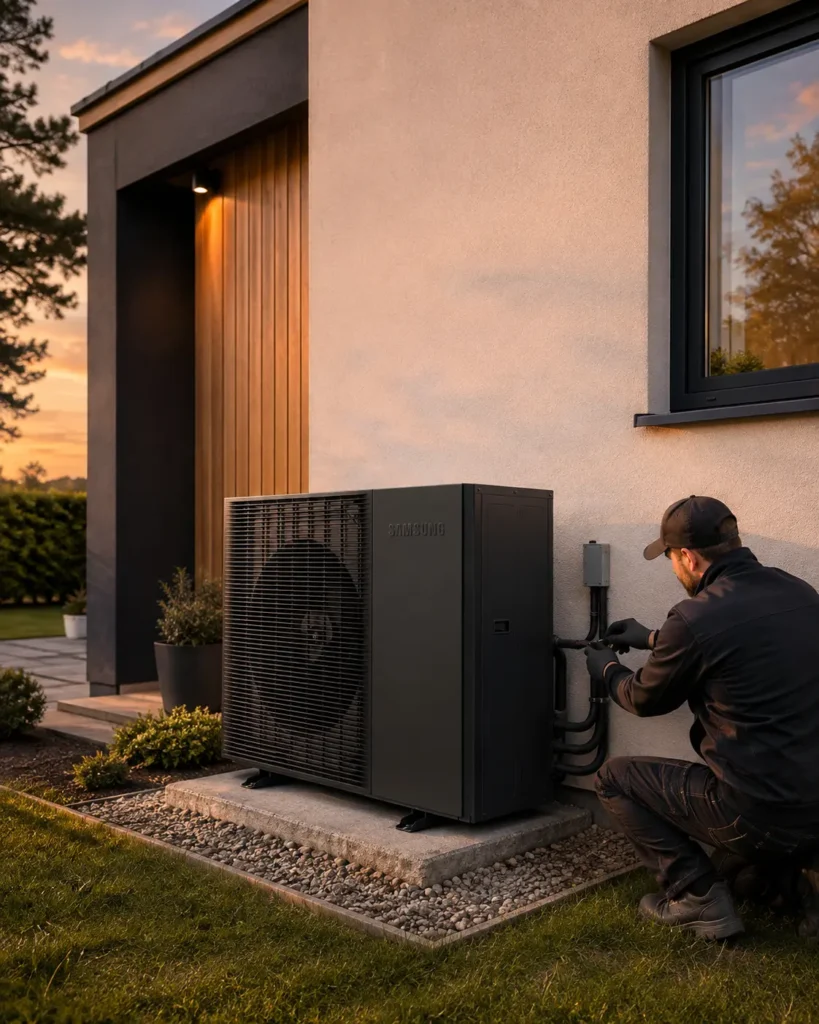
Step 2: Install the outdoor unit
The outdoor unit is normally fixed to a suitable base, wall brackets or another manufacturer-approved support.
It needs unrestricted airflow, access for servicing and a position that satisfies the relevant noise assessment. Boxing the unit in simply to hide it can restrict airflow and should not be done unless the arrangement is specifically approved.
Drainage also matters. Air source heat pumps produce condensate and can release additional water during defrost cycles in cold, damp weather. The installation should manage this safely rather than allowing water to collect or freeze across a walkway.
Energy Saving Trust notes that installers may need to construct a platform and, where necessary, provide suitable drainage or a soakaway.
Step 3: Fit the hot-water cylinder and indoor equipment
Most air-to-water systems replacing a combi boiler need stored hot water.
A suitable heat-pump cylinder therefore needs enough capacity for the household and an effective heat exchanger for the system’s operating temperatures. Energy Saving Trust advises that an existing cylinder may need replacement if it is unsuitable for the new heat pump.
Depending on the design, installers may also fit pumps, valves, expansion vessels, hydraulic modules or a buffer vessel.
A buffer vessel is not automatically necessary in every system. If one appears in the design, ask what hydraulic or control function it serves.
Step 4: Upgrade radiators and pipework where necessary
Radiators that cannot deliver enough heat at the chosen flow temperature may need replacing with larger or higher-output models.
Underfloor heating can also work well because it provides a large heat-emitting surface and can operate at relatively low water temperatures.
Pipework must carry the required water flow without creating excessive resistance. Existing microbore pipe does not automatically mean a heat pump is impossible. However, the installer must assess whether the existing network can provide the required flow. Energy Saving Trust specifically identifies small-diameter pipework as something that may require replacement in some homes.
Step 5: Complete the electrical work and controls
The heat pump needs a suitable electrical supply, protective devices and controls. The installer or electrician connects the system and completes the necessary DNO process.
Controls may include weather compensation. This adjusts heating-water temperature in response to outdoor conditions, allowing the system to run cooler when the weather is mild.
Correct setup matters. Unnecessarily high water temperatures can reduce heat-pump efficiency.
Step 6: Fill, flush, test and commission
Once everything is connected, the heating circuit should be filled, vented and checked for leaks.
Existing systems should be cleaned or flushed where required. MCS guidance also highlights correct pipe sizing, pressure testing, water treatment, venting, flow-rate checks and hydraulic balancing as important commissioning considerations.
Commissioning then confirms flow rates, radiator balance, sensor operation, hot-water settings, weather compensation and manufacturer parameters.
The system should be tested in both heating and hot-water modes. Commissioning is not simply switching the unit on: it is where the original design is translated into real operating settings.
Step 7: Handover and homeowner training
Before the installer leaves, you should understand how to set heating temperatures, schedules and hot water.
You should also know what normal defrost behaviour looks like, which settings should not be changed casually and who to contact if the house is not reaching temperature.
For an MCS-certified installation, GOV.UK says the installer should provide an MCS certificate and Heat Pump Handover Pack. Relevant Building Regulations documentation may also be required.
Keep these records with the property’s other important documents.
How Long Does an Air Source Heat Pump Installation Take?
Energy Saving Trust says the physical installation itself typically takes around three days.
More complex properties can take longer, particularly where numerous radiators, pipe runs or floors need alteration.
You can often remain at home while work takes place. However, heating and hot water may be unavailable for part of the installation.
If the work is taking place during cold weather, agree any temporary-heating arrangements before the start date.
How Much Does Air Source Heat Pump Installation Cost?
Energy Saving Trust’s latest air source heat pump guidance gives a typical installation cost of around £12,000 before financial support, although actual quotations can vary significantly by property.
Major variables include heat-pump capacity, radiator changes, cylinder work, pipework, electrical upgrades, access, drainage, removal of the existing heating system and making good.
This is why a cheap headline figure is not always a cheap installation. Check our guide to the hidden costs of heat pump installation when comparing quotations.
In England and Wales, the Boiler Upgrade Scheme currently provides £7,500 towards an eligible air-to-water heat pump. Qualifying properties without mains gas that replace oil or LPG can currently receive £9,000 until 31 March 2027.
The installer normally manages the BUS application, with the grant reflected as an upfront reduction in the customer’s cost.
Treat online prices as indications rather than quotations. A complete survey and heating-system design are needed before relying on a final figure.
What Should a Good Installation Deliver?
At the end of the project, the system should be capable of heating every room to its design temperature without relying on unnecessarily high flow temperatures.
Hot water should suit normal household demand, controls should be understandable, and the outdoor unit should have appropriate airflow, drainage, access and siting.
You should also receive relevant design information, commissioning settings, operating instructions, warranties, installer contact details and certificates.
Those records are useful long after installation day. If comfort or electricity consumption later looks wrong, the original heat-loss figures, design temperature and commissioning settings give an engineer something concrete to investigate.
Get Your Free Air Source Heat Pump Quote
Find the right air source heat pump solution for your home. Tell us a few details and our team will help you explore suitable options at a competitive price.
Quick to complete. No obligation.
Get your quote
Enter your details below and one of our team will get back to you.
Frequently asked questions
Find clear answers to common questions comparing air source and ground source heat pumps, including efficiency, installation and running costs, winter performance, noise, land requirements and borehole depth.
A sensible 2026 planning range is around £8,000 to £12,500 before grants. However, straightforward smaller installations can cost less.
If the installation costs £8,000 to £12,500, an eligible homeowner could pay roughly £500 to £5,000 after the standard £7,500 BUS grant.
Potentially. Some companies offer qualifying smaller properties installations with a £0 customer contribution after BUS. However, this is an installer-specific offer rather than an automatic government entitlement.
Yes. The standard grant for an eligible air-to-water heat pump in England and Wales is currently £7,500.
Some qualifying off-gas-grid homes replacing oil or LPG can receive additional BUS support under current rules. Therefore, check the latest GOV.UK eligibility guidance before getting quotes.
Many smaller homes may need around 4kW to 7kW. However, the correct size must come from a heat-loss calculation rather than the number of bedrooms.
Not always. Some existing radiators may already be large enough. However, others may need replacing so they can provide enough heat at lower water temperatures.
If you are replacing a combi boiler with an air-to-water heat pump, you will normally need stored hot water. Therefore, check whether a suitable cylinder is included in the quote.
Not automatically. The answer depends on electricity prices, gas prices, heat demand and heat-pump efficiency. As a result, ask for a property-specific running-cost estimate.
It can be. A heat pump can provide several units of heat for every unit of electricity used. Therefore, it can use much less electricity than direct resistance heating.
There is no fixed payback period. Instead, compare the extra amount you pay for the heat pump with the heating system you would otherwise choose and divide that by your expected annual savings.
No. However, reducing heat loss can allow the system to run more efficiently and may reduce the heat-pump output required.
Yes. Air source heat pumps operate during cold UK weather. However, efficiency changes as outdoor temperatures fall.
Modern units are designed for residential use. Even so, outdoor-unit position matters, which is why installers should assess noise and siting as part of the design.
Eligible landlords can use BUS for qualifying properties. However, the property and proposed installation still need to meet scheme requirements.
Normally, no. The installer applies for the voucher on behalf of the property owner and deducts the grant from the amount charged.
Not automatically. Instead, compare what each quote includes, the heat-loss calculation, radiator changes, estimated electricity use, warranties and the final amount you pay after BUS.
Yes. Solar PV can normally be added separately. In addition, using your own solar electricity can reduce the amount of electricity you need to buy from the grid.
Conclusion:
Successful air source heat pump installation is mainly a design and commissioning job supported by good physical installation.
The outdoor unit matters, but so do room-by-room heat loss, radiator outputs, water flow, cylinder sizing, electrical capacity and controls.
Before accepting a quote, understand exactly what will be changed and why. Compare complete heating designs, not just heat-pump brands or headline prices.
When the survey, specification and commissioning are right, the system has a much better chance of delivering steady comfort and efficient operation from its first winter.


