
Can You Install a Heat Pump in a Terraced House? UK Guide
Check Your Eligibility for Boiler Upgrade Scheme (BUS)
Complete your details below to check your eligibility.
Thank you
We've received your details and will be in touch shortly.

Quick answer: can you put a heat pump in a terraced house?
Yes. A terraced house can use an air-to-water heat pump for central heating and hot water if the system is designed for the property. The installer should calculate heat loss, check radiator outputs, find a suitable outdoor position and assess noise at neighbouring windows and doors. Most air-to-water systems also need a hot-water cylinder.
In England, changes introduced in May 2025 removed the old rule requiring an air source heat pump to be at least one metre from the property boundary. Wales updated its permitted-development rules on 1 June 2026. Planning rules still vary across the UK, and MCS sound requirements remain important in closely spaced homes.
Can an Air Source Heat Pump Be Installed in a Terraced House?
Yes. An air source heat pump can be installed in many terraced houses, including older Victorian and Edwardian homes. Being mid-terrace or end-terrace does not make a property unsuitable.
The key questions are more practical: is there a suitable position for the outdoor unit, can neighbour-noise limits be met, can the system cover the home’s calculated heat loss, and is there space for the hot-water cylinder and pipework?
Terraces can be tighter to design around because gardens, access routes and cupboards are often smaller. However, recent planning changes in England and Wales have removed some barriers that previously made installations harder.
For the underlying technology, see our guide to how air source heat pumps work.
Get a free quote: A heat-loss and site survey can confirm whether a heat pump is practical before you commit to equipment or building work.
How does an air source heat pump actually heat a terraced house?
The process is the same as in any other home. The outdoor evaporator absorbs heat from the air into refrigerant. A compressor raises the refrigerant’s pressure and temperature before a condenser transfers that heat into the water circulating through your radiators or underfloor heating.
The refrigerant then passes through an expansion valve, cools and repeats the refrigeration cycle. In winter, the outdoor coil may occasionally need an automatic defrost cycle.
What changes in a terraced house is not the heat-pump mechanism. It is how the system is sized, positioned and integrated into the available space.
Terraced-house heat pump feasibility at a glance
| Check | Usually workable? | What needs assessing |
|---|---|---|
| Outdoor space | Often | Airflow, service access and drainage |
| Neighbour noise | Often, but critical | MCS 020(a) sound calculation |
| Heating demand | Yes, if correctly designed | Room-by-room heat loss and winter output |
| Existing radiators | Sometimes | Output at the proposed flow temperature |
| Hot-water storage | Usually | Cylinder size and location |
| Planning | Often permitted development | Nation, property status and siting |
Why a terraced house can suit a heat pump
A mid-terrace has party walls on both sides, so it often has fewer exposed external walls than a similar detached property. That can reduce heat loss. An end-terrace has one extra exposed wall, so demand may be higher.
Age and construction matter more than the word “terraced”. A modern insulated home may have a modest heating load. A draughty Victorian terrace with solid walls, suspended floors and older windows can lose far more heat.
That does not automatically mean full solid-wall insulation is required. Start with a room-by-room heat-loss calculation. Fabric improvements can reduce heat demand and may allow smaller radiators, lower flow temperatures or a smaller heat pump.
Research commissioned by the MCS Foundation into common Plymouth property types found that an air source heat pump could be installed in every property assessed, including Victorian and other terrace archetypes. Outdoor-unit siting and finding space for hot-water storage were among the most significant challenges. Read the MCS Foundation property-archetype research
1. Where can the outdoor unit go?
This is often the first terrace-specific test.
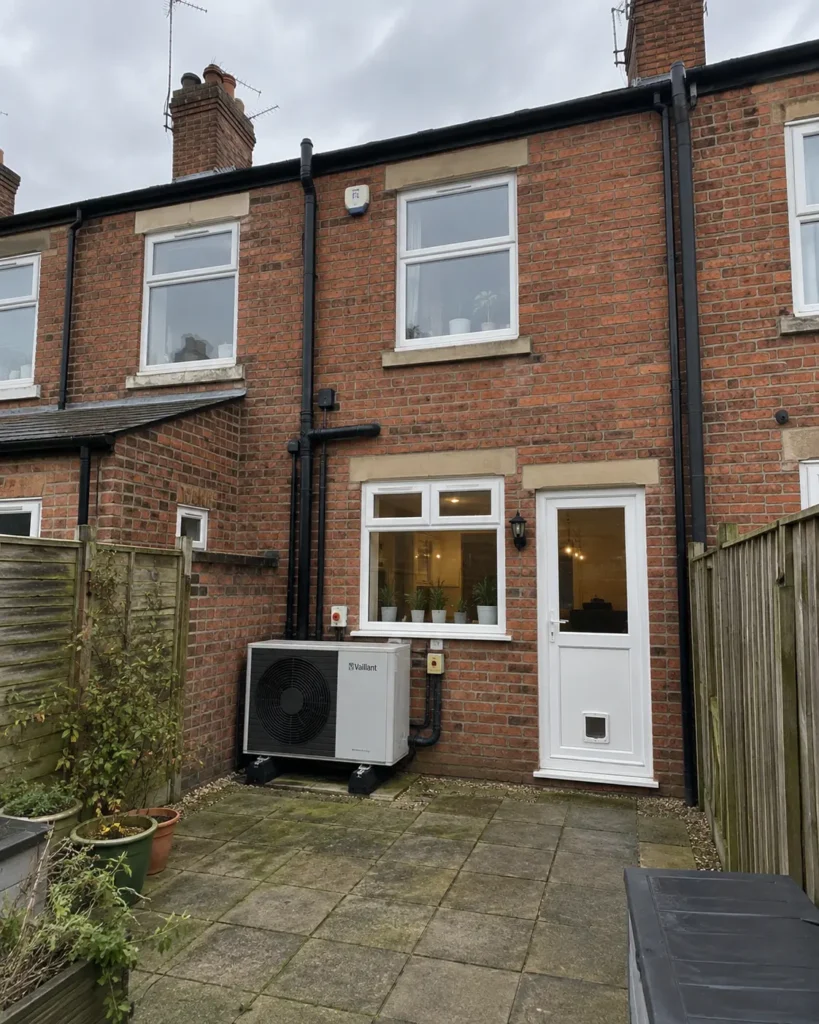
The unit needs free airflow, service access and a practical route for heating pipes and electrical connections. Common positions include a rear garden, rear wall area, side return on an end-terrace, or farther down the garden where the pipe run remains sensible.
Avoid treating the nearest empty corner as the automatic choice. Walls and fences can affect airflow and reflect sound. The unit also produces water during defrost, so condensate drainage needs planning.
For the wider process, see our air source heat pump installation guide.
What if there is no rear access?
No side passage does not automatically stop an installation. Equipment may sometimes be brought through the house if dimensions, weight and safe access allow.
That can make the job more disruptive, so it should be identified at survey stage rather than discovered on installation day.
2. Will the heat pump be too noisy for neighbours?
This is especially important in a terrace because neighbouring bedroom and living-room windows may be close.
For permitted-development installations, the current MCS 020(a) sound standard sets out the acoustic calculation. It uses a permitted-development limit of 37 dB LAeq,5min at relevant assessment positions, ignoring the effect of the façade.
The calculation considers the heat pump’s sound power, distance, barriers and reflective surfaces. One garden position may therefore fail while another position at the same property passes.
Ask the installer to show you the completed MCS noise calculation rather than simply saying the unit is “quiet”. The site layout matters as much as the manufacturer’s headline sound figure.
3. Do you need planning permission?
Often not, but the answer depends on where you live and the property itself.
England
Permitted-development rules changed on 29 May 2025. The previous one-metre boundary restriction was removed, while the maximum outdoor compressor volume for a house increased from 0.6 to 1.5 cubic metres.
Terraced and semi-detached homes remain limited to one air source heat pump under the permitted-development right. Detached homes can have up to two.
The other Class G conditions still apply, including the relevant MCS planning requirements. Read the 2025 legislation covering the changes
Wales
Wales updated domestic heat-pump permitted-development rights on 1 June 2026. A non-detached property can generally have one air source heat pump under those rights, provided the installation complies with MCS 020(a) and the remaining conditions. Check the current Welsh Government heat-pump planning guidance
Scotland and Northern Ireland have separate planning frameworks. Listed buildings, conservation areas, Article 4 directions and unusual siting can also change the position.
Therefore, confirm the final position with your local planning authority before relying on permitted development.
4. Will your existing radiators work?
Possibly. A heat pump does not automatically require every radiator to be replaced.
Air-to-water heat pumps are generally more efficient at lower heating-water temperatures than conventional boilers. Each room therefore needs enough radiator output to replace its heat loss at the proposed flow temperature.
A proper design should compare each room’s heat loss with the output of its existing radiator. Some can stay; others may need larger or higher-output models.
Energy Saving Trust guidance explains that heat-pump efficiency improves as the required flow temperature falls. Weather compensation can also lower the flow temperature when outdoor conditions become milder. See Energy Saving Trust guidance on efficient heat-pump operation
For more detail on electricity use and tariffs, see our air source heat pump running-costs guide.
5. Where will the hot-water cylinder go?
This is a common issue in smaller terraces, particularly when replacing a combi boiler.
Most air-to-water heat pumps store domestic hot water, so a suitable cylinder is normally required. Possible locations can include an airing cupboard, utility space, technically suitable loft or eaves area, a fitted cupboard, or part of a redesigned kitchen or bathroom.
The installer needs to consider cylinder dimensions, access, structural loading, pipe routes and the household’s hot-water demand.
A cylinder that physically fits is not necessarily large enough for the people living in the house. A family taking several showers in quick succession may need more stored water than a one-person household.
How much does a heat pump cost for a terraced house?
There is no fixed “terraced house price”.
Energy Saving Trust currently gives an indicative typical air source heat pump installation cost of around £12,000. Property size, heat-pump capacity and alterations to the existing heating system can move the final figure substantially. See current Energy Saving Trust heat-pump cost guidance
For a terrace, radiator changes, cylinder installation, difficult access, longer pipe runs, electrical work and planning or acoustic requirements can all affect the quotation.
In England and Wales, the Boiler Upgrade Scheme currently provides £7,500 towards an eligible air-to-water heat pump. Eligible off-gas-grid properties replacing oil or LPG can receive £9,000 between 21 July 2026 and 31 March 2027. Ofgem’s current Boiler Upgrade Scheme guidance
See our Boiler Upgrade Scheme 2026 updates for the current eligibility details.
These are indicative costs and grant amounts, not quotations. A property survey is needed for accurate pricing.
Will it be cheaper to run?
It can be, but being terraced does not determine the answer.
Running cost depends mainly on annual heat demand, seasonal heat-pump efficiency, flow temperature, electricity tariff, controls and the heating system being replaced.
Energy Saving Trust says heat pumps using standard electricity tariffs can sometimes cost around the same as, or more than, an efficient modern gas boiler. However, dedicated heat-pump time-of-use tariffs can materially improve running costs.
A lower-heat-loss mid-terrace can be a favourable starting point because the heating system has less energy to replace. Poor design, however, can still make any heat pump expensive to run.
How to decide whether your terraced house is suitable
Before accepting a quote, make sure the survey confirms:
- The room-by-room design heat loss and required heat-pump output.
- The exact outdoor-unit position and MCS 020(a) sound result.
- Which radiators can remain and the proposed flow temperature.
- The hot-water cylinder location and capacity.
- Pipework and electrical requirements.
- Whether the installation qualifies as permitted development.
- The complete price after grants and enabling work.
If these points are not clear, the quotation is not detailed enough to judge confidently.
Get Your Free Air Source Heat Pump Quote
Find the right air source heat pump solution for your home. Tell us a few details and our team will help you explore suitable options at a competitive price.
Quick to complete. No obligation.
Get your quote
Enter your details below and one of our team will get back to you.
Frequently asked questions
Find clear answers to common questions about installing air source heat pumps in terraced and Victorian homes, including planning, noise, small gardens, access, radiators, cylinders, grants, winter performance and running costs.
Yes. Mid-terraced houses can use air source heat pumps. Outdoor siting, neighbour noise, heat loss, radiator capacity and cylinder space should all be assessed first.
Yes. A Victorian terrace is not automatically unsuitable. Solid walls, draughts and suspended floors can increase heat loss, so the system must be sized from a proper heat-loss calculation.
Not always. Many installations qualify as permitted development, but the rules differ between England, Wales, Scotland and Northern Ireland and can be affected by listed status, conservation areas and local restrictions.
The previous one-metre boundary restriction for permitted-development air source heat pumps in England was removed on 29 May 2025. Other siting and noise requirements still apply.
For installations relying on permitted-development rights under MCS 020(a), the sound calculation uses a 37 dB LAeq,5min limit at relevant assessment positions, ignoring the façade effect.
Potentially, but planning, appearance and noise requirements can make front positions more complicated. The exact answer depends on the relevant planning framework and the property.
It can be. What matters is whether the selected unit has adequate airflow, service clearance, drainage and an acoustically acceptable position.
That does not automatically prevent installation. The installer may be able to bring equipment through the house if access dimensions and safe handling allow.
Usually, yes, for a conventional air-to-water heat-pump system. The cylinder stores domestic hot water for showers, baths and taps.
Yes, a correctly designed air-to-water system can provide both space heating and domestic hot water. It normally stores hot water rather than producing it instantly like a combi.
Not necessarily. Each existing radiator should be checked against the room’s heat loss at the proposed heat-pump flow temperature. Some may be suitable without replacement.
No universal insulation standard makes a house “heat-pump ready”. However, reducing avoidable heat loss can lower the required system output and improve efficiency.
Yes. Suitable air source heat pumps continue operating below freezing. Efficiency usually decreases as outdoor temperatures fall, and occasional defrost cycles are normal.
There is no terrace-specific fixed price. Energy Saving Trust currently gives an indicative typical air source heat pump installation cost of around £12,000 before available support.
Eligible properties in England and Wales can currently receive £7,500 towards an air-to-water heat pump. Certain qualifying off-gas-grid oil or LPG replacements can currently receive £9,000 until 31 March 2027.
Not automatically. The comparison depends on heat demand, seasonal efficiency, electricity tariffs and system design. Dedicated heat-pump tariffs can improve the economics significantly.
Conclusion: can a heat pump work in your terrace?
Yes. A heat pump can work well in a terraced house when the design fits the building.
The main terrace-specific constraints are usually outdoor siting, neighbour noise, hot-water cylinder space and pipe routes. Heat loss and radiator sizing then determine how efficiently the system can heat the home.
Planning changes have made installation easier for many tightly spaced properties in England and Wales, but noise compliance and local restrictions still need checking.
Compare a properly surveyed design rather than choosing from an online headline price. Get a free, no-obligation quote through GetFreeQuote.co.uk to find out what is practical for your property.


