
Air Source Heat Pump Planning Permission: UK Rules 2026
Check Your Eligibility for Boiler Upgrade Scheme (BUS)
Complete your details below to check your eligibility.
Thank you
We've received your details and will be in touch shortly.

Quick Answer: Do You Need Planning Permission for an Air Source Heat Pump?
Usually not. Domestic air source heat pumps can often be installed under permitted development rights, meaning you do not need to submit a normal planning application.
However, permitted-development conditions must still be satisfied.
In England and Wales, current rules allow qualifying heat pumps up to 1.5 cubic metres at houses and have removed the old minimum boundary-distance requirements. Installations must satisfy the relevant MCS sound standard. Scotland and Northern Ireland use different rules, while listed buildings and some sensitive locations face additional restrictions.
When in doubt, check the proposal with your local planning authority before installation.
Do You Need Planning Permission for an Air Source Heat Pump?
In most cases, you do not need to make a planning application for an air source heat pump at a UK home. However, the exact rules depend on whether your property is in England, Wales, Scotland or Northern Ireland.
England relaxed its rules significantly in May 2025. Wales followed with new permitted-development rules on 1 June 2026. Scotland and Northern Ireland have their own requirements.
Your heat pump’s position also matters. Noise, the number of outdoor units, listed-building status, roof mounting and where the unit sits in relation to a road can determine whether an installation qualifies as permitted development.
This guide explains the current air source heat pump planning permission rules, when you may need to apply and what to check before installation.
If you are still deciding whether a heat pump suits your property, our guide explaining how air source heat pumps work covers the heating system itself in more detail.
Considering a heat pump? You can compare suitable home-improvement quotes through Getfreequote.co.uk once you know where the outdoor unit can legally be installed.
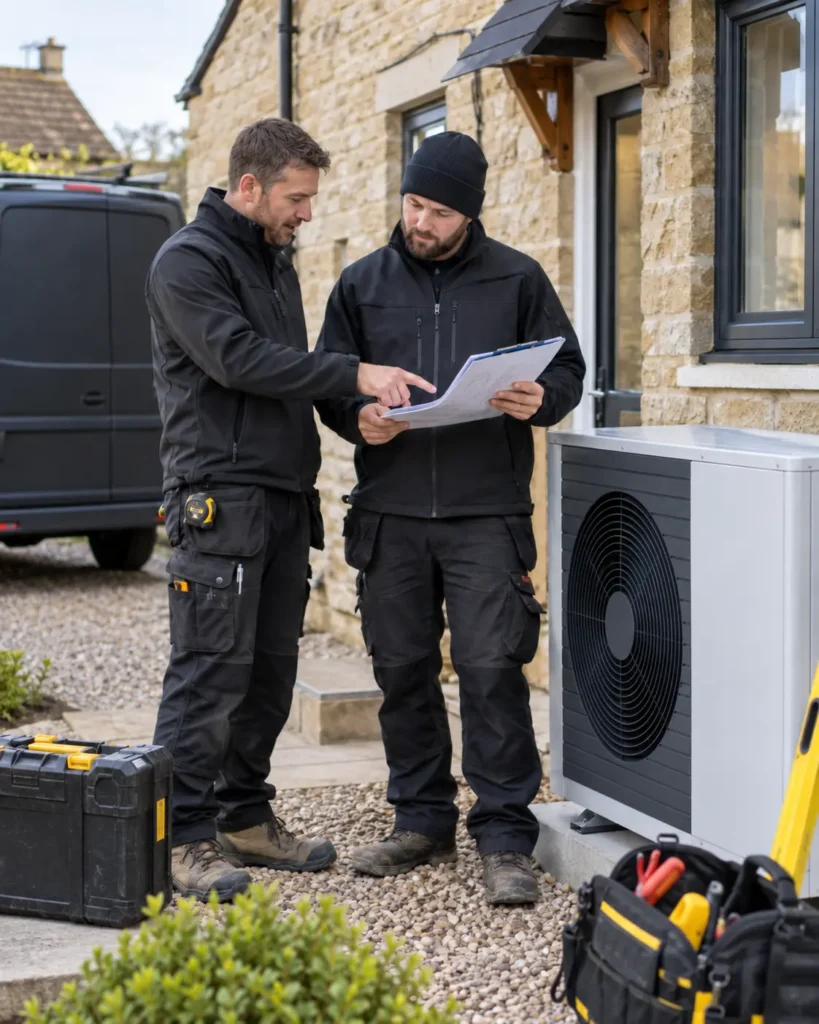
Air Source Heat Pump Planning Rules Across the UK
The biggest mistake is assuming one set of planning rules applies throughout Britain and Northern Ireland.
| Nation | Normal position for domestic ASHPs | Important current rule |
|---|---|---|
| England | Usually permitted development | House units up to 1.5m³; old 1m boundary restriction removed |
| Wales | Usually permitted development | Rules updated 1 June 2026; up to 1.5m³ and old 3m boundary restriction removed |
| Scotland | Usually permitted development if Class 6H conditions are met | Generally one ASHP per building; separate location restrictions apply |
| Northern Ireland | Usually permitted development if conditions are met | Unit generally must remain at least 1m from the boundary of another dwellinghouse |
Sources: Planning Portal, GOV.WALES, Scottish Government and Northern Ireland Department for Infrastructure.
What Does Permitted Development Mean?
Permitted development is effectively planning permission already granted through national legislation for specified types of development.
If your installation meets every relevant limitation and condition, you normally do not need to submit a full planning application.
That does not mean you can put the heat pump anywhere you choose. Permitted-development rights place controls on issues such as noise, position, number of units and sensitive buildings.
Rights can also sometimes be restricted by a planning condition, an Article 4 Direction or another local constraint. Planning Portal therefore recommends contacting the local planning authority where there is uncertainty.
Air Source Heat Pump Planning Permission in England
England’s rules became considerably more flexible on 29 May 2025.
The change removed the previous rule preventing an air source heat pump from being installed within one metre of the property’s boundary. It also increased the permitted outdoor-unit volume for houses from 0.6m³ to 1.5m³.
A qualifying installation can now include:
- one air source heat pump at a non-detached house;
- one unit at a qualifying block of flats;
- up to two units at a detached house;
- an outdoor unit of up to 1.5m³ at a house; and
- a system providing heating and cooling, provided it is not used solely for cooling.
Blocks of flats retain a 0.6m³ outdoor-unit volume limit.
Can an Air Source Heat Pump Be Installed Next to a Boundary?
In England, there is no longer a blanket rule requiring the unit to remain one metre from your property’s boundary.
This is particularly useful for terraces, semi-detached homes and properties with narrow side passages.
However, removing the boundary restriction did not remove the noise requirement.
A unit immediately beside a boundary may still fail permitted-development rules if its predicted sound at a relevant neighbouring assessment position is too high.
What Are the Other England Restrictions?
An installation will not automatically qualify simply because its size and noise levels comply.
For example, Planning Portal states that permitted development does not cover heat pumps on pitched roofs. A unit on a flat roof must be at least one metre from the roof’s external edge.
Additional restrictions affect listed buildings, scheduled monuments, conservation areas, World Heritage Sites and some installations facing a highway.
The outdoor unit must also be positioned, as far as practical, to reduce its effect on the building’s appearance and the amenity of the surrounding area.
The MCS Noise Requirement Matters
Noise is one of the most important parts of air source heat pump planning permission.
In England, a permitted-development installation must comply with the applicable MCS 020a Air Source Heat Pump Sound Calculation standard. Wales also now requires compliance with MCS 020(a).
MCS 020a uses factors including:
- the manufacturer’s sound-power figure;
- distance to relevant neighbouring positions;
- walls and other reflective surfaces;
- acoustic barriers; and
- the number of heat pumps.
Under the current standard, the calculated sound pressure at every relevant assessment position must be 37.0 dB(A) or lower for the installation to satisfy the permitted-development noise limit.
This is why simply measuring the distance between the heat pump and the neighbour’s fence does not tell you whether an installation complies.
A quieter model in a carefully chosen location may pass where another unit in the same garden does not.
For a wider look at the physical work involved, see our air source heat pump installation guide.
What Are the Planning Rules in Wales?
Wales changed its permitted-development rights on 1 June 2026.
The new rules brought several requirements closer to those used in England.
For qualifying domestic installations:
- detached homes can have up to two air source heat pumps;
- other homes can have one;
- the outdoor compressor unit can be up to 1.5m³;
- the previous three-metre boundary restriction has gone;
- installations must comply with MCS 020(a);
- pitched-roof installation is not permitted development; and
- a flat-roof unit must remain at least one metre from the roof edge.
Air source heat pumps providing both heating and cooling can also qualify. A unit intended solely for cooling cannot.
Listed buildings and particular locations in conservation areas remain subject to tighter controls.
What Are the Rules in Scotland?
Scotland has separate Class 6H permitted-development rules.
At present, the rules generally allow one air source heat pump on a building or within its curtilage.
If attached to the dwelling, the heat pump must not protrude more than one metre from the outer wall, roof plane, roof ridge or chimney. A free-standing installation within the curtilage must not normally sit forward of a principal or road-facing side elevation and must not exceed three metres in height.
There are additional restrictions for conservation areas, World Heritage Sites and the curtilage of listed buildings.
The Scottish Government considered further relaxation of ASHP permitted-development rights during its 2025 consultation but confirmed in March 2026 that it would not make those proposed changes at that time.
What Are the Rules in Northern Ireland?
Northern Ireland introduced more flexible domestic heat-pump permitted-development rights in July 2023.
Generally, only one air source heat pump is permitted within the curtilage.
Unlike England and Wales, an outdoor unit cannot qualify under these rights if any part of it sits within one metre of the boundary of another dwellinghouse.
Other restrictions include:
- no roof installation;
- a maximum external-unit height of three metres;
- controls on installations facing roads;
- additional rules for conservation areas and World Heritage Sites; and
- MCS planning-standard compliance.
When Will You Need Planning Permission?
You are more likely to need a planning application where the proposed installation fails one or more permitted-development conditions.
Common examples include:
| Situation | Likely next step |
|---|---|
| Noise calculation fails the permitted-development standard | Reposition/change unit or consider planning application |
| More heat pumps than permitted | Planning permission may be required |
| Unit exceeds the relevant size or height limit | Planning permission may be required |
| Restricted roof position | Change position or apply |
| Listed building or protected setting | Ask the local planning authority; separate consent may also apply |
| Permitted-development rights have been removed locally | Seek planning advice |
| Proposed commercial/non-domestic ASHP | Check separately; domestic rights should not be assumed |
For example, Planning Portal states that air source heat pumps on non-domestic land in England are likely to require a planning application.
What About Listed Buildings and Conservation Areas?
Do not assume permitted-development rights apply normally to a listed property.
Listed buildings and their curtilage face much stricter planning controls. Depending on the location and proposed work, you may also require listed building consent, which is separate from ordinary planning permission.
Conservation areas do not necessarily prevent a heat pump installation, but restrictions may apply to highly visible positions, particularly those facing a highway.
Contact the local planning authority before committing to an outdoor position where heritage restrictions may apply.
What About Flats and Leasehold Properties?
Planning permission is only one issue.
A leaseholder may also need permission from a freeholder, landlord or management company, even where planning legislation treats the heat pump as permitted development.
Flats can also be more complicated because of shared walls, common land, available outdoor space and neighbouring windows.
In England, blocks consisting wholly of flats can benefit from the domestic ASHP permitted-development right, but different limits apply — including the 0.6m³ outdoor-unit volume limit.
How to Check Your Heat Pump Before Installation
Before agreeing the outdoor-unit position:
- Confirm which nation’s rules apply. Do not use an England checklist for a property in Scotland or Northern Ireland.
- Check the property’s planning status. Identify listed-building, conservation-area or other restrictions.
- Check the proposed unit. Confirm its dimensions, number and intended position.
- Get the required sound assessment. Do not rely only on a manufacturer’s headline decibel figure.
- Keep the documentation. Retain the site plan, specifications, sound calculation and relevant installer records.
If you are also comparing installation economics, the 2026 Boiler Upgrade Scheme guide explains current grant support in England and Wales.
Should You Get a Lawful Development Certificate?
In England, you can apply for a Lawful Development Certificate (LDC) if you want formal confirmation that a proposed development is lawful.
It is not the same as planning permission and is not compulsory simply because your heat pump qualifies as permitted development.
However, it can provide useful evidence where the planning position is unclear or where you want documentary confirmation for the property records. GOV.UK confirms that an LDC can establish whether proposed operations would be lawful for planning purposes.
Get Your Free Air Source Heat Pump Quote
Find the right air source heat pump solution for your home. Tell us a few details and our team will help you explore suitable options at a competitive price.
Quick to complete. No obligation.
Get your quote
Enter your details below and one of our team will get back to you.
Frequently asked questions
Find clear answers to common questions about air source heat pump planning permission, permitted-development rules, boundaries, noise limits, roof installations, conservation areas, listed buildings and commercial properties across the UK.
Usually not for a domestic property, provided the installation meets the relevant permitted-development conditions. The rules differ across England, Wales, Scotland and Northern Ireland.
In England and Wales, there is no longer a blanket minimum boundary-distance rule for qualifying domestic ASHP installations. Noise and other conditions still apply. Northern Ireland retains a one-metre restriction in relation to the boundary of another dwellinghouse.
Not for property boundaries. England removed the old one-metre boundary restriction on 29 May 2025. A separate one-metre rule still applies when an ASHP is installed on a flat roof: it must remain at least one metre from the external roof edge.
No. Wales updated its permitted-development rights on 1 June 2026, removing the previous three-metre boundary requirement.
There is no universal UK distance. The relevant planning rules and MCS sound assessment determine whether a proposed location qualifies.
MCS 020a uses a permitted-development noise limit of 37.0 dB(A) at the relevant assessment positions. Other conditions must also be met.
No. Noise is only one condition. Unit size, number, position, roof installation and heritage restrictions may also matter.
England and Wales allow up to two qualifying ASHPs at a detached home. Different rules apply to other properties. Scotland generally permits one per building under its current Class 6H right.
In England and Wales, systems capable of both heating and cooling can qualify for permitted development if all other requirements are met. Cooling-only equipment does not qualify under those ASHP rights.
Rules vary. In England and Wales, installing one on a pitched roof does not qualify under the standard domestic ASHP permitted-development right. Flat-roof installations face specific siting restrictions.
Not automatically. Permitted development may still be possible, but stricter siting restrictions apply. Check the rules for your UK nation and your local planning authority.
Do not assume normal permitted-development rights apply. Listed buildings and their curtilage face additional restrictions, and listed building consent may also be required.
No. Grant eligibility and planning compliance are separate matters. Receiving or qualifying for financial support does not override planning law.
Potentially. Domestic permitted-development rules should not be applied to commercial premises. For example, Planning Portal advises that ASHP installations on non-domestic land in England are likely to require planning permission.
In England, you can apply to the local planning authority for a Lawful Development Certificate for a proposed development. It provides formal confirmation of its planning lawfulness.
Conclusion:
Most domestic air source heat pumps do not need a full planning application, but there is no single UK-wide rule.
England and Wales now have relatively flexible permitted-development rights, including no blanket minimum distance from the property boundary. Scotland retains different Class 6H restrictions, while Northern Ireland normally requires at least one metre between the heat pump and the boundary of another dwellinghouse.
Noise remains particularly important. A location that physically fits may still fail the relevant MCS sound assessment.
Check the exact outdoor position before committing to an installation, particularly for flats, listed buildings, conservation areas or properties with limited outdoor space.
Once the planning position is clear, consider the complete financial and practical case. Our guide to whether air source heat pumps are worth it covers those wider considerations.


