A+++ Air Conditioning UK: Ratings, Costs & Best Units
Check Your Eligibility for Boiler Upgrade Scheme (BUS)
Complete your details below to check your eligibility.
Thank you
We've received your details and will be in touch shortly.
Quick Answer: What Does A+++ Air Conditioning Mean?
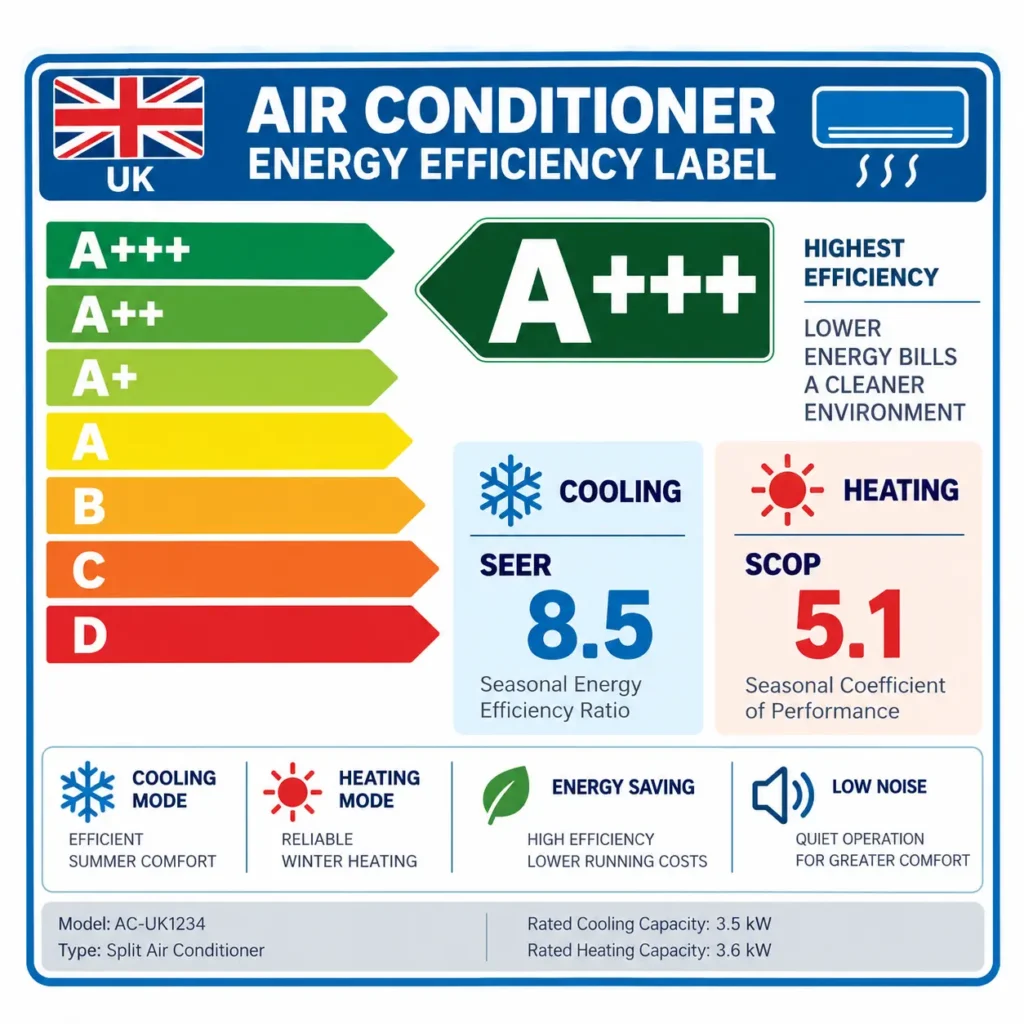
For conventional split air conditioners, an A+++ cooling rating requires a SEER of at least 8.50. An A+++ heating rating requires a SCOP of at least 5.10 under the applicable seasonal test method.
That makes A+++ the highest class on the current Great Britain A+++–D air-conditioner label. However, always compare the actual SEER, SCOP and annual energy-consumption figures as well as the letter rating. An A++ unit with a SEER of 8.4, for example, is only marginally below an A+++ unit at 8.5.
Also check cooling and heating separately. A system may be A+++ in one mode without being A+++ in the other.
Already comparing systems? Compare free home-improvement quotes through Get Free Quote and ask for the exact indoor/outdoor model combination, SEER, SCOP and full installed price.
A+++ Air Conditioning UK: Energy Ratings, Running Costs & What to Buy
If you are comparing efficient air conditioning for a UK home, A+++ is the highest energy-efficiency class currently shown for this type of air conditioner on Great Britain’s A+++–D energy-label scale.
However, the badge alone does not tell you everything.
A unit can achieve A+++ for cooling but only A++ for heating. Two A+++ systems can also have noticeably different seasonal efficiency figures. Even different capacities within the same product range can receive different ratings.
This guide explains what A+++ air conditioning in the UK actually means, how SEER and SCOP affect electricity use, whether paying more for A+++ is worthwhile, and what to compare before choosing a system.
For a wider introduction to system types, costs and heating options, see the Get Free Quote guide to air con in the UK.
What Does A+++ Mean on an Air-Conditioning Energy Label?
For split air conditioners, the energy class comes from seasonal efficiency, rather than simply measuring performance at one fixed operating point.
The two figures to understand are:
SEER – Seasonal Energy Efficiency Ratio: used for cooling.
SCOP – Seasonal Coefficient of Performance: used for heating under average-climate test conditions.
The applicable efficiency thresholds for conventional air conditioners are: UK air-conditioner efficiency-class thresholds
| Energy class | Cooling: SEER | Heating: SCOP |
|---|---|---|
| A+++ | 8.50 or higher | 5.10 or higher |
| A++ | 6.10–8.49 | 4.60–5.09 |
| A+ | 5.60–6.09 | 4.00–4.59 |
| A | 5.10–5.59 | 3.40–3.99 |
This immediately reveals one limitation of shopping by letter grade.
A cooling system with a SEER of 8.49 sits in A++, while one at 8.50 reaches A+++. Their real energy use should be extremely similar.
By contrast, another A++ system at SEER 6.10 would use considerably more electricity for the same seasonal cooling demand.
The government’s current air-conditioner label specification also includes the model, design load, SEER, annual cooling consumption, heating class, SCOP and sound information. See the GOV.UK air-conditioner energy-label specification
Do portable air conditioners use the same A+++ scale?
Do not compare the letters blindly.
Single-duct and double-duct air conditioners have a separate efficiency table based on rated EER and COP rather than the same SEER/SCOP thresholds used for conventional split systems. Therefore, an A+++ portable product and an A+++ split system are not automatically equivalent in seasonal efficiency.
How Much Electricity Can A+++ Air Conditioning Save?
SEER provides a useful way to understand the difference.
Imagine two systems each delivering 1,000kWh of useful seasonal cooling.
At the minimum A+++ threshold of SEER 8.5:
1,000 ÷ 8.5 = approximately 118kWh of electricity
At the bottom of A++, with SEER 6.1:
1,000 ÷ 6.1 = approximately 164kWh
That is roughly 28% less electricity for the A+++ threshold system for the same theoretical cooling output.
Using Ofgem’s average Direct Debit electricity rate of 26.32p/kWh for 1 October to 31 December 2026, those simplified figures equate to about £31 versus £43. Check Ofgem’s current electricity unit rates
This is an illustration, not a prediction of your bill. Actual consumption depends on weather, desired room temperature, hours of use, system sizing, insulation, glazing and your electricity tariff.
It also shows why the exact SEER matters more than the A+++ badge alone.
How Does A+++ Air Conditioning Achieve High Efficiency?
A split air conditioner does not generate “cold”. It moves heat.
In cooling mode, the evaporator inside the home absorbs heat from room air. Refrigerant carries that heat towards the outdoor unit.
The compressor raises the refrigerant pressure and temperature. The outdoor condenser can then release the collected heat into the outside air.
Next, the refrigerant passes through an expansion valve, which reduces its pressure and temperature before it returns to the evaporator. The refrigeration cycle then repeats.
Modern high-efficiency units normally use inverter-controlled compressors. Rather than repeatedly switching between full output and off, they can reduce compressor speed when the room approaches the target temperature. This helps improve part-load seasonal efficiency.
Reversible systems run the process in the opposite direction for heating. They extract heat from outside air and deliver it indoors, which is why many modern split air conditioners are also air-to-air heat pumps.
Unlike a typical air-to-water heat pump, they normally deliver warm air directly rather than heating radiators, underfloor heating or domestic hot water.
Examples of High-Efficiency Air Conditioning Available in the UK
A+++ products are available from several established manufacturers, but always check the exact capacity and indoor/outdoor combination rather than assuming an entire range has one rating.
| Example | Cooling efficiency | Heating efficiency | Useful point |
|---|---|---|---|
| Panasonic Etherea 2.5kW KIT-Z25-CKE | SEER 9.50, A+++ | SCOP 5.20, A+++ | 19dB(A) quiet indoor setting; 92kWh stated annual cooling consumption under the label methodology. |
| Daikin Perfera wall-mounted | Up to A+++ | Up to A+++ | Up to 7.1kW cooling capacity and sound pressure from 19dBA; rating depends on the selected combination. |
| Mitsubishi Electric MSZ-AY25VGK2 | SEER 8.70, A+++ | SCOP 4.80, A++ | Demonstrates why cooling and heating ratings must be checked separately; indoor sound pressure starts at 18dBA. |
Panasonic’s current Etherea specification is a good example of a system comfortably exceeding the minimum A+++ threshold. View the Panasonic Etherea specification Daikin likewise publishes Perfera systems reaching A+++ in cooling and heating on suitable combinations. View Daikin Perfera specifications
Mitsubishi Electric’s February 2026 technical data provides an equally useful lesson. The 2.5kW MSZ-AY25 has SEER 8.70 and SCOP 4.80, placing cooling in A+++ but heating in A++. Larger models within the range also have different SEER values. View Mitsubishi Electric’s MSZ-AY technical data
These examples are not a ranking. The best choice depends on the room, required capacity, installation design, noise limits and how much heating or cooling you expect to use.
Is A+++ Air Conditioning Worth Paying More For?
Often, but not automatically.
A+++ becomes particularly attractive where the system will operate for long periods. That may include a south-facing home office, loft conversion, heavily glazed living space or a system that will also provide significant winter heating.
Efficiency can also matter more across several rooms because the annual operating hours and total demand rise.
However, paying a large premium simply to move from SEER 8.4 to 8.5 would be difficult to justify on energy savings alone. In that situation, purchase price, noise, warranty, minimum output, controls and installation quality could matter more.
Likewise, someone who expects to cool one bedroom for a handful of exceptionally warm nights each year may never recover a substantial A+++ price premium through electricity savings.
The practical rule is simple: compare exact efficiency figures and lifetime use, not just the coloured arrow on the label.
How to Choose an A+++ Air Conditioner
First, make sure you are comparing the correct capacity.
An efficient 2.5kW unit is not a substitute for a correctly selected 3.5kW system if the room genuinely requires the larger output. Conversely, buying an oversized unit simply because it carries an A+++ badge does not guarantee better comfort or lower bills.
For capacity guidance, use the UK air-conditioning sizing guide. For rooms with significant glazing, solar gain, high ceilings or unusual internal loads, the more detailed air-conditioning heat-load calculation guide explains why floor area alone can be misleading.
Next, compare:
The exact indoor and outdoor model numbers.
Cooling SEER and energy class.
Heating SCOP and energy class.
Annual label energy consumption.
Minimum and maximum output.
Indoor and outdoor noise.
Heating performance at lower outdoor temperatures.
Controls, warranty and servicing requirements.
Total installed cost rather than equipment price alone.
Where equipment contains regulated F-gas, refrigerant work requires the appropriate qualifications. GOV.UK says qualified personnel are required for activities including installation, servicing, maintenance and refrigerant recovery. Check current GOV.UK F-gas qualification requirements
Does A+++ Air Conditioning Stay A+++ in Winter?
The energy class is based on a standardised seasonal calculation. It does not mean the system achieves exactly the same efficiency every hour of winter.
As outdoor temperatures fall, an air-to-air heat pump has to work across a greater temperature difference. Frost can also form on the outdoor heat exchanger in cold, damp weather.
The system may occasionally reverse its cycle to defrost the coil. During that period, heating output is temporarily interrupted and energy is used to restore normal operation.
That is why homeowners planning to use air conditioning as a meaningful source of winter heating should look beyond the cooling badge. Compare SCOP, heating capacity at low temperatures and the heating energy class.
Get Your Free Air Source Heat Pump Quote
Find the right air source heat pump solution for your home. Tell us a few details and our team will help you explore suitable options at a competitive price.
Quick to complete. No obligation.
Get your quote
Enter your details below and one of our team will get back to you.
Frequently asked questions
Find clear answers to common questions comparing air source and ground source heat pumps, including efficiency, installation and running costs, winter performance, noise, land requirements and borehole depth.
For conventional split air conditioners, A+++ represents the highest current energy-efficiency class on the A+++–D scale used by the Great Britain label service. It requires SEER of at least 8.50 for cooling or SCOP of at least 5.10 for heating.
Yes, on the current A+++–D Great Britain air-conditioner label scale.
A conventional split air conditioner needs a SEER of at least 8.50 to achieve A+++ for cooling.
A SCOP of at least 5.10 qualifies for A+++ heating under the applicable average-climate efficiency class.
Yes. Cooling and heating receive separate seasonal ratings. Mitsubishi Electric's MSZ-AY25, for example, has SEER 8.70 but SCOP 4.80.
It is most worthwhile where you expect regular cooling or significant winter heating. For occasional use, the saving may not justify a large purchase-price premium over an efficient A++ system.
There is no single percentage because both classes cover ranges. At their minimum SEER thresholds, 8.5 versus 6.1 represents about 28% less electricity for the same theoretical seasonal cooling output.
No. An A++ system at SEER 8.4 is only marginally below the A+++ threshold of 8.5. Compare the actual SEER rather than relying only on the letter.
No. Single-duct and double-duct units are covered by separate efficiency thresholds, so their letter grades should not be directly compared with split-system SEER and SCOP ratings.
Current high-efficiency ranges include products from manufacturers such as Panasonic, Daikin and Mitsubishi Electric. Ratings vary by model and capacity.
Not necessarily. Changing the indoor or outdoor unit, capacity or system combination can alter SEER, SCOP and energy class.
No. Running cost also depends on operating hours, thermostat setting, outdoor conditions, property heat gain, system size and your electricity tariff.
SEER matters most for cooling. SCOP matters most if you intend to use the system regularly for heating. For a reversible unit used year-round, compare both.
Reversible A+++ systems can provide winter heating, but output and instantaneous efficiency change with outdoor temperature. Check low-temperature heating data as well as SCOP.
Temporarily, yes. In cold and damp conditions, the outdoor coil can frost and the system may run a defrost cycle. Seasonal efficiency calculations account for varying operating conditions.
Yes. An incorrectly selected system can operate less effectively and provide poorer comfort. Correct room-by-room sizing remains important.
Where the installation involves regulated F-gas equipment, anyone carrying out the relevant refrigerant work needs the appropriate qualification.
Check SEER, SCOP, capacity, annual label consumption, noise, low-temperature heating output, warranty, controls, exact model combination and complete installed price.
A+++ Air Conditioning UK: The Practical Verdict
A+++ is a useful sign of high seasonal efficiency, but it should be treated as the beginning of the comparison rather than the final decision.
For conventional split systems, A+++ starts at SEER 8.50 for cooling and SCOP 5.10 for heating. The exact numbers matter because one A+++ unit can outperform another, while a high-performing A++ system can sit only fractionally below the A+++ boundary.
For UK homeowners, the strongest buying decision combines:
the correct capacity for the room
high SEER if cooling use will be substantial
high SCOP if winter heating matters
acceptable indoor and outdoor noise
a sensible installed price
a model combination whose published figures you have actually checked
If you are moving from product research to quotations, the Get Free Quote guide to air-conditioning installation in the UK explains the installation considerations worth checking before you commit.