Domestic Air Conditioning UK: Costs & Systems Guide 2026
Check Your Eligibility for Boiler Upgrade Scheme (BUS)
Complete your details below to check your eligibility.
Thank you
We've received your details and will be in touch shortly.
Quick answer: what is the best domestic air conditioning for a UK home?
For most homeowners who want reliable cooling in one room, a professionally installed wall-mounted single-split system is the practical starting point. It pairs one indoor unit with one outdoor unit and usually provides both cooling and heating.
If you want to condition several rooms while limiting the number of outdoor units, a multi-split can connect several indoor units to one condenser. Ducted systems provide the most discreet finish but usually cost more and suit major renovations or homes with suitable ceiling or loft space.
Typical 2026 fitted prices for a straightforward single split are roughly £1,500–£3,000, although capacity, access, pipe runs, electrical work and brand choice can change the final price.
Domestic Air Conditioning: UK Homeowner Guide to Systems, Costs and Choosing the Right Setup
Domestic air conditioning can make a hot bedroom, loft conversion, home office or open-plan living space much more comfortable. Modern fixed systems can also provide heating, because most reversible split air conditioners work as air-to-air heat pumps.
For UK homeowners, the key decision is not simply whether to buy “air con”. You need to decide which rooms need cooling, whether you also want heating, where an outdoor unit can go, and how much disruption you will accept. Correct sizing matters too.
This guide explains the main domestic air-conditioning options, typical 2026 UK costs, how fixed systems work, what affects running costs and what to check before requesting quotes.
After narrowing down the type of system you need, you can compare no-obligation home-improvement quotes through Get Free Quote.
Domestic air conditioning options compared
| System | Best for | Typical 2026 budget | Main consideration |
|---|---|---|---|
| Portable air conditioner | Renters or occasional cooling | £300–£650 to buy | No permanent install, but usually noisier |
| Single-split system | One bedroom, office or living room | £1,500–£3,000 fitted | Requires indoor and outdoor units |
| Multi-split system | Several rooms | Around £3,000–£8,000+ fitted | More pipework and design complexity |
| Ducted system | Discreet multi-room cooling | Often £7,000–£15,000+ | Best where duct routes are available |
These are budgeting ranges, not quotations. UK guides vary because some include electrical work, longer pipe runs or premium equipment while others assume a simple installation.
Which type of domestic air conditioning should you choose?
Single-split air conditioning
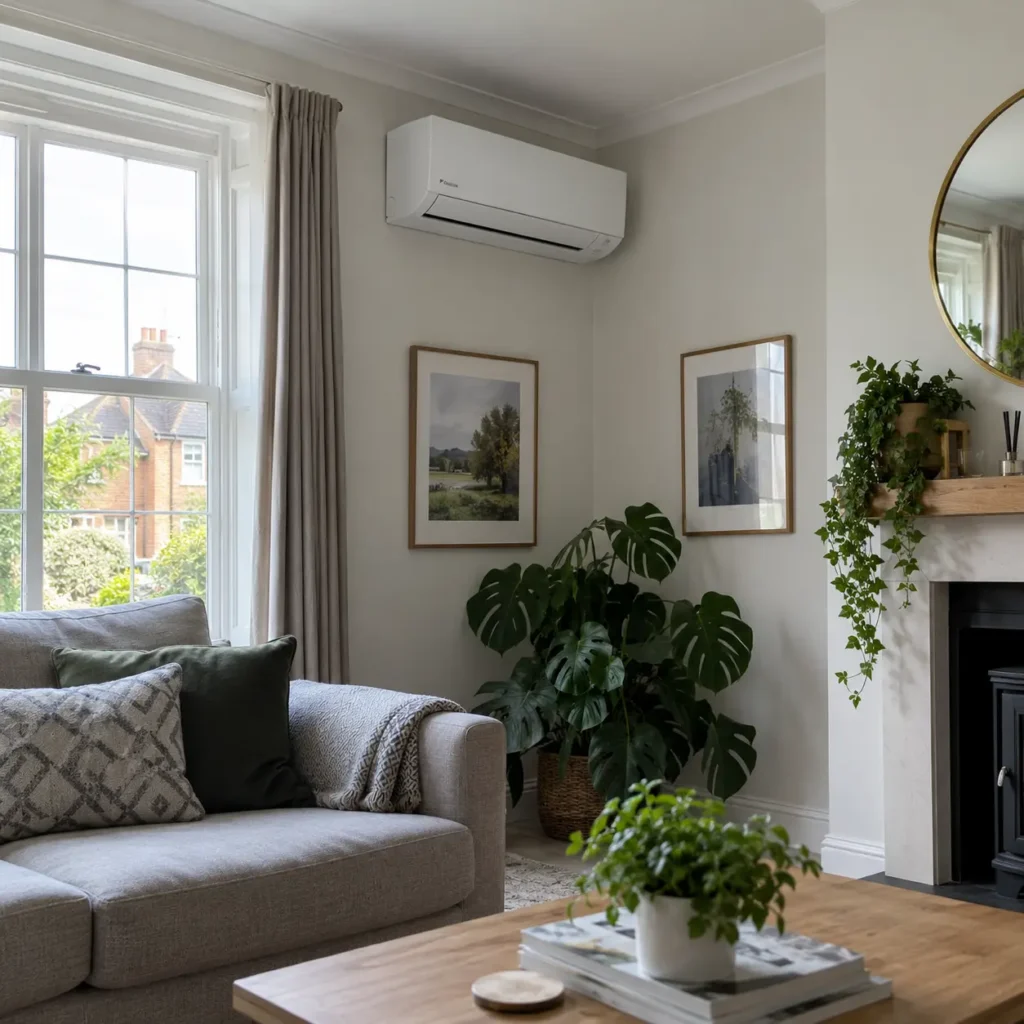
A single split uses one indoor unit and one outdoor condenser. It is usually the simplest fixed choice for a bedroom, garden room, loft conversion, home office or living room.
It works well when one room causes most of the overheating problem. If you are deciding between one outdoor unit per room and a shared system, see the guide to single-split vs multi-split air conditioning.
Multi-split air conditioning
A multi-split connects several indoor units to one outdoor unit. Each indoor unit can normally have its own temperature setting, although standard systems generally operate in the same overall heating or cooling mode.
This can be useful when outside wall space is limited. However, longer pipe runs and more complex commissioning can increase the price.
Ducted air conditioning
Ducted systems hide most equipment above ceilings or in loft space and deliver conditioned air through grilles.
They provide a discreet finish, but installation is more involved. Ducted air conditioning often makes most sense during a refurbishment, extension or new build.
Portable air conditioning
Portable units exhaust hot air through a hose, usually via a window. They can suit renters or occasional heatwaves, but they take up floor space and are usually louder than fixed split systems.
If upfront cost is your main concern, compare portable vs split air conditioning before buying.
How does domestic air conditioning work?
A split air conditioner moves heat rather than simply “creating cold air”. In cooling mode, the indoor evaporator absorbs heat from the room into a refrigerant.
The compressor raises the refrigerant’s pressure and temperature. The outdoor condenser releases that heat outside. The refrigerant then passes through an expansion device, lowering its pressure and temperature so the cycle can repeat.
A fan blows room air across the cold evaporator coil. Moisture can also condense on the coil, so the system needs a condensate drain.
When a reversible system switches to heating, the cycle runs in the opposite direction. The outdoor unit extracts heat from outside air and the indoor unit releases it into the room. Energy Saving Trust guidance on air-to-air heat pumps describes these systems as capable of providing both heating and summer cooling.
How much does domestic air conditioning cost?
A realistic 2026 budget for a professionally installed single-room split system is about £1,500–£3,000. Premium, high-capacity or difficult installations can cost more. Multi-room systems often run from the low thousands to £8,000 or more, while concealed whole-home systems can reach five figures.
Important cost factors include:
required cooling and heating capacity;
number of indoor units;
refrigerant pipe length and route;
outdoor-unit access;
condensate drainage;
electrical work;
scaffolding or specialist access; and
brand, controls and warranty.
Compare quotations based on the same design and installation scope, not just the equipment price.
What does domestic air conditioning cost to run?
Running cost depends on electrical input, not headline cooling output.
From 1 October to 31 December 2026, Ofgem’s current energy price-cap rates give an average electricity rate of 26.32p per kWh for a Direct Debit customer on the price cap in England, Scotland and Wales. At that rate, a unit drawing 0.8kW would cost about 21p for one hour at that input level.
Inverter-driven systems vary compressor speed. Once the room reaches the target temperature, power demand can fall rather than staying at maximum output.
Real costs depend on heat gain, thermostat setting, insulation, glazing, outdoor temperature, efficiency and operating time. Shading windows can reduce the cooling load before the air conditioner starts. Energy Saving Trust also recommends measures such as shading, insulation and ventilation to limit overheating.
What size air conditioner do you need?
Do not choose capacity from floor area alone. Ceiling height, glazing, orientation, insulation, occupancy and heat-producing equipment all matter.
A sunny loft bedroom can need more cooling than a larger shaded ground-floor room. The installer should assess heat gain rather than simply recommending the next unit size up.
Get Free Quote’s air-conditioning sizing guide explains the main factors behind kW and BTU selection.
Can domestic air conditioning heat your home?
Yes. Most modern fixed split systems are reversible air-to-air heat pumps.
They can be useful for heating individual rooms quickly, particularly home offices, garden rooms or bedrooms. However, they normally do not heat domestic hot water, so they are not a direct substitute for every function of a boiler or air-to-water heat pump.
Energy Saving Trust recommends considering passive cooling first, such as shading and ventilation, but recognises air-to-air heat pumps where homes still overheat.
The Boiler Upgrade Scheme now includes a £2,500 air-to-air heat-pump grant category for eligible residential properties in England and Wales. However, there is an important practical limitation as of October 2026: Ofgem requires an MCS-certified installer, while Energy Saving Trust reported on 16 October 2026 that no installers were yet MCS-certified for air-to-air systems. Do not budget on receiving the grant until current installer availability is confirmed. Ofgem Boiler Upgrade Scheme information
Planning, permissions and installer requirements
Planning rules vary by UK nation and property. Fixed outdoor equipment needs extra care in flats, listed buildings, conservation areas and prominent positions.
In England, qualifying domestic air-source heat-pump installations can fall within permitted-development rights, subject to the relevant conditions. Cooling-only equipment should not automatically be treated the same as a reversible heat pump, and planning rules differ elsewhere in the UK. Check the relevant local rules if there is any doubt. England’s domestic air-source heat-pump permitted-development legislation
Where a system contains fluorinated refrigerant, GOV.UK guidance on F-gas qualifications says people carrying out installation, servicing, maintenance, leak checks or refrigerant recovery need the appropriate qualification.
HMRC also states that most fixed air-conditioning units are air-source heat pumps for VAT purposes. Qualifying residential installations of fixed air-source heat pumps are currently zero-rated for VAT until 31 March 2027. HMRC VAT guidance for energy-saving materials
How to choose domestic air conditioning in six steps
Identify the problem rooms. Start with bedrooms, loft rooms, offices or spaces with high solar gain.
Decide whether you want heating too. A reversible system can add year-round value.
Choose the layout. Use a single split for one room, multi-split for several rooms, or ducted equipment where a concealed finish justifies the work.
Get a proper load assessment. Capacity should reflect heat gain, not floor area alone.
Compare like-for-like quotes. Check models, capacities, pipework, electrical work, drainage, controls and warranty.
Check permissions and competence. This matters especially for flats, heritage properties and refrigerant work.
For the installation process and what a quote should contain, read the UK air-conditioning installation guide.
Get Your Free Air Source Heat Pump Quote
Find the right air source heat pump solution for your home. Tell us a few details and our team will help you explore suitable options at a competitive price.
Quick to complete. No obligation.
Get your quote
Enter your details below and one of our team will get back to you.
Frequently asked questions
Find clear answers to common questions about domestic air conditioning in the UK, including installation costs, running costs, heating, system types, sizing, planning permission, F-gas requirements, grants, VAT and servicing.
A straightforward professionally fitted single-split system typically costs around £1,500–£3,000 in 2026. Multi-room and ducted systems cost more, depending on capacity, layout, pipework and electrical requirements.
For one room, a wall-mounted single split is usually the simplest fixed option. Multi-splits suit several rooms, while ducted systems suit homeowners who prioritise a discreet finish.
Not necessarily. Cost depends on the unit’s electrical input, efficiency, thermostat setting and operating time. At the October–December 2026 average price-cap electricity rate, a hypothetical 0.8kW input costs about 21p per hour.
Yes. Most modern reversible split air conditioners work as air-to-air heat pumps and can provide heating as well as cooling.
Normally no. Standard air-to-air systems heat or cool room air rather than supplying domestic hot water.
The technologies substantially overlap. A reversible split air-conditioning system can operate as an air-to-air heat pump when it runs in heating mode.
Usually not. Many homeowners get better value by targeting bedrooms, loft rooms, home offices or other spaces that regularly overheat.
A proper assessment should consider room dimensions, glazing, orientation, insulation, occupancy and internal heat gains. Floor area alone is not enough.
It can make sense for renters, occasional use or where permanent installation is impossible. Fixed split systems are generally quieter and better suited to regular cooling.
It depends on the UK nation, property and equipment. Some qualifying reversible heat-pump installations benefit from permitted-development rights, but flats, listed properties and conservation areas need particular care.
Potentially, but you may need freeholder, leasehold or planning approval before installing an outdoor condenser or altering the building.
If work involves equipment containing regulated fluorinated refrigerant, the person carrying out refrigerant installation or servicing work needs the appropriate F-gas qualification.
Follow the manufacturer’s servicing and maintenance requirements. Regular cleaning and professional checks can help maintain performance and may be required under warranty terms.
Modern fixed split units can operate quietly, especially at low fan speeds. Check both indoor and outdoor sound ratings before choosing a system, particularly for bedrooms or close neighbours.
A £2,500 Boiler Upgrade Scheme category exists for eligible residential air-to-air heat pumps in England and Wales. However, practical access remains limited in October 2026 because MCS-certified air-to-air installers are not yet available according to Energy Saving Trust.
Qualifying installations of permanently fixed air-source heat pumps in residential accommodation currently benefit from 0% VAT until 31 March 2027. HMRC says most fixed air-conditioning units are air-source heat pumps, although individual circumstances still matter.
It can be if summer overheating regularly disrupts sleep. A single split lets you target one problem room without paying to condition the entire house.
You can, but demand and installer availability can rise sharply during very hot weather. Planning the work outside peak summer periods may give you more time to compare designs and quotations.
Is domestic air conditioning worth it in the UK?
It can be, particularly if overheating repeatedly affects sleep, working from home or the use of loft and south-facing rooms.
A fixed split costs more upfront than a fan or portable unit, but it offers stronger cooling, quieter operation and useful heating. A multi-room or ducted system is a bigger home-improvement decision and deserves a proper design rather than a quick equipment quote.
Reduce avoidable heat gain with shading, sensible ventilation and insulation where appropriate. Then target air conditioning at rooms that still overheat.
If a fixed system is right for your home, Get Free Quote can help you compare suitable quotations based on your property and project rather than a generic national price.