
Heat Pump Maintenance Checklist: UK Guide 2026
Check Your Eligibility for Boiler Upgrade Scheme (BUS)
Complete your details below to check your eligibility.
Thank you
We've received your details and will be in touch shortly.

Quick answer: what maintenance does an air source heat pump need?
Most homeowners only need to carry out light visual maintenance between professional services. Keep the outdoor unit free from leaves, bins, plants and other airflow obstructions. Check that condensate can drain away, look for damage to exposed pipe insulation, note recurring fault codes, and pay attention to unusual noise, vibration or a sudden loss of heating performance.
Energy Saving Trust’s heat-pump maintenance advice says servicing should follow the manufacturer’s recommendations, usually once a year. The Heat Pump Association also recommends annual servicing by a competent person and says manufacturer-specific instructions take priority. Refrigerant, electrical and safety-critical work should not be treated as DIY maintenance.
Air Source Heat Pump Maintenance Checklist: UK Homeowner Guide
An air source heat pump needs far less day-to-day attention than many homeowners expect, but it should not be ignored. The most useful routine is simple: keep the outdoor unit clear, watch for changes in noise or performance, check visible pipework and drainage, and arrange professional servicing in line with the manufacturer’s instructions.
This guide gives UK homeowners a practical heat pump maintenance checklist for air-to-water systems. It separates safe owner checks from work that belongs with a competent engineer, explains what should happen during an annual service, and shows which warning signs deserve attention.
If you are still deciding whether a heat pump suits your property, start with the Get Free Quote home page and compare property-specific quotations before choosing a system.
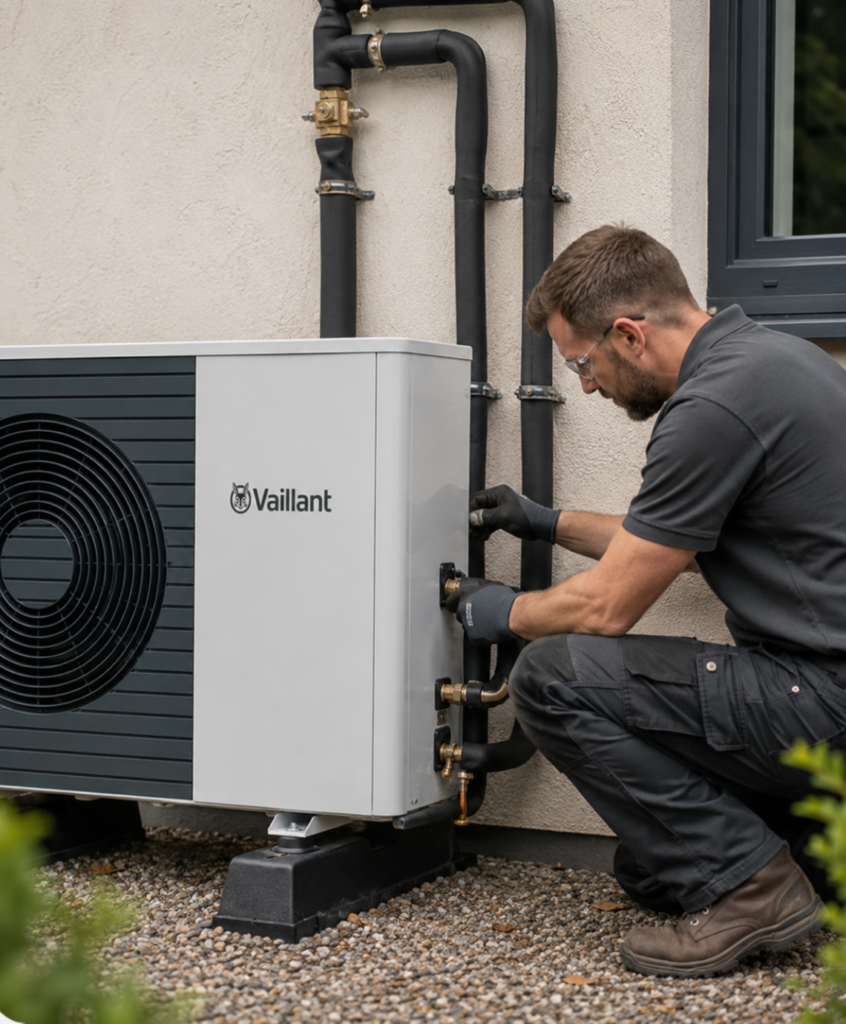
Heat pump maintenance checklist at a glance
| Check | Suggested frequency | Homeowner or engineer? | What to look for |
|---|---|---|---|
| Outdoor airflow | Monthly and after storms | Homeowner | Leaves, bins, plants or debris blocking the unit |
| Visible damage or unusual noise | Monthly | Homeowner | Loose panels, new vibration, grinding or rattling |
| Condensate drainage | Seasonally | Homeowner visual check | Water should have a clear route away from the unit |
| External pipe insulation | Seasonally | Homeowner visual check | Splits, missing sections or weather damage |
| Controller and fault log | Monthly | Homeowner | New warnings, repeated faults or unexpected settings |
| Coil, fan, filters and hydraulics | During service | Engineer | Cleanliness, flow, pressure and correct operation |
| Electrical and refrigerant system | During service or fault diagnosis | Qualified person | Safety, leaks, connections and system condition |
| Full service | Manufacturer schedule, usually annually | Competent engineer | Complete system review and service record |
Monthly and seasonal homeowner checks
Keep the outdoor unit clear
Air must move freely through the outdoor heat exchanger. Energy Saving Trust specifically recommends keeping the unit clear of obstructions such as bikes, wheelie bins and leaves. Good airflow helps the system operate efficiently.
Check the area after strong winds, autumn leaf fall and gardening. Remove loose debris around the casing without opening it. Keep shrubs and stored items away from the clearances stated in the manufacturer’s manual.
If you want to understand why airflow matters, read Get Free Quote’s guide to how air source heat pumps work rather than turning routine maintenance into guesswork.
Look, listen and compare
A heat pump will make normal compressor and fan noise, and that sound can change with operating conditions. The useful maintenance habit is noticing what is different from normal.
Look for damaged panels, staining, persistent water where it should not be, damaged insulation or obvious movement of the unit. Listen for new rattling, scraping or grinding. Note repeated fault codes instead of simply resetting the controller again and again.
A small change does not automatically mean a breakdown. However, a recurring pattern gives your engineer useful diagnostic information.
Check drainage and winter behaviour
Air source heat pumps produce condensate, while cold-weather defrost cycles can create noticeable water or vapour. Defrosting is a normal part of operation in cold, damp conditions.
Your job is not to interfere with the defrost process. Instead, make sure the drainage route looks clear and that water is not repeatedly freezing into an obstructive build-up around the unit. The HPA annual checklist specifically includes checking condensate drains and airflow through the outdoor coil.
If ice remains on the coil for long periods, the fan appears obstructed or heating performance falls sharply, contact the installer or service company.
Inspect visible pipe insulation
External pipe insulation helps protect the heating circuit and reduces unwanted heat loss. The Heat Pump Association’s annual service checklist includes confirming that external pipe insulation remains in good condition.
Homeowners can make the same visual observation between services. If insulation has split, slipped or deteriorated in the weather, ask the installer what repair is appropriate rather than disturbing valves, wiring or internal components.
What happens during an annual heat pump service?
A proper service should examine the heating system rather than simply giving the outside casing a quick clean.
The Heat Pump Association air-to-water heat pump annual service checklist covers the heat-pump unit, heating hydraulics, domestic hot-water cylinder and controls. Checks include airflow, coil condition, condensate drainage, the fan, pipe insulation, filters, system pressure, flow, cylinder-related checks and fault logs.
| Service area | Typical professional checks |
|---|---|
| Outdoor unit | Condition, clearances, airflow, coil, fan, drainage and signs of leaks |
| Heating circuit | Pipe insulation, filters, freeze protection where relevant, pressure, flow and valves |
| Hot-water system | Cylinder-related safety and pasteurisation checks where applicable |
| Controls | Time, date, fault history and operating settings |
| Electrical/refrigerant side | Safety, connections and refrigerant-related checks appropriate to the system |
Manufacturer instructions should always come first. The Heat Pump Association describes its checklist as a reference where manufacturer-specific maintenance guidance is unavailable rather than a replacement for it.
Energy Saving Trust says a typical air source heat pump service can also involve electrical safety checks, thermostat operation, leak and pressure checks, cleaning filters and coils, and checking major components including the compressor, fan and pump.
How often should an air source heat pump be serviced?
Follow the schedule in the manufacturer’s manual and warranty terms. For many domestic systems, that means a service once a year.
The Heat Pump Association states that the system should be serviced annually in line with the manufacturer’s recommendations by a competent person, with the details recorded. It also warns that failing to comply with manufacturer servicing requirements could invalidate the warranty, although statutory consumer rights are unaffected.
Do not assume every warranty has identical conditions. Check the documents for your exact heat-pump model, installer and warranty provider.
How much does heat pump servicing cost in the UK?
There is no fixed national price. As of September 2026, Energy Saving Trust says homeowners can typically expect to pay around £150 for heat-pump servicing, although actual prices vary by system, provider, location and scope.
Before booking, ask exactly what the quoted service includes. A short visual inspection is not equivalent to a service covering the outdoor unit, hydraulic system, controls and hot-water cylinder where applicable.
If efficiency seems to have fallen, compare the engineer’s findings with your electricity use. Get Free Quote’s air source heat pump efficiency guide and air source heat pump running-cost guide explain which performance figures matter.
Signs your heat pump needs attention
Contact your installer or service engineer if you notice repeated fault codes, persistent loss of heating or hot water, unusual mechanical noise, substantial new vibration, visible leakage, damaged electrical cabling or ice that does not clear through normal defrost operation.
A sudden rise in electricity use can also justify investigation. However, compare similar weather periods and household demand first. Higher winter consumption on its own does not prove that the system has developed a fault.
For more detail about cold-weather performance, Get Free Quote’s air source heat pump temperature guide explains how outdoor conditions and defrosting affect operation.
What should you not do yourself?
Do not open electrical panels, dismantle the refrigerant circuit, alter safety devices or attempt a refrigerant repair yourself.
GOV.UK guidance on qualifications for working with F-gas states that people working on equipment containing fluorinated greenhouse gases require the appropriate qualifications. Not every modern heat pump uses an F-gas refrigerant, but internal refrigerant work is still not normal homeowner maintenance.
Avoid pressure-washing delicate heat-exchanger fins or trying to break ice away from the coil. Manufacturer guidance from Daikin, for example, recommends keeping outdoor equipment free from leaves and debris and having the system professionally serviced each year.
Keep a simple maintenance record
Keep the installation manual, commissioning documents, warranty, service reports and fault history together. After each service, record the date, company, engineer and any remedial work recommended.
It is also useful to note unusual changes in electricity consumption, comfort or controller warnings. Those records give an engineer a much clearer picture than trying to remember when a problem first appeared.
The HPA checklist itself includes a service record, reinforcing the value of keeping a traceable history of maintenance.
Get Your Free Air Source Heat Pump Quote
Find the right air source heat pump solution for your home. Tell us a few details and our team will help you explore suitable options at a competitive price.
Quick to complete. No obligation.
Get your quote
Enter your details below and one of our team will get back to you.
Frequently asked questions
Find clear answers to common questions about air source heat pump maintenance, annual servicing, outdoor-unit cleaning, frost, filters, warranties, refrigerant work, engineer qualifications and maintenance records.
Usually, yes. Energy Saving Trust says servicing should follow manufacturer advice and is normally annual. The Heat Pump Association also recommends annual servicing in accordance with the manufacturer’s requirements.
You can keep the outdoor unit clear, visually inspect accessible pipe insulation and drainage, monitor fault messages and watch for unusual noise or performance changes. Do not open the casing or interfere with electrical or refrigerant components.
You can usually remove loose leaves and debris from around the unit. For cleaning the heat exchanger itself, follow the manufacturer’s instructions and avoid damaging the fins.
A pressure washer is not appropriate for delicate heat-exchanger fins. Use only cleaning methods approved by the manufacturer or leave coil cleaning to the service engineer.
Some frost is normal during cold, damp weather because the system periodically enters a defrost cycle. Persistent ice that fails to clear or prevents normal operation deserves professional investigation.
Typical checks cover the outdoor unit, airflow, coil and fan, drainage, pipe insulation, heating-system filters, pressure and flow, controls and relevant cylinder components. Exact requirements depend on the manufacturer and system design.
Energy Saving Trust currently gives a typical figure of around £150, although quotes vary according to location, system and service scope.
It can affect warranty cover if annual servicing is a condition of that particular manufacturer's warranty. The HPA warns that failure to follow manufacturer servicing requirements could invalidate a warranty, so check your own documents.
Not necessarily for every routine service. MCS certification is particularly relevant to compliant installations and schemes such as BUS. For maintenance, use a competent engineer who meets your manufacturer's requirements. Any work involving F-gas must be performed by someone with the relevant F-gas qualifications.
No. Refrigerant diagnosis and charging are specialist activities. Where the system contains F-gas, the person carrying out that work must hold the appropriate qualifications.
Many air-to-water systems have filters or strainers in the heating circuit. The HPA annual checklist includes checking and cleaning filters, including magnetic filters where fitted. Follow the manufacturer's maintenance procedure.
There is no universal required season. Many homeowners prefer servicing before the main heating period so any faults can be addressed before winter. The important point is to meet the interval required by your manufacturer and warranty.
Maintenance can help avoid efficiency losses caused by problems such as restricted airflow, dirty components or incorrect system operation. However, servicing cannot guarantee a particular bill because weather, tariffs, heat demand and system settings also affect electricity use.
Check first for obvious external causes such as loose debris or an obstruction around the outdoor unit. If the noise is new, persistent, mechanical or accompanied by a fault code or loss of performance, arrange professional inspection.
Keep service dates, engineer reports, warranty documents, fault codes, repair invoices and any changes to system settings. A continuous service history is useful for diagnosing problems and demonstrating compliance with warranty conditions.
Final pre-winter maintenance check
Before the main heating season, clear the outdoor unit, inspect exposed insulation and drainage, check the controller for warnings, and run the heating early enough to identify problems before the first very cold spell.
Then confirm that professional servicing is up to date under the manufacturer’s schedule.
Routine heat pump maintenance should be straightforward. The homeowner’s role is mainly observation, airflow and basic housekeeping. The engineer’s role covers internal checks, safety and professional servicing.
If you are planning an installation rather than maintaining an existing system, compare property-specific quotations and make sure the proposed system comes with clear servicing and warranty requirements.


