Heat Pump or New Boiler? UK Guide 2026 | Get Free Quote
Check Your Eligibility for Boiler Upgrade Scheme (BUS)
Complete your details below to check your eligibility.
Thank you
We've received your details and will be in touch shortly.
Quick Answer: Heat Pump or New Boiler?
Choose a heat pump if your home can meet its winter heat demand at sensible flow temperatures, you have room for the outdoor unit and usually a hot-water cylinder, and the total price after grants works for you. It is particularly worth pricing when your boiler already needs replacing.
Choose a new boiler when your priority is the lowest upfront cost, you need heating restored quickly, you lack suitable heat-pump space or you do not want significant changes to radiators, hot-water storage or pipework.
For many homes, there is no universal winner. Compare a complete boiler quotation with a complete heat-pump design, including predicted seasonal efficiency and all required upgrades.
Heat Pump or New Boiler? Which Should You Choose in the UK in 2026?
If your boiler is ageing, unreliable or already expensive to repair, you have a bigger decision than simply choosing another boiler. For many UK homeowners, the real question is whether this is the right moment to switch to an air source heat pump.
A new gas boiler is usually cheaper and quicker to install. A heat pump needs more design work and may require radiator, hot-water or electrical changes. However, the Boiler Upgrade Scheme can narrow the upfront-cost gap substantially, while a well-designed heat pump can now match or beat gas on running costs.
The best choice depends on your home, budget, timescale and the quality of the proposed system. This guide focuses on that decision point: what to compare before spending money, and when each option makes sense.
If your boiler is approaching replacement, compare free, no-obligation home-improvement quotes before committing to either technology.
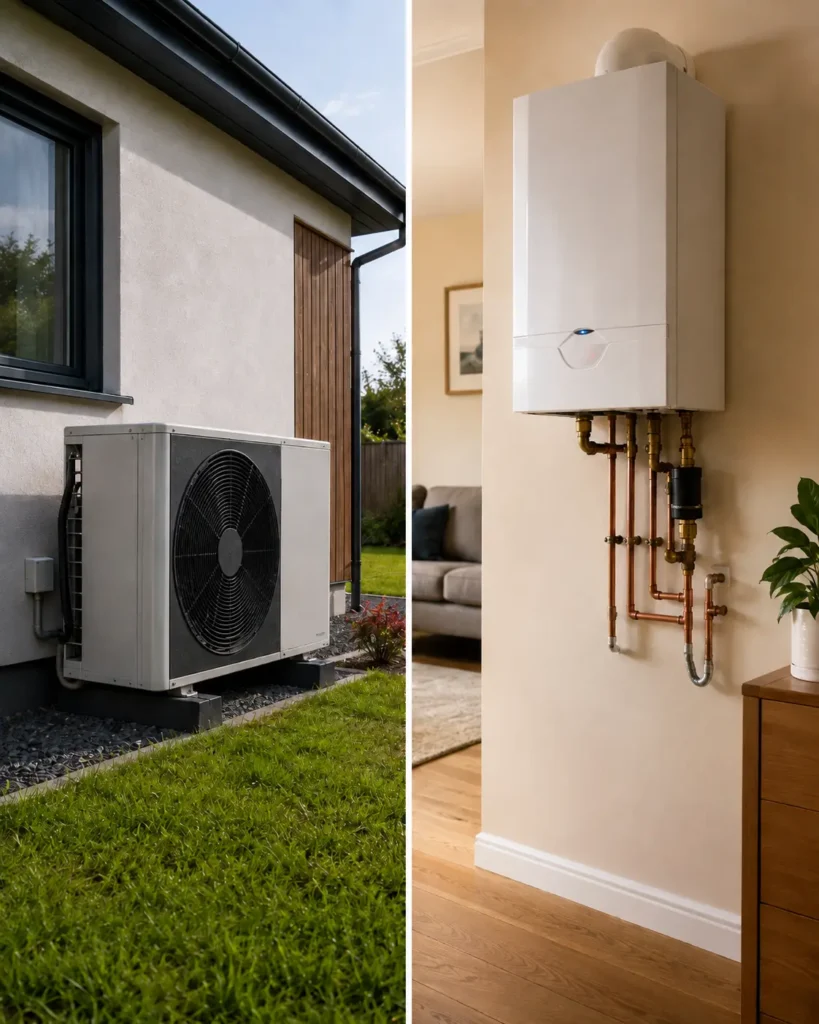
Heat Pump vs New Boiler at a Glance
| Factor | Air source heat pump | New gas boiler |
|---|---|---|
| Upfront cost | Higher before grants; potentially much closer after BUS support | Usually lower |
| Current grant | £7,500 for eligible air-to-water systems in England and Wales | No equivalent BUS grant |
| Running cost | Can match or beat gas with good seasonal efficiency | Competitive where gas remains relatively cheap |
| Heating style | Lower-temperature, steadier heating | Higher-temperature, faster response |
| Hot water | Usually stored in a cylinder | Combi boilers can provide hot water on demand |
| Home changes | May require radiator, cylinder, electrical or pipework work | Often a simpler like-for-like replacement |
| Best suited to | Planned replacement and a suitable property | Urgent replacement, tighter budgets or difficult heat-pump layouts |
Which Costs Less to Install?
A new boiler still normally wins on simple upfront price. Current UK market figures put a straightforward fitted gas combi replacement at around £3,000 on average, although more complicated conversions, relocation and pipework changes can increase the cost.
Energy Saving Trust gives a typical air source heat-pump installation cost of around £11,000. Costs vary according to property size, heat-pump capacity and whether radiator upgrades are needed.
In England and Wales, the Boiler Upgrade Scheme currently provides £7,500 towards qualifying air-to-water heat pumps. Until 31 March 2027, eligible off-gas-grid homes replacing oil or LPG can receive an additional £1,500, bringing available support to £9,000.
That does not mean every heat pump costs only £3,500 after the grant. Cylinder work, larger radiators, pipework, electrical upgrades and installation complexity can materially change the final quotation.
Compare complete specifications, not an all-inclusive boiler price with an advertised heat-pump starting price.
Which Costs Less to Run in October 2026?
Ofgem’s average Direct Debit price-cap rates from 1 October to 31 December 2026 are 26.32p/kWh for electricity and 7.97p/kWh for gas.
A gas boiler operating at 90% efficiency therefore costs about 8.86p for each useful kWh of heat.
A heat pump’s result depends on its seasonal performance factor, or SPF. This measures how much heat the system delivers across the heating season for every unit of electricity consumed.
| Heating system | Approx. energy cost per useful kWh of heat |
|---|---|
| Gas boiler at 90% efficiency | 8.86p |
| Heat pump at SPF 3.0 | 8.77p |
| Heat pump at SPF 3.5 | 7.52p |
| Heat pump at SPF 4.0 | 6.58p |
At these rates, the break-even SPF is approximately 2.97. A heat pump averaging around SPF 3.0 is therefore broadly level with a 90%-efficient gas boiler on fuel cost. Better-performing systems can be cheaper.
This is why saying that a heat pump is “300% efficient” does not mean it costs one-third as much to run. Electricity and gas have different unit prices.
A suitable heat-pump tariff can improve the calculation further. If you stop using gas completely, removing the gas supply may also eliminate the gas standing charge.
For the detailed calculations, see the Heat Pump vs Gas Boiler Running Costs UK guide.
Is Your Home Ready for a Heat Pump?
Do not decide from house age, EPC rating or radiator appearance alone.
The important question is how much heat each room loses on a cold winter day. MCS guidance says heat-loss calculations should consider factors including building fabric, room dimensions, ventilation, desired temperatures and local winter conditions.
That calculation determines both heat-pump size and radiator requirements.
Heat pumps generally achieve better efficiency at lower heating-water temperatures than boilers. As a result, an existing radiator may provide less heat than it does on a high-temperature boiler system. Some radiators may already be adequate; others may need greater surface area.
A proper survey should also check:
outdoor-unit space and airflow
hot-water cylinder space
existing pipework
electrical supply
noise and positioning
household hot-water demand
Your property does not need to become a new build before a heat pump can work. However, sensible insulation and draught-proofing improvements can reduce heat loss and make system design easier.
Use the Getfreequote heat-pump suitability checklist for a more detailed property assessment.
What Actually Changes When You Switch?
A boiler generates heat by burning fuel. An air-to-water heat pump moves heat already present in outdoor air.
First, refrigerant absorbs heat from outside air inside the evaporator. A compressor then raises the refrigerant’s pressure and temperature.
Next, the condenser transfers that heat into water for radiators, underfloor heating and stored hot water. Finally, an expansion valve reduces the refrigerant pressure so the cycle can begin again. Energy Saving Trust describes this as a refrigeration cycle, similar to a refrigerator operating in reverse.
That process explains why a heat pump can provide several units of heat from one unit of electricity.
For a deeper technical explanation, read How Air Source Heat Pumps Work.
The day-to-day heating pattern may change too. Heat pumps commonly work best by maintaining a steady indoor temperature rather than providing short bursts of very hot radiator water.
Homeowners replacing a combi boiler also need to consider hot water. Most air-to-water heat pumps use stored hot water, which normally means installing a suitable cylinder.
When Does a New Boiler Still Make Sense?
A new boiler can remain a practical choice if your existing boiler has failed and you need heating and hot water restored quickly.
A straightforward like-for-like replacement may reuse much of your existing pipework, radiators and controls. That can make the installation cheaper and less disruptive than redesigning the heating system around a heat pump.
A boiler may also make more sense where:
there is no suitable outdoor-unit position
cylinder space is extremely limited
extensive enabling work makes the project uneconomic
the post-grant heat-pump price exceeds your budget
you expect to move home soon and cannot justify a larger investment
There is no immediate requirement forcing owners of existing UK homes to remove working gas boilers. Current government policy instead aims to make low-carbon heating increasingly common as heating systems reach their natural replacement point.
When Is a Heat Pump the Stronger Choice?
One of the best times to consider a heat pump is when your boiler already needs replacing.
You are then comparing the additional cost of switching with the cost of buying another boiler, rather than comparing a heat pump against doing nothing.
The case becomes stronger when:
your home can maintain comfort at relatively low flow temperatures
predicted seasonal efficiency is comfortably above the running-cost break-even point
government funding reduces the installed cost
your electricity tariff works well with electric heating
you are already renovating or changing radiators
you plan to remain in the property for several years
Check the latest Boiler Upgrade Scheme 2026 rules before relying on any grant figure.
Seven Checks Before You Choose
Compare complete quotations. Include equipment, labour, controls and all enabling work.
Get a room-by-room heat-loss calculation. Do not accept final heat-pump sizing based only on bedrooms or floor area.
Ask for the proposed flow temperature. Lower temperatures usually support better heat-pump efficiency.
Check the radiator schedule. Ask which radiators can stay, which need changing and why.
Model running costs properly. Use predicted seasonal efficiency and your actual tariff rather than a single laboratory CoP.
Confirm grant eligibility before committing. Current BUS grants are significant, but the installation and property must meet scheme requirements.
Consider disruption and timing. A heat pump installation is often a heating-system project, not simply an appliance swap.
Get Your Free Air Source Heat Pump Quote
Find the right air source heat pump solution for your home. Tell us a few details and our team will help you explore suitable options at a competitive price.
Quick to complete. No obligation.
Get your quote
Enter your details below and one of our team will get back to you.
Frequently asked questions
Find clear answers to common questions about choosing between a heat pump and a new boiler, including installation costs, running costs, radiators, underfloor heating, hot-water cylinders, Boiler Upgrade Scheme grants, EPC requirements and system design.
A gas boiler is usually cheaper to install. However, the £7,500 Boiler Upgrade Scheme grant can reduce the difference significantly for eligible heat-pump installations in England and Wales.
It can be. At October 2026 price-cap rates, a heat pump needs an SPF of roughly 3.0 to match a 90%-efficient gas boiler on fuel cost. Higher seasonal efficiency can make the heat pump cheaper to run.
Not automatically. The financial case is generally stronger when your boiler already needs replacing, because you would otherwise be paying for another heating system anyway.
If you need heating restored immediately, a like-for-like boiler replacement may be simpler. A heat pump usually needs a proper property survey and heating-system design first.
Existing homeowners are not currently being forced to remove functioning gas boilers. Government policy is encouraging an increasing proportion of replacement heating systems to use low-carbon technologies.
Not necessarily. Each radiator should be checked against the room's heat loss and proposed water temperature. Some existing radiators may be large enough, while others may require upgrading.
No. Heat pumps can work with correctly sized radiators. Underfloor heating can be well suited to heat pumps because its large surface area works effectively at lower water temperatures.
Most air-to-water systems do, particularly when replacing a combi boiler. The cylinder stores domestic hot water because the heat pump does not normally produce unlimited instantaneous hot water like a combi boiler.
Eligible air-to-water and ground-source heat pumps in England and Wales currently receive £7,500. Certain off-gas-grid properties replacing oil or LPG can receive £9,000 until 31 March 2027.
A new EPC is no longer automatically required. Where a valid EPC exists, its certificate number should be provided; alternative evidence can be used where there is no valid EPC.
Yes. House age alone does not decide suitability. What matters is heat loss, radiator output, flow temperature, hot-water requirements, available space and system design.
Yes. Air source heat pumps continue extracting thermal energy from outside air in sub-zero temperatures. Efficiency and available output vary with temperature and model, and frost is managed through automatic defrost cycles.
Higher is generally better. At October 2026 Ofgem price-cap rates, an SPF of approximately 3.0 represents the rough fuel-cost break-even point against a 90%-efficient gas boiler.
Possibly. Pipework must be checked against the required water-flow rates and heat demand. A survey should confirm whether the existing system can be retained or needs modification.
Yes. A correctly designed air-to-water heat pump can provide both space heating and domestic hot water, normally using radiators or underfloor heating plus a hot-water cylinder.
Conclusion: Heat Pump or New Boiler?
If you need the cheapest, quickest and least disruptive replacement, a new boiler can still be the right answer.
If your boiler already needs replacing and your home can support a well-designed low-temperature heating system, a heat pump deserves a proper quotation before you automatically choose another boiler.
Current grants can substantially reduce the installation-cost difference. Meanwhile, October 2026 energy prices mean a heat pump achieving an SPF of around 3.0 can broadly match an efficient gas boiler on fuel cost, while better-performing systems can cost less to run.
The important comparison is not simply boiler price versus heat-pump price. Compare total installed cost, predicted seasonal performance, running costs, disruption and how well each option fits your home.
Get properly surveyed quotations before making the final decision.