
Heat Pump Underfloor Heating: Does It Work? UK Guideoom House UK (2026)
Check Your Eligibility for Boiler Upgrade Scheme (BUS)
Complete your details below to check your eligibility.
Thank you
We've received your details and will be in touch shortly.

Quick answer: do heat pumps work with underfloor heating?
Yes. A heat pump can supply warm water directly to a wet underfloor heating system. The floor acts as a large heat emitter, allowing the home to be heated at lower flow temperatures than many radiator systems.
Lower water temperatures generally help a heat pump run more efficiently. Energy Saving Trust’s underfloor heating guidance specifically notes that wet underfloor heating is easy to combine with heat pumps and can allow lower flow temperatures.
The important distinction is between wet UFH, which uses water-filled pipes, and electric UFH, which uses cables or mats. A heat pump can heat the water in a wet system. It does not power electric UFH in the same way.
Do Heat Pumps Work With Underfloor Heating? UK Guide
Yes. Heat pump underfloor heating can work extremely well because water-based underfloor heating and heat pumps both suit relatively low water temperatures.
Underfloor heating spreads heat across a large floor area. As a result, it can usually keep a room comfortable with cooler water than a smaller radiator needs. That can help a heat pump operate more efficiently.
However, not every underfloor system is automatically heat-pump-ready. Floor construction, insulation, pipe spacing, controls and room-by-room heat loss all matter.
Electric underfloor heating is different too. It uses resistance cables or mats and is not heated by an air-to-water or ground-source heat pump.
This guide explains how heat pumps work with underfloor heating, what flow temperatures to expect, whether existing UFH can be reused and when a mixed system with radiators makes more sense.
Considering a heat pump? Compare properly surveyed options before changing your heating system or floors.
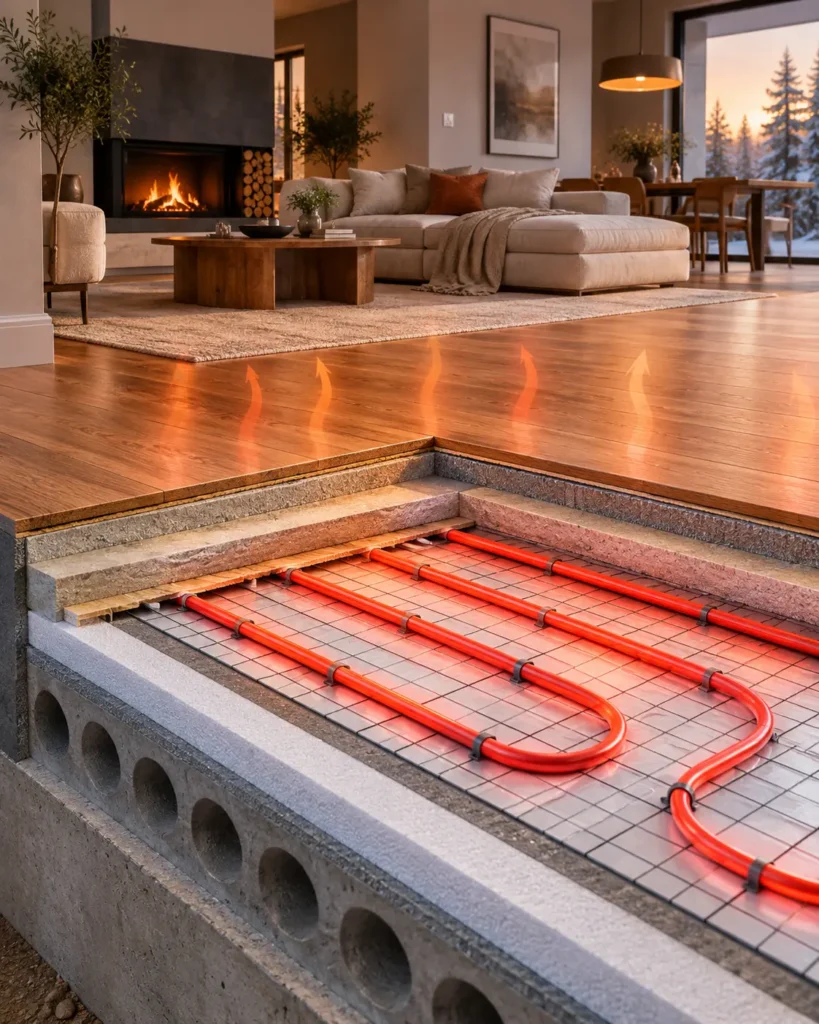
Heat pump underfloor heating at a glance
| Setup | Suitability | Main advantage | Main consideration |
|---|---|---|---|
| Heat pump + wet UFH | Excellent when correctly designed | Large emitter area supports low flow temperatures | Floor output must match room heat loss |
| Heat pump + suitable radiators | Very good | Easier to retrofit | Some radiators may need upgrading |
| UFH downstairs + radiators upstairs | Often practical | Balances efficiency and disruption | Both emitter types need compatible design temperatures |
| Electric UFH | Separate system | Simple for small areas | Does not use heat-pump-heated water |
Why does underfloor heating suit a heat pump?
The key is surface area.
A radiator releases heat from a relatively small panel. Underfloor heating uses much of the floor as the heat emitter, so the water can be cooler while still delivering enough heat into the room.
That matters because a heat pump must raise low-temperature heat from outside to a useful temperature inside. Generally, the higher the required heating-water temperature, the harder the compressor has to work.
Energy Saving Trust’s installer guidance demonstrates this relationship: heat-pump efficiency normally improves as the required leaving-water temperature falls.
For the complete evaporator, refrigerant, compressor, condenser and expansion-valve process, read Getfreequote.co.uk’s guide to how air source heat pumps work rather than repeating the whole refrigeration cycle here.
For underfloor heating, the important point is simple: a larger heat-emitting surface can reduce the water temperature the heat pump needs to produce.
What flow temperature does underfloor heating use with a heat pump?
There is no single correct temperature for every property.
Many heat-pump UFH systems operate at roughly 30–40°C, but the actual design temperature depends on:
- the calculated room heat loss;
- pipe spacing;
- heated floor area;
- insulation;
- floor construction;
- floor covering;
- outdoor design temperature.
Daikin’s heat pump and underfloor heating guidance describes typical underfloor leaving-water temperatures of around 25–35°C. Energy Saving Trust, meanwhile, says heat pumps often supply radiators at around 35–45°C.
The aim is not simply to chase the lowest number possible.
Instead, the system should use the lowest practical flow temperature that can still keep every room warm during the property’s design winter conditions.
For a deeper explanation, see Getfreequote.co.uk’s guide to air source heat pump temperature.
Wet vs electric underfloor heating
Wet UFH contains water-filled pipes beneath the floor. A heat pump can heat this water, allowing the heat pump and UFH to operate as one integrated heating system.
Electric UFH contains resistance cables or mats. Electricity flows through them and produces heat directly.
Therefore, adding a heat pump does not convert existing electric UFH into heat-pump underfloor heating.
Electric UFH can still be practical for a bathroom or another small area used for short periods. However, Energy Saving Trust notes that electric underfloor heating can become expensive when used for larger spaces or long periods compared with wet systems using efficient heat sources.
Can existing underfloor heating work with a heat pump?
Often, yes. But it should be checked rather than assumed.
The designer needs to confirm that each room can produce enough heat at the proposed lower water temperature.
They should assess the room heat loss, pipe spacing, loop lengths, manifold flow rates, insulation and floor-covering resistance.
Older wet UFH may also have been designed around a boiler and blending valve. The blending valve reduces hotter boiler water to a temperature suitable for the floor.
With a low-temperature heat source, the arrangement may need changing. Heat-pump-specific UFH systems can supply water without a conventional blending valve because the heat source itself already produces low-temperature water.
A proper heat pump survey should assess the underfloor heating alongside heat-pump capacity, pipework, hot-water requirements and electrical supply.
Can you combine underfloor heating and radiators?
Yes.
Underfloor heating downstairs with radiators upstairs is a common and practical retrofit arrangement.
Energy Saving Trust specifically notes that homeowners may use UFH downstairs and radiators upstairs, reducing the cost and disruption involved in installing underfloor heating throughout the property.
The important issue is radiator sizing.
Upstairs radiators need enough surface area to produce the required room heat at the chosen low water temperature. Some existing radiators may already be large enough. Others may need larger, double-panel or triple-panel replacements.
So the real design question is not simply “underfloor heating or radiators?”
It is:
Can every room receive enough heat at an efficient system flow temperature?
Floor construction, insulation and coverings matter
UFH performance depends heavily on what surrounds the heating pipes.
Screeded concrete floors can distribute heat evenly but usually respond relatively slowly.
Suspended timber floors can also work with UFH. Depending on the system, they may use insulation together with aluminium heat-spreader plates or purpose-designed panels. Low-profile overlay systems provide another option where removing the existing floor would create excessive disruption.
Insulation underneath the heating layer is important because the objective is to direct useful heat upwards into the room rather than down towards the ground or an unheated void.
Floor finishes matter as well.
Tile and stone transfer heat readily. Carpet can also work, but thick carpet and underlay restrict heat transfer. Energy Saving Trust cites a combined carpet-and-underlay recommendation of 2.5 tog or less for faster heat transfer.
Older and listed properties require additional care. Historic England’s guidance on installing heat pumps in historic buildings notes that changes to floors, doors, steps and skirtings may have conservation implications.
Is heat pump underfloor heating better for new builds or retrofits?
UFH is easiest to integrate during a new build, extension or major renovation.
The designer can coordinate insulation, pipework, screed and finished floor height before construction starts.
Retrofit is still possible. Options include low-profile overlay systems, routed or milled systems and between-joist solutions for suspended timber floors.
The right method depends on available floor height, door thresholds, stairs, insulation and the existing structure.
If you already intend to replace a kitchen or ground-floor finish, that can be a logical opportunity to install wet UFH.
Before committing, check whether your home is suitable for a heat pump as a complete heating system rather than assessing the floor alone.
Will underfloor heating reduce heat-pump running costs?
Potentially, but there is no responsible fixed saving percentage.
Lower flow temperatures can improve heat-pump efficiency. That may reduce the electricity needed to deliver the same amount of useful heat.
However, actual bills still depend on:
- property heat demand;
- seasonal heat-pump performance;
- electricity tariff;
- hot-water demand;
- heating controls;
- the system being replaced.
Underfloor heating can also respond more slowly than radiators, particularly when pipes are buried in a high-mass screed.
Heat pumps generally suit steady operation rather than repeatedly allowing the building to become cold and then demanding a rapid temperature increase. Energy Saving Trust recommends continuous operation with sensible temperature setbacks rather than treating a heat pump exactly like a traditional boiler.
Do not replace perfectly suitable radiators purely because someone promises a guaranteed UFH payback.
If existing or upgraded radiators can already heat the rooms at a low design temperature, installing UFH may not justify the building work.
What does heat pump underfloor heating cost?
Underfloor heating costs vary significantly by project.
Energy Saving Trust currently cites an indicative installed cost of around £85–£110 per square metre for wet UFH, based on Checkatrade figures. Treat this as a broad guide rather than a quotation.
Costs can increase where installation requires floor removal, new insulation, screed, joist work, door changes or new floor finishes.
For the heat pump itself, eligible homes in England and Wales can currently receive £7,500 towards an air-to-water or ground-source heat pump through the Boiler Upgrade Scheme.
Until 31 March 2027, qualifying off-gas properties replacing oil or LPG can receive £9,000 towards an eligible air-to-water or ground-source system. GOV.UK and Ofgem confirm the current grant levels.
For the detailed rules, see Getfreequote.co.uk’s Boiler Upgrade Scheme 2026 updates.
Do not assume the headline grant will automatically cover every separate flooring or renovation expense.
How to design heat pump underfloor heating properly
- Calculate room-by-room heat loss. The heating emitter needs enough output to meet each room’s requirement. The MCS heat-load methodology is based on room-level calculations.
- Choose the design flow temperature. Aim for the lowest practical temperature that still satisfies the calculated heat demand.
- Check UFH output. Pipe spacing, usable heated area, insulation and floor finish all change the result.
- Coordinate radiators. Where radiators remain upstairs, size them around the same low-temperature strategy where practical.
- Review manifolds and controls. Boiler-era pumps or blending arrangements should not automatically be retained.
- Check finished floor levels. Doors, stairs, fitted kitchens and thresholds can turn a straightforward UFH installation into a larger building project.
Get Your Free Air Source Heat Pump Quote
Find the right air source heat pump solution for your home. Tell us a few details and our team will help you explore suitable options at a competitive price.
Quick to complete. No obligation.
Get your quote
Enter your details below and one of our team will get back to you.
Frequently asked questions
Find clear answers to common questions about using underfloor heating with heat pumps, including wet and electric UFH, flow temperatures, mixed radiator systems, carpets, timber floors, insulation, blending valves, running costs and grants.
No. Heat pumps can work with correctly sized radiators as well as wet underfloor heating. UFH can help achieve lower flow temperatures, but it is not mandatory.
Water-based, or wet, underfloor heating connects directly to an air-to-water or ground-source heat pump. Electric heating mats and cables operate separately.
Potentially, yes. Its pipe layout, manifold, floor construction and heat output should first be checked against the room-by-room heat loss at the proposed flow temperature.
There is no universal setting. Around 30–40°C is common, while some well-designed systems operate lower. The correct temperature depends on the property and UFH design.
Yes. This is a common approach and can reduce retrofit disruption. The upstairs radiators should be sized to deliver enough heat at the intended low system temperature.
Not directly. Electric UFH converts electricity into heat using cables or mats. A hydronic heat pump heats water, which can circulate through wet UFH.
It can. The deciding factors are heat loss, insulation, floor construction and whether enough heat can be delivered at an efficient water temperature. The property's age alone does not answer the question.
Yes, provided the carpet and underlay are suitable. Energy Saving Trust cites guidance recommending a combined rating of 2.5 tog or less for quicker heat transfer.
Yes. Purpose-designed UFH systems can be installed with suspended timber floors, often using insulation and heat-spreader plates or structural UFH panels.
Yes. Good insulation reduces unwanted downward heat loss and makes it easier for the system to deliver useful heat into the occupied room.
It can. Screeded systems have considerable thermal mass and can respond more slowly than radiators. This is one reason steady heating strategies often suit UFH.
Possibly, but it should be reviewed. Boiler-based UFH often uses a blending valve to reduce high-temperature water. Heat-pump UFH can sometimes operate directly without this arrangement.
It can improve heat-pump efficiency, but savings are not guaranteed. Bills still depend on heat demand, electricity price, controls, seasonal efficiency and what heating system you replace.
An eligible heat-pump installation in England or Wales can currently receive BUS support. Standard air-to-water and ground-source grants are £7,500, with £9,000 temporarily available for qualifying off-gas oil/LPG properties until 31 March 2027.
No. Many properties use UFH only downstairs and appropriately sized radiators upstairs.
Final recommendation
Heat pumps and wet underfloor heating are a strong technical match.
The large floor area can provide comfortable heating using relatively low water temperatures. Those lower temperatures generally create favourable operating conditions for a heat pump.
However, underfloor heating is not essential for a heat pump.
In many existing UK homes, correctly sized radiators can provide good performance with far less disruption.
If you are already renovating, installing wet UFH can be an excellent long-term choice. If your floors are staying in place, first establish whether your existing radiators can meet each room’s heat loss at an efficient design temperature.
Next step: compare a room-by-room heat-loss assessment, proposed flow temperature and complete emitter schedule before deciding whether to keep radiators, install underfloor heating or use a mixture of both.


