
Replace Gas Boiler With Heat Pump? UK Guide 2026
Check Your Eligibility for Boiler Upgrade Scheme (BUS)
Complete your details below to check your eligibility.
Thank you
We've received your details and will be in touch shortly.

Quick Answer
Yes, replacing a gas boiler with an air source heat pump can be a good decision if your boiler is nearing the end of its life, your home can be heated efficiently at relatively low flow temperatures, you have space for the outdoor unit and usually a hot-water cylinder, and the final cost after grants is acceptable.
It is not automatically cheaper to run than a modern gas boiler. Running costs depend on seasonal efficiency, electricity tariffs and heat demand. Start with a room-by-room heat-loss calculation and a complete quotation showing radiator, cylinder, electrical and pipework work. For eligible mains-gas homes in England and Wales, the Boiler Upgrade Scheme currently provides £7,500 towards a qualifying air-to-water heat pump.
Should I Replace My Gas Boiler With an Air Source Heat Pump?
If your gas boiler is ageing, unreliable or approaching replacement, an air source heat pump is now a realistic alternative for many UK homes. The decision is not simply “gas versus electric”. A heat pump changes how your heating system works, including radiator temperatures, hot-water storage, controls and sometimes pipework.
For many homeowners, the strongest time to switch is when a boiler already needs replacing. However, a heat pump only makes financial and practical sense when the property can be heated efficiently at suitable water temperatures and the total installed cost works for your budget.
This guide explains when replacing a gas boiler with a heat pump makes sense, what needs to change in your home, how running costs compare, what the Boiler Upgrade Scheme covers and when keeping your boiler for longer may be sensible.
Thinking about replacing your boiler? Compare properly surveyed heating options through Get Free Quote before committing to either technology.
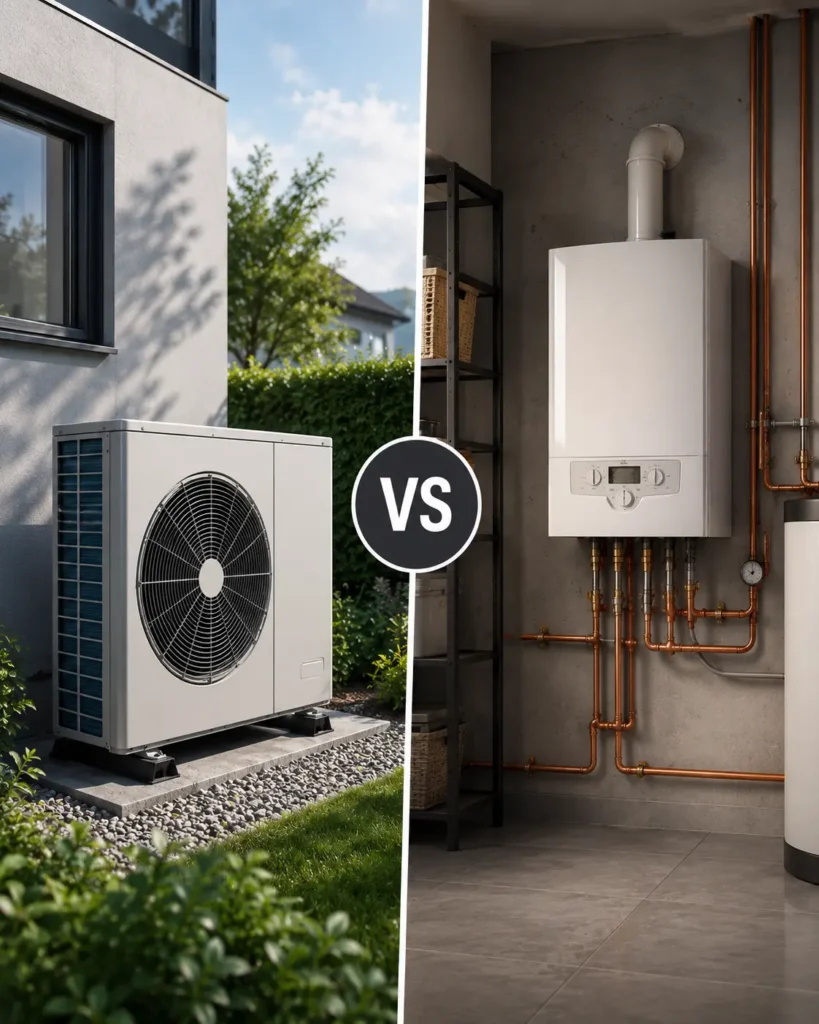
Should You Replace Your Gas Boiler Now?
The answer depends more on timing and property design than on the age of the building.
| Situation | Heat-pump decision |
|---|---|
| Boiler is old, unreliable or needs replacement soon | Strong time to price a heat pump alongside a new boiler |
| Boiler is relatively new and reliable | Switching may still suit low-carbon goals, but the financial case is usually weaker |
| Home is being renovated | Good opportunity to design radiators, insulation and hot water around a heat pump |
| No practical cylinder or outdoor-unit space | A standard air-to-water heat pump may be difficult without redesign |
| Major avoidable heat loss remains | Address sensible fabric improvements before final sizing |
| Quote relies on very high flow temperatures | Ask for predicted seasonal efficiency before proceeding |
For a detailed appliance-by-appliance comparison, use our air source heat pump vs gas boiler guide. This page focuses on the decision to remove an existing gas boiler and what that change involves.
What Actually Changes When the Gas Boiler Comes Out?
A gas boiler creates heat by burning gas. An air-to-water heat pump moves heat from outdoor air into your home. Refrigerant absorbs heat outside, a compressor raises its temperature, and a heat exchanger transfers that heat into water for radiators, underfloor heating and usually stored hot water. Energy Saving Trust describes the same transfer process in its current air source heat pump guidance.
Because moving heat is more efficient than combustion, a well-designed heat pump can deliver several units of heat for each unit of electricity. The trade-off is that heat pumps generally work best with lower heating-water temperatures than gas boilers.
Your Radiators May Run Cooler
Heat pumps usually favour steadier heating at lower flow temperatures. That does not mean every radiator needs replacing.
Each room should be checked against its calculated heat loss. Some radiators may already be large enough; others may need a larger double- or triple-panel radiator. See our heat pump with existing radiators guide for the detailed design issues.
A Combi-Boiler Home Usually Needs Stored Hot Water
If you have a combi boiler, hot water is produced on demand. Most air-to-water heat pumps instead heat a hot-water cylinder, so you need an appropriate location and a cylinder sized for household demand.
This is an important practical check before switching. A technically efficient system can still be inconvenient if the cylinder does not suit the household’s normal shower, bath and hot-water use.
Is Your Home Suitable for a Heat Pump?
Most homes should be judged by calculated heat loss, not labels such as “old”, “Victorian” or “poor EPC”.
MCS guidance treats room-by-room heat-loss calculation as central to correct heating-system sizing. Its heat-load methodology considers factors such as building fabric, room dimensions, ventilation, desired room temperatures and local winter conditions. MCS explains heat-loss calculations here.
A good survey should establish whether the heat pump can meet winter demand, whether radiators can deliver enough heat at the proposed flow temperature, whether there is suitable space for the outdoor unit and cylinder, and whether the electrics and pipework suit the design.
Insulation helps because lower heat loss can reduce required heat-pump output and radiator size. However, a home does not need to become a new-build before a heat pump can work. Target sensible improvements where appropriate, then design around the resulting heat demand.
For a property-specific checklist, read Is My Home Suitable for a Heat Pump?. The key question is whether the complete system can meet the property’s heat loss efficiently, rather than simply how old the house is.
Will Replacing a Gas Boiler With a Heat Pump Save Money?
Possibly, but “300% efficient” does not automatically mean a lower bill.
At Ofgem’s average Direct Debit price-cap rates for 1 July to 30 September 2026, electricity is 26.11p/kWh and gas is 7.33p/kWh. A gas boiler operating at 90% efficiency therefore produces useful heat at about 8.14p/kWh. A heat pump paying the same electricity rate reaches roughly the same useful-heat cost at a seasonal COP of about 3.2. See Ofgem’s current and forthcoming price-cap unit rates.
Ofgem has already announced the rates taking effect on 1 October 2026: average Direct Debit rates of 26.32p/kWh for electricity and 7.97p/kWh for gas. Using the same 90% gas-boiler assumption, the heat-pump break-even seasonal COP falls to roughly 3.0.
Real homes vary. Heat-pump tariffs can improve the calculation, while poor design, high flow temperatures or excessive electric backup can worsen it. If you remove the gas supply completely, you may also avoid the gas standing charge.
Energy Saving Trust notes that heat pumps on standard electricity tariffs can cost slightly more to run than new gas boilers, while time-of-use tariffs can reduce heat-pump running costs significantly. Ask installers to show the electricity price, gas price, heat demand and predicted seasonal efficiency behind any savings claim.
How Much Does Replacement Cost, and What Grant Can You Get?
Energy Saving Trust currently gives a typical air source heat pump installation cost of around £12,000, although actual quotations vary with the property and the work required.
For an eligible mains-gas property in England or Wales, the Boiler Upgrade Scheme provides £7,500 towards an air-to-water heat pump. Your installer applies and the grant is passed on as an upfront discount.
The temporary £9,000 BUS grant does not apply to an ordinary mains-gas replacement. It applies until 31 March 2027 to qualifying off-gas-grid properties replacing oil or LPG heating.
Scotland uses a different system. The Home Energy Scotland Grant and Loan currently offers eligible homeowners up to £7,500 in heat-pump grant funding, with a rural uplift and optional interest-free loan subject to scheme terms.
| Cost point | What to allow for |
|---|---|
| Heat pump and core installation | Equipment, labour and commissioning |
| Heating-system changes | Selected radiators, pipework and controls |
| Hot water | Heat-pump-compatible cylinder and plumbing |
| Electrical work | Consumer-unit or supply work if required |
| Grant | Deduct only after confirming eligibility |
For the England and Wales grant rules, see our replace gas boiler with heat pump grant guide.
When Should You Keep Your Gas Boiler for Now?
Replacing a reliable, recently installed boiler purely to chase short-term bill savings can be difficult to justify financially. The case is often stronger when you already face boiler replacement or major heating work.
Delay can also be sensible if the proposed heat-pump design is weak. Warning signs include no room-by-room heat-loss calculation, no radiator schedule, unclear cylinder sizing, no predicted seasonal performance, or a quotation that depends on very high flow temperatures without explaining the efficiency impact.
If major renovation or insulation work is planned soon, complete that work before final sizing where practical. Otherwise, the system may be designed around heat losses that will shortly change.
A Practical Seven-Step Decision Checklist
- Check the boiler decision first. If it needs major repair or replacement soon, compare complete quotations now.
- Get a room-by-room heat-loss calculation. Do not size a final system from floor area or bedroom count alone.
- Ask for the design flow temperature. Lower practical temperatures generally support better heat-pump efficiency.
- Review radiators and pipework. Keep suitable components rather than assuming everything must go.
- Plan hot water properly. Confirm cylinder volume, location and expected household demand.
- Compare running-cost assumptions. Ask for heat demand, SCOP, tariff and standing-charge assumptions.
- Compare the final installed price after grants. Include electrical, radiator, cylinder and remedial work.
If you are ready to compare surveyed options, Get Free Quote can help you review quotations rather than judging the decision on headline equipment prices alone.
Get Your Free Air Source Heat Pump Quote
Find the right air source heat pump solution for your home. Tell us a few details and our team will help you explore suitable options at a competitive price.
Quick to complete. No obligation.
Get your quote
Enter your details below and one of our team will get back to you.
Frequently asked questions
Find clear answers to common questions about replacing a gas boiler with an air source heat pump, including Boiler Upgrade Scheme grants, installation costs, running costs, radiators, hot-water cylinders, insulation, planning and gas connections.
Yes. An air-to-water heat pump can replace a gas boiler and supply both central heating and stored hot water when the system is correctly sized for the property.
Yes. Eligible property owners in England and Wales can currently receive £7,500 through the Boiler Upgrade Scheme when a qualifying heat pump replaces fossil-fuel heating such as gas.
The BUS-funded system cannot be a new fossil-fuel hybrid heat-pump system. Ofgem states that hybrid systems combining a fossil-fuel boiler and heat pump are not eligible.
Energy Saving Trust currently gives a typical installation figure of around £12,000, but the actual price depends on the property, system size and any radiator or heating-system modifications.
It can be. The result depends mainly on heat-pump seasonal efficiency, gas and electricity prices, your heating demand and tariff. Energy Saving Trust says suitable time-of-use tariffs can significantly improve heat-pump running costs.
Using Ofgem's July–September 2026 average Direct Debit rates and a 90%-efficient boiler, the approximate break-even SCOP is 3.2. Using the announced October–December rates, it falls to roughly 3.0. Energy prices change, so this threshold should be recalculated periodically.
No. Existing radiators can stay where they produce enough heat at the proposed flow temperature. A room-by-room calculation should identify which, if any, need upgrading.
No. Underfloor heating can work very well at low water temperatures, but correctly sized radiators can also heat a home effectively.
Usually, yes. Standard air-to-water heat pumps generally use stored hot water rather than producing it instantaneously like a combi boiler.
Yes. House age alone does not decide suitability. Heat loss, emitters, pipework, available space and the proposed operating temperature matter more.
It can, but a high heat loss increases the amount of heat the system must provide. Appropriate insulation improvements may allow a smaller system, lower flow temperatures and lower running costs.
Yes. Energy Saving Trust confirms that air source heat pumps work below freezing, although efficiency declines as outdoor temperature falls and defrost cycles may be required.
Many installations in England qualify as permitted development when the relevant conditions are met. Rules were relaxed in May 2025, including removal of the former one-metre boundary restriction, but listed buildings and some other properties can require additional consent. Rules differ elsewhere in the UK.
Potentially, yes. A mains-gas connection does not prevent a property receiving the standard BUS grant. However, retaining gas means you may continue paying a gas standing charge, and the BUS-funded heating system itself cannot be a fossil-fuel hybrid.
Compare complete designs rather than appliance prices. Obtain a room-by-room heat-loss calculation, radiator assessment, hot-water plan, predicted seasonal efficiency and itemised installed price before choosing.
Conclusion: Should You Replace Your Gas Boiler With a Heat Pump?
For many UK homeowners, the best time to replace a gas boiler with an air source heat pump is when the boiler is already approaching replacement and the home can support an efficient low-temperature heating design.
The switch is less compelling when a modern boiler has many useful years left, the home is about to undergo major changes, or the heat-pump proposal lacks proper heat-loss and emitter design.
Treat the decision as a whole-home heating project, not an appliance swap. A good quotation should show what stays, what changes, expected performance and the final cost after funding. That gives you a firmer basis for deciding whether to remove the gas boiler now or wait.


