
Replace an Oil Boiler with a Heat Pump Grant | BUS 2026
Check Your Eligibility for Boiler Upgrade Scheme (BUS)
Complete your details below to check your eligibility.
Thank you
We've received your details and will be in touch shortly.

Quick Answer
Yes, an oil boiler can be replaced using the Boiler Upgrade Scheme. The scheme supports eligible property owners in England and Wales who replace fossil-fuel heating with qualifying low-carbon heating.
Until 31 March 2027, an eligible property heated by oil or LPG can receive £9,000 towards an air-to-water or ground-source heat pump if it has no mains gas connection. Otherwise, an eligible air-to-water or ground-source installation normally receives £7,500. The oil heating system must be replaced rather than retained as a fossil-fuel backup. An MCS-certified installer checks eligibility and applies to Ofgem on your behalf.
Can You Replace an Oil Boiler with a Heat Pump Grant? Boiler Upgrade Scheme Guide 2026
Yes. If you own an eligible property in England or Wales, you can replace an oil boiler with a heat pump using the Boiler Upgrade Scheme (BUS).
For many oil-heated homes, the support is particularly valuable in 2026. Until 31 March 2027, qualifying properties can receive £9,000 towards an air-to-water or ground source heat pump. The normal grant for these systems is £7,500. To receive the £9,000 rate, the property must be heated by oil or LPG and have no mains gas connection.
That does not mean every home with an oil boiler automatically qualifies for £9,000. Your property, existing heating system and proposed heat pump must all meet the scheme rules.
This guide explains exactly when you can replace an oil boiler with a heat pump grant, what must happen to the existing oil heating, what the upgrade may involve inside your home and how the application works.
Considering the switch? Compare properly surveyed heat-pump quotations before deciding whether replacing your oil boiler makes financial and practical sense.
How Much Grant Can You Get for Replacing an Oil Boiler?
The amount depends on both the technology you install and whether your property meets the special off-gas-grid criteria.
| Replacement system | BUS grant | Position for an oil-heated home |
|---|---|---|
| Air-to-water heat pump | £7,500 standard / £9,000 qualifying off-gas | Most conventional oil-boiler replacements |
| Ground-source heat pump | £7,500 standard / £9,000 qualifying off-gas | Suitable where land or boreholes are practical |
| Air-to-air heat pump | £2,500 | No £9,000 oil/LPG uplift |
| Biomass boiler | £5,000 | Only eligible in specific rural, off-gas circumstances |
he £9,000 grant is therefore not a general £9,000 heat-pump grant. It is a temporary uplift for eligible off-gas-grid properties replacing oil or LPG with an air-to-water or ground-source heat pump. It applies from 21 July 2026 until 31 March 2027.
For a wider explanation of the latest changes, see the Boiler Upgrade Scheme 2026 updates.
Official grant categories are published by the Department for Energy Security and Net Zero. GOV.UK approved BUS grant values
Who Qualifies for the £9,000 Oil-Boiler Heat-Pump Grant?
The first requirement is straightforward: the existing heating must be eligible for replacement. Oil is specifically recognised as a fossil-fuel heating system under BUS.
For the £9,000 rate, however, your home must also qualify as an off-gas-grid property.
Ofgem states that a qualifying property must not be fuelled by mains gas, have a record of an existing gas meter point, be connected to a heat network or be a new-build property. The heating being replaced must be oil or LPG.
This distinction matters. A house may currently use an oil boiler but still have an existing mains-gas connection or meter-point record. In that situation, it may fail the special £9,000 criteria even though the property could potentially qualify for the standard BUS heat-pump grant.
You must also own the property. Eligible owners can include homeowners, private landlords and owners of qualifying business properties. Most new builds and social housing do not qualify.
See the detailed Boiler Upgrade Scheme requirements before assuming eligibility.
Do you still need an EPC?
A valid EPC is no longer a standing requirement for applications properly made under the rules introduced from 28 April 2026.
If a valid EPC exists, its certificate number should be supplied. Where there is no valid EPC, the installer can instead provide alternative evidence required by Ofgem.
Previous rules linking BUS eligibility to outstanding loft or cavity-wall insulation recommendations should therefore not be confused with the current 2026 requirements.
Can You Keep Your Oil Boiler as a Backup?
Not if you want the heat-pump installation funded through BUS.
The new system must replace the existing fossil-fuel heating system. A BUS-funded installation cannot be a hybrid arrangement that combines the new heat pump with fossil-fuel heating. Any supplementary heating permitted under the scheme cannot itself be fossil fuelled.
In practical terms, you should not plan to install a heat pump while continuing to use the oil boiler whenever the weather becomes cold.
This is an important difference between a private heat-pump retrofit and a BUS-funded project.
Does the oil tank have to disappear?
The scheme’s central requirement concerns replacing the fossil-fuel heating system. The practical work associated with a redundant oil tank should therefore be agreed separately with your installer or an appropriate specialist.
Ask the quotation to state clearly whether it includes:
- decommissioning the oil boiler;
- dealing with remaining heating oil;
- disconnecting redundant fuel lines;
- emptying, cleaning or removing the oil tank; and
- making good any area affected by removal.
Do not assume oil-tank removal is included simply because the quotation says “oil boiler removal”.
What Actually Changes When an Oil Boiler Is Replaced?
For many homes, an air-to-water heat pump is the closest functional replacement because it can continue using a wet central-heating system.
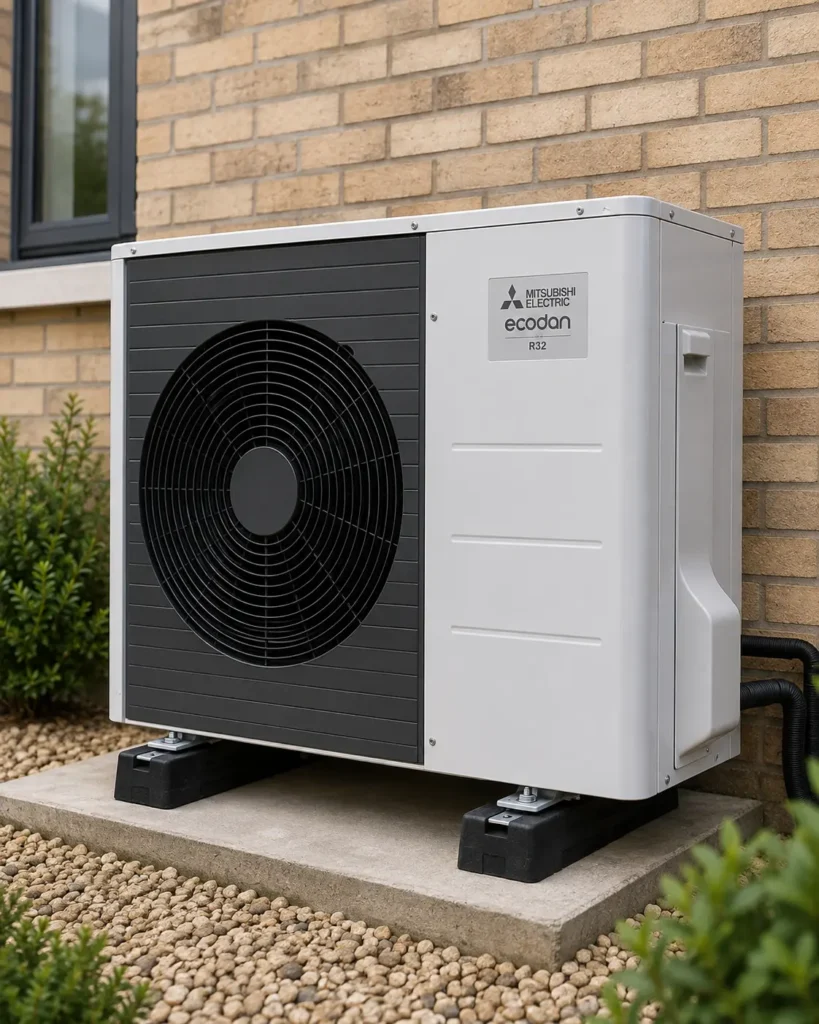
Instead of burning oil, the outdoor unit takes heat from the outside air and transfers it into water for your radiators or underfloor heating. It can also heat water stored in a cylinder. Energy Saving Trust describes air-source heat pumps as suitable for most home types.
For a fuller explanation, see air source heat pumps explained.
Your radiators may stay — but they need checking
An oil boiler commonly sends relatively hot water through radiators for shorter periods. A heat pump normally works most efficiently by supplying lower-temperature water for longer.
That means some existing radiators may already be large enough, while others may need replacing or resizing.
The key question is not simply whether your home has old radiators. It is whether each radiator can deliver enough heat at the proposed heat-pump flow temperature.
A proper survey should therefore include a room-by-room heat-loss calculation and assessment of the existing emitters.
You may need a hot-water cylinder
If your oil boiler already heats a stored hot-water cylinder, part of the existing arrangement may be adaptable depending on the equipment and design.
However, the cylinder itself must be suitable for the new system.
Energy Saving Trust notes that a standard air-source heat pump does not provide instantaneous hot water in the same way as a combi boiler. Stored hot water is normally required.
Other property-specific work can include electrical upgrades, new controls, pipework changes and a suitable base and location for the outdoor unit.
How Much Does Replacing an Oil Boiler with a Heat Pump Cost?
Energy Saving Trust currently gives an indicative figure of around £12,000 for a typical air-source heat-pump installation. Actual costs vary with property size, heat-pump capacity and whether radiators need upgrading.
| Example | Indicative amount |
|---|---|
| Typical air-source heat-pump installation before grant | Around £12,000 |
| Qualifying oil/LPG off-gas BUS grant | £9,000 |
| Illustrative balance | Around £3,000 |
| Property-specific extras or savings | Depends on survey and quotation |
This is an illustration, not a quotation. One oil-heated property may need several radiators, substantial electrical work and a new cylinder. Another may need relatively few changes.
The grant must be shown as an upfront deduction on the installer quotation and invoice. You should not have to pay the grant amount and reclaim it later yourself.
Will a Heat Pump Be Cheaper to Run Than an Oil Boiler?
Possibly, but the grant should not be confused with a guaranteed running-cost saving.
Heat-pump operating costs depend on the amount of heat your home needs, electricity tariff, required flow temperature, system efficiency and how the controls are set.
Energy Saving Trust says appropriately sized radiators, tariff choice and heat-pump controls can all affect running costs. Its current analysis also shows that specialist time-of-use tariffs can materially improve the economics.
For a detailed comparison, see air source heat pump running costs.
When comparing oil with a proposed heat pump, ask the installer to show the assumptions behind projected electricity consumption rather than relying on a generic percentage-saving claim.
How to Apply for the Boiler Upgrade Scheme
You do not normally submit the BUS voucher application yourself.
The current process is:
- Contact one or more MCS-certified heat-pump installers.
- Have your property and heating requirements assessed.
- Confirm that the proposed system and property satisfy BUS rules.
- Agree a quotation showing the grant as a deduction.
- Authorise your chosen installer to apply to Ofgem.
- Respond when Ofgem contacts you to confirm consent and identity details.
- The installer completes and commissions the eligible system.
- The installer redeems the voucher and receives the grant payment.
GOV.UK confirms that the installer applies on the property owner’s behalf and that the grant should appear as a reduction on the quotation and invoice.
For more detail, read the Boiler Upgrade Scheme application guide.
Get Your Free Air Source Heat Pump Quote
Find the right air source heat pump solution for your home. Tell us a few details and our team will help you explore suitable options at a competitive price.
Quick to complete. No obligation.
Get your quote
Enter your details below and one of our team will get back to you.
Frequently asked questions
Find clear answers to common questions about replacing oil heating under the Boiler Upgrade Scheme, including the £7,500 and £9,000 grants, off-gas-grid eligibility, gas connections, hybrid systems, oil tanks, EPCs, insulation, radiators, hot-water cylinders, ground-source and air-to-air heat pumps, and installer applications.
Yes. Oil is an eligible fossil-fuel heating system for replacement under BUS, subject to the other property and installation requirements.
You can normally receive £7,500 for an eligible air-to-water or ground-source heat pump. Until 31 March 2027, qualifying oil- or LPG-heated off-gas-grid properties can receive £9,000.
No. The property must meet the BUS definition of off-gas grid and the new system must be an eligible air-to-water or ground-source heat pump.
Among other criteria, the property must not be fuelled by mains gas, have a record of an existing gas meter point or be attached to a heat network.
Normally no. An existing gas meter-point record can prevent the property qualifying for the special off-gas-grid uplift, although standard BUS support may still be available if the other rules are met.
Not as part of a BUS-funded hybrid system. The funded heat pump must replace the fossil-fuel heating system, and supplementary heating cannot be fossil fuelled.
No current BUS rule says an eligible fossil-fuel boiler must first break down. The important requirement is that the eligible new heating system replaces it.
BUS requires the fossil-fuel heating system to be replaced. Oil-tank decommissioning or physical removal should be confirmed separately in your quotation.
A valid EPC is no longer a standing requirement. Where no valid EPC exists, an installer can provide alternative evidence to Ofgem.
The previous BUS insulation conditions no longer apply in the same way under the rules effective from 28 April 2026. Improving insulation can still reduce heat loss and help heat-pump performance.
Not necessarily. Each radiator should be checked against the room's calculated heat requirement and the proposed heat-pump flow temperature.
Possibly. Air-to-water heat pumps usually store domestic hot water in a suitable cylinder, so your installer must assess whether an existing cylinder can be used.
Yes. Eligible ground-source installations receive £7,500 normally or £9,000 for qualifying off-gas oil/LPG properties during the temporary uplift period.
Air-to-air heat pumps are now an eligible BUS technology for residential properties, but their grant is £2,500 rather than the £9,000 oil/LPG uplift available for qualifying hydronic heat pumps.
Your MCS-certified installer applies to Ofgem on your behalf. You then confirm your consent and relevant details when Ofgem contacts you.
Is Replacing an Oil Boiler with a Heat Pump Worth Considering?
For an eligible oil-heated home, 2026 is an unusually favourable time to investigate the numbers because the temporary £9,000 BUS grant can significantly reduce the upfront cost.
Interest from oil-heated households has risen sharply since the uplift. Government figures published in August 2026 reported 8,150 heat-pump applications during July, with increased demand from heating-oil households.
However, grant eligibility alone does not make a heat pump the right answer.
Before replacing your oil boiler, establish your home’s heat loss, likely radiator changes, hot-water requirements, electrical work, expected seasonal efficiency and total cost after the grant.
If those figures work, the Boiler Upgrade Scheme can make moving away from oil considerably more affordable.
Next step: compare properly surveyed heat-pump quotations and confirm your £9,000 eligibility before committing to installation.


