Solar Panel Maintenance Cost UK 2026: Full Price Guide
Check Your Eligibility for Boiler Upgrade Scheme (BUS)
Complete your details below to check your eligibility.
Thank you
We've received your details and will be in touch shortly.
Quick answer: how much does solar panel maintenance cost in the UK?
For most UK homeowners, solar panel maintenance is an occasional cost rather than a compulsory annual bill. Professional cleaning generally starts at around £60–£100 for a standard domestic system. A standard inspection or service is commonly quoted at about £80–£130, depending on what is tested and access. The largest long-term expense is usually the inverter: Energy Saving Trust says replacement commonly costs around £800 and may be needed after 10–15 years. Many homes can therefore have years with little or no maintenance spending, followed by a larger cost when cleaning, repairs or inverter replacement becomes necessary.
Solar Panel Maintenance Cost UK 2026: Cleaning, Servicing and Repair Prices
Solar panels are low-maintenance, but they are not maintenance-free. For a typical UK home, the main costs are occasional cleaning, periodic inspection or servicing, and eventually replacing the inverter. These costs do not usually arrive every year.
Energy Saving Trust says professional cleaning typically starts at about £60–£100 for a standard system, while an inverter replacement is around £800 and is commonly needed after 10–15 years. Current UK trade price guides put a standard service at roughly £80–£130, although the scope varies. Energy Saving Trust
This guide explains solar panel maintenance costs in the UK in 2026, which jobs are genuinely necessary, what raises the price, and how to budget without paying for unnecessary annual work.
If you are considering solar rather than maintaining an existing system, compare maintenance requirements, inverter warranties and aftercare before choosing on headline price alone. You can compare solar panel installation quotes based on the complete specification rather than installation price alone.
Solar panel maintenance costs at a glance
| Maintenance item | Typical 2026 UK cost | Typical timing |
|---|---|---|
| Professional panel cleaning | About £60–£100 | When visibly needed |
| Standard service/inspection | About £80–£130 | Periodically |
| Minor component repairs | Roughly £80–£250 | As required |
| Inverter replacement | Around £800 | Commonly after 10–15 years |
These are indicative figures, not guaranteed quotations. Roof access, system size, location, equipment type and the work included can change the final price considerably.
How much should you budget each year?
A fixed “annual solar panel maintenance cost” can be misleading. Solar PV panels have no moving parts, and many domestic systems need little paid attention during a normal year.
A better approach is to keep a long-term maintenance reserve. For example, assume you pay £60–£100 for cleaning every two years, £80–£130 for a service every four years, and reserve for an £800 inverter replacement every 10–15 years. That works out at roughly £100–£165 a year when averaged over time.
That is a budgeting example, not an expected annual bill. You might spend nothing one year and face an inverter or repair bill several years later. The underlying cost assumptions reflect current Energy Saving Trust and UK trade benchmarks. Energy Saving Trust
If normal rainfall keeps your array clean and your warranty does not require frequent servicing, your routine expenditure could be lower.
For the wider ownership picture, compare maintenance with the installation figures in our solar panel cost UK guide.
Do solar panels need an annual service?
Not necessarily. This is an important distinction because many commercial maintenance guides describe an annual service as standard.
The current MCS Solar PV Standard MIS 3002 describes its maintenance frequencies as advisory. For a privately owned domestic system, its example schedule shows annual homeowner visual checks, an intermediate contractor visit at 10 years and a fuller maintenance visit at 15 years. MCS also says the appropriate frequency depends on factors such as system size, building use and roof access. MCS Certified
Energy Saving Trust takes a more frequent approach. Its October 2026 guidance recommends inspecting panels, mounting equipment and visible wiring every one to two years and having a full professional service every three to five years.
| Guidance | Practical message for homeowners |
|---|---|
| MCS 2026 | Annual homeowner visual checks; contractor intervals are advisory and system-specific |
| Energy Saving Trust | Inspect every 1–2 years and consider a full professional service every 3–5 years |
Therefore, use your own handover pack, manufacturer instructions, warranty conditions and insurer requirements to decide the right interval.
Our separate solar panel installation maintenance guide covers the actual inspection and maintenance tasks in more detail.
How often do solar panels need cleaning?
Usually, only when there is a reason.
Energy Saving Trust says UK rainfall removes much ordinary dirt from rooftop panels. It recommends checking panels roughly every 12–18 months and cleaning them where visible contamination has accumulated. Its current solar panel cleaning and maintenance guidance also notes that homes near trees, dusty areas or regular bird activity may need more attention. Energy Saving Trust
Cleaning becomes more worthwhile when you have:
- bird droppings or lichen
- leaves or tree sap
- persistent road or construction dust
- shallow-pitch panels
- ground-mounted panels
- an unexplained performance reduction alongside visible dirt.
Before paying for cleaning, check your monitoring data. Falling generation can indicate dirt, but shading, an inverter problem or another electrical fault can have a similar effect.
Our solar panel output UK guide explains the other factors that influence electricity generation.
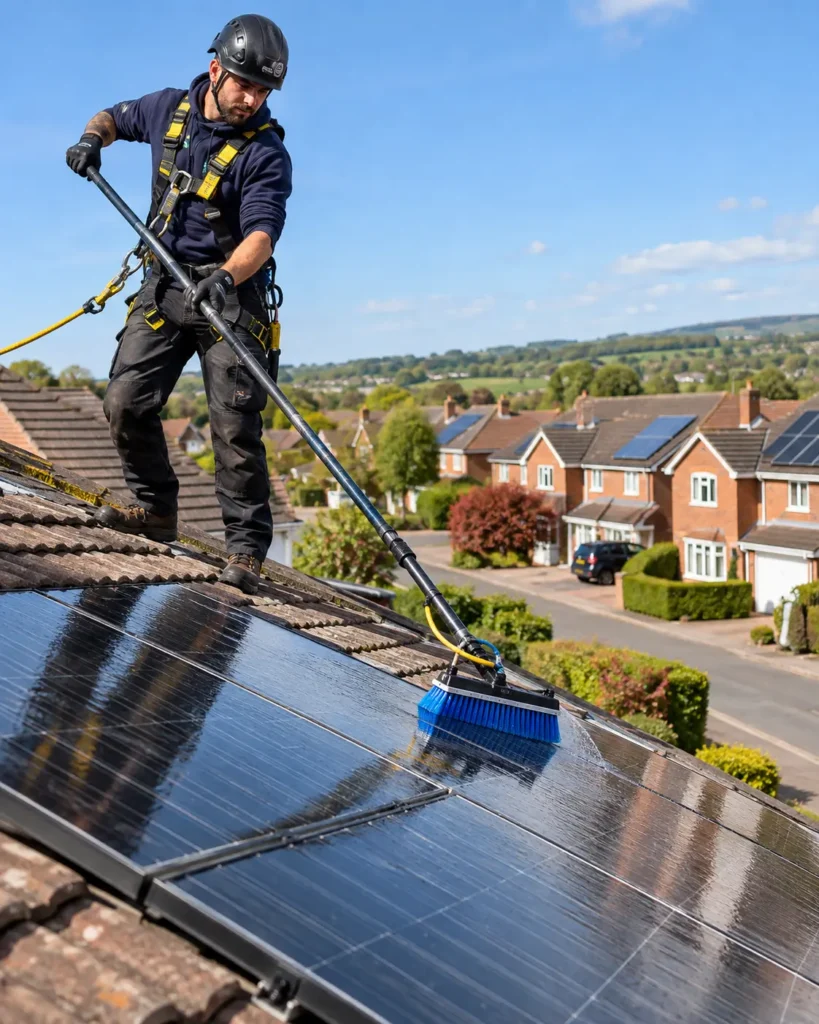
Professional cleaning starts at about £60–£100 for a standard installation, although difficult roof access can increase the price. Energy Saving Trust
Avoid high-pressure washing. Energy Saving Trust warns that pressure washers can interfere with panel seals and wiring. Water with a soft brush or sponge is preferable, subject to the panel manufacturer’s instructions. Energy Saving Trust
What affects solar panel maintenance cost?
System size affects the price because larger arrays take longer to clean, inspect and test.
However, roof access can matter even more. A small array on an accessible bungalow may be straightforward. Panels on a steep, high or awkward roof may need specialist access equipment.
Energy Saving Trust specifically identifies the number of panels, their location and the need for specialist access as factors affecting professional cleaning prices. Energy Saving Trust
Local conditions matter too. Coastal salt, frequent bird activity, overhanging trees, busy roads or dusty surroundings may increase cleaning requirements.
Older installations can also take longer to investigate if an engineer needs to diagnose faults. Systems with batteries, microinverters, optimisers or extra monitoring equipment contain more components that may require checking.
Ask contractors to separate cleaning, electrical testing, parts, access equipment and call-out charges in their quotation. Otherwise, two apparently similar maintenance prices may cover very different work.
Inverter replacement is the main long-term cost
The inverter converts the DC electricity generated by the panels into AC electricity your home can use.
Because it operates whenever the array is producing electricity, it commonly needs replacement sooner than the solar panels themselves.
Energy Saving Trust currently says solar inverters typically require replacement every 10–15 years and gives an indicative replacement cost of around £800. Energy Saving Trust
The actual quote can be higher for a hybrid inverter, larger installation or system requiring additional electrical work.
Before authorising replacement, check the inverter warranty and your original installation paperwork. Some faults may still be covered.
Also ask whether the replacement affects monitoring or battery compatibility. Selecting a different inverter is not simply a matter of choosing whichever replacement unit has the lowest purchase price.
Are solar panel maintenance contracts worth it?
They can be, but they are not automatically necessary.
A maintenance contract becomes more useful when it includes meaningful technical checks, remote monitoring, priority call-outs or work specifically required under a warranty or insurance policy.
It offers less value if you are mainly paying for a basic visual check that could safely be completed from ground level.
Ask exactly what the price includes:
- electrical testing
- inverter fault-log checks
- comparison of actual and predicted performance
- panel cleaning
- roof access
- written inspection reports
- call-outs
- labour and replacement parts.
MCS explicitly describes its example maintenance frequencies as advisory, which makes the scope of the contract more important than the word “annual”. MCS Certified
How to keep solar maintenance costs under control
- Keep your handover documents. Store warranties, manuals, system drawings and inverter information together.
- Use your monitoring system. Unexpected changes can reveal faults before they become expensive.
- Make an annual ground-level visual check. Look for damage, heavy soiling and new shading.
- Clean when there is evidence it is needed. Avoid paying for arbitrary cleaning schedules.
- Compare written repair quotes. Make sure contractors are pricing the same work.
- Check warranty cover first. Do this before authorising replacement parts.
- Avoid unsafe DIY roof access. The saving is rarely worth the additional risk.
If you are buying solar now, compare aftercare and inverter warranty alongside installation price.
When should you call a professional?
Arrange professional help if you notice cracked panels, loose-looking modules, damaged visible cables, repeated inverter errors, water ingress, unusual burning smells or a significant unexplained fall in generation.
Electrical fault-finding and roof-level work also need appropriate competence and equipment.
The Health and Safety Executive’s work-at-height guidance says work at height should be avoided where possible and specifically gives extending tools used from ground level as an example of safer working. HSE
If you cannot clean or inspect the system safely from the ground, professional access should be regarded as part of maintaining the installation safely.
Is solar panel maintenance worth paying for?
Yes, when the work solves a genuine problem or satisfies a real inspection requirement.
No, when you are paying for unnecessary cleaning or a vague service that offers little more than a quick visual check.
Use evidence to make the decision: visible dirt, monitoring data, inverter warnings, warranty requirements or a scheduled inspection.
That keeps a genuinely low-maintenance technology from becoming an unnecessary annual subscription.
For homeowners considering a new system, compare the panels, inverter warranty, monitoring, aftercare and total installed cost together.
Get Your Free Air Source Heat Pump Quote
Find the right air source heat pump solution for your home. Tell us a few details and our team will help you explore suitable options at a competitive price.
Quick to complete. No obligation.
Get your quote
Enter your details below and one of our team will get back to you.
Frequently asked questions
Find clear answers to common questions about solar panel maintenance costs, cleaning, servicing, inverter replacement, warranties and ongoing care.
There is no fixed annual cost. Some years may cost nothing. For budgeting purposes, roughly £100–£165 a year averaged over the long term can cover periodic cleaning and servicing plus an inverter reserve, depending on your system and maintenance schedule.
Not necessarily. MCS's 2026 maintenance intervals are advisory and show annual homeowner visual checks rather than annual professional servicing for privately owned domestic systems. Energy Saving Trust recommends a fuller service every three to five years.
Energy Saving Trust says professional cleaning generally starts at around £60–£100 for a standard domestic system. Large or difficult-to-access arrays can cost more.
Check them roughly every 12–18 months and clean them when dirt has visibly accumulated. Properties affected by birds, trees or heavy dust may need more frequent attention.
Yes. UK rainfall removes much ordinary dust and dirt, particularly from tilted rooftop arrays. Persistent bird droppings, lichen and other deposits may still require cleaning.
Potentially, if you can work safely from ground level and follow the manufacturer's instructions. Avoid climbing onto the roof simply to clean panels.
No. Energy Saving Trust advises against high-pressure power washing because it can interfere with panel seals and wiring.
Energy Saving Trust currently gives an indicative cost of around £800. The actual price depends on the inverter specification and installation work required.
A typical inverter may need replacing after around 10–15 years, although lifespan varies by product, operating conditions and warranty.
It depends on the warranty. Energy Saving Trust advises homeowners to check their installer and warranty conditions because some require servicing within specified periods.
They can be if they include useful technical testing, monitoring, reporting or required warranty work. Compare the included services against paying only when maintenance is actually needed.
They can. Shallow-mounted panels may retain more dirt, while access arrangements can also affect cleaning and inspection prices.
The main factors include system size, difficult roof access, specialist access equipment, location, extensive soiling, older equipment and the amount of fault-finding or electrical work required.
Look for persistent reductions in generation, inverter warnings, visible damage, damaged cabling, water ingress, loose components or heavy contamination.
Use somebody competent for the work required. Electrical testing and specialist PV maintenance should be undertaken by someone with suitable electrical and solar PV competence, while roof work requires appropriate access skills and equipment.
Conclusion
Solar panel maintenance costs in the UK are generally modest, but they are uneven. Professional cleaning typically starts at £60–£100, a standard service may cost around £80–£130, and the main long-term expense is usually an inverter replacement at approximately £800. Energy Saving Trust
The most important point is that annual paid servicing is not automatically appropriate for every privately owned system. Follow the maintenance guidance for your installation, monitor its performance and spend money when there is a clear reason to do so.
Budget for occasional costs, maintain an inverter reserve and use competent professionals where roof access or electrical work makes DIY inappropriate.
Ready to compare your options? Visit Get Free Quote to compare suitable home-improvement quotations with no obligation.