
Solar Panel Mounting for Flat Roof: UK Guide 2026
Check Your Eligibility for Boiler Upgrade Scheme (BUS)
Complete your details below to check your eligibility.
Thank you
We've received your details and will be in touch shortly.

Quick answer: how are solar panels mounted on a flat roof?
Solar panels on flat roofs are normally supported by angled frames rather than laid directly against the roof surface. The mounting system may be ballasted, using weights to resist wind movement without penetrating the waterproof layer, or mechanically fixed to the roof structure.
The correct system depends on the roof construction, available load capacity, waterproofing, building height, wind exposure and panel layout. MCS’s current solar PV installation standard requires specific structural and wind-loading considerations for flat-roof systems. For ballasted arrays, a qualified structural engineer must confirm that the roof can carry the solar equipment and ballast. MCS Certified
Solar Panel Mounting for Flat Roof: UK Guide to Systems, Fixings and Structural Checks
Installing solar panels on a flat roof is perfectly possible, but the mounting system needs more consideration than it would on many pitched roofs.
Instead of simply following the existing roof angle, a flat-roof array needs a supporting structure that holds each panel at the required tilt and keeps it secure against wind. The design must also avoid overloading the roof or damaging its waterproof covering.
For UK homeowners, the main choice is usually between a ballasted mounting system, which uses weight to secure the array, and a mechanically fixed system, which connects the mounting structure to the building. Some specialist roof systems also use bonded or membrane-welded mounting points.
This guide focuses specifically on solar panel mounting for flat roof installations: how the systems work, what determines the right mounting method and what your installer should check before panels go onto the roof.
For broader information about whether flat-roof solar is suitable in the first place, see our guide to solar panels on a flat roof in the UK.
Planning a solar installation? Get Free Quote can help you compare suitable solar installation quotations for your property.
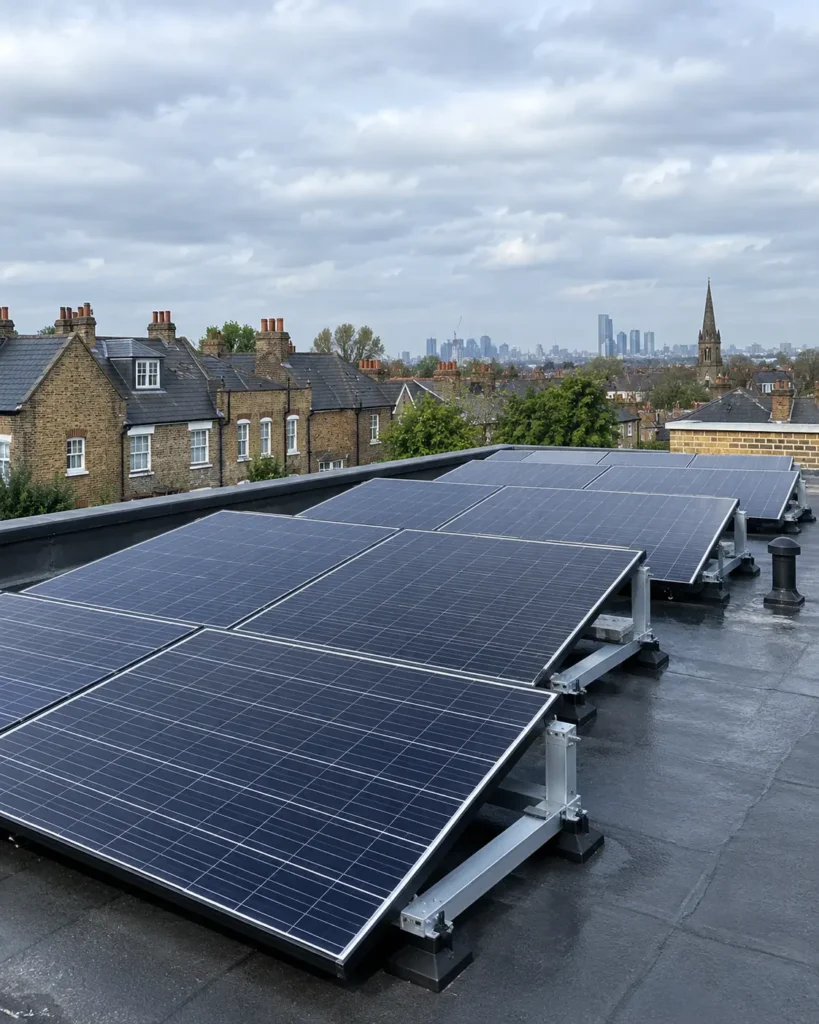
How does solar panel mounting on a flat roof work?
A flat roof gives the installer more freedom over panel direction and tilt than a conventional pitched roof.
The panels sit on a purpose-designed mounting structure. Depending on the system, that structure may consist of aluminium rails, triangular supports, moulded trays or linked aerodynamic frames.
The frame has three important jobs. It must support the modules at the designed angle, transfer loads safely into or across the roof and prevent the array from moving under wind pressure.
Flat-roof mounting therefore cannot be selected simply by counting panels. The installer needs to design the array around the specific building.
Energy Saving Trust confirms that panels can be installed on flat roofs and notes that weighted systems are commonly used to avoid disturbing the roof covering. It also stresses that the roof needs enough strength to support any additional weight. Energy Saving Trust solar panel guidance
What types of flat-roof solar mounting system are available?
Three approaches are commonly encountered.
| Mounting method | How it is secured | Main advantage | Main consideration |
|---|---|---|---|
| Ballasted | Concrete blocks, slabs or dedicated ballast hold the frame down | Usually avoids penetrating the waterproof covering | Adds weight and requires structural and wind calculations |
| Mechanically fixed | Anchors connect the frame to the roof structure | Can reduce the ballast requirement | Penetrations must be designed and waterproofed correctly |
| Bonded or membrane-integrated | Specialist mounting points attach to a compatible roofing system | Can avoid both penetrations and heavy ballast | Usually limited to specific roofing products and approved systems |
Manufacturers offer variations within these categories. Renusol, for example, produces aerodynamic ballasted rail systems and mechanically restrained alternatives, while K2 offers both ballasted and fixed flat-roof configurations. Renusol
Specialist waterproofing manufacturers may take a different approach. Bauder offers systems in which mounting units are integrated with compatible roof membranes without conventional roof penetrations or separate ballast. Bauder
Is ballasted solar mounting better than fixing into the roof?
Neither method is automatically better.
When ballasted mounting makes sense
Ballasted systems are popular because they can leave the waterproof membrane intact. The mounting frame sits on protective pads, and calculated weights resist sliding and wind uplift.
However, “no roof penetrations” does not mean “no structural concerns”.
The ballast, panels and framework create additional permanent loads. Wind can also produce uplift forces, particularly around exposed roof areas.
Under the current MCS installation standard, the wind-resistance calculation for a ballasted system must account for friction and relevant wind pressure. A qualified structural engineer must also confirm that the roof can withstand the combined PV and ballast load. MCS solar PV installation standard
When mechanical fixing may be preferable
If the roof cannot safely carry the ballast required, fixing the array into the building structure may provide a better solution.
Mechanical fixing transfers forces through anchors rather than relying primarily on weight.
MCS states that mechanically fixed flat-roof installations on existing solid decks may require a condition survey and pull-out testing. Where the roof build-up cannot be established reliably, suitable pull-out tests should also be undertaken. MCS Certified
The trade-off is that any penetration through a roof covering must maintain weather-tightness.
For more detail about the wider installation sequence, see our flat-roof solar panel installation guide.
Why structural loading matters
A solar array introduces more than just the weight of the panels.
The roof may need to carry:
- modules and rails
- mounting frames
- ballast
- cables and ancillary equipment
- snow loads
- forces created by wind
Wind deserves particular attention. Tilting a panel creates surfaces that wind can act upon, and the forces differ across the roof.
That is why professional mounting-system software normally uses details such as building dimensions, postcode, roof height, panel arrangement and edge distances when producing a ballast or fixing design.
A quotation that simply states a standard amount of ballast per panel without showing how the mounting design has been calculated deserves further investigation.
Will flat-roof solar mounting damage the waterproofing?
It should not if the system is correctly designed and installed.
MCS states that a PV installation should not adversely affect the building’s weather-tightness or structural integrity. It also says the roof warranty provider should be consulted where an existing covering remains under warranty. MCS Certified
For ballasted systems, compatible protective or slip layers separate the mounting frame from the waterproofing.
Mechanical fixings require correctly designed penetrations and weatherproofing.
The condition of the existing roof also matters. Installing a 20- to 30-year solar system above a waterproof covering that may soon need replacement can create avoidable future costs. Energy Saving Trust therefore notes that renewing the roof covering before solar installation can sometimes make financial sense. Energy Saving Trust
What angle should flat-roof solar panels use?
Mounting angle affects generation, wind loading, shading between rows and the amount of roof area available.
Many commercial flat-roof mounting products use relatively shallow angles such as 10°. For example, current Renusol and K2 flat-roof systems include 10° configurations. Renusol
A steeper angle is not automatically better. Increasing the tilt can:
- increase wind forces
- require more ballast or stronger fixings
- create greater inter-row shading
- reduce the number of panels that fit
- make planning limits more relevant
An east-west array can often fit panels more densely because modules are arranged back-to-back at shallow angles. A south-facing layout may use wider gaps between rows to limit shading.
For a detailed discussion of this design choice, see our UK flat-roof solar panel angle guide.
What are the UK planning rules for flat-roof solar panels?
Planning law varies between England, Wales, Scotland and Northern Ireland, so installers should check the rules applying to the property rather than relying on one UK-wide figure.
| Location | Example current guidance |
|---|---|
| England – domestic | Planning Portal states that flat-roof solar installed under permitted development cannot normally extend more than 600mm above the highest part of the roof. England's domestic solar rules were updated on 27 August 2026, with transitional arrangements running to August 2027. |
| Wales – domestic | Welsh Government guidance states that flat-roof panels must satisfy specific restrictions concerning the external roof edge and height above the roof plane. |
| Scotland – domestic | Scottish guidance provides specific permitted-development rights for solar equipment, including limits on how far equipment can project from the building. |
Planning Portal guidance for England explains the current domestic rules and exceptions. Welsh Government solar planning guidance and Scottish Government microgeneration guidance cover their respective regimes.
Listed buildings, conservation areas and other designated locations can have additional requirements. Always verify the position for the individual property.
What should an installer check before choosing the mounting system?
A proper survey should establish the roof construction rather than treating every flat roof alike.
The installer or design team needs to know the roof deck type, supporting structure, waterproofing material, roof condition, slope, drainage routes and existing warranty conditions.
They should then consider building height, local wind exposure, obstructions, parapets and viable array layouts.
For a ballasted proposal, ask to see evidence that the roof loading and wind resistance have actually been calculated. For mechanically fixed systems, ask how the fixing method has been verified and how waterproofing will be maintained.
The broader solar panel installation process should also include the electrical design, inverter location, cabling, DNO requirements and commissioning.
Does flat-roof mounting make solar more expensive?
It can, although there is no reliable universal percentage premium.
Energy Saving Trust currently estimates around £7,600 for a typical domestic solar PV installation, but actual cost varies according to system size, equipment, access and property conditions. Energy Saving Trust
A flat roof may introduce additional costs for mounting hardware, ballast handling, structural engineering, roof works or specialist waterproofing.
However, another flat roof may be straightforward and easy to access.
For this reason, compare itemised quotations rather than applying a generic flat-roof surcharge. The quotation should make clear what mounting system is proposed and whether structural calculations, ballast, roof works and access costs are included.
Get Your Free Air Source Heat Pump Quote
Find the right air source heat pump solution for your home. Tell us a few details and our team will help you explore suitable options at a competitive price.
Quick to complete. No obligation.
Get your quote
Enter your details below and one of our team will get back to you.
Frequently asked questions
Find clear answers to common questions comparing air source and ground source heat pumps, including efficiency, installation and running costs, winter performance, noise, land requirements and borehole depth.
Not automatically. The roof must have adequate structural capacity, suitable waterproofing and enough usable space for the proposed mounting system.
No. Many systems use calculated ballast instead of penetrating the roof covering.
It is a mounting system held in place partly or wholly by added weight, usually combined with an aerodynamic frame designed to resist wind forces.
There is no standard weight per panel. Required ballast depends on factors including the mounting system, building dimensions, location, wind loading and array position.
For ballasted systems installed under the current MCS installation standard, a qualified structural engineer must be consulted to ensure the roof can withstand the PV system and ballast. MCS Certified
Poor design or incompatible materials can cause problems. Correct systems use suitable protective interfaces and maintain the roof's weather-tightness.
Mechanically fixed systems can penetrate the roof where appropriately designed, but fixings and waterproofing must suit the roof construction.
There is no universal best angle. Shallow mounting around 10° is common because it can balance generation, wind loading, row spacing and roof utilisation.
South-facing arrays can favour peak annual generation, while east-west arrangements can use roof space efficiently and spread production across more of the day. The best option depends on the property and electricity-use pattern.
Technically panels can generate at very low angles, but purpose-designed tilted mounting normally improves drainage, system layout and performance.
The required distance depends on mounting-system design, wind calculations and applicable planning rules. Do not assume one universal setback applies throughout the UK.
A properly designed system uses protective layers or pads between the mounting system and compatible waterproofing.
Often yes, provided the proposed mounting and protection materials are compatible with that specific roof system and its warranty requirements.
It can be sensible if the covering is approaching the end of its service life. Removing an array later to renew the roof adds work and expense.
Ask for the proposed mounting system, panel layout, structural assessment, wind-load calculation, ballast or fixing details, waterproofing method, warranty implications and clear exclusions.
How to choose solar panel mounting for a flat roof
Start with the roof, not the mounting product.
First, establish whether the structure can accept additional load. Then identify the roof covering and its remaining life.
Next, compare a ballasted design with mechanically fixed or specialist low-load alternatives where appropriate. Look at the calculated wind loads rather than selecting a system solely because it avoids penetrations.
Finally, assess the panel layout. The best design balances annual generation, usable roof area, shading, loading, planning restrictions and maintenance access.
The mounting system may be largely hidden once the panels are installed, but it is one of the most important parts of a flat-roof solar project. A sound design keeps the modules secure while protecting the building underneath them.
If you are comparing proposals, ask each installer to explain how the array will be held down, what loads the roof will experience and how those figures were verified. Those answers are more useful than simply comparing the number of panels or total quotation price.


