
Solar Panels Price UK 2026: Costs, Savings & Payback
Check Your Eligibility for Boiler Upgrade Scheme (BUS)
Complete your details below to check your eligibility.
Thank you
We've received your details and will be in touch shortly.

Quick answer: how much do solar panels cost in the UK?
A typical domestic solar PV system costs around £7,600 installed for a 4.5 kWp system, according to Energy Saving Trust. Battery storage commonly adds around £5,000–£8,000.
Installed solar panels and qualifying batteries currently benefit from 0% VAT until 31 March 2027. Your actual quote depends on the size of the system, roof complexity, panels and inverter chosen, scaffolding, electrical upgrades and any grid-connection requirements.
For independent homeowner guidance, see the Energy Saving Trust solar panel guide.
Solar Panels for Farms UK: Costs, Payback, Planning and Practical Advice for 2026
If you are comparing solar panels prices in the UK, a realistic starting point in 2026 is around £7,600 for a typical 4.5 kWp domestic system, before battery storage. That is the current benchmark from Energy Saving Trust.
The final price can be lower or higher. System size, roof access, scaffolding, inverter choice, electrical work and battery storage can all change the quotation.
Government cost data gives another useful benchmark. The latest Department for Energy Security and Net Zero figures are based on installations recorded through the MCS database. For domestic retrofit systems installed in 2025/26, averages were approximately £2,109 per kW for systems up to 4 kW and £1,651 per kW for systems between 4 and 10 kW.
This guide explains what a reasonable solar panel price looks like, what changes the cost, whether a battery is worth adding and how to compare quotes properly.
Ready to find out what solar would cost on your property? Compare free solar quotes with Get Free Quote
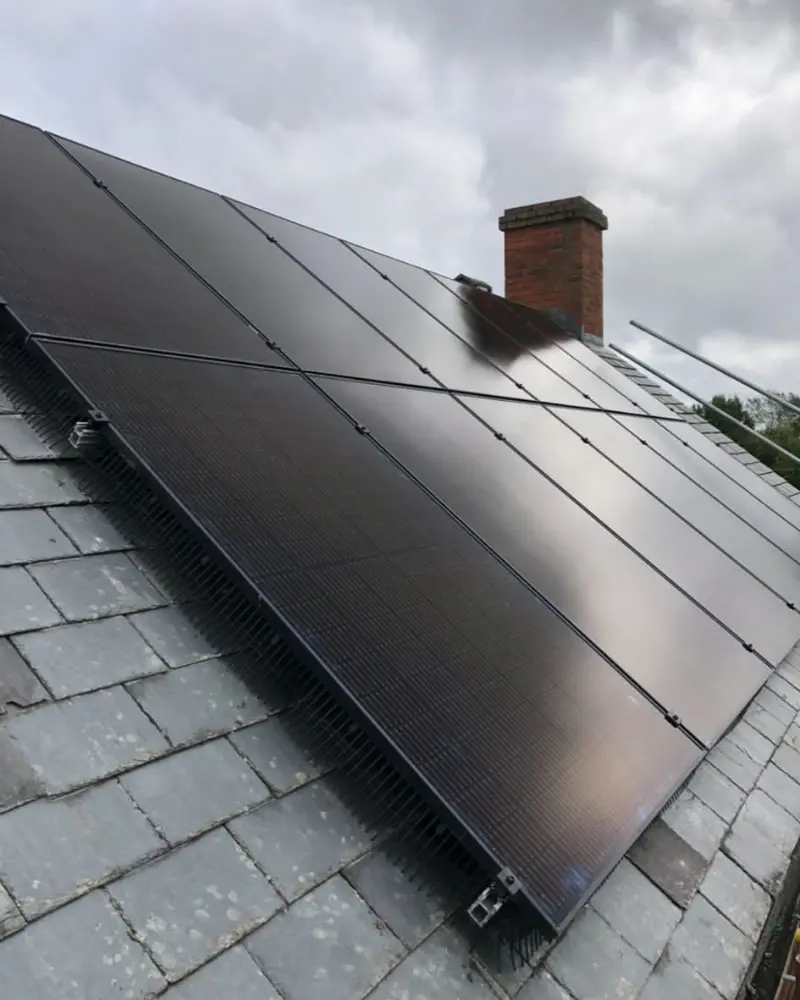
Solar panel prices in the UK in 2026
The most useful way to compare solar prices is by installed capacity, measured in kilowatt-peak (kWp). This tells you the combined rated output of the panels under standard test conditions.
A typical domestic system is around 4.5 kWp. Energy Saving Trust says this normally requires about 12 panels and roughly 20–30m² of usable roof area.
| Price benchmark | 2026 figure | What it tells you |
|---|---|---|
| Typical 4.5 kWp home system | Around £7,600 | Energy Saving Trust benchmark |
| Domestic retrofit up to 4 kW | About £2,109 per kW | 2025/26 government/MCS cost data |
| Domestic retrofit 4–10 kW | About £1,651 per kW | 2025/26 government/MCS cost data |
| Battery storage | Around £5,000–£8,000 | Energy Saving Trust estimate |
The government’s underlying solar PV cost statistics come from the MCS Installation Database. You can review the official UK solar PV cost data.
These figures are benchmarks, not quotations. A straightforward pitched roof could cost less than a property requiring complicated scaffolding, roof repairs or substantial electrical work.
One useful comparison is price per kWp. Divide the solar-only quote by the system’s total kWp. If one quotation is substantially more expensive, ask what accounts for the difference.
For a more detailed checklist, see the solar panel installation quote guide.
What affects the price of solar panels?
System size and panel specification
More panels increase the total price, although larger installations often become cheaper per kWp. Scaffolding, surveys, system design, electrical protection and administration create fixed costs whether you install six panels or sixteen.
Panel efficiency matters too. Higher-efficiency modules can be useful where roof space is limited because they provide more rated capacity from the available area.
However, the highest-wattage or most expensive panel is not automatically the best financial choice. Compare efficiency, degradation guarantees, product warranties and manufacturer support.
Roof access, scaffolding and condition
Roof design can have a significant effect on installation costs.
A simple two-storey pitched roof will normally be easier to work on than a property with several roof elevations, dormers, conservatories or restricted access.
The roof should also have enough remaining life to justify installing a system expected to operate for decades. Energy Saving Trust says solar panels themselves should generally last 25 years or more.
If significant roofing work is already likely, read the guidance on whether you need a new roof before installing solar panels.
Inverter and electrical work
Every solar PV system needs an inverter. It converts the direct-current electricity generated by the panels into alternating current that household appliances can use.
A standard string inverter is usually the simplest option. Microinverters or power optimisers can cost more but may help on complicated or partially shaded arrays.
Hybrid inverters are designed to work with battery storage and may make a future battery upgrade simpler.
Your quote might also include consumer-unit work, new cabling, isolators, monitoring equipment or export limitation equipment. Ask installers to identify these costs rather than supplying an unexplained total.
How much does a solar battery add?
Energy Saving Trust currently puts typical battery storage costs at approximately £5,000–£8,000.
A battery stores electricity that your panels generate but your home does not immediately use. You can then use that electricity later, including during the evening.
This can increase solar self-consumption. However, it does not automatically mean a battery provides the fastest financial return.
Ask for two calculations:
Solar panels without a battery.
The same array with battery storage.
Compare the extra battery cost with the additional estimated annual saving.
Installed electrical storage batteries currently receive the same temporary 0% VAT relief as qualifying installed solar panels. The zero rate runs until 31 March 2027 and is scheduled to revert to the reduced 5% rate from 1 April 2027 under current rules.
See the current HMRC guidance on VAT for energy-saving products.
How much can solar panels save?
Your savings depend mainly on:
How much electricity the panels generate.
How much solar electricity you use yourself.
The price you would otherwise pay for grid electricity.
How much electricity you export.
Your export tariff.
Future energy prices.
For 1 October to 31 December 2026, Ofgem’s average electricity unit rate for households on standard-variable Direct Debit tariffs in Great Britain is 26.32p per kWh.
This helps explain why using your solar electricity at home can be valuable: every unit used directly is one less unit that needs to be purchased from the grid.
For a more detailed estimate of generation, see the guide to solar panel output in the UK.
What about electricity exported to the grid?
The Smart Export Guarantee (SEG) enables eligible small-scale generators in Great Britain to receive payment for electricity exported to the grid. Suppliers set their own rates, contract terms and eligibility conditions. SEG tariff rates must be above zero.
You should therefore avoid calculating payback using an export rate without checking whether you actually qualify for that tariff.
See Ofgem’s Smart Export Guarantee guidance.
How long do solar panels take to pay for themselves?
Energy Saving Trust’s current modelling gives typical solar-panel payback periods of roughly 9–12 years in Great Britain when export payments are included, depending on location and how electricity is used.
That is not a guaranteed return.
Electricity prices, export tariffs, generation, degradation, maintenance costs and inverter replacement can all alter the eventual result.
Roof orientation also matters. Energy Saving Trust estimates east- or west-facing systems typically generate around 15–20% less electricity than an equivalent directly south-facing array.
Are there solar panel grants in 2026?
There is no single dedicated UK Government solar-panel grant available automatically to every homeowner. Energy Saving Trust advises that support may instead be available through wider government or supplier schemes.
The Warm Homes Plan includes direct support aimed at lower-income and fuel-poor households as well as plans for low- and zero-interest finance that can help households fund measures including solar panels and batteries.
Eligibility varies. Check the current rules before assuming funding will apply to your property.
See the government’s Warm Homes Plan for the latest national policy position.
For many households buying without grant support, the immediate tax benefit remains the temporary 0% VAT treatment for qualifying installations until 31 March 2027.
How to compare solar panel quotes properly
Price matters, but a cheap system that is poorly specified can be worse value than a more expensive installation designed around the property.
Ask each installer to provide the same information:
Total system capacity in kWp.
Number, make and model of panels.
Estimated annual generation and modelling assumptions.
Inverter make, model and warranty.
Scaffolding and access costs.
Mounting system and electrical work.
DNO connection or notification responsibilities.
Product and workmanship warranties.
Any exclusions or possible additional charges.
Solar-only and battery-inclusive prices separately.
A site survey should also confirm usable roof space, orientation, shading, roof condition, cable routes and suitable inverter or battery locations.
Where MCS certification is relevant, verify the installer rather than relying solely on a logo displayed on a quotation. MCS-certified businesses must follow scheme requirements covering installation standards, pre-sale information and system-performance estimates.
Read more about choosing MCS-certified solar installers in the UK.
Are solar panels worth the price?
Solar can make financial sense when the system is correctly sized, the property is suitable and you expect to benefit from the installation for long enough.
Use this practical decision process:
Start with your annual electricity consumption, rather than the number of bedrooms.
Check usable roof area, direction and shading.
Calculate the solar-only return before considering a battery.
Compare several written quotations based on similar specifications.
Check how each installer calculated annual generation.
Verify the assumed electricity and export prices.
Consider possible inverter replacement and other long-term costs.
A quotation close to the national average can still represent poor value if the design is unsuitable. Equally, a price above the average may be reasonable where the property needs additional scaffolding, premium equipment or electrical upgrades.
Get Your Free Air Source Heat Pump Quote
Find the right air source heat pump solution for your home. Tell us a few details and our team will help you explore suitable options at a competitive price.
Quick to complete. No obligation.
Get your quote
Enter your details below and one of our team will get back to you.
Frequently asked questions
Find clear answers to common questions comparing air source and ground source heat pumps, including efficiency, installation and running costs, winter performance, noise, land requirements and borehole depth.
Energy Saving Trust currently estimates around £7,600 for a typical 4.5 kWp domestic solar system. Your price will depend on system size, roof design, equipment and installation requirements.
There is no fixed national price. Government 2025/26 data shows smaller domestic retrofit systems can cost more per kW than larger arrays, so compare quotations using both the total price and installed kWp.
A typical 4.5 kWp solar installation is around £7,600, while Energy Saving Trust estimates battery storage at about £5,000–£8,000. Actual package prices vary considerably.
Qualifying installed solar panels currently benefit from 0% VAT until 31 March 2027. Under current legislation, the reduced 5% rate is scheduled to apply afterwards.
Yes. Qualifying installed electrical storage batteries are included in the temporary zero-rate treatment.
Energy Saving Trust currently models roughly 9–12 years for typical Great Britain examples including export payments. Actual payback depends on your system, location, usage and tariffs.
Yes. Solar PV produces electricity from daylight rather than heat, although generation is substantially lower during shorter, darker winter days.
Yes. Energy Saving Trust estimates an east- or west-facing system typically generates about 15–20% less electricity than an equivalent south-facing system.
Energy Saving Trust describes a typical 4.5 kWp domestic installation as using roughly 12 panels, although modern panel wattages and household requirements vary.
A typical 4.5 kWp system may require roughly 20–30m² of roof area. Panel dimensions and layout affect the exact requirement.
Eligible generators in Great Britain can receive export payments through the Smart Export Guarantee. Individual suppliers decide their tariff rates and terms.
It depends on the battery price, electricity use, solar generation, tariff structure and how much surplus electricity you would otherwise export. Compare solar-only and solar-plus-battery calculations separately.
Often, yes. However, inverter compatibility and electrical design matter. If you expect to add storage later, ask whether a hybrid inverter or battery-ready design would reduce future work.
Most domestic rooftop solar installations do not normally need a planning application when permitted-development conditions are met, although restrictions can apply to listed buildings and sensitive locations.
There is no universal dedicated solar grant for every homeowner. Targeted household support and finance are available or planned through schemes including the Warm Homes Plan, with eligibility depending on circumstances.
Look for system capacity, panel and inverter models, generation estimates, scaffolding, mounting, electrical work, DNO responsibilities, warranties and clearly stated exclusions.
Energy Saving Trust says solar panels should generally last 25 years or more. Inverters may need replacement sooner.
Not necessarily. Compare equipment, system size, generation estimates, warranties, installation scope and exclusions before judging value.
Conclusion
For UK homeowners researching solar panels price UK, the most useful 2026 starting benchmark is around £7,600 for a typical 4.5 kWp installation. Battery storage commonly adds another £5,000–£8,000.
Government MCS data also shows why comparing price per kWp matters. Fixed installation costs mean larger domestic systems can cost less per unit of capacity.
Do not judge a quotation on headline price alone. Check the installed capacity, likely annual generation, equipment specification, warranties, access costs and exactly what the installer includes.
Then compare those costs against realistic bill savings and export income rather than relying on an optimistic headline payback figure.
Want a price based on your actual roof and electricity use? Compare free, no-obligation solar quotations before deciding whether to proceed.


