
Air Source Heat Pump Freezing: Causes & Defrost Guide
Check Your Eligibility for Boiler Upgrade Scheme (BUS)
Complete your details below to check your eligibility.
Thank you
We've received your details and will be in touch shortly.

Quick Answer
Air source heat pump freezing usually happens when moisture in cold outdoor air freezes on the evaporator coil. A thin layer of frost during cold, damp weather is normal. The heat pump should detect the build-up and run an automatic defrost cycle, briefly warming the outdoor coil so the ice melts and drains away. Persistent thick ice, a frozen fan, repeated fault codes or poor heating output can indicate restricted airflow, drainage problems, a faulty sensor, fan trouble, a refrigerant issue or another service fault. Do not chip ice from the coil or pour boiling water over the unit.
Air Source Heat Pump Freezing: Why It Happens, Defrost Cycles and When to Worry
Seeing frost or ice on an air source heat pump can look alarming. Often, a light coating on the outdoor coil is a normal part of winter operation.
The outdoor heat exchanger can become colder than the surrounding air, so moisture condenses on its fins and may freeze. The heat pump should then clear that frost automatically through a defrost cycle.
The key question is not simply, “Is there ice?” It is whether the system clears it and returns to normal heating. This guide explains why air source heat pump freezing happens, what normal defrost behaviour looks like, which faults can cause excessive icing and what homeowners can safely check.
Considering a new system rather than troubleshooting one? Compare a properly surveyed heat-pump design through Get Free Quote rather than choosing on headline output alone.
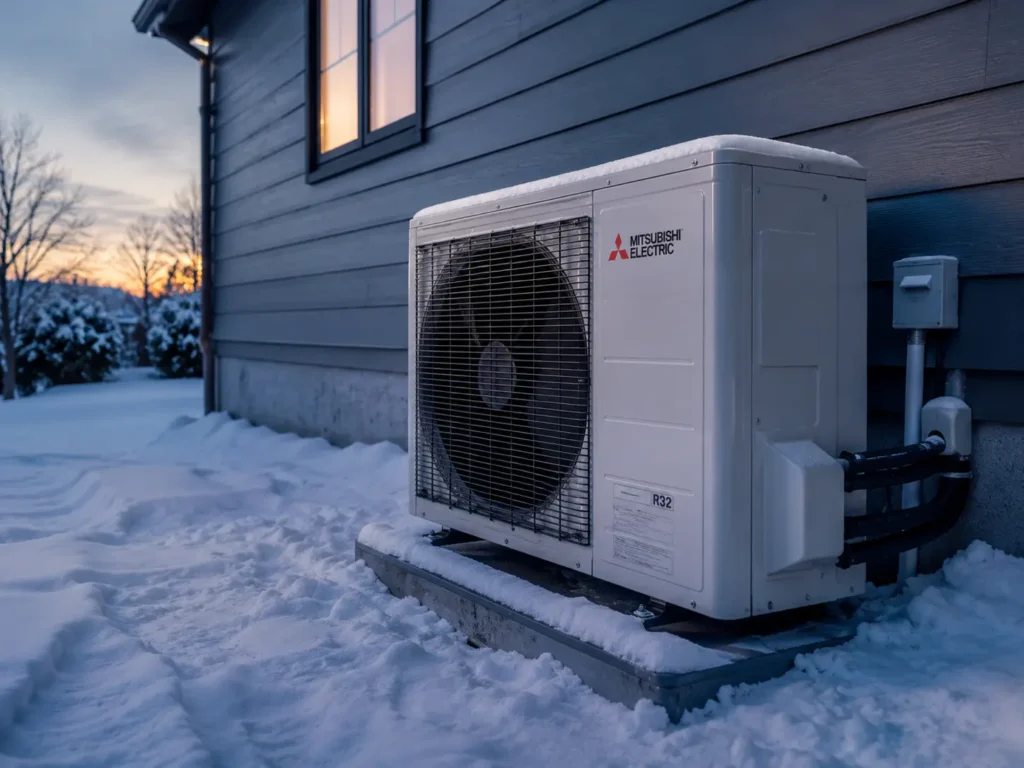
Why Does an Air Source Heat Pump Freeze?
In heating mode, the outdoor coil acts as the evaporator. Refrigerant inside it absorbs heat from the outside air. Because the refrigerant and coil surface can be colder than the air itself, water vapour condenses on the fins. If the surface temperature falls below freezing, that moisture becomes frost.
This is why frost can appear even when a garden thermometer reads slightly above 0°C. The coil does not have to be the same temperature as the surrounding air.
Cold, damp weather is especially favourable for icing. CIBSE’s heat-pump application guidance notes that frost can form when outdoor temperatures are below roughly 5–7°C and relative humidity is high. A damp day around freezing can therefore create more visible frost than a colder but drier day.
For the wider refrigeration cycle, see our guide to how air source heat pumps work.
Visual suggestion: a labelled outdoor-coil illustration showing moist air, the cold evaporator surface and frost forming on the fins.
How Does a Heat Pump Defrost Itself?
Modern air source heat pumps remove frost automatically. Control logic varies by manufacturer, but the sequence is broadly similar.
The system detects frost on the outdoor heat exchanger and temporarily sends heat to the outdoor coil. Many systems do this by reversing the refrigeration cycle for a short period. Grant UK describes this process as directing hot refrigerant back towards the iced evaporator to melt the frost.
You may notice the outdoor fan stop, the sound change or space heating pause briefly. The frost melts, water drains from the base, and the heat pump returns to heating.
Water vapour can also appear. Daikin’s guidance on water and steam from outdoor units explains that defrost operation can produce both water and steam. On a cold morning this can look dramatic, but it is not automatically a fault.
Energy Saving Trust’s installer guidance on system volume and frost protection also notes that domestic systems need enough thermal energy available in the heating circuit for defrosting. System water volume and flow can therefore affect winter operation.
Visual suggestion: a five-stage diagram showing frost detection → temporary heating pause → reverse-cycle defrost → meltwater drainage → normal heating resumes.
Normal Frost vs a Freezing Problem
| What you see | Usually normal? | What to do |
|---|---|---|
| Thin frost on the coil | Yes | Let the system manage it |
| Frost clears after defrost | Yes | No action needed |
| Water or vapour during defrost | Yes | Keep drainage safe |
| Thick ice remains or quickly rebuilds | No | Check airflow and seek service if persistent |
| Fan trapped, fault codes or poor heating | No | Contact a competent heat-pump engineer |
A healthy system does not have to stay frost-free. It needs to clear the coil and maintain useful heat output. Manufacturer guidance likewise distinguishes normal temporary frosting from a unit that remains heavily iced.
Why Does an Air Source Heat Pump Freeze Up Excessively?
Persistent icing can have several causes.
| Possible cause | Why it matters | Homeowner action |
|---|---|---|
| Restricted airflow | Less air crosses the coil | Clear leaves, snow, bins and vegetation |
| Poor drainage | Meltwater can refreeze | Check visible drainage routes |
| Dirty outdoor coil | Heat transfer and airflow fall | Follow manufacturer cleaning guidance |
| Defrost sensor/control fault | Defrost may start late or fail | Engineer diagnosis |
| Fan fault | Airflow drops sharply | Engineer diagnosis |
| Refrigerant or reversing-valve problem | Defrost and heat transfer can be impaired | Engineer diagnosis |
| Poor siting | Cold-air recirculation or blocked clearances can worsen conditions | Check manufacturer requirements |
Airflow and siting
The outdoor unit needs clear inlet and discharge paths. Fences, screens, shrubs, stored items and compact snow can restrict airflow.
Our air source heat pump location guide explains why manufacturer clearances, airflow and safe drainage should be planned together.
Daikin also advises homeowners to keep the rear of the outdoor unit clear of leaves and debris and not to obstruct its discharge area.
Drainage and refreezing
Defrosting produces water. If it cannot drain away, it can freeze around or beneath the unit. Over time this can form a solid ice mass that is different from normal frost on the coil.
Repeated ice slabs below the unit justify a drainage review. The outdoor position should allow defrost water to escape rather than pool around the base or freeze across a walkway.
Sensors, fans and refrigerant
A faulty sensor, fan problem, low refrigerant charge or reversing-valve fault can interfere with defrost. These are not DIY repairs.
Viessmann lists restricted airflow, refrigerant problems, sensor faults and reversing-valve issues among possible reasons for excessive icing or failed defrost. Refrigerant, electrical and control-system checks need a competent engineer.
Does Frosting Reduce Heat Pump Efficiency?
Normal defrosting carries an energy cost because the system briefly clears the outdoor coil instead of continuously heating the home.
Heavy ice is different. As it blocks airflow, heat transfer deteriorates and the heat pump may run harder, defrost more often and deliver less useful heating.
Cold weather also reduces efficiency because the heat pump must move heat across a larger temperature difference. Energy Saving Trust explains that real-world CoP changes with outdoor temperature, while seasonal measures such as SCoP or SPF provide a better view across the year.
Our air source heat pump efficiency guide explains COP, SCOP and real UK winter performance in more detail.
What Can You Safely Check If Your Heat Pump Is Frozen?
Start with simple visual checks rather than trying to force the ice off.
- Give the heat pump time to complete its own defrost cycle.
- Remove loose leaves, litter or snow clearly blocking the air inlet or outlet.
- Check whether meltwater can drain away from the base.
- Note any controller fault code before resetting anything.
- Check the manufacturer’s manual for winter-operation and clearance guidance.
- Arrange professional help if ice remains, heating output falls or faults return.
Do not attack the fins with tools. They bend easily. Viessmann’s heat-pump icing guidance advises against picking ice away and warns against pouring water over equipment containing electrical components.
Repeated power-cycling can also hide useful diagnostic information. Record any fault code for the engineer.
How Can You Reduce Repeat Freezing?
Keep vegetation and stored objects outside the manufacturer’s required clearances. Remove loose leaves and debris before winter. Make sure gutters or nearby structures are not directing large amounts of water onto the unit.
Defrost water should drain without collecting beneath the heat pump or across a path where it can freeze.
Follow the manufacturer’s service schedule. A service can check the heat exchanger, fan, sensors, controls, water flow and other components that influence defrost behaviour. See our air source heat pump servicing guide for what to expect.
Can an Air Source Heat Pump Work Below Freezing?
Yes. Frost on the outdoor coil does not mean the technology has stopped working.
Energy Saving Trust’s current heat-pump fact check confirms that heat pumps operate below freezing, although efficiency reduces as outdoor temperature falls. Manufacturers publish model-specific operating limits, so check the cold-weather output of the actual unit being proposed or installed.
The heat pump must also be sized for the home’s design heat loss. A system that is too small or badly configured may struggle in winter for reasons that have little to do with visible frost.
When Should You Call a Heat-Pump Engineer?
Arrange an inspection if the unit stays heavily iced, the fan cannot turn, the heat pump repeatedly fails to defrost, the same fault code returns, heating output drops sharply or the system appears to be defrosting almost continuously.
An engineer can test sensors, fan operation, refrigerant performance, the reversing valve, water flow and defrost controls to distinguish weather-related frost from an underlying fault.
Get Your Free Air Source Heat Pump Quote
Find the right air source heat pump solution for your home. Tell us a few details and our team will help you explore suitable options at a competitive price.
Quick to complete. No obligation.
Get your quote
Enter your details below and one of our team will get back to you.
Frequently asked questions
Find clear answers to common questions about air source heat pump frosting and defrosting, including ice formation, steam, drainage, fan behaviour, winter efficiency, cold-weather operation and when persistent icing needs professional attention.
A thin layer of frost on the outdoor coil is normal in cold, damp weather. It should disappear when the heat pump completes its automatic defrost cycle.
The evaporator coil can be colder than the outdoor air. Its surface may therefore fall below freezing even when the measured air temperature remains a few degrees above 0°C.
There is no single threshold. Frost depends on coil temperature and humidity as well as outdoor temperature. CIBSE notes that icing can occur below roughly 5–7°C when relative humidity is high.
It is an automatic process that warms the outdoor heat exchanger so accumulated frost melts. Many heat pumps temporarily reverse the refrigerant cycle to do this.
There is no universal duration. It depends on the model, outdoor conditions and amount of frost. Check the manufacturer's documentation if a defrost seems unusually long or heating does not resume.
There is no fixed interval. Cold, damp conditions can require more frequent defrosting than dry weather. Frequent cycles become more concerning if the coil never clears or the home cannot maintain temperature.
Steam or white vapour can appear when frost melts during defrost. Daikin confirms that outdoor units can discharge water or steam during this process.
Melted frost leaves the unit as water during defrost. Some water is therefore normal, but persistent pooling or refreezing can indicate inadequate drainage.
Yes, on many systems. Fan behaviour varies by manufacturer, so check the instructions for your particular model.
It is safer not to. Viessmann advises against pouring water over heat-pump equipment containing electrical components. Let the built-in defrost operate or contact an engineer if the ice remains.
No. Tools can bend the delicate coil fins or damage components behind them. Persistent ice should be diagnosed rather than forcibly removed.
Possible causes include restricted airflow, blocked drainage, fan failure, a sensor or control problem, refrigerant issues or a reversing-valve fault. An engineer should investigate persistent icing.
Defrost uses energy and temporarily interrupts normal heat collection, so it affects winter efficiency. Normal defrosting is expected; excessive frosting and repeated defrosting can have a larger performance impact.
Yes. Modern heat pumps can work below freezing. Their efficiency and available output vary as outdoor temperatures fall, so model-specific cold-weather performance matters.
Call an engineer if thick ice persists, the fan is trapped, heating output falls significantly, fault codes keep returning or normal defrost cycles fail to clear the outdoor coil.
Conclusion
A light coating of frost on an air source heat pump is usually normal. The outdoor coil runs colder than the surrounding air, so moisture can freeze on it even when air temperature is slightly above 0°C.
The key test is what happens next. A healthy heat pump should detect the frost, run a defrost cycle, drain the meltwater and return to heating. Persistent thick ice, poor airflow, frozen drainage, recurring fault codes or falling heat output deserve investigation.
If you are planning a new installation, correct siting, drainage and system design can reduce winter problems from the start. Compare surveyed heat-pump quotes through Get Free Quote rather than relying on a generic system size or headline efficiency figure.


