
Flat Roof Solar Panel Angle UK: Best Tilt Guide 2026
Check Your Eligibility for Boiler Upgrade Scheme (BUS)
Complete your details below to check your eligibility.
Thank you
We've received your details and will be in touch shortly.

Quick answer
For a flat roof in the UK, 10° to 15° is usually the most practical solar-panel angle. The theoretical annual-energy optimum for a south-facing panel is often closer to 35° to 40°, but flat roofs create extra constraints.
A steeper tilt increases wind exposure, ballast or fixing requirements and the gap needed between rows to prevent self-shading. Shallow arrays can use roof area more efficiently and are common in both south-facing and east-west mounting systems.
The final angle should be based on structural capacity, roof membrane, wind conditions, shading, orientation, planning rules and a site-specific generation model.
Flat Roof Solar Panel Angle UK: Best Tilt, Direction and Spacing
A flat roof gives you control over solar-panel tilt and direction. That does not mean every panel should be set at the theoretical optimum. UK flat-roof design must also balance wind loading, ballast, row spacing, roof strength and planning limits.
For most UK flat-roof systems, about 10° to 15° is a common practical choice. A steeper south-facing angle of roughly 30° to 40° can improve the output of an individual panel, but it raises the back edge, catches more wind and increases the space needed between rows. Flat-roof mounting manufacturers commonly offer low-profile systems around 10° to 20°, reflecting these practical constraints.
On a constrained roof, a lower tilt may therefore let you fit more panels and produce more electricity overall.
Ask installers to model more than one layout. The key question is not “which angle produces the most per panel?” but “which safe, compliant layout produces the most useful electricity from this roof?”
Get a Free Quote: Compare surveyed solar-panel installation quotes that show tilt, orientation, panel count, annual-generation assumptions and mounting system.
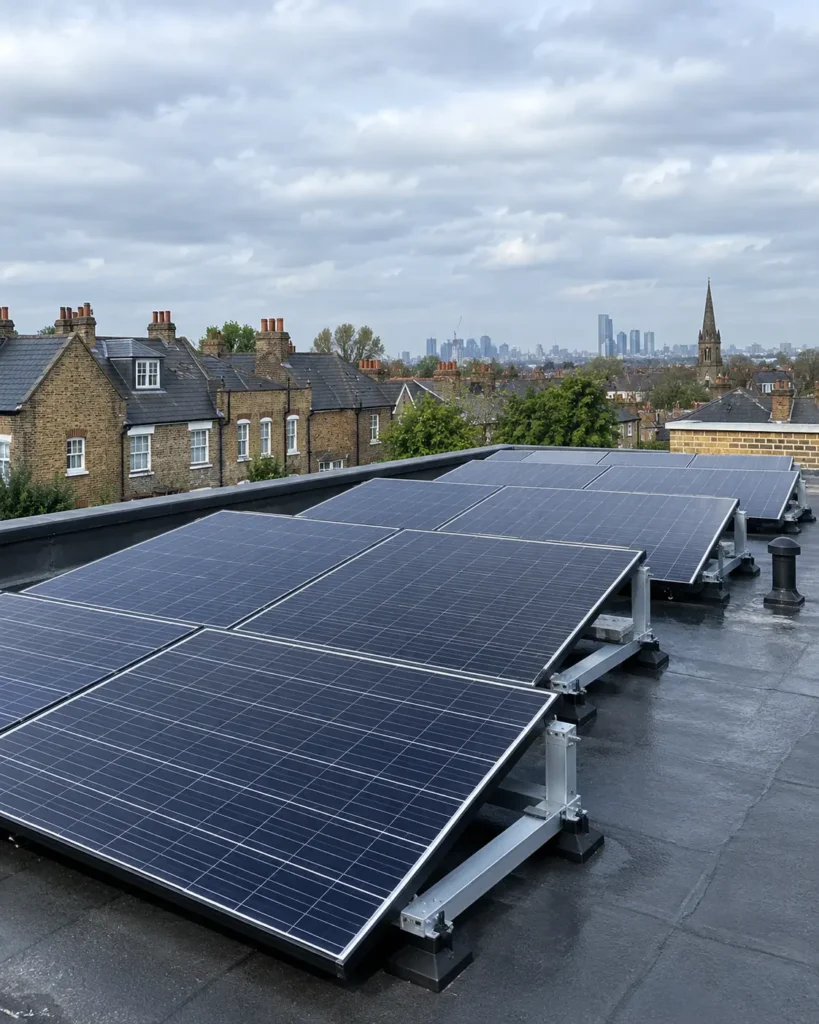
Flat roof solar panel angles compared
| Panel tilt | Typical reason to use it | Main trade-off |
|---|---|---|
| 0°–5° | Very low profile | More soiling and poorer rainwater run-off |
| 10° | Common on low-profile south or east-west systems | Slightly less ideal solar incidence |
| 15° | Good balance of output and drainage | A little more spacing and wind exposure |
| 18°–20° | Useful where space and structure allow | Higher rear edge and larger shadows |
| 30°–40° | Close to the theoretical UK annual optimum | Often impractical because of wind, ballast and spacing |
What is the best flat roof solar panel angle in the UK?
There are two answers.
If you only consider sunlight striking one south-facing panel, a fixed tilt around the mid-to-high 30s is often close to the UK annual optimum. That is why many solar guides describe 30° to 40° as the “best” angle.
Flat-roof design has a different objective. The installer must optimise the whole array. Manufacturers offer flat-roof systems at angles such as 10°, 15°, 18° and 20° because lower profiles can reduce wind exposure and improve roof coverage. Renusol, for example, offers 10° east-west, 10° south and 18° south configurations, while Sika lists 10°, 15° and 20° systems.
For that reason, 10° to 15° is usually the practical starting range. It is not a magic figure. A particular roof may justify another tilt after structural and generation modelling.
Why 10° to 15° is so common
A lower tilt keeps the rear edge of the panel closer to the roof. That reduces the surface presented to the wind and shortens the shadow behind each row.
Rows can therefore sit closer together without as much self-shading when the sun is low. A lower-profile system may also simplify mounting and reduce the height of the installation.
The trade-off is that a 10° panel is not pointed at the sun as directly as a steeper south-facing panel through much of the year.
However, the aim is to maximise system output, not panel output in isolation. A slightly less productive panel angle can make sense if it allows additional modules to fit safely on the roof.
South-facing or east-west on a flat roof?
South-facing layout
A south-facing array usually gives the highest annual generation per panel in the UK. Energy Saving Trust identifies an unshaded south-facing roof as the ideal orientation for maximum generation.
Flat-roof panels are often tilted around 10° to 15°.
The drawback is row spacing. Because each row slopes in the same direction, the raised rear edge can shade the row behind. The steeper the tilt, the larger the separation normally needs to be.
East-west layout
An east-west array places panels in opposing low-angle rows, often around 10°. It can use roof area efficiently because the panels form compact back-to-back pairs. Renusol specifically offers a 10° east-west system aimed at good roof utilisation and more distributed generation through the day.
East-facing modules contribute more in the morning, while west-facing modules contribute more later.
That can be useful for a household with morning and evening consumption, including homes considering a solar-compatible EV charger.
Ask for annual kWh, installed kWp and estimated self-consumption for both layouts rather than deciding from orientation alone.
Visual suggestion: a plan-view comparison of south-facing rows versus a compact east-west array.
How does tilt affect row spacing?
As tilt increases, the upper edge of each panel rises and casts a longer shadow when the sun is low.
The designer must then increase the distance between rows, accept some shading or choose another orientation. This is one reason a 30° or 35° array can use substantially more roof area than a shallow system.
There is no reliable one-size-fits-all row gap. It depends on panel dimensions, tilt, latitude, roof obstacles and the amount of shading the designer accepts.
Ask the installer to show the shading assumptions used in the generation estimate. A quotation that provides panel wattage but does not explain layout losses gives you an incomplete comparison.
Wind loading, ballast and roof strength
Tilt is also a structural decision.
Many flat-roof arrays use ballasted frames that sit above the waterproof covering instead of penetrating it. Energy Saving Trust notes that weighted systems can help avoid disturbing the roof covering, although the roof must be capable of carrying the additional weight.
The ballast requirement is not a universal number. Renusol’s installation guidance says required ballast depends on factors including the building’s height, location, roof covering and wind loads.
Before installation, the designer should confirm that the roof structure can carry the loads, the mounting system is compatible with the membrane, drainage remains clear and any penetrations are properly waterproofed.
If the covering is already approaching replacement, deal with that before putting a long-life PV array over it. Get Free Quote’s roofing quote service may also be relevant when remedial roof work is needed first.
What angle is best for rainwater and cleaning?
Energy Saving Trust says UK rainfall will generally clean solar panels if they are tilted at 15° or more.
That gives 15° a practical advantage where the roof and mounting design allow it.
At 10°, water still drains, but dirt, pollen and bird fouling may clear less effectively. Panels installed almost flat are more prone to retaining grime around their lower edge.
Cleaning needs also depend on nearby trees, birds, dust and local pollution. Follow the panel manufacturer’s maintenance instructions rather than assuming every low-angle installation needs scheduled cleaning.
Do planning rules limit the angle?
Potentially — and this is an area where current UK rules matter.
In England, domestic solar permitted-development rules changed on 27 August 2026, with a transitional period until 27 August 2027. Under the new rules for a house, the highest part of equipment on a flat roof cannot be more than 600mm above the highest part of the roof, excluding the chimney. Additional restrictions apply in certain designated locations and to listed buildings.
In Wales, current government guidance says flat-roof panels cannot be within 1 metre of the external roof edge or protrude more than 1 metre above the roof plane.
Scottish rules are different again, while Northern Ireland advises homeowners to check permitted-development requirements with the relevant council where necessary.
This is another reason not to copy a flat-roof angle from a generic online calculator without checking the proposed installation height.
How to choose the right flat roof solar panel angle
- Check the roof first. Confirm membrane condition, drainage, construction and structural capacity.
- Model more than one tilt. A 10° and 15° comparison is often useful.
- Compare complete layouts. Look at panel count, installed kWp and predicted annual kWh.
- Test south-facing against east-west. Higher output per panel is not always higher output per roof.
- Check wind and ballast calculations. Ask how building height and site exposure affect the mounting design.
- Check planning and access. Parapets, maintenance routes and roof obstacles can reduce usable area.
- Review the generation assumptions. Orientation, tilt, shading and system losses should be visible in the proposal.
For complex roofs, a 3D layout or solar-design model is more useful than a rule-of-thumb angle. You can also verify certified contractors using the official MCS Find an Installer service.
Is a 30° to 40° tilt worth using?
Sometimes, but it is not automatically better.
A steep south-facing array can maximise annual output per module. It may suit a large, sheltered roof with plenty of spacing and a structure capable of handling the mounting loads.
On many domestic flat roofs, however, the penalties are greater wind exposure, larger row gaps, a taller structure and fewer modules.
That is why 10° to 15° frequently makes more sense in practice.
Get Your Free Air Source Heat Pump Quote
Find the right air source heat pump solution for your home. Tell us a few details and our team will help you explore suitable options at a competitive price.
Quick to complete. No obligation.
Get your quote
Enter your details below and one of our team will get back to you.
Frequently asked questions
Find clear answers to common questions comparing air source and ground source heat pumps, including efficiency, installation and running costs, winter performance, noise, land requirements and borehole depth.
Around 10° to 15° is a common practical range. It balances generation with wind exposure, row spacing, roof utilisation and mounting requirements.
It can be close to the ideal annual angle for an individual south-facing module, but that does not automatically make 35° the best flat-roof array design.
It depends on the roof. A 10° system has a lower profile and may allow tighter packing. A 15° system improves rainwater self-cleaning; Energy Saving Trust says rainfall generally cleans panels tilted at 15° or more.
They can operate horizontally, but completely flat installation is normally less attractive because water and dirt clear less effectively and solar incidence is less favourable.
South normally gives the greatest annual generation per panel in the UK, provided shading is limited.
Yes. A shallow east-west layout can fit efficiently into available roof space and produce electricity across a broader part of the day.
There is no universal distance. The gap depends on tilt, panel dimensions, location and acceptable shading losses.
It can. Increased tilt generally increases wind exposure, while the actual ballast requirement must be calculated for the specific building and mounting system.
Potentially. The garage roof must have adequate structural capacity, a suitable covering and enough unshaded space, and the electrical and planning requirements still apply.
They should not when correctly specified, protected and compatible with the roof membrane. However, both structural loading and waterproofing need to be checked.
Low-angle panels may accumulate dirt more readily. Energy Saving Trust says rain normally cleans panels tilted at least 15°.
It can. Energy Saving Trust notes that trees, chimneys and neighbouring buildings can materially reduce generation, so avoiding shade can be more important than chasing a few degrees of extra tilt.
Yes, if the structural, wind, spacing, planning and mounting requirements allow it. It is simply less practical on many domestic roofs.
Not directly. However, the household's consumption profile can influence whether a south-facing or east-west generation pattern provides better self-consumption.
Not always. Permitted-development rules exist, but limits and exceptions vary between England, Wales, Scotland and Northern Ireland. England's domestic rules changed in August 2026.
MCS provides a searchable register of certified renewable-energy installers and is a useful credential to verify when comparing providers.
Final recommendation
For most UK homeowners, treat 10° to 15° as the practical starting range, not an absolute rule.
South-facing low-angle arrays can maximise generation per panel, while east-west low-angle arrays can make better use of limited roof area and spread output across the day.
The installer should justify the angle with a roof layout, shading analysis, wind and ballast assessment, structural checks and generation estimate.
When comparing quotes, ask each installer to show the proposed angle, orientation, mounting method, panel count, annual kWh and assumptions.
You can start from the Get Free Quote homepage or read how Get Free Quote works before comparing providers.


