
Solar Panels Cost Birmingham 2026 | Prices & Savings
Check Your Eligibility for Boiler Upgrade Scheme (BUS)
Complete your details below to check your eligibility.
Thank you
We've received your details and will be in touch shortly.

Quick answer: how much do solar panels cost in Birmingham?
For most Birmingham homes, a solar-only system will commonly fall somewhere around £5,000 to £10,000. Current local market guides place many 3–5 kWp systems within that band, while Energy Saving Trust’s national benchmark is about £7,600 for a typical 4.5 kWp system.
A larger array, difficult scaffolding, premium equipment or electrical upgrades can push the price higher. Battery storage typically adds several thousand pounds; Energy Saving Trust gives a broad figure of around £5,000–£8,000. Installed solar panels on qualifying residential property currently benefit from 0% VAT until 31 March 2027. Exact pricing needs a survey and written quote.
Solar Panels Cost Birmingham: 2026 Prices, Savings and Payback
If you are comparing solar panel costs in Birmingham, a sensible 2026 budget for a straightforward domestic solar-only installation is roughly £5,000 to £10,000. Energy Saving Trust currently puts a typical UK home system at around 4.5 kWp and £7,600 installed, making that a useful national benchmark rather than a guaranteed Birmingham price.
This guide explains what changes the quote, whether battery storage is worth adding, how export payments affect payback, and which Birmingham planning or funding points to check. The aim is to help you compare like-for-like quotations rather than simply choose the lowest headline price.
For broader guidance, see Get Free Quote’s solar panel service page. If you are ready to compare local quotes, you can also start from the Get Free Quote homepage.
Compare free solar quotes: A roof survey and itemised proposal are the best way to turn a broad budget into a property-specific price.
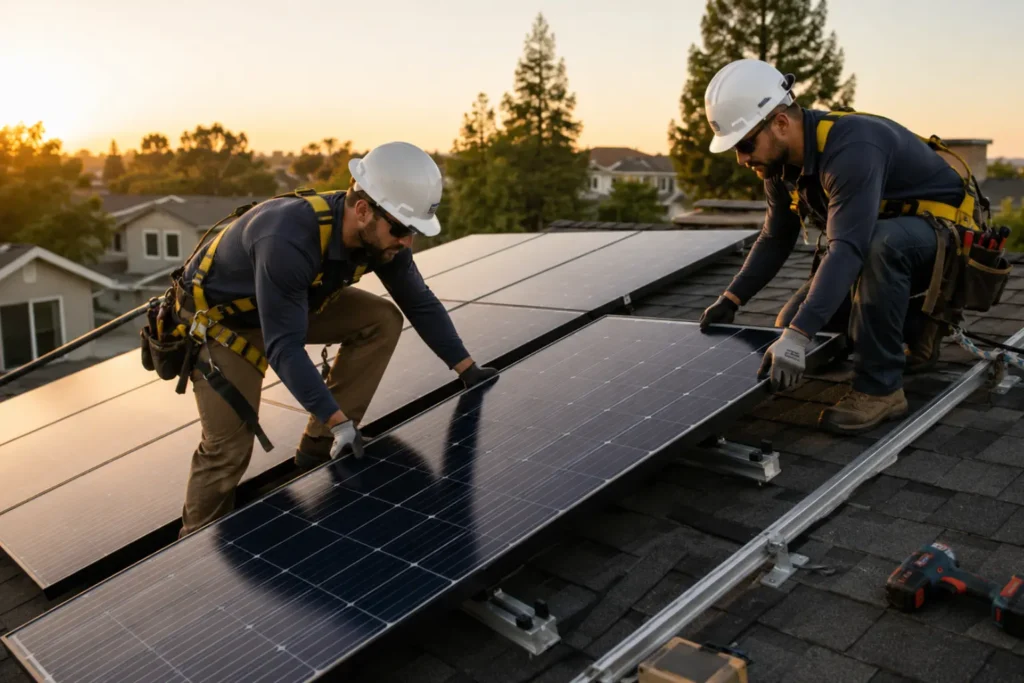
Birmingham solar panel prices in 2026
There is no official Birmingham-wide tariff for solar installation. Contractors price each property around array size, access, roof condition, inverter choice, electrical work and storage.
Current market guides show a wide spread. One Birmingham specialist quotes around £5,000–£6,500 for 3 kW, £6,500–£8,000 for 4 kW and £7,500–£9,500 for 5 kW solar-only systems. Another 2026 Birmingham modelling service places 3–6 kW systems at roughly £5,950–£9,950. These figures are useful for early budgeting, not guaranteed local averages.
| 2-bedroom property | Typical cost before BUS | £7,500 BUS grant | Potential homeowner cost |
|---|---|---|---|
| Straightforward small terrace or heat-pump-ready home | £7,500–£9,500 | -£7,500 | £0–£2,000 |
| Typical 2-bed terrace or semi | £9,000–£11,500 | -£7,500 | £1,500–£4,000 |
| More complex retrofit | £11,500–£12,500+ | -£7,500 | £4,000–£5,000+ |
Compare the complete installed system rather than cost per panel. Two quotes with the same panel count can differ because panel wattage, inverter design, warranties, scaffolding and electrical work are different.
For more local context, see Get Free Quote’s solar panels in Birmingham guide.
What affects the cost?
System size and equipment
A larger array costs more overall, although the cost per kWp can fall as fixed expenses are spread across more panels. Premium modules, microinverters or power optimisers may also increase the quote. Compare output, warranties and system design rather than brand names alone.
Get Free Quote’s 2026 guide to the best solar panels in the UK can help you compare the specifications behind each quotation.
Roof access and condition
A simple pitched roof with easy access is usually cheaper than a multi-level roof, awkward rear access or a property requiring specialist scaffolding. Roof repairs should be priced separately.
Older Birmingham housing can also create more variation in access and electrical work. That does not make an older home unsuitable; it simply makes the survey more important.
Electrical work and grid connection
The inverter converts panel output into electricity your home can use. Consumer-unit work, cable routes, surge protection, metering or network-connection requirements can change the final price.
Ask the installer to identify these items before you sign. Get Free Quote’s existing solar service guidance also recommends comparing the assumed system size, annual generation, scaffolding, electrical work and DNO responsibilities rather than relying on the headline price alone.
How much can solar panels save in Birmingham?
Savings come from buying less electricity from the grid and receiving payment for surplus electricity exported through a Smart Export Guarantee tariff.
Self-consumption matters. If you run appliances, charge an EV or work from home while panels are generating, you can use more solar electricity directly. If the house is empty during the day, more electricity may be exported instead.
Energy Saving Trust’s July 2026 examples show solar payback at about nine years in London and around 10–11 years in Manchester, depending on occupancy. Birmingham homeowners should not simply assume a figure between the two. Roof orientation, shading, tariff choice, system price and electricity use can materially change the result.
Ofgem says Smart Export Guarantee licensees must offer eligible generators an export tariff above zero, but suppliers set their own rates. Your SEG provider does not have to be the company that supplies your imported electricity, so comparing export tariffs can be worthwhile. Read Ofgem’s Smart Export Guarantee guidance
For a property-specific estimate, Energy Saving Trust also provides a solar panel calculator based on property details, energy use and location.
Is a solar battery worth adding?
A battery can increase the share of solar generation you use at home, especially if most demand occurs after sunset. It may suit homes with an EV, heat pump or time-of-use electricity tariff.
However, a battery is not automatically the strongest financial choice. Energy Saving Trust’s 2026 modelling found that batteries can increase bill savings, but the additional savings do not always recover the battery cost within its expected lifetime, particularly where a household already has access to a good export tariff. See Energy Saving Trust’s 2026 technology-and-tariff analysis
Ask for both solar-only and solar-plus-battery quotations. Compare expected savings, usable capacity, efficiency, warranty and replacement assumptions rather than judging a battery by headline capacity alone.
0% VAT, grants and Birmingham schemes
Installed solar panels on qualifying residential property are currently zero-rated for VAT. HMRC states that this temporary 0% rate runs until 31 March 2027, after which the reduced 5% rate is scheduled to return. Check HMRC’s energy-saving materials VAT guidance
There is no universal UK Government grant that pays for solar panels for every homeowner. Some households may qualify through wider energy-efficiency support, so check eligibility rather than assuming funding is available. Energy Saving Trust likewise advises checking current government, council and supplier support because eligibility varies.
Birmingham City Council has also promoted Switch Together Birmingham, a group-buying scheme for solar PV and battery storage. Availability can be campaign-based, so check current registration before relying on it when budgeting. Check Switch Together Birmingham
Do you need planning permission?
Most standard domestic rooftop solar installations are permitted development in England when they meet the relevant limits and conditions. Birmingham City Council also says solar PV will generally not require planning permission.
Extra checks may be needed for listed buildings, conservation areas, Article 4 restrictions or unusual installations. Birmingham currently has 29 recognised conservation areas, so homeowners in protected parts of the city should check their property before work begins. Check Birmingham planning restrictions
Flat roofs can also require different mounting, ballast and panel angles, all of which can influence the final installation price.
How to compare solar panel quotes in Birmingham
Do not compare quotations on total price alone. Ask each installer to use the same basic brief so that the proposals are genuinely comparable.
| Cost factor | How it affects the quote | What you should check |
|---|---|---|
| Heat loss | Higher heat loss can require more heating output | Ask for room-by-room calculations |
| Radiators | Some may need replacing with larger models | Ask which radiators stay and which change |
| Hot-water cylinder | Combi-boiler homes normally need stored hot water | Check whether the cylinder is included |
| Electrical work | Older homes may need upgrades | Confirm all electrical work is included |
| Outdoor-unit position | Difficult access or long pipe runs increase labour | Agree the location before signing |
| System design | Better design can improve efficiency | Ask about flow temperature and expected seasonal performance |
Get at least three written quotations, check their generation assumptions, compare warranties, confirm who handles the network connection and ask what is excluded. Energy Saving Trust also recommends obtaining at least three installer quotes and checking MCS certification.
For a clearer idea of what happens after accepting a quote, read Get Free Quote’s solar panel installation process guide.
Are solar panels worth it in Birmingham?
Solar can be financially worthwhile when your roof has usable unshaded space, the system is sensibly sized and the installation price is competitive. Solar PV also generates on cloudy days, although output is lower than in strong sunlight.
The key calculation is the relationship between upfront cost, realistic annual generation, how much electricity you will use yourself, export income and equipment life. A good quotation should make those assumptions visible.
If one proposal promises dramatically higher savings than the others, ask why. Differences in roof modelling, tariff assumptions or battery use can create projections that may not match real-life operation.
Ready to compare? Get Free Quote can help you compare written solar proposals and understand differences in price, scope, warranties and expected generation.
Get Your Free Air Source Heat Pump Quote
Find the right air source heat pump solution for your home. Tell us a few details and our team will help you explore suitable options at a competitive price.
Quick to complete. No obligation.
Get your quote
Enter your details below and one of our team will get back to you.
Frequently asked questions
Find clear answers to common questions comparing air source and ground source heat pumps, including efficiency, installation and running costs, winter performance, noise, land requirements and borehole depth.
A sensible 2026 planning range is around £8,000 to £12,500 before grants. However, straightforward smaller installations can cost less.
If the installation costs £8,000 to £12,500, an eligible homeowner could pay roughly £500 to £5,000 after the standard £7,500 BUS grant.
Potentially. Some companies offer qualifying smaller properties installations with a £0 customer contribution after BUS. However, this is an installer-specific offer rather than an automatic government entitlement.
Yes. The standard grant for an eligible air-to-water heat pump in England and Wales is currently £7,500.
Some qualifying off-gas-grid homes replacing oil or LPG can receive additional BUS support under current rules. Therefore, check the latest GOV.UK eligibility guidance before getting quotes.
Many smaller homes may need around 4kW to 7kW. However, the correct size must come from a heat-loss calculation rather than the number of bedrooms.
Not always. Some existing radiators may already be large enough. However, others may need replacing so they can provide enough heat at lower water temperatures.
If you are replacing a combi boiler with an air-to-water heat pump, you will normally need stored hot water. Therefore, check whether a suitable cylinder is included in the quote.
Not automatically. The answer depends on electricity prices, gas prices, heat demand and heat-pump efficiency. As a result, ask for a property-specific running-cost estimate.
It can be. A heat pump can provide several units of heat for every unit of electricity used. Therefore, it can use much less electricity than direct resistance heating.
There is no fixed payback period. Instead, compare the extra amount you pay for the heat pump with the heating system you would otherwise choose and divide that by your expected annual savings.
No. However, reducing heat loss can allow the system to run more efficiently and may reduce the heat-pump output required.
Yes. Air source heat pumps operate during cold UK weather. However, efficiency changes as outdoor temperatures fall.
Modern units are designed for residential use. Even so, outdoor-unit position matters, which is why installers should assess noise and siting as part of the design.
Eligible landlords can use BUS for qualifying properties. However, the property and proposed installation still need to meet scheme requirements.
Normally, no. The installer applies for the voucher on behalf of the property owner and deducts the grant from the amount charged.
Not automatically. Instead, compare what each quote includes, the heat-loss calculation, radiator changes, estimated electricity use, warranties and the final amount you pay after BUS.
Yes. Solar PV can normally be added separately. In addition, using your own solar electricity can reduce the amount of electricity you need to buy from the grid.
Conclusion
For a typical Birmingham home in 2026, budgeting around £5,000–£10,000 for solar alone is a practical starting point, with Energy Saving Trust’s £7,600 national benchmark near the middle. Battery storage can add several thousand pounds, while roof complexity, electrical upgrades and premium equipment can raise the total.
Before choosing a system, compare at least three itemised quotes and focus on annual generation assumptions, self-consumption, export tariffs and warranties. The right system is one that fits your roof and electricity use at a price supported by realistic savings.


