
Heat Pump With Existing Radiators: UK Guide 2026
Check Your Eligibility for Boiler Upgrade Scheme (BUS)
Complete your details below to check your eligibility.
Thank you
We've received your details and will be in touch shortly.

Quick answer: can a heat pump use your current radiators?
In many UK homes, yes. An air-to-water heat pump can connect to a wet radiator system much like a boiler does. The important difference is temperature. Heat pumps are usually more efficient when they send lower-temperature water around the heating system for longer periods.
If an existing radiator can still meet the room’s calculated heat loss at the proposed flow temperature, it can usually remain. If it cannot, the installer may recommend a larger radiator, a double- or triple-panel model, a fan-assisted emitter or another change.
A room-by-room heat-loss calculation and radiator schedule should decide this — not the radiator’s age alone. MCS guidance specifically treats room-by-room heat loss as an essential part of sizing a heat-pump system correctly.
Can Air Source Heat Pumps Work With Existing Radiators? UK Guide 2026
Yes. An air source heat pump can work with existing radiators, and replacing every radiator is not automatically necessary. The real question is whether each radiator can deliver enough heat to its room at the lower water temperature the heat pump is designed to use.
That is why similar homes can receive very different quotations. One may keep nearly all its radiators; another may need several upgrades. The answer depends mainly on room-by-room heat loss, radiator output, design flow temperature and the existing heating circuit.
This guide explains how to judge whether a heat pump with existing radiators will work, when upgrades make sense and what to ask for before accepting a quote.
Considering a heat pump? Compare properly surveyed options rather than assuming every radiator must stay or every radiator must go.
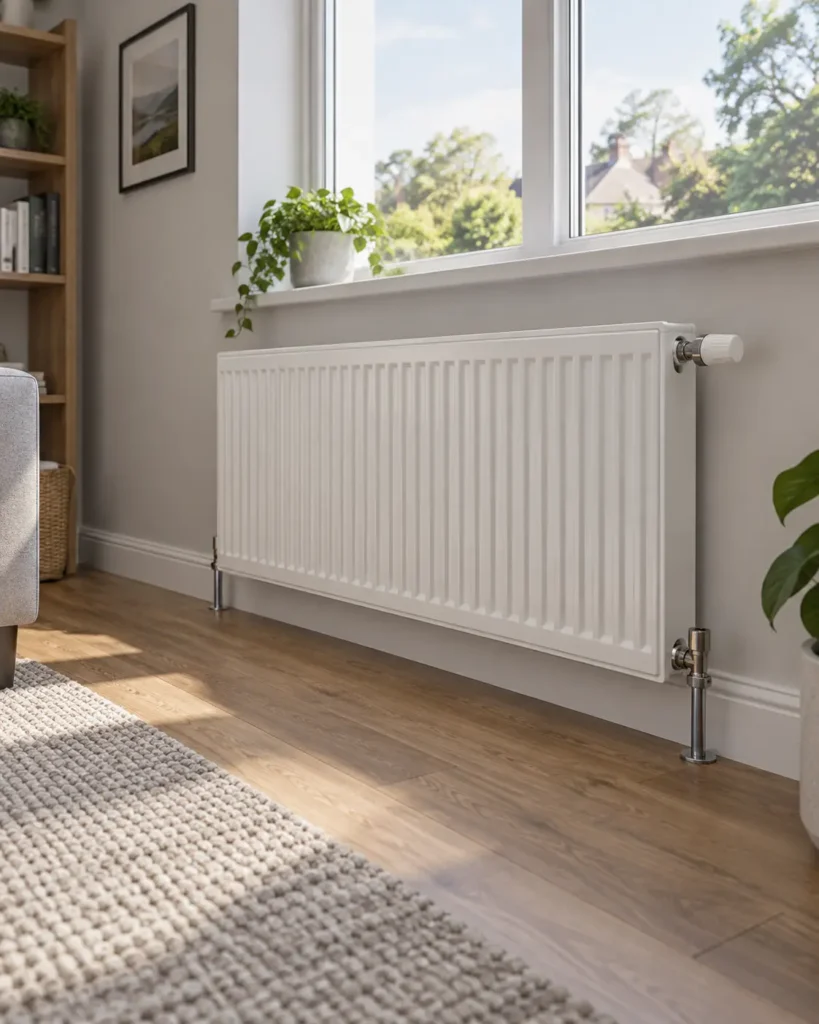
Existing radiators: what usually happens?
| Situation | Likely outcome | Main reason |
|---|---|---|
| Large or previously oversized radiators in a lower-heat-loss home | Many may stay | Enough output at the proposed water temperature |
| Mixed radiator sizes and room heat losses | Some upgrades likely | A few rooms become the limiting factor |
| Small single-panel radiators in high-heat-loss rooms | More upgrades likely | Insufficient output at an efficient flow temperature |
| High-temperature heat pump proposed | More radiators may be retained | Hotter water raises output but can reduce efficiency |
How does a heat pump use existing radiators?
For this topic, the relevant system is an air-to-water heat pump. It takes heat from outside air, raises its temperature through a refrigeration cycle and transfers that energy into water. The water then circulates through radiators in broadly the same way as a boiler-fed wet system.
The practical difference is heat delivery. A boiler may run radiators very hot for shorter periods. A heat pump normally works best with a lower flow temperature and longer, steadier heating periods. Energy Saving Trust says 45°C is a usual heat-pump radiator water temperature, although the correct temperature is property-specific.
For the full refrigerant, compressor and hot-water process, see how an air source heat pump heats a home.
You can also read the Energy Saving Trust guidance on efficient heat-pump operation.
Why lower water temperature changes radiator output
A radiator does not have one fixed heat output. Its output depends heavily on the difference between the radiator’s average water temperature and the room temperature.
Radiator catalogues commonly quote output at ΔT50. A typical example is 75°C flow, 65°C return and a 20°C room. The mean radiator water temperature is 70°C, or 50°C above the room temperature.
Run the same radiator cooler and its output drops sharply. Stelrad’s manufacturer correction table shows that a radiator at ΔT30 gives about 51% of its stated ΔT50 output; at ΔT20 it gives about 30%.
| Example condition | Approx. ΔT | Output from a radiator rated 2,000W at ΔT50* |
|---|---|---|
| 75°C flow / 65°C return / 20°C room | 50 | 2,000W |
| Mean water temperature 50°C / 20°C room | 30 | about 1,026W |
| Mean water temperature 40°C / 20°C room | 20 | about 604W |
Illustrative only. Final sizing should use the radiator manufacturer’s data and the actual design temperatures.
This is why “the radiators get hot now” does not prove heat-pump suitability. The useful question is: how many watts can each radiator deliver at the proposed design temperature?
The Stelrad radiator correction-factor table provides a useful illustration of how output changes with ΔT.
How can you tell whether your radiators are big enough?
Start with the room, not the radiator.
MCS guidance says heat loss should be assessed room by room using factors such as the building fabric, room dimensions, air change rates, desired indoor temperature and local winter design temperature.
The installer then compares each room’s heat loss, in watts, with the output of its existing radiator at the proposed flow and return temperatures.
If a bedroom loses 700W at design conditions and its radiator can provide 850W, there may be no reason to replace it. If a living room loses 1,500W but its radiator can provide only 900W, something needs to change.
That change could be a higher-output emitter, another radiator, practical insulation work that lowers heat loss, or a different design temperature. The system should be designed as a whole.
A useful quote should show:
- room-by-room heat loss;
- the proposed maximum flow temperature;
- existing radiator outputs at that temperature;
- replacement radiator sizes where required; and
- expected seasonal performance.
A dedicated heat pump survey should make those assumptions visible before installation.
Do all radiators need replacing?
No. Blanket replacement can add unnecessary cost and disruption.
Some homes already have generous radiators because the original system was oversized, rooms were later insulated, or double-panel radiators were fitted during previous upgrades. Those emitters may work well at lower temperatures.
Where an upgrade is needed, it does not always mean fitting a much wider radiator. Double- or triple-panel radiators can add heat-emitting surface area within a similar wall footprint. Energy Saving Trust specifically highlights double- and triple-panel radiators as ways to increase output without necessarily using more wall width.
Fan-assisted emitters are another option where wall space is limited, although they use electricity and contain moving components.
Bathrooms, open-plan rooms, conservatories and heavily glazed spaces deserve particular attention because their heat loss can be high. Towel rails can also be weak emitters if they were selected mainly for appearance.
For older properties, age alone does not decide suitability. See the guide to heat pumps for old houses for the wider property considerations. Energy Saving Trust likewise notes that poorly insulated older homes can still use heat pumps, although larger radiators may be needed where heat demand is high.
Can a high-temperature heat pump avoid radiator changes?
Sometimes.
Some modern air-to-water heat pumps can produce much hotter water than conventional low-temperature designs. Viessmann, for example, markets retrofit models capable of flow temperatures up to 70°C and specifically states that existing radiators can continue to be used in suitable installations.
However, “can run hotter” is not the same as “should run hotter all winter”.
Heat-pump efficiency generally improves as the required flow temperature falls. MCS best-practice guidance says lower heat-pump flow temperatures improve efficiency and suggests sizing radiators around a maximum flow temperature of approximately 45°C where practical.
A high-temperature design can therefore be useful where radiator replacement would be unusually difficult. However, compare predicted seasonal efficiency and running costs rather than choosing it solely to avoid changing emitters.
What about existing pipework and insulation?
Radiator size is only part of a retrofit.
Heat pumps can require higher water flow rates than boilers because the temperature difference between flow and return is often smaller. Existing pipes, valves and circulation arrangements therefore need checking to confirm that adequate water can move around the system without excessive resistance or noise. MCS technical guidance highlights the relationship between smaller flow/return temperature differences and the increased water flow needed to transfer the same amount of heat.
This does not mean every old pipe needs replacing. It means keeping the existing circuit should be a design decision rather than an assumption.
Insulation can change the answer too. Reducing loft, wall or draught heat loss lowers the number of watts a room needs. That can make an existing radiator suitable at a lower water temperature.
For the wider relationship between water temperature and heat-pump performance, see the air source heat pump temperature guide.
What do radiator changes cost?
There is no responsible fixed figure. Cost depends on how many emitters change, radiator type, pipe alterations, labour and any redecoration.
Compare quotations by asking which radiators are being replaced, the required room output in watts and the replacement radiator’s output at the proposed design temperature. You should be able to see why each change is needed.
Current Boiler Upgrade Scheme support in England and Wales is £7,500 for an eligible air-to-water heat pump. Until 31 March 2027, qualifying off-gas-grid properties replacing oil or LPG can receive £9,000.
Check the Boiler Upgrade Scheme 2026 updates before relying on any grant figure. The latest eligibility is also available through GOV.UK Boiler Upgrade Scheme guidance.
Five steps before agreeing to radiator replacements
- Get room-by-room heat-loss figures. A whole-house kW estimate cannot tell you whether one room’s emitter is adequate.
- Ask for the design flow temperature. It directly affects radiator output and heat-pump efficiency.
- Check outputs at the correct ΔT. Do not compare a ΔT50 catalogue figure directly with a low-temperature heat-pump requirement.
- Challenge blanket replacement. Ask why each radiator needs changing and whether another practical option works better.
- Compare complete system performance. A cheap quote may be poor value if it relies on unnecessarily high water temperatures and higher predicted electricity use.
Get Your Free Air Source Heat Pump Quote
Find the right air source heat pump solution for your home. Tell us a few details and our team will help you explore suitable options at a competitive price.
Quick to complete. No obligation.
Get your quote
Enter your details below and one of our team will get back to you.
Frequently asked questions
Find clear answers to common questions about using existing radiators with air source heat pumps, including flow temperatures, ΔT50, cast-iron and double-panel radiators, towel rails, microbore pipework, insulation and mixed underfloor-heating systems.
Yes. Many existing wet radiators can work with an air-to-water heat pump. Their suitability depends on whether they can provide enough heat at the proposed lower water temperature.
No. Some homes need no radiator changes, while others need upgrades only in particular rooms. A room-by-room calculation should determine this.
They do not always need larger radiators. However, lower-temperature water reduces radiator output, so extra surface area may be necessary to provide the same room heat.
There is no universal figure. Around 45°C is common, but actual flow temperatures vary with system design, outdoor temperature, emitter size and controls.
Usually, yes. They may feel warm rather than very hot because heat pumps commonly deliver lower-temperature water for longer periods.
ΔT50 means the radiator output was measured with a 50°C difference between its mean water temperature and the room temperature. It is a common reference point for radiator catalogue ratings.
Potentially. Their large surface area can sometimes be useful, but their actual output at the proposed water temperature and the system’s hydraulic requirements must be checked.
They can be. Their extra surface area can produce more heat at lower water temperatures than a comparable single-panel radiator.
They can, but some towel rails have relatively low heat output. Bathrooms should be checked carefully against their calculated heat loss.
Not necessarily. Higher flow temperatures can increase radiator output, but radiator capacity, pipework and room heat loss still need checking. Higher operating temperatures can also reduce efficiency.
Sometimes, but small-bore pipework needs careful assessment because heat-pump systems can require relatively high water flow rates. The correct answer depends on circuit lengths, pipe diameter, required flow and pressure losses.
It may. Improving insulation or reducing draughts lowers room heat loss, which means the existing radiator needs to deliver less heat.
Usually not. The survey should establish the room heat losses and design temperatures first, so you know which radiators genuinely require changing.
Yes. Mixed systems are possible, although their temperatures and controls need designing correctly. MCS guidance highlights the importance of avoiding unnecessary higher flow temperatures where different emitter types share a system.
Ask for the heat loss of each room, the design flow and return temperatures, the output of each existing radiator at those temperatures, and the specification of any proposed replacement.
Conclusion:
An air source heat pump can work very well with existing radiators, but compatibility is a calculation rather than a yes-or-no rule.
The best retrofit keeps radiators that already provide enough heat, upgrades the rooms that genuinely need more output and uses the lowest practical flow temperature that still keeps the whole home comfortable.
Before choosing an installer, ask for the room-by-room heat loss, radiator schedule and design flow temperature in writing. If those numbers are missing, you do not yet have enough information to judge the proposed system.
Ready to compare options? Get properly surveyed heat-pump quotations that show what can stay, what needs changing and why.


