
Heat Pump Radiators: Do You Need New Radiators? UK Guide
Check Your Eligibility for Boiler Upgrade Scheme (BUS)
Complete your details below to check your eligibility.
Thank you
We've received your details and will be in touch shortly.

Quick answer: do you need new radiators with an air source heat pump?
Not necessarily. An air source heat pump can work with existing radiators if they provide enough heat at the system’s design water temperature. Because heat pumps often run radiators at lower temperatures than boilers, some radiators may need more surface area. That can mean replacing a single-panel radiator with a double or triple-panel model, fitting a larger radiator or using another low-temperature emitter. A room-by-room heat-loss calculation should determine this. The goal is to meet each room’s heat demand at the lowest practical flow temperature without replacing radiators that are already suitable.
Heat Pump Radiators: Do You Need New Radiators With an Air Source Heat Pump?
Switching from a boiler to an air source heat pump does not automatically mean replacing every radiator in your home. Some existing radiators may already be large enough to heat their rooms at lower water temperatures. Others may need to be replaced with larger, deeper or higher-output models.
The deciding factor is not the radiator’s age or appearance. It is whether each radiator can deliver enough heat to match that room’s calculated heat loss at the heat pump’s proposed flow temperature.
This matters because air source heat pumps usually work most efficiently when they circulate cooler water than a traditional boiler. If the radiators are too small, the system may need a higher flow temperature to keep the house warm. That can reduce heat-pump efficiency and increase electricity use.
Before agreeing to radiator upgrades, ask for a room-by-room heat-loss calculation and a radiator schedule showing which emitters can stay, which should change and the design flow temperature.
Get a free quote: Start with a property-specific heat pump survey so you can compare properly designed systems rather than standard package prices.
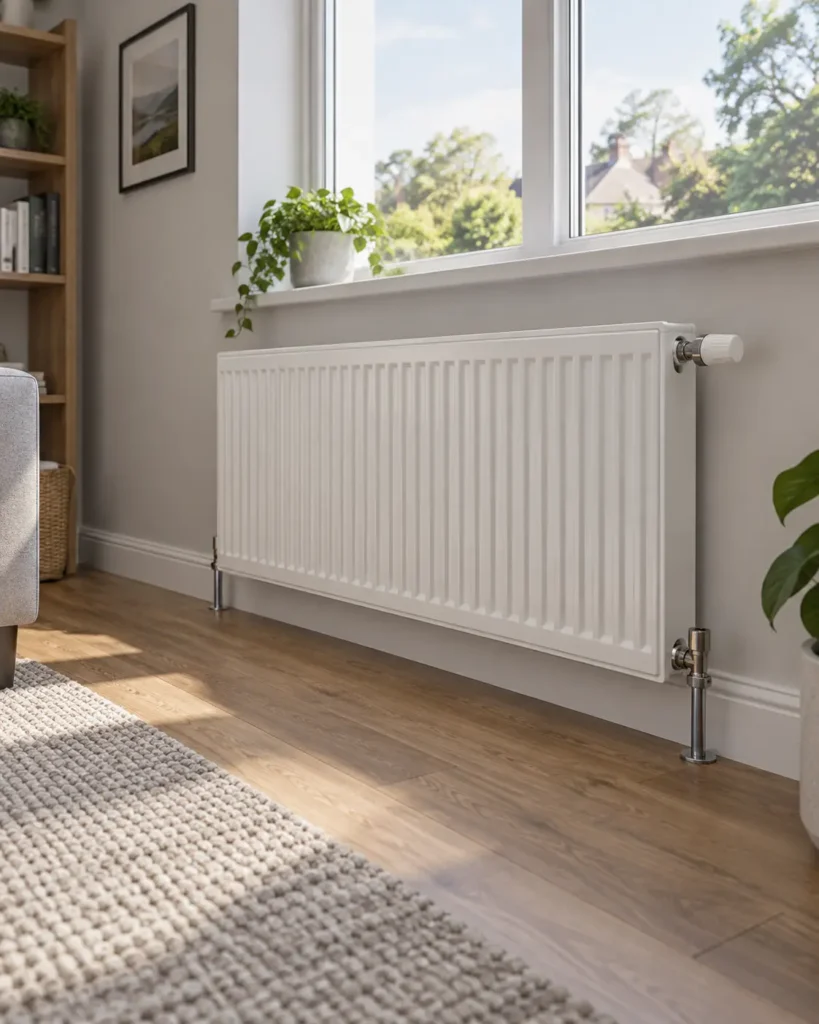
Why can heat pumps need larger radiators?
An air-to-water heat pump transfers heat from outside air into the water circulating through your heating system. The radiators then release that heat into each room. For a deeper explanation of the refrigerant, compressor and heat-exchange process, see our guide to how air source heat pumps work.
The important difference for radiators is water temperature. The Energy Saving Trust heat-pump installation guide says heat pumps often send water to radiators at around 35–45°C. A fossil-fuel boiler may previously have operated the same radiators at considerably higher temperatures.
A cooler radiator releases less heat. Therefore, a radiator that was easily large enough for a boiler may be too small for a low-temperature heat-pump design. Our separate guide to air source heat pump temperatures explains the wider relationship between flow temperature and system performance.
| Existing situation | Likely outcome | Why |
|---|---|---|
| Large double or triple-panel radiator | May be reusable | Greater surface area helps provide useful output at lower water temperatures. |
| Small single-panel radiator | More likely to need upgrading | Its output may fall below the room’s calculated heat loss. |
| Well-insulated room with an oversized radiator | Often suitable to retain | Lower heat loss reduces the output the radiator must provide. |
| High-heat-loss room | May need a larger radiator | More heat must be delivered during cold design conditions. |
| Limited wall space | Fan-assisted emitter may help | Greater output can be achieved without an exceptionally wide panel radiator. |
How do you know if your existing radiators are suitable?
A proper answer starts with the heat loss of each room.
The designer calculates how much heat escapes through walls, windows, floors, roofs and ventilation at the local winter design temperature. The radiator in that room then needs to provide enough heat to replace that loss.
The current MCS heat-pump design standard requires a heat-load calculation using recognised design conditions. It also requires heat-pump selection to take the proposed flow temperature into account.
In practice, the designer should calculate each room’s heat loss, identify the existing radiator, establish its output at the proposed heat-pump temperatures and compare the two.
Only radiators that cannot meet the requirement — or that force the entire system to run hotter than necessary — need attention.
The hardest room can influence the whole system. If one undersized radiator needs very hot water, replacing that radiator may allow a lower flow temperature throughout the house.
Why does the radiator’s Delta T rating matter?
Radiator catalogues commonly quote output at ΔT50. Delta T is the difference between the radiator’s mean water temperature and the room temperature.
A radiator rated at 2,000W at ΔT50 does not still produce 2,000W on a cooler heat-pump system.
The Stelrad radiator correction-factor table gives a factor of 0.513 at ΔT30 and 0.404 at ΔT25. In other words, the same radiator produces only around 51% of its ΔT50 rating at ΔT30 and roughly 40% at ΔT25.
A nominal 2,000W radiator would therefore provide about 1,026W at ΔT30 and approximately 808W at ΔT25.
This is why heat pump radiator sizing should use manufacturer performance data at the intended temperatures, rather than comparing physical dimensions alone.
Which radiators work best with an air source heat pump?
Standard steel panel radiators can work very well with heat pumps when correctly sized.
A common retrofit is to replace a single-panel radiator with a Type 22 double-panel, double-convector radiator. This provides more emitting surface without necessarily requiring much more wall width. Energy Saving Trust also notes that single-panel radiators can sometimes be replaced by double or triple-panel models.
Where wall space is limited, a deeper triple-panel radiator may be suitable. Fan-assisted radiators or fan convectors are another option because they move room air across the heat exchanger. However, they need electricity and can produce some fan noise.
Designer, column and cast-iron radiators are not automatically unsuitable. Their actual output at the intended operating temperature is what matters.
Can insulation reduce the number of radiator upgrades?
Yes. Improving insulation and draught control reduces a room’s heat loss, so its radiator has less work to do.
For example, an existing radiator that is marginal in a draughty room may become adequate after insulation reduces the design heat loss. Centre for Sustainable Energy likewise notes that lowering heat loss can allow existing radiators to remain suitable.
This does not mean every property needs new-build levels of insulation before a heat pump can work. Planned improvements should simply be included in the calculations.
If you are considering several home improvements together, our guide to whether your home is suitable for a heat pump covers the wider property factors.
Does the pipework need replacing too?
Sometimes, but not automatically.
Heat pumps can require different water flow rates from an existing boiler installation. The installer therefore needs to check pipe diameter, circuit length, resistance and the required flow through each emitter.
Microbore is a good example. The Energy Saving Trust installer guidance on microbore pipework specifically says it is not always true that heat pumps cannot work with mini- or microbore systems. The required flow rate and water velocity need to be calculated.
Ofgem’s current Boiler Upgrade Scheme guidance also confirms that suitable existing pipework and radiators can be retained when they are in good condition and appropriate for the new installation.
Ask for radiator changes and pipework changes to be itemised separately, especially if floors may need lifting.
How much do new heat pump radiators cost?
There is no fixed “heat pump radiator” price. Cost depends on radiator size, panel type, valves, pipe alterations, labour and whether the radiator needs moving.
As a broad 2026 UK benchmark, Checkatrade’s radiator replacement cost guide lists about £200 for replacing a double-panel radiator and around £300 for replacing a large radiator. These are guide prices rather than quotations.
A heat-pump quotation should therefore explain exactly which radiators are being changed and why.
It is also worth considering radiator costs as part of the whole system. Spending more on several correctly sized emitters can sometimes support a lower flow temperature and better long-term efficiency.
Eligible homeowners may also be able to reduce the overall heat-pump installation cost through current government funding. See our Boiler Upgrade Scheme 2026 updates for the latest grant position.
Are radiators or underfloor heating better for a heat pump?
Both can work well.
Underfloor heating has a large emitting surface, so it can often provide the required room heat at relatively low water temperatures. This makes it a good match for a heat pump.
However, retrofitting underfloor heating can involve significant disruption where floors are not already being renovated. Correctly sized radiators are often the simpler choice in an existing UK home.
A mixed arrangement is also possible. For example, a renovated ground floor could use underfloor heating while bedrooms retain radiators.
Should you use a high-temperature heat pump to keep old radiators?
Not as the automatic solution.
A higher flow temperature increases radiator output and may reduce the number of radiator changes. However, lower heating-water temperatures generally help heat pumps operate more efficiently.
The current MCS design standard says high-temperature heat pumps should be avoided unless the application requires a flow temperature above 55°C. Where a design proposes more than 55°C, an alternative design at 55°C or below should also be provided, with the differences in efficiency and energy consumption explained to the customer.
The best design therefore balances installation cost with long-term performance. Replacing every radiator unnecessarily makes little sense, but neither does retaining undersized radiators if that forces the heat pump to run hotter for years.
What should you ask for before accepting a heat-pump quote?
Ask the installer to provide:
- The calculated heat loss for every room.
- The proposed flow temperature at the winter design condition.
- The output of each existing radiator at that temperature.
- A schedule showing which radiators can stay and which should change.
- The size and type of each replacement radiator.
- Any necessary pipework alterations.
- The expected seasonal performance or efficiency.
- An explanation of any room that determines the highest required water temperature.
If a quote simply says “replace all radiators” without showing the calculations, ask for the design evidence.
Equally, if every radiator is being retained but the proposed flow temperature is unusually high, ask whether selective radiator upgrades could allow the heat pump to run cooler.
Get Your Free Air Source Heat Pump Quote
Find the right air source heat pump solution for your home. Tell us a few details and our team will help you explore suitable options at a competitive price.
Quick to complete. No obligation.
Get your quote
Enter your details below and one of our team will get back to you.
Frequently asked questions
Find clear answers to common questions about radiators for air source heat pumps, including radiator sizing, flow temperatures, double-panel and cast-iron radiators, towel rails, microbore pipework, underfloor heating and replacement costs.
No. Some existing radiators may already provide enough heat at the proposed lower water temperature. Each room should be assessed separately.
Yes. Standard panel radiators can work with an air source heat pump if they provide sufficient output at the system’s design temperatures.
Not necessarily. The important factor is radiator output at the chosen flow and return temperatures, rather than whether a product is marketed specifically as a “heat pump radiator”.
Heat pumps often circulate cooler water than boilers. A larger emitting surface helps release enough heat into the room despite the lower water temperature.
There is no universal temperature. Energy Saving Trust says heat pumps often supply radiators at around 35–45°C, although the correct design temperature depends on the property.
Not necessarily. They may feel warm rather than very hot because heat pumps often provide gentler heat over longer periods. Comfort and room temperature matter more than how hot the radiator feels.
They can be useful because they provide more emitting surface than a comparable single-panel radiator. However, the correct radiator still needs to be sized against the room’s calculated heat loss.
Potentially. The designer must check their actual output at the proposed water temperatures. Their material alone does not determine whether they are suitable.
Yes, provided their verified output at the heat-pump operating temperature is sufficient for the room.
Yes, but bathrooms often have relatively high design temperatures and towel rails can have limited output. Their performance should therefore be checked carefully against the bathroom heat loss.
Not always. Energy Saving Trust guidance says microbore can work in some heat-pump systems, but the installer must calculate the required flow rate and check that pipe velocity and resistance are acceptable.
No. Underfloor heating is well suited to low water temperatures, but correctly sized radiators can also work effectively.
There is no reliable universal percentage. The increase depends on room heat loss and the proposed flow and return temperatures. Manufacturer output data should be used instead of a rule of thumb.
Sometimes, but higher flow temperatures can reduce efficiency. It may be more economical over the long term to upgrade selected radiators and operate the system at a lower temperature.
Costs vary by size, type and pipework. Checkatrade’s 2026 guide gives roughly £200 for replacing a double-panel radiator and £300 for a large radiator as broad UK benchmarks.
They should calculate each room’s heat loss and compare it with the radiator’s output at the proposed system temperature. A radiator should only be retained if it can meet the design requirement.
Conclusion:
You do not automatically need new radiators with an air source heat pump. The correct answer is usually different from room to room.
Existing radiators can stay where their output at the proposed heat-pump temperature meets the room’s calculated heat loss. Undersized radiators may need to become larger, deeper or fan-assisted. Better insulation can also reduce the output required.
The key number is not how many radiators are replaced. It is the lowest practical flow temperature at which the complete heating system can keep every room comfortable on a cold design day.
Before deciding, compare properly designed quotations that show heat loss, radiator output, flow temperature and any required pipework changes.
Compare free heat-pump quotes: Request a property-specific assessment and compare complete system designs, not just the price of the outdoor unit.


