
Heat Pump for a Poorly Insulated House: Does It Work?
Check Your Eligibility for Boiler Upgrade Scheme (BUS)
Complete your details below to check your eligibility.
Thank you
We've received your details and will be in touch shortly.

Quick answer
A heat pump can heat a poorly insulated house if the system is sized and designed for the property’s actual heat loss. Insulation does not make the heat pump create heat; it slows the rate at which the home loses heat.
A high-loss property may therefore need a higher-capacity heat pump, larger radiators, more operating hours or a higher flow temperature. Those changes can increase installation and running costs.
Improving practical measures such as loft insulation and draught-proofing can reduce heat demand, but expensive wall or floor insulation is not automatically a prerequisite. A proper heat-loss survey should determine what is essential, what is optional and whether the proposed system can keep every room comfortable on a cold design day.
Do Heat Pumps Work in Poorly Insulated Homes?
Yes. A heat pump can work in a poorly insulated house, but poor insulation changes the design challenge. The home loses heat faster, so the heat pump and heating system must replace that heat quickly enough on cold days without relying on unnecessarily high water temperatures.
That can mean a larger heat pump, bigger radiators, longer run times and higher electricity use. Improving insulation usually reduces those demands, but a home does not have to be “perfectly insulated” first.
The better question is: “What is my measured heat loss, and what system design will meet it efficiently?”
Get a free quote: If you are considering a heat pump, compare options only after a room-by-room heat-loss assessment has shown what your property actually needs.
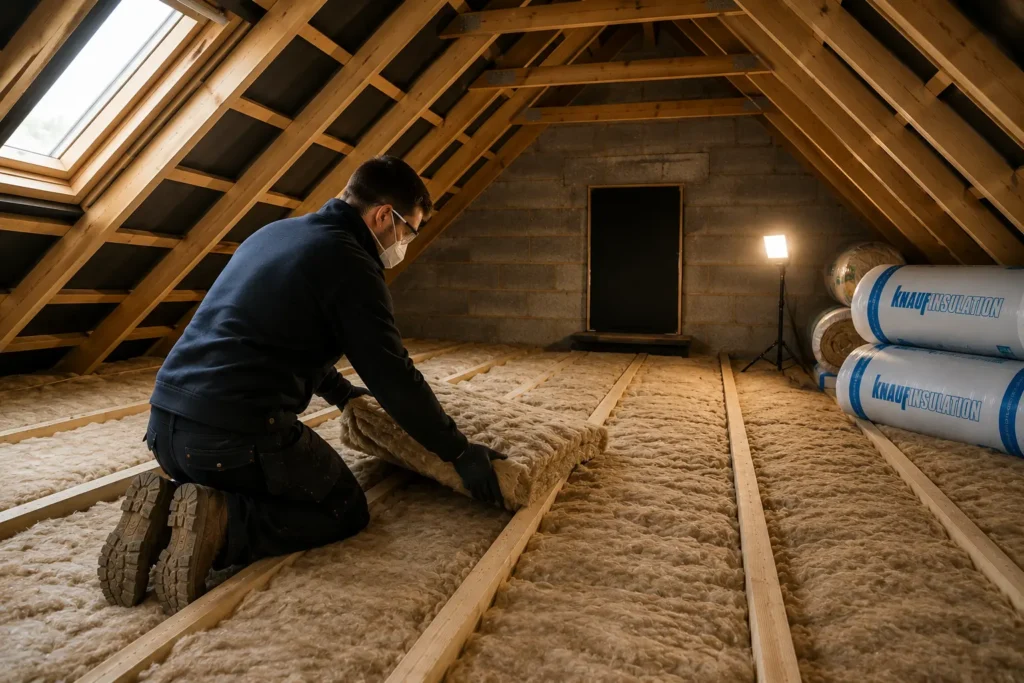
Can a heat pump really work in a poorly insulated house?
Yes.
Energy Saving Trust guidance on heat pumps and different property types says heat pumps can work in homes with less insulation. It also notes that design measures such as increasing radiator size can compensate where additional insulation cannot be fitted.
Its Electrification of Heat demonstration project installed heat pumps across different property types and ages. Older pre-1945 properties presented greater design challenges, but 163 heat pumps were still successfully installed in these homes.
The International Energy Agency’s analysis of heat pumps in poorly insulated homes reaches the same broad conclusion. Heat pumps can still reduce energy use in poorly insulated homes, while combining insulation with a heat pump reduces heating demand further.
The key distinction is whether the system can supply enough heat versus how efficiently and economically it can do so.
| Issue in a poorly insulated home | What it changes | Typical design response |
|---|---|---|
| High fabric heat loss | More heat must be supplied each hour | Higher heat-pump capacity and/or insulation improvements |
| Small existing radiators | May not emit enough heat at low water temperatures | Larger radiators, fan-assisted emitters or underfloor heating |
| Draughts and air leakage | Heat demand can rise, especially in windy weather | Draught-proofing while preserving necessary ventilation |
| Higher required flow temperature | Heat pump usually works less efficiently | Increase emitter area and reduce heat loss where practical |
| High annual heat demand | More electricity is needed across the heating season | Improve fabric, optimise controls and compare tariffs |
Why insulation affects heat-pump performance
Insulation does not change the refrigeration cycle inside the heat pump. It changes what happens to the heat after it reaches your home.
A house loses heat through its roof, walls, windows, floors and ventilation. A heating system must replace that loss. If a room is losing 2kW of heat on a cold day, its radiator or underfloor heating needs to deliver roughly that amount to maintain the target room temperature.
This is why a room-by-room heat-loss calculation matters more than an EPC letter alone.
The calculation should consider room dimensions, exposed surfaces, construction, insulation, glazing and air-change assumptions. It then helps determine the required heat-pump output and emitter sizes.
For the refrigeration cycle itself, see how air source heat pumps work rather than duplicating that explanation here.
What happens to radiators and flow temperature?
Heat pumps usually perform best when they can heat a home using relatively low water temperatures.
The Energy Saving Trust/MCS domestic heat-pump best-practice guide explains that heat-pump efficiency is strongly affected by both source temperature and flow temperature. In general, lowering the required heating-water temperature improves efficiency.
Poor insulation can make this harder.
If a high-loss room has a small radiator, the heating system may need hotter water to deliver enough heat. Higher flow temperatures generally reduce heat-pump efficiency.
Increasing emitter area can avoid that problem. Larger radiators release more heat at lower water temperatures; underfloor heating can do the same through a large surface area.
This is why “Do I need new radiators?” cannot be answered from the property’s age or EPC rating alone. Each radiator should be checked against that room’s design heat loss at the proposed flow temperature.
Will a poorly insulated house stay warm in winter?
It can, provided the system is designed to meet the home’s heat loss at the local winter design temperature.
Air source heat pumps continue operating below freezing, although their output and efficiency change with outdoor temperature. In cold, damp conditions, frost can also form on the outdoor heat exchanger, causing the unit to run periodic defrost cycles.
A correctly designed system must still provide enough output when the house is losing heat fastest.
Older buildings can make that calculation more challenging rather than impossible. Energy Saving Trust’s field evidence shows successful installations in pre-1945 homes, provided the heating system is designed for the building.
If your concern relates mainly to period construction rather than insulation alone, see heat pumps for old houses.
Should you insulate before installing a heat pump?
Often it makes sense to address simple, cost-effective heat-loss measures first, but not every property needs a full retrofit.
Start with improvements that are practical for your building. Loft or roof insulation, draught-proofing and cavity-wall insulation can reduce heating demand where appropriate. Improving poor glazing or adding secondary glazing may also help.
Solid-wall, floor or heritage-property upgrades can be disruptive and expensive. In those cases, compare the benefit of the fabric work with designing the heating system around the existing building.
A useful assessment should separate improvements into three categories:
- Essential: work needed to achieve adequate comfort or a viable heating design.
- High-value: improvements likely to reduce heat demand significantly for a reasonable cost.
- Optional: upgrades that could improve efficiency but are not necessary for the heat pump to work.
The aim is not to chase an arbitrary insulation standard. It is to reduce heat loss where doing so makes technical and financial sense.
How to design a heat pump for a high-heat-loss home
For a poorly insulated property, focus on the complete heating design rather than the heat-pump brand.
Ask for a proper heat pump survey that includes room-by-room heat loss.
The proposal should show the design heat load, selected heat-pump output, proposed flow temperature, radiator outputs and any required pipework or cylinder changes.
Avoid assuming that “bigger is always safer”. Oversizing can cause unnecessary cycling in milder conditions, while undersizing can leave the system short of heat at peak demand. The aim is appropriate capacity combined with the lowest practical flow temperature.
Controls matter too. Heat pumps generally favour steady operation rather than short bursts of very hot water. Energy Saving Trust’s 2026 guidance recommends longer operating periods and lowering flow temperatures where possible to improve efficiency.
Running costs in a poorly insulated property
Poor insulation increases the amount of useful heat the building needs over a year. Any heating system will therefore use more energy than it would after effective insulation improvements.
For a heat pump, electricity consumption depends on both heat demand and seasonal efficiency.
A useful simplified relationship is:
Electricity used ≈ annual heat demand ÷ seasonal performance factor (SPF).
A higher-loss home therefore uses more electricity even at the same SPF.
Running-cost claims based only on heat-pump model or house size are unreliable. Electricity tariffs, flow temperature, controls, radiator sizing and the heating system being replaced all affect the result.
Energy Saving Trust currently notes that heat pumps on standard electricity tariffs can cost slightly more to run than newer gas or oil boilers in some circumstances. Suitable time-of-use tariffs can improve the comparison because heat pumps use much less delivered energy for each unit of useful heat produced.
See air source heat pump running costs for the wider cost factors.
Boiler Upgrade Scheme: do you need insulation first?
In England and Wales, poor insulation does not automatically prevent a property from receiving Boiler Upgrade Scheme support.
The previous requirement to address outstanding loft or cavity-wall insulation recommendations on an EPC was removed for applications from 8 May 2024. Current eligibility guidance does not make completing those insulation measures a prerequisite, although improving energy efficiency can still improve comfort and heat-pump performance.
Current Boiler Upgrade Scheme support includes £7,500 for an eligible air-to-water heat pump. Certain off-gas properties replacing oil or LPG can receive £9,000 under the temporary uplift available until 31 March 2027.
Because grant rules can change, check Boiler Upgrade Scheme 2026 updates before relying on any grant figure.
Get Your Free Air Source Heat Pump Quote
Find the right air source heat pump solution for your home. Tell us a few details and our team will help you explore suitable options at a competitive price.
Quick to complete. No obligation.
Get your quote
Enter your details below and one of our team will get back to you.
Frequently asked questions
Find clear answers to common questions about using heat pumps in poorly insulated, solid-wall and draughty homes, including EPC ratings, radiators, underfloor heating, flow temperature, loft insulation, winter performance and heat-loss assessments.
Yes. It must be sized and designed to replace the heat that the property loses. A badly insulated home may need more heat-pump capacity, larger radiators and more electricity than a better-insulated equivalent.
No general EPC C requirement determines whether a heat pump can physically work. A proper room-by-room heat-loss calculation is much more useful for system design.
Not simply because an EPC recommends loft or cavity-wall insulation. That specific BUS prerequisite was removed from May 2024. Other scheme eligibility rules still apply.
Yes. Solid-wall properties often have higher heat loss, but that does not automatically rule out a heat pump. The required capacity, radiators and flow temperature should be established from a heat-loss survey.
Possibly. Higher heat loss increases the maximum heating output required on cold days. However, system sizing should come from calculations rather than simply choosing the largest available unit.
Not necessarily. Some existing radiators may already provide enough output at the proposed flow temperature. Others, particularly in high-loss rooms, may need to be enlarged.
No. Heat pumps can work successfully with correctly sized radiators. Underfloor heating is useful because its large surface area can provide adequate output at relatively low water temperatures.
A heat pump generally becomes less efficient as the temperature it must produce increases. Larger emitters and lower heat loss can help the system provide enough warmth while keeping flow temperature down.
It can be more expensive than in an insulated version of the same property because the building requires more heat. Actual cost also depends on seasonal efficiency, electricity tariff, controls and the heating system being replaced.
Yes. Air source heat pumps are designed to operate in winter conditions. Output and efficiency change as outdoor temperatures fall, and defrost cycles may occur in cold, damp weather.
Not automatically. A higher-temperature model can help where high flow temperatures are unavoidable, but producing hotter water normally carries an efficiency penalty. Reducing heat loss or increasing radiator size may provide a better overall design.
Often, yes. Where loft insulation is straightforward and currently poor, reducing roof heat loss can lower heating demand regardless of whether you install a heat pump, gas boiler or another heating system.
There is no single UK insulation thickness or EPC rating that determines technical suitability. The key measurement is how much heat the whole building and individual rooms lose under design conditions.
Technically, it may be possible, but uncontrolled air leakage can create high and variable heat demand. Draught-proofing is often worth investigating first, provided necessary ventilation is maintained.
Arrange a detailed heat-loss assessment before choosing equipment. It should show whether targeted insulation, radiator upgrades or another change would improve the proposed system enough to justify the cost.
The practical verdict
A heat pump can work in a poorly insulated house.
The deciding factor is not whether the walls meet an arbitrary insulation standard. It is whether a properly designed system can meet the building’s heat loss at an efficient and affordable operating point.
For some homes, modest insulation and radiator changes will make the design straightforward. For others, especially very draughty solid-wall properties, reducing heat loss before installation may be the better investment.
In a small number of particularly difficult properties, the cost of the necessary improvements may make another heating strategy more attractive for the time being.
The right next step is therefore a measured heat-loss survey.
Ask the designer to show you:
- the calculated heat loss for each room;
- the whole-house design heat load;
- the proposed heat-pump capacity;
- the assumed winter flow temperature;
- which radiators need changing;
- expected seasonal efficiency; and
- which insulation measures are essential rather than merely desirable.
Compare free quotes: Use those figures to compare complete heating-system designs, not just heat-pump brands or headline installation prices.


