Bedroom Air Conditioning UK: Costs, Sizing & Noise
Check Your Eligibility for Boiler Upgrade Scheme (BUS)
Complete your details below to check your eligibility.
Thank you
We've received your details and will be in touch shortly.
Quick Answer: What Is the Best Air Conditioning for a UK Bedroom?
For most UK bedrooms, a correctly sized wall-mounted split system is the best all-round choice. It is normally quieter and more efficient than a portable air conditioner because the compressor sits outdoors.
Many smaller bedroom systems are around 2.0–2.5 kW, but the correct capacity should come from the room’s heat gain rather than floor area alone.
Look for low indoor noise on quiet or sleep mode, inverter control, good seasonal efficiency and an installation position that avoids blowing directly onto the bed.
Energy Saving Trust currently gives about £1,900 as a typical cost for a one-room air-to-air heat pump, although actual quotations depend on the equipment, access, pipework and electrical work.
Bedroom Air Conditioning UK: Costs, Sizing, Noise and the Best Options
Bedroom air conditioning can make a hot UK bedroom far more comfortable, but the right system is not simply the one with the biggest cooling number. For sleep, noise, airflow direction, correct sizing and running cost matter just as much as headline capacity.
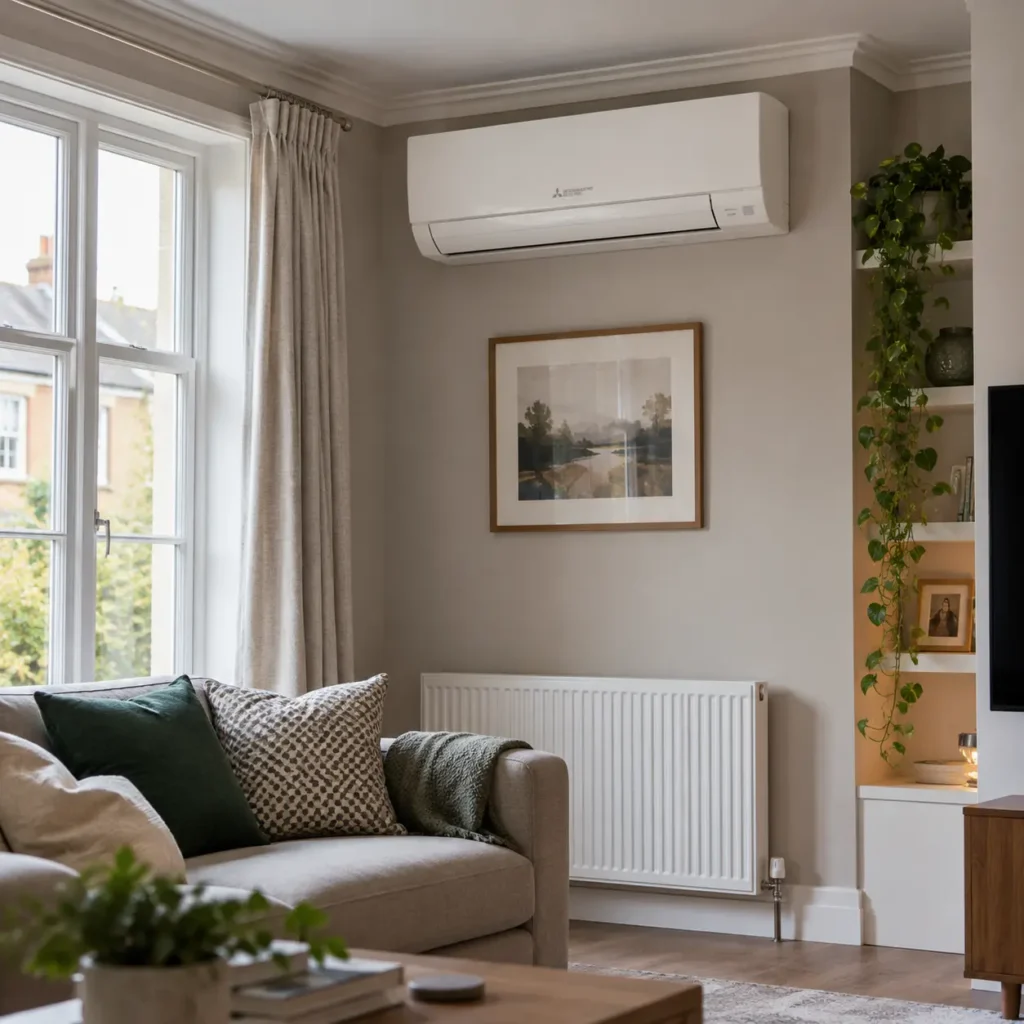
For most homeowners who want reliable cooling every summer, a small wall-mounted split system is usually the strongest option. It places the compressor outside, which keeps the bedroom quieter. Modern reversible systems can also provide heating when required.
Portable units cost less upfront and suit renters or occasional use. However, they are normally noisier because the compressor remains inside the bedroom.
This guide explains the main bedroom air conditioning options in the UK, how much they can cost, how to think about sizing, what to check for quiet operation, and the planning and installation rules that can affect your project.
Planning a permanent bedroom system? See the UK air-conditioning installation guide before comparing quotations.
Bedroom Air Conditioning Options Compared
| Option | Best for | Key advantage | Main consideration |
|---|---|---|---|
| Wall-mounted split | Homeowners using the room regularly | Quiet, efficient and effective | Requires professional installation and an outdoor unit |
| Portable air conditioner | Renters or occasional heatwaves | Lower upfront cost | Compressor noise remains inside and a window hose is required |
| Multi-split | Several bedrooms | Several indoor units can share one outdoor unit | More complex pipework and system design |
| Ducted system | Premium renovations | Very discreet inside the bedroom | Higher cost and suitable ceiling or loft space is needed |
If you are deciding between temporary and permanent cooling, our portable vs split air conditioning comparison goes into the differences in more detail.
How Does Bedroom Air Conditioning Actually Work?
A split air conditioner uses the refrigeration cycle to move heat from your bedroom to the outside.
Inside the bedroom, the evaporator absorbs heat into a refrigerant. The refrigerant then travels to the compressor, which increases its pressure and temperature.
Next, the hot refrigerant moves through the outdoor condenser, where the absorbed heat is released outside. An expansion valve then reduces the refrigerant pressure before it returns to the indoor coil and repeats the cycle.
A reversible split system can run the process in the opposite direction to provide heating. That is why many modern fixed air-conditioning systems are also described as air-to-air heat pumps. Energy Saving Trust confirms that air-to-air heat pumps can provide both heating and cooling.
For bedrooms, the important design advantage is that the compressor sits outside. The indoor unit mainly contains the fan and heat exchanger.
How Quiet Should Bedroom Air Conditioning Be?
Noise should be one of your first selection criteria.
Some current wall-mounted systems publish indoor sound-pressure levels as low as 19 dB(A) on their quietest settings. Daikin, for example, publishes a 19 dB(A) figure for its Perfera range.
However, do not compare systems using only the lowest marketing figure.
Ask for the exact model’s sound-pressure figures at quiet, low, medium and high fan speeds. A system may be extremely quiet while maintaining temperature but noticeably louder when initially cooling a hot room.
Outdoor noise matters too. Check where the condenser will sit in relation to your own bedroom window and neighbouring properties.
Correct sizing can also improve comfort. An unnecessarily large unit may create stronger airflow than the room requires.
For model-specific comparisons, see our guide to the quietest air conditioning in the UK.
Think About Airflow as Well as Decibels
A quiet unit can still be uncomfortable if cold air blows directly across the bed.
The installer should select a position that lets conditioned air circulate through the bedroom without creating a persistent draught over the sleeping area.
Sleep modes can also reduce fan speed and adjust operation overnight.
What Size Air Conditioner Does a Bedroom Need?
Many ordinary UK bedrooms may ultimately suit a system around 2.0–2.5 kW, but bedroom size alone is not enough to specify the equipment.
A proper assessment should consider:
bedroom dimensions and ceiling height;
window size and orientation;
solar gain;
whether the bedroom is directly below a roof;
insulation levels;
wall construction;
number of occupants;
equipment and lighting;
ventilation and air leakage.
A west-facing loft bedroom can require considerably more cooling than a shaded ground-floor bedroom with the same floor area.
That is why simple rules such as “X kW for X square metres” should only be treated as starting points.
Oversizing is not automatically safer. A larger system may cost more, create unnecessary airflow and fail to deliver the quiet operation you expected.
Our UK air-conditioning sizing guide explains the important heat-load factors in more detail.
How Much Does Bedroom Air Conditioning Cost in the UK?
Energy Saving Trust currently estimates approximately £1,900 for a one-room air-to-air heat pump. Treat this as an indicative planning figure rather than a guaranteed quotation.
The final installation cost depends on factors including:
indoor and outdoor unit specification;
pipework length;
electrical work;
condensate drainage;
wall construction;
outdoor-unit mounting;
scaffolding or difficult access;
making good and redecoration.
A straightforward bedroom where the indoor and outdoor units sit on opposite sides of the same external wall will normally be easier to install than a loft bedroom requiring a long refrigerant route.
When comparing quotations, check whether the price includes the unit, installation labour, electrical supply, pipework, brackets or base, drainage, commissioning, VAT and warranty registration.
Do not compare the headline figure alone.
How Much Does Bedroom Air Conditioning Cost to Run Overnight?
Running cost depends on the electricity the system actually draws, rather than simply the cooling capacity printed on the product.
For 1 October to 31 December 2026, Ofgem’s average electricity rate for a Direct Debit customer covered by the price cap is 26.32p per kWh across England, Scotland and Wales. Your own tariff and regional rate may be different.
The basic calculation is:
Running cost = average electrical input × running hours × electricity unit rate
| Illustrative average electrical draw | Energy over eight hours | Cost at 26.32p/kWh |
|---|---|---|
| 0.3 kW | 2.4 kWh | About £0.63 |
| 0.5 kW | 4.0 kWh | About £1.05 |
| 0.7 kW | 5.6 kWh | About £1.47 |
These are illustrations, not promised running costs for a particular air conditioner.
Modern inverter systems change their electrical input as the cooling requirement changes. After bringing the bedroom down to temperature, the compressor can reduce output rather than constantly operating at maximum power.
You can also reduce the cooling load by closing curtains or blinds during strong sunshine and keeping windows closed while the system runs.
Where Should Bedroom Air Conditioning Be Installed?
The indoor unit should distribute air through the room without directing a constant stream towards the bed.
A high wall position is common because it gives the unit clear airflow and allows conditioned air to mix effectively.
The outdoor condenser needs suitable airflow around it and access for maintenance. Its position should also consider appearance, drainage and noise affecting neighbours.
Pipe routes matter. A short, straightforward route is usually simpler than running refrigerant pipework through several rooms or floors.
Condensate produced during cooling must also drain safely without causing damp, staining or nuisance.
If you live in a flat or leasehold property, check whether landlord, freeholder or managing-agent consent is required before equipment is fixed to an outside wall.
Do You Need Planning Permission for Bedroom Air Conditioning?
It depends on the equipment, the property and the UK nation in which you live.
In England, an air-source heat pump can fall within permitted-development rights when the relevant conditions are met. One particularly important condition is that the system must not be solely used for cooling.
Therefore, a reversible unit providing heating and cooling can have a different planning position from a cooling-only air conditioner.
The Planning Portal also highlights restrictions affecting matters such as protected locations and listed buildings.
Planning rules differ between England, Wales, Scotland and Northern Ireland, and individual properties can have additional restrictions. Check with your local planning authority before committing to equipment where permission is uncertain.
Who Can Install a Split Air Conditioner?
Stationary air-conditioning equipment containing F-gas is regulated.
GOV.UK states that individuals working on relevant refrigeration, air-conditioning and heat-pump systems need the appropriate qualifications. Businesses carrying out installation, servicing and similar work also require appropriate company certification.
This is one reason a fixed split system is not a normal DIY installation.
Is Bedroom Air Conditioning Worth It in the UK?
It can be, especially where a bedroom:
regularly overheats in summer;
is immediately below the roof;
receives strong afternoon or evening sun;
remains warm long after outdoor temperatures fall;
faces a noisy road that makes open-window cooling impractical.
For occasional heatwaves, a portable unit may be sufficient.
However, if your priority is low noise, closed windows, reliable cooling and regular use over many summers, a fixed split system will usually provide the better bedroom experience.
The most important decision is not the brand badge.
Start with the bedroom’s cooling requirement. Then compare indoor noise, efficiency, airflow, outdoor-unit positioning and the proposed installation design.
Get Your Free Air Source Heat Pump Quote
Find the right air source heat pump solution for your home. Tell us a few details and our team will help you explore suitable options at a competitive price.
Quick to complete. No obligation.
Get your quote
Enter your details below and one of our team will get back to you.
Frequently asked questions
Find clear answers to common questions about bedroom air conditioning in the UK, including system type, sizing, noise, overnight use, installation costs, running costs, portable units, heating, planning permission, F-gas requirements, servicing, grants and dehumidification.
For most homeowners, a wall-mounted split system offers the best balance of quiet operation, efficiency and effective cooling. A portable air conditioner may make more sense for tenants or occasional use.
Many ordinary bedrooms may fall around the 2.0–2.5 kW range, but the correct size depends on heat gain, glazing, orientation, insulation, roof exposure and other factors. A room-specific assessment is more reliable than floor area alone.
Often, but not always. A normal bedroom with moderate heat gain may suit 2.5 kW, while a large, highly glazed or top-floor room can require more capacity.
Some modern wall-mounted systems publish quiet-mode figures around 19 dB(A). Check the exact model at several fan speeds rather than relying only on its lowest published figure.
A suitably designed system can be used overnight. Timers, sleep modes and temperature controls can reduce unnecessary operation. Follow the manufacturer's operating instructions.
Energy Saving Trust currently uses approximately £1,900 as a typical one-room air-to-air heat-pump cost. Actual bedroom installations can differ significantly depending on equipment and installation complexity.
It depends on the unit's average electrical consumption and your tariff. At Ofgem's October–December 2026 average Direct Debit rate of 26.32p/kWh, an illustrative average draw of 0.5 kW for eight hours would cost about £1.05.
It can work well for occasional use or rented accommodation. The main disadvantage is noise because the compressor remains inside the room.
Usually, yes. A split system places the compressor outside, leaving mainly the indoor fan and heat exchanger inside the bedroom.
Many modern reversible split systems can both cool and heat. These systems operate as air-to-air heat pumps.
Possibly. The answer depends on the system, property and UK nation. In England, permitted-development provisions can apply to qualifying air-source heat pumps, but a system used solely for cooling does not satisfy the relevant condition.
Potentially, but you may need permission from the freeholder, landlord or managing agent as well as satisfying planning and building requirements.
People working on relevant stationary air-conditioning refrigerant systems need the required qualifications, while businesses undertaking installation or servicing also need appropriate company certification.
Follow the manufacturer's maintenance schedule and warranty conditions. Filters normally require more frequent cleaning than the complete system requires professional servicing.
Do not assume so. Ofgem currently lists a £2,500 Boiler Upgrade Scheme grant for eligible residential air-to-air heat pumps in England and Wales. However, the funded heat pump must be designed to meet the property's full space-heating requirement and replace an eligible existing heating system. A single bedroom cooling add-on would therefore not normally meet the scheme's purpose.
Energy Saving Trust also noted on 16 October 2026 that practical access depends on suitable MCS-certified air-to-air installation capability becoming available.
Cooling-mode air conditioning normally removes some moisture from indoor air as water condenses on the cold indoor coil. Actual dehumidification performance depends on the system and operating conditions.
Conclusion
The best bedroom air conditioning in the UK is usually a quiet, correctly sized split system rather than simply the largest unit available.
For many bedrooms, a small inverter system provides a strong balance of comfort, low noise, efficiency and control. However, the final capacity should follow a heat-load assessment rather than a rule of thumb.
Check the exact model’s noise data, installation position, electrical requirements and outdoor-unit location before agreeing to a quotation.
A well-designed bedroom system should fade into the background. It should maintain a comfortable room without excessive noise, draughts or unnecessary electricity consumption.
Ready to compare suitable options? Get free, no-obligation home-improvement quotes from Getfreequote.co.uk.