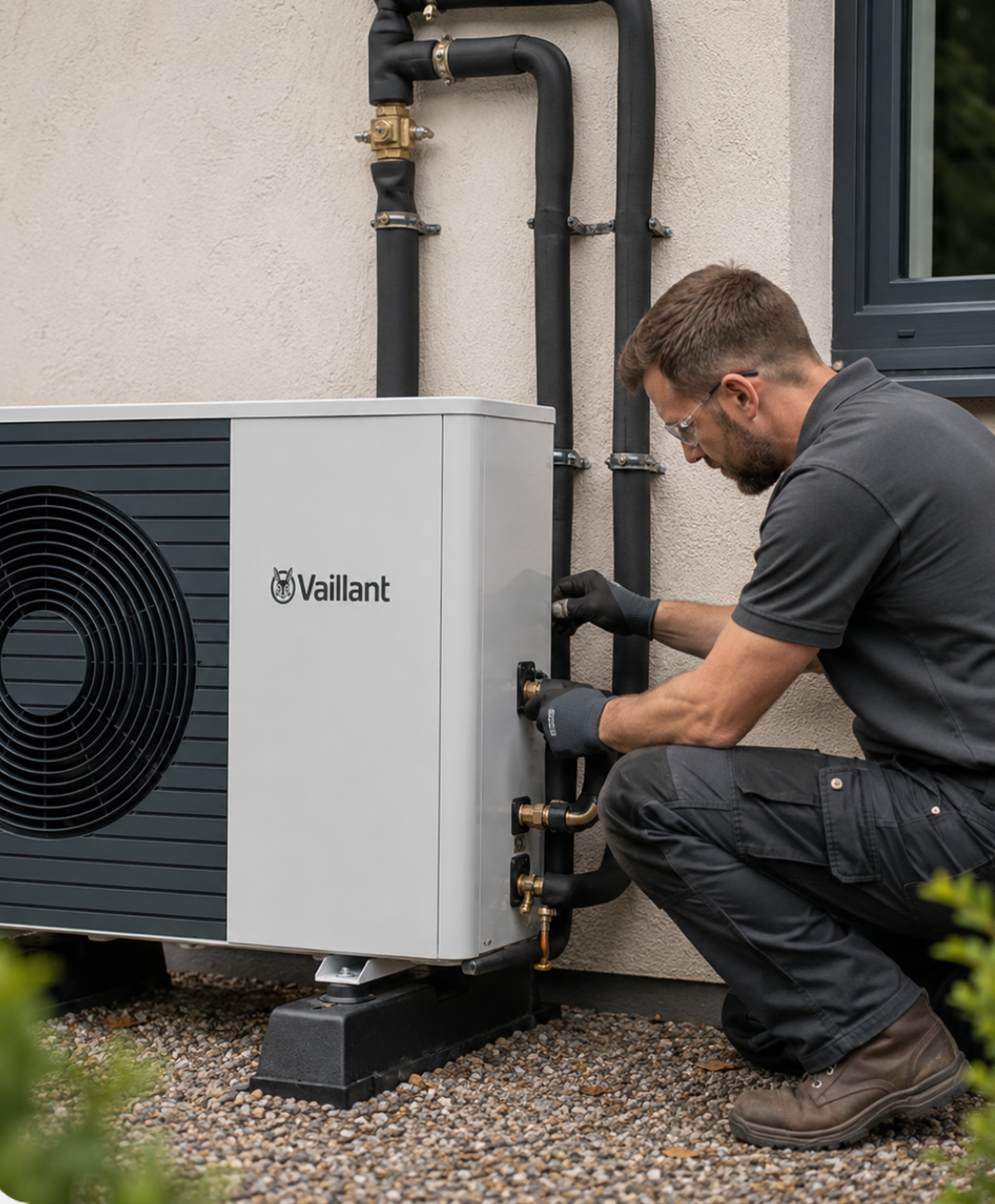
Heat Pumps for Holiday Lets: UK Owner's Guide 2026
Check Your Eligibility for Boiler Upgrade Scheme (BUS)
Complete your details below to check your eligibility.
Thank you
We've received your details and will be in touch shortly.

Quick Answer: Are Heat Pumps Suitable for Holiday Lets?
Yes. Heat pumps can work very well in holiday lets when the system is designed around maximum guest occupancy rather than average annual occupancy.
Air-to-water heat pumps can supply radiators or underfloor heating and produce stored hot water. They are particularly attractive for properties replacing direct electric, oil or LPG heating.
Holiday-let owners should pay particular attention to remote controls, pre-arrival heating, hot-water-cylinder capacity, frost protection, noise and the electricity tariff used by the property. Properties in England and Wales may also qualify for the Boiler Upgrade Scheme; current Ofgem guidance explicitly lists holiday homes among eligible residential property examples.
Heat Pumps for Holiday Lets: Are They a Good Choice for UK Holiday Homes?
Heat pumps can be an excellent heating option for UK holiday lets, particularly cottages, lodges and rural properties currently using oil, LPG or direct electric heating. However, a holiday let needs a slightly different approach from a permanently occupied home.
The biggest issue is not whether a heat pump can heat the property. It is how the system copes with changing occupancy, cold-weather arrivals, high simultaneous hot-water demand and periods when nobody is staying.
A well-designed system can keep guests comfortable while giving owners remote control over heating and potentially reducing energy use. Poor sizing or controls can create exactly the opposite experience: slow warm-up, expensive electricity use and guests who cannot get enough hot water.
Before deciding, arrange a property-specific heat pump survey rather than choosing equipment from bedroom count alone.
Considering a heat pump for a holiday property? Get a free quote and compare designs based on the building, expected occupancy and current heating system.

What Makes a Holiday Let Different?
A family home normally follows a fairly predictable daily heating pattern. Holiday accommodation does not.
A cottage might be empty for several days, then suddenly house six guests who all expect warm bedrooms, hot showers and a comfortable living room immediately.
That changes how the heating system should be designed and controlled.
| Holiday-let issue | Heat-pump design response |
|---|---|
| Empty periods between bookings | Use controlled setback and frost protection rather than simply switching everything off |
| Guests arriving to a cold property | Start heating before check-in |
| Maximum occupancy | Size space heating and hot water for a full property |
| Several showers or baths close together | Specify appropriate cylinder capacity and recovery performance |
| Owner lives elsewhere | Provide reliable remote monitoring and controls |
| Guest bedrooms near outdoor unit | Consider sound and siting carefully |
| Rural property | Compare against oil, LPG or direct-electric heating rather than gas alone |
Heat pumps generally achieve their best efficiency when maintaining temperature steadily rather than repeatedly recovering a very cold building.
That makes an extreme “off when empty, maximum heat at check-in” strategy less suitable for many winter holiday lets.
Which Heat Pump Is Best for a Holiday Let?
For many houses and cottages, an air-to-water heat pump is the most practical choice.
It takes heat from the outside air and transfers it into a wet central-heating system. It can supply radiators, underfloor heating and a hot-water cylinder. Energy Saving Trust describes air-to-water systems as the most common domestic heat-pump type in the UK.
Ground-source systems may make sense for larger developments or properties with substantial land, but installation is considerably more involved.
Air-to-air systems can suit compact lodges, apartments and properties without wet central heating. However, they normally require a separate solution for domestic hot water. Energy Saving Trust currently estimates typical air-to-air installation costs at around £1,900 for one room and around £3,700 for a three-bedroom semi-detached property, although actual holiday-let designs can differ significantly.
How Do You Keep Guests Warm Without Wasting Electricity?
Think in terms of setback and pre-heating, rather than switching the property completely off.
During longer vacant periods, the appropriate minimum temperature will depend on the property, pipework, weather, insurance requirements and manufacturer settings. Frost protection should remain active where required.
Before the next booking, remote controls can raise the target temperature early enough for the building fabric, radiators and floors to reach comfortable conditions.
This matters because heat pumps usually deliver lower-temperature heat for longer periods than boilers.
Guests should not need to understand any of this.
Controls inside the property should remain simple: guests need to be able to make reasonable temperature adjustments without accidentally disabling weather compensation, frost protection or other important settings.
Hot Water Can Be More Important Than Bedroom Count
A holiday let advertised for six people should be designed for six people using it.
That sounds obvious, but hot-water demand can be underestimated when a system is designed from normal owner occupancy rather than guest capacity.
MCS heat-pump design guidance requires domestic hot-water demand and cylinder sizing to take account of occupancy.
Consider:
maximum permitted guest numbers
number of showers and baths
likely simultaneous morning demand
changeover requirements
cylinder reheat time
available cylinder space.
A standard air-to-water heat pump usually stores hot water rather than producing unlimited instantaneous hot water like a combi boiler.
There is another holiday-let consideration: water hygiene during vacant periods. HSE guidance says landlords and people controlling premises must assess and manage Legionella risks. Where temperature is used as the control measure, HSE advises storing hot water at at least 60°C and managing stagnation in properties left empty.
Your heating engineer and property manager should therefore agree how hot-water temperatures, hygiene cycles and void periods will be managed.
How Much Does a Heat Pump Cost to Run in a Holiday Let?
There is no reliable “average holiday-let heat-pump bill”.
The correct calculation starts with useful heat demand:
Annual heat demand ÷ seasonal efficiency = approximate electricity consumption
For example, if a property requires 12,000kWh of useful heat and achieves a seasonal efficiency of 3.2:
12,000 ÷ 3.2 = 3,750kWh of electricity
At Ofgem’s average domestic electricity rate of 26.32p/kWh for 1 October to 31 December 2026, that would equal about £987 before standing charges.
However, that figure is only an illustration.
Holiday lets may have a domestic tariff, specialist arrangement or non-domestic business energy contract. Business energy customers are not protected by the domestic energy price cap.
Occupancy also changes the calculation. A heavily booked winter cottage will behave differently from a coastal property that is largely empty from November to March.
For a fuller calculation method, see the air source heat pump running costs guide.
Can Holiday Lets Get the Boiler Upgrade Scheme?
Potentially, yes.
This is an area where some online advice is currently inaccurate.
Ofgem’s 2026 installer guidance explicitly includes holiday homes, second homes and properties rented to tenants among examples of eligible residential properties. Residential and non-residential properties can also qualify for air-to-water and ground-source heat pumps, subject to the wider scheme rules.
Current support includes:
£7,500 for eligible air-to-water heat pumps
£7,500 for eligible ground-source heat pumps
£2,500 for qualifying residential air-to-air systems
£9,000 for qualifying off-gas-grid properties replacing oil or LPG with eligible air-to-water or ground-source systems until 31 March 2027.
From 28 April 2026, a valid EPC is no longer a standing BUS eligibility requirement. Where one exists, its reference is supplied; where it does not, the installer can submit alternative evidence.
Owners specifically comparing grant rules for additional properties can read the Boiler Upgrade Scheme second-home guide.
What About Old Holiday Cottages?
Stone cottages, converted barns and older coastal properties are not automatically unsuitable.
What matters is the building’s heat loss.
MCS methodology requires room-by-room heat-loss calculations that consider dimensions, fabric, ventilation, required room temperatures and winter outdoor conditions.
An older holiday cottage may need:
higher-output radiators
pipework changes
draught reduction
sensible insulation improvements
careful outdoor-unit positioning.
Underfloor heating can work particularly well because its large surface area allows lower water temperatures.
The installer should not simply oversize the heat pump to compensate for an uncertain survey. Correct emitter design and flow temperature are central to both comfort and running cost.
Remote Controls Are Particularly Valuable
Holiday-let owners often manage properties from another town or county.
Remote access allows you or the property manager to check temperatures, change schedules before arrivals and identify faults before guests discover them.
Useful features include:
remote temperature adjustment
frost-protection visibility
fault notifications
hot-water scheduling
energy-consumption data
locked or limited guest controls.
Keep the setup robust. A complex automation that depends on several cloud services may be less useful than a reliable manufacturer control system that your cleaner or maintenance engineer also understands.
Noise and Planning Need Extra Attention
Outdoor-unit location matters more in holiday accommodation because poor siting can affect both neighbours and paying guests.
MCS’s current planning sound method uses a 37dB LAeq,5mins limit at the relevant assessment position for domestic permitted-development calculations.
See the air source heat pump noise guide for a fuller explanation of sound power, distance and reflective surfaces.
Planning status also deserves checking.
In England, domestic air-source heat pumps can benefit from permitted-development rights if the relevant conditions are met. However, Planning Portal advises that air-source heat pumps on non-domestic land are likely to require planning permission.
Because holiday accommodation can have different planning or use classifications, do not assume the rule applying to your main home automatically applies to the let.
How to Choose a Heat Pump for a Holiday Let
Calculate room-by-room heat loss.
Do not select capacity from floor area or bedroom count alone.Design for full guest occupancy.
Heating and hot water must work when every bed is occupied.Agree the empty-property strategy.
Decide how setback, frost protection and pre-arrival heating will operate.Check the electricity contract.
Use the property’s actual tariff when forecasting running costs.Specify hot-water performance carefully.
Confirm cylinder capacity, recovery time and water-hygiene controls.Plan remote management.
Make sure owners, cleaners or maintenance staff can recognise faults.Check noise and planning before installation.
This is especially important for closely spaced cottages, listed buildings and properties with non-domestic status.Compare whole-system quotations.
Look at radiators, cylinder, controls, electrical work, expected seasonal performance and grant deduction — not only the heat-pump brand.
Get Your Free Air Source Heat Pump Quote
Find the right air source heat pump solution for your home. Tell us a few details and our team will help you explore suitable options at a competitive price.
Quick to complete. No obligation.
Get your quote
Enter your details below and one of our team will get back to you.
Frequently asked questions
Find clear answers to common questions about heat pumps for holiday lets, including Boiler Upgrade Scheme funding, EPC requirements, remote controls, hot-water demand, vacant periods, winter operation, running costs, planning permission, noise and multiple holiday properties.
Yes. They can work very effectively when heating, hot water and controls are designed around variable occupancy and maximum guest numbers.
Potentially, yes. Ofgem explicitly lists holiday homes among eligible residential property examples, subject to the full scheme rules.
Eligible air-to-water and ground-source installations normally receive £7,500. Certain qualifying off-gas properties replacing oil or LPG can receive £9,000 until 31 March 2027.
Not necessarily. From 28 April 2026, a valid EPC stopped being a standing BUS requirement. Alternative evidence can be provided where there is no valid certificate.
Usually, complete shutdown is not the best winter strategy. Use appropriate setback and frost-protection settings and pre-heat before guests arrive.
Most modern systems offer some form of remote or app-based control, although features differ by manufacturer.
They should not need technical knowledge. Guest-facing controls should be simple while important system settings remain protected.
They can, provided the cylinder and heat pump are designed for maximum occupancy and expected shower or bath demand.
Most air-to-water systems providing domestic hot water use a cylinder rather than producing instantaneous hot water like a combi boiler.
Stagnation and water temperature need managing as part of the property's Legionella risk controls. HSE specifically highlights vacant properties as requiring careful water-system management.
Yes, potentially. Building age itself is not the deciding factor. Heat loss, emitters, pipework and available space matter more.
Yes. Its large surface area can deliver comfortable heating at relatively low water temperatures, which supports efficient heat-pump operation.
It depends on heat demand, seasonal efficiency, occupancy and the electricity tariff. Business energy contracts can produce very different costs from domestic tariffs.
Not if it is supplied through a business energy contract. Ofgem's domestic price cap does not protect business energy customers.
Yes. Air-source heat pumps continue operating in cold weather, although output and efficiency change as outdoor temperatures fall.
Not automatically. MCS design starts with calculated heat loss. Oversizing can create poor cycling and efficiency, so recovery requirements should be solved through proper system design.
It depends on the property's planning status and location. Domestic permitted-development rights may apply, while air-source installations on non-domestic land are more likely to require permission.
Modern units can be quiet when correctly selected and positioned. Noise should still be assessed carefully near bedrooms, boundaries and neighbouring properties.
Potentially. Ofgem says owners of multiple properties may apply for a voucher for each legally separate eligible property, with one voucher redeemable per property.
It can be, particularly for an efficient property with a good electricity tariff. The comparison should use actual annual heat demand and fuel prices rather than assumptions.
Are Heat Pumps Worth It for Holiday Lets?
They can be.
The strongest cases are often properties replacing expensive direct electric heating, oil or LPG, particularly where the building is used through the colder months.
The commercial decision should still be based on numbers.
Compare the total installation cost after grants with expected electricity use, current fuel costs, maintenance requirements and the value of reliable year-round guest comfort.
A heat pump should make the property easier to operate, not give the owner another system to constantly manage.
Next step: arrange a survey and compare complete designs based on your property’s heat loss, guest numbers and booking pattern rather than buying from a headline system price.