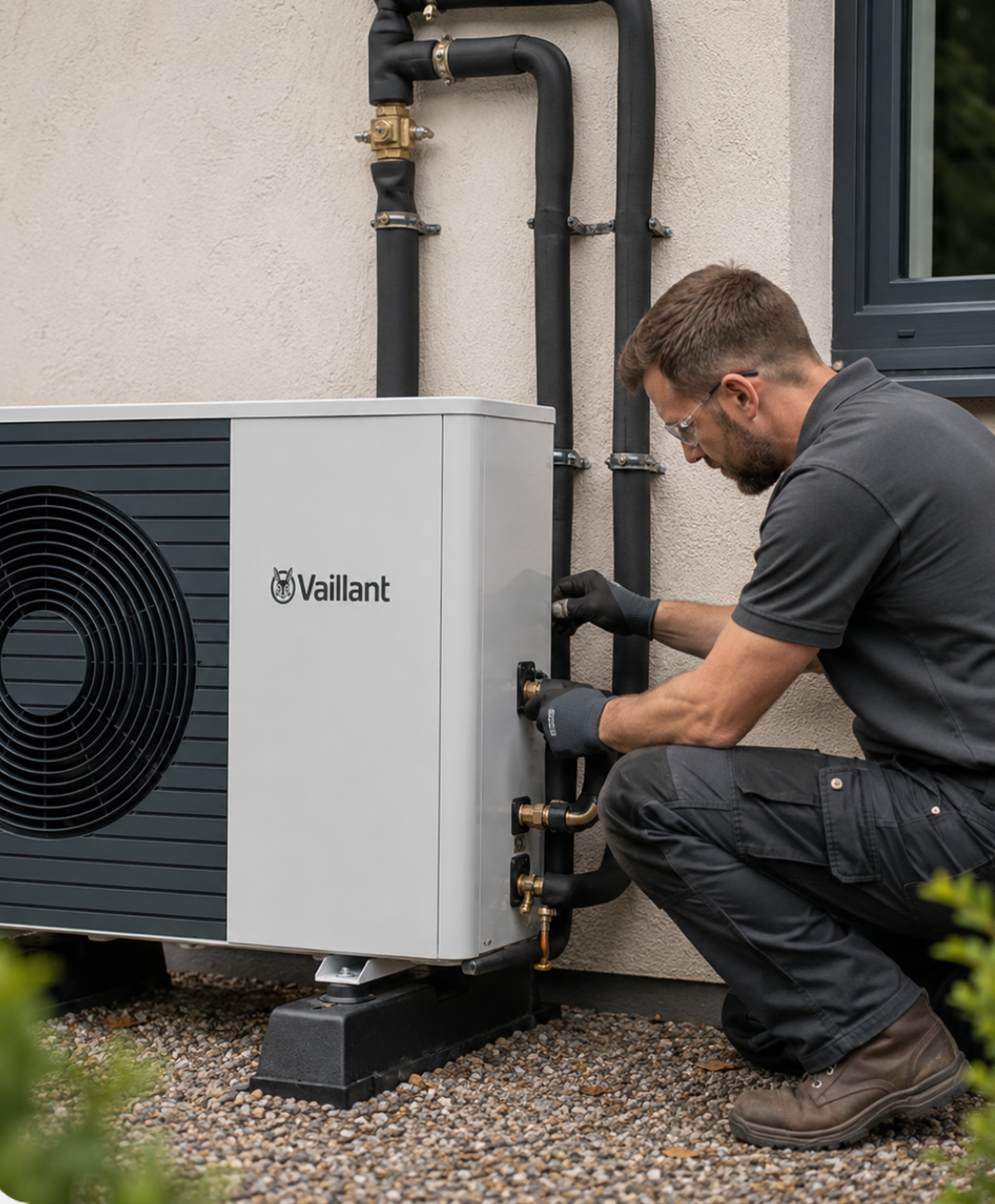
Air Source Heat Pump New Build: UK Guide 2026
Check Your Eligibility for Boiler Upgrade Scheme (BUS)
Complete your details below to check your eligibility.
Thank you
We've received your details and will be in touch shortly.
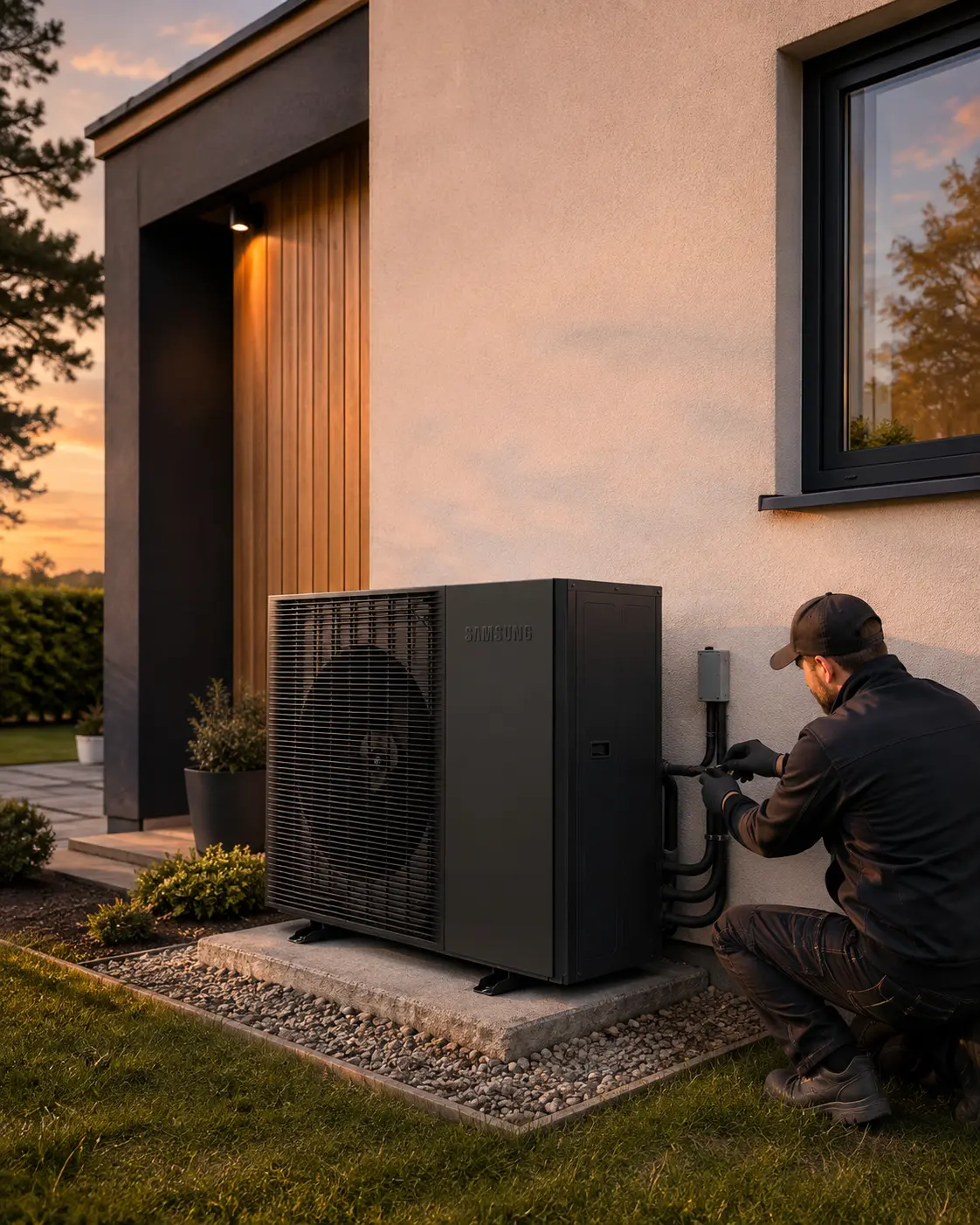
Quick answer: is an air source heat pump good for a new build?
Yes. A well-designed new build is usually an excellent match for an air-to-water heat pump. High insulation levels and low heat loss allow the system to operate at lower flow temperatures, while underfloor heating or correctly sized radiators can keep rooms comfortable without boiler-style high-temperature water.
The best results come from designing the heat pump as part of the building. Before first fix, confirm the room-by-room heat loss, heat-pump output at the local winter design temperature, emitter outputs, pipe sizes, hot-water cylinder, electrical requirements, controls and outdoor-unit location.
Air Source Heat Pump for a New Build: UK Design Guide 2026
An air source heat pump can be an excellent heating choice for a new-build home because the house and heating system can be designed together from day one. New homes normally have lower heat loss than older properties, making it easier to use the lower water temperatures that help heat pumps run efficiently.
For self-builders and developers, the key decision is not simply which unit to buy. Room-by-room heat loss, emitters, hot-water storage, pipework, electrical supply, controls and outdoor-unit position should all be coordinated before first fix.
This guide explains how to design an air source heat pump new build system, what current regulations mean and when a self-build may qualify for support.
Get a Free Quote: Compare properly designed heat-pump quotes before finalising plumbing, floor build-ups or plant-room space.
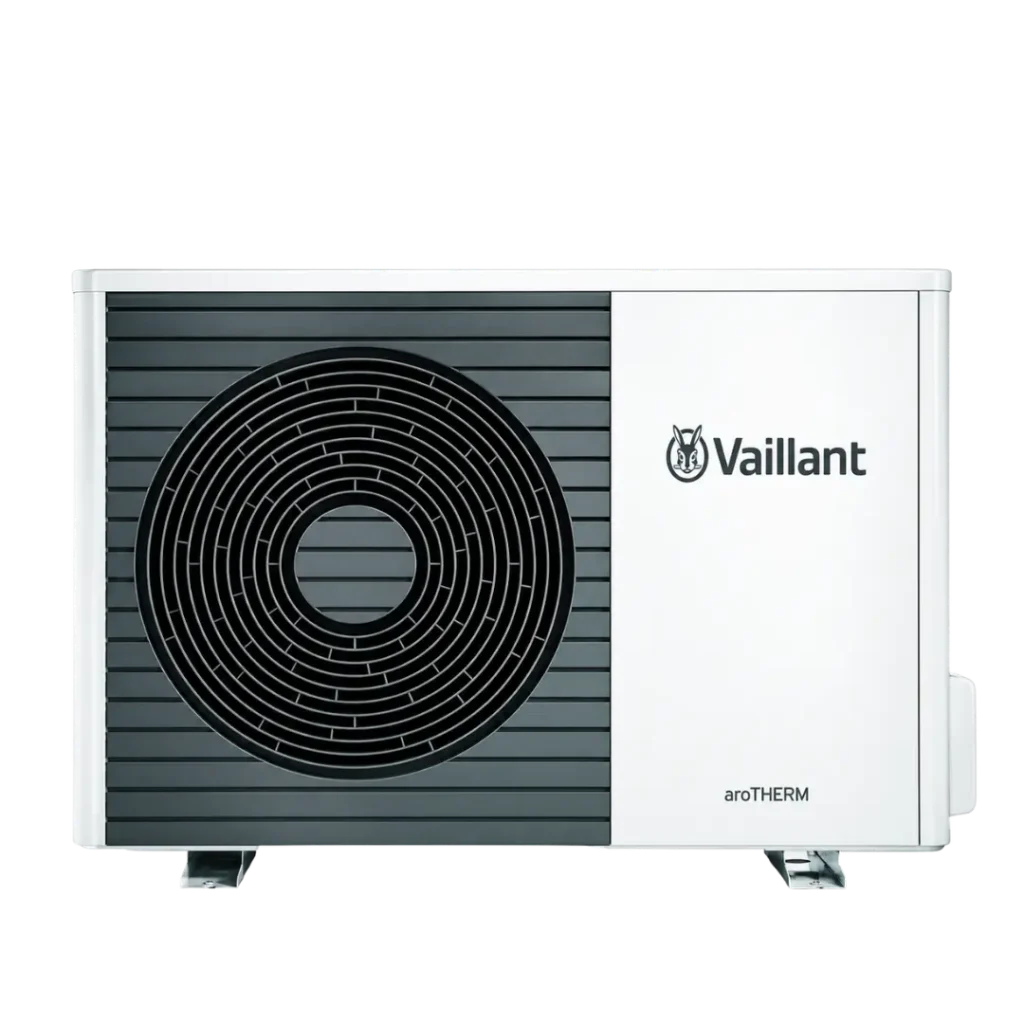
Why new builds suit air source heat pumps
Heat pumps are most efficient when they do not have to raise water to unnecessarily high temperatures. Energy Saving Trust says heat pumps commonly send water to radiators at around 35–45°C, while correctly designed underfloor heating can operate at still lower temperatures. Energy Saving Trust heat-pump installation guidance
A new build gives you control over insulation, airtightness, glazing, ventilation, floor construction, radiator sizes and pipework. There is no old boiler to match or legacy heating layout to work around.
An air-to-water heat pump takes low-temperature heat from outside air and transfers it into water for space heating and, normally, stored hot water. In a new build, however, the bigger performance question is whether the complete system has been designed to operate efficiently.
What do the 2026 new-build rules mean?
In England, the Future Homes and Buildings Standards were published on 24 March 2026 and are due to come into force on 24 March 2027, subject to transitional arrangements.
Government guidance says new homes built to the standards will use low-carbon heating, such as heat pumps or heat networks, alongside high levels of energy efficiency. It also states that gas boilers will not meet the required performance standard. Future Homes and Buildings Standards guidance
The rules are performance-based, so they do not prescribe one identical heating system for every property. However, heat pumps are a central route for low-carbon heating.
The 2026 Approved Document L also includes specific heat-pump guidance covering controls, siting and commissioning. It calls for weather compensation or internal temperature control, a space-heating timer or programmer, suitable defrost control and measures to avoid cold-air recirculation around the outdoor unit. Approved Document L 2026
Projects already in the pipeline may fall under transitional provisions, so confirm the applicable standard with building control.
How to design an air source heat pump for a new build
1. Start with a room-by-room heat-loss calculation
Do not size the heat pump from floor area alone.
The designer should calculate how much heat each room loses under winter design conditions. MCS methodology considers factors such as dimensions, building fabric, ventilation, U-values and design temperatures. The result helps determine both heat-pump capacity and required emitter output. MCS Heat Load Calculator information
Complete this calculation early enough to influence floor loops, radiator sizes, pipe diameters and plant space.
2. Size for winter output, not the badge
A model labelled “8kW” does not necessarily deliver 8kW at every combination of outdoor temperature and heating-water temperature.
Manufacturer performance data should therefore be checked at the design outdoor temperature and proposed flow temperature.
Oversizing is not automatically safer. A unit that cannot reduce its output enough during mild weather may cycle more frequently. Good sizing aims to meet the winter design load while allowing efficient operation during milder conditions.
3. Design for the lowest practical flow temperature
Lower flow temperatures generally improve heat-pump efficiency, so emitter design is crucial. Energy Saving Trust installer guidance shows how both output and seasonal efficiency vary as flow temperature changes.
| Heating layout | New-build suitability | Main advantage | Main consideration |
|---|---|---|---|
| Wet underfloor heating | Excellent | Large emitter area supports low temperatures | Floor build-up, spacing and controls need correct design |
| Heat-pump-sized radiators | Very good | Simpler than whole-house UFH | Output must be checked at design flow temperature |
| UFH downstairs + radiators upstairs | Excellent | Practical balance of comfort and cost | Both circuits need compatible design temperatures |
For a deeper comparison, see the Getfreequote.co.uk heat pump underfloor heating guide.
4. Get the pipework right before first fix
Heat pumps can require higher water flow rates than boilers. Pipework therefore needs to carry the design flow without excessive resistance or noise.
Ask the designer to confirm primary pipe sizes, distribution pipe sizes and required flow rates before walls and floors are closed.
This is much easier to correct on a drawing than after plastering.
5. Use controls that suit a heat pump
Heat pumps normally work best with steady operation rather than short bursts of very hot water.
Weather compensation adjusts the heating-water temperature as outdoor conditions change. When less heat is needed, the system can reduce the flow temperature rather than repeatedly switching on and off. Energy Saving Trust notes that excessive cycling can reduce both efficiency and product life.
What about hot water?
Most air-to-water heat pumps use a hot-water cylinder. A new build lets you reserve the right cupboard or plant-room space from the outset.
Cylinder sizing should reflect household demand, including the number of occupants, bathrooms, showers, baths and likely simultaneous use. A heat-pump cylinder also needs a suitable heat-exchanger coil and appropriate controls.
Hot water normally needs a higher temperature than space heating, so the system periodically switches to cylinder heating. An immersion heater may provide backup or periodic hygiene heating, depending on the system design.
Do not leave the cylinder decision until the plant room has already been built. Storage volume, cylinder dimensions, pipe routes and maintenance access should form part of the early design.
Outdoor unit, noise and planning
Choose the outdoor-unit position before landscaping, paths and fencing are fixed.
The heat pump needs clear airflow and a route for water produced during defrost cycles. It should not discharge cold exhaust air into a confined space where that air can recirculate through the coil.
Approved Document L also advises against siting heat pumps beside sleeping areas or fixing them to materials that readily transmit vibration.
Planning rules differ across the UK. England relaxed its permitted-development rules in May 2025, while Wales introduced updated rules in June 2026. Noise, outdoor-unit size, listed-building status, roof mounting and sensitive locations can still affect whether permission is required.
See the Getfreequote.co.uk air source heat pump planning permission guide for the nation-specific position.
How efficient can a new-build heat pump be?
Energy Saving Trust explains that a heat pump can typically provide around three to four units of heat for each unit of electricity it consumes. That does not mean every installation will achieve the same result. Energy Saving Trust heat-pump efficiency guidance
For buying decisions, look beyond one laboratory Coefficient of Performance, or CoP, figure.
Seasonal Coefficient of Performance, or SCOP, gives a better indication of performance across a heating season. Real efficiency will depend on:
outdoor temperatures;
heating flow temperature;
heat-pump sizing;
emitter design;
controls;
hot-water demand; and
how the system is commissioned and operated.
A low-heat-loss new build gives the designer a strong starting point. However, good insulation does not compensate for a poorly designed heating system.
Ask for the predicted seasonal performance and the assumptions behind it.
How much does an air source heat pump cost in a new build?
Energy Saving Trust currently gives an average air source heat pump installation cost of around £12,000. Treat this as a broad benchmark rather than a new-build quotation. Energy Saving Trust renovation cost guidance
Project cost depends on the heat-pump capacity, cylinder, controls, emitters, pipework, electrical work and site complexity.
The incremental cost can also look different in a new build because the property requires a heating and hot-water system regardless. For example, underfloor heating, cylinders and heating pipework may already form part of the construction budget.
Compare complete specifications rather than headline heat-pump prices. The Getfreequote.co.uk air source heat pump installation guide explains what a complete installation normally involves.
Can a new build get the Boiler Upgrade Scheme?
Usually, a developer-built home cannot use the Boiler Upgrade Scheme to fund its original heating system.
However, a qualifying self-build in England or Wales can receive support for a heat pump if it meets the scheme’s conditions. Current GOV.UK guidance lists a £7,500 grant towards an air source heat pump. GOV.UK Boiler Upgrade Scheme grant guidance
Ofgem states that an eligible self-build must have been built mainly using the labour or resources of the first owner, must never have been owned by a business or organisation, and must not form part of an excluded property development.
A finished developer-built home may be treated differently later if an existing eligible heating system is being replaced.
See the Getfreequote.co.uk Boiler Upgrade Scheme new-build guide for the detailed eligibility distinctions.
New-build heat pump design checklist
Before construction makes changes expensive, confirm:
The room-by-room heat loss and winter design temperature.
Heat-pump output at the planned flow temperature and winter condition.
Underfloor-heating or radiator output for every room.
Heating pipe sizes and required flow rates.
Hot-water cylinder capacity and location.
Outdoor-unit airflow, drainage, vibration and noise.
Electrical supply and connection requirements.
Weather compensation and control strategy.
Applicable Building Regulations and planning position.
Whether the property meets the self-build rules for BUS support.
Compare new-build heat pump quotes
The best time to compare air source heat pump designs is before first fix, when pipe routes, emitter sizes, plant space and floor construction can still be changed without major disruption.
Use Getfreequote.co.uk to compare suitable home-improvement quotes and understand the design assumptions behind each proposal.
Get Your Free Air Source Heat Pump Quote
Find the right air source heat pump solution for your home. Tell us a few details and our team will help you explore suitable options at a competitive price.
Quick to complete. No obligation.
Get your quote
Enter your details below and one of our team will get back to you.
Frequently asked questions
Find clear answers to common questions about air source heat pumps for new-build homes, including the Future Homes Standard, underfloor heating, radiators, system sizing, hot-water cylinders, Boiler Upgrade Scheme eligibility, self-builds, flow temperatures, winter performance and solar panels.
Yes. New builds are often particularly suitable because good insulation and relatively low heat loss make low-temperature heating easier to design effectively.
Not universally. In England, the Future Homes Standard is performance-based. However, it requires low-carbon heating standards that gas boilers will not meet, making heat pumps and heat networks important compliance routes.
The relevant 2026 regulations are scheduled to come into force in England on 24 March 2027, with transitional provisions for qualifying projects already underway.
No. Correctly sized radiators can work very well. Wet underfloor heating is attractive because its large surface area can deliver the required heat at relatively low water temperatures.
It depends on the design and budget. Whole-house UFH can support very low flow temperatures, while radiators are simpler in bedrooms and upper floors. A mixed system is common and can work efficiently.
The correct size comes from a room-by-room and whole-building heat-loss calculation. Floor area or bedroom count alone is not an adequate sizing method.
An air-to-water heat pump can normally provide domestic hot water through a suitable cylinder. The cylinder and heat exchanger need to be designed for heat-pump operation.
Most domestic air-to-water systems do. Other storage arrangements exist, but cylinder space should normally be considered early in a new-build design.
Most commercially developed new homes cannot use BUS for their original heating installation. Qualifying self-build properties in England and Wales can be eligible, subject to the scheme rules.
Potentially. The property must meet Ofgem's self-build criteria, including rules covering how it was built and its ownership history.
Energy Saving Trust currently quotes an average installation cost of around £12,000, although new-build costs vary substantially with system design and specification.
There is no single correct temperature. The aim is usually the lowest flow temperature that can still satisfy every room's calculated heat loss under design conditions.
Yes. Air source heat pumps are designed to extract heat at low outdoor temperatures. Their output and efficiency change as temperatures fall, which is why winter performance data must be checked during system sizing.
Frost can form on the outdoor coil during cold, damp conditions. The heat pump periodically runs a defrost cycle to clear it. Proper drainage and outdoor-unit positioning are therefore important.
Yes. Solar PV can generate some of the electricity used by the home and heat pump. The actual financial benefit depends on when electricity is generated and consumed, system size and tariff arrangements.
Conclusion
A new-build home is one of the best opportunities to design an air source heat pump without the compromises often found in retrofit projects.
The priority is not simply buying a high-spec heat pump. Start with an accurate room-by-room heat-loss calculation, design suitable low-temperature emitters, specify the right pipework and cylinder, choose the outdoor-unit position early and use controls that support efficient operation.
Do that before the building reaches first fix and the heating system can become part of the home’s design rather than an appliance added afterwards.