
Home Solar Installation UK: Costs, Savings & Guide 2026
Check Your Eligibility for Boiler Upgrade Scheme (BUS)
Complete your details below to check your eligibility.
Thank you
We've received your details and will be in touch shortly.

Quick answer: what should you know before installing solar panels at home?
A typical UK home solar PV installation costs around £7,600, according to the Energy Saving Trust’s solar panel guidance, although the final price varies with system size, roof access, scaffolding, electrical work and equipment choice. A well-designed system should be sized around your roof and electricity use, not a standard package. Most conventional rooftop installations can be completed in one to two days once surveys, design and any network checks are complete. You may also be able to earn money from surplus electricity through the Smart Export Guarantee. Before signing, compare the proposed panel capacity, annual generation estimate, inverter, warranties, DNO responsibilities and whether a battery genuinely improves your figures.
Home Solar Installation UK: 2026 Costs, Suitability, Savings and What to Expect
A home solar installation can reduce how much electricity you buy from the grid, but the right system depends on your roof, shading, electricity use, budget and future plans. For UK homeowners in 2026, the practical questions are simple: Is the roof suitable? What size system makes sense? What will it cost? Do you need a battery? Which permissions and grid checks apply?
This guide answers those questions without repeating the detailed roof-by-roof installation process already covered elsewhere.
Ready to compare options? Compare solar panel installation quotes based on system size, equipment, projected generation, warranties and the full scope of work—not price alone.
Home solar installation UK: key figures
| Item | Current guide |
|---|---|
| Typical home solar PV cost | Around £7,600 for an average installation. |
| Physical installation | Commonly one to two days. |
| Example payback range | Around 9–12 years in Energy Saving Trust example locations, with export payments. |
| Typical 5kWh battery cost | Around £4,600. |
| VAT on qualifying installed solar | 0% until 31 March 2027 under current rules. |
| Payment for exported electricity | Available through qualifying Smart Export Guarantee tariffs in Great Britain. |
These are planning figures, not quotations. Your roof, location, system size and electricity use can move the numbers materially.
Is your home suitable for solar panels?
Solar works in the UK because photovoltaic panels generate electricity from daylight, not just strong sunshine. A south-facing, low-shade roof is useful, but east- and west-facing roofs can also generate useful electricity. Energy Saving Trust says an east- or west-facing system tends to produce around 15–20% less energy than one facing directly south.
The survey should assess roof orientation, pitch, shading, usable area and structural condition. Chimneys, trees, dormers and neighbouring buildings can reduce available space or create shade.
If the roof is likely to need major work soon, it can be cheaper to repair it before the panels are fitted. Removing and reinstalling an array later adds labour and scaffolding costs. For a deeper roof-condition check, see whether you need a new roof before installing solar panels. Energy Saving Trust similarly advises that renewing a roof covering first can be cheaper in the long run where work is already needed.
Electricity use matters too. A household that uses more power during daylight hours can normally consume more of its solar generation directly. Future plans such as an EV, heat pump or battery can also affect system sizing.
How large should a home solar system be?
Solar systems are described in kilowatt peak, or kWp. Your actual annual generation is measured in kilowatt hours, or kWh.
Energy Saving Trust currently describes an average domestic system as around 4.5kWp, typically using about 12 panels and 20–30m² of roof area. However, the right size should come from a property-specific design. Bigger is not automatically better if much of the extra electricity will be exported rather than used in the home.
Ask the installer to show the assumptions behind the annual generation estimate, including orientation, pitch, shading, location and system losses. If two quotes predict very different output from similar roof space, ask why.
Panel efficiency matters when roof space is tight, but warranty, manufacturer support, inverter choice and overall design also affect long-term value. If you are comparing equipment rather than complete installations, the existing guide to the best solar panels for UK homes can take that intent further.
How much does home solar installation cost in the UK in 2026?
Energy Saving Trust currently gives an average installed home solar PV cost of around £7,600. The exact figure depends on the number of panels, inverter, mounting system, roof access, scaffolding, cabling and any electrical upgrades.
A battery is a separate decision. Energy Saving Trust currently puts a typical 5kWh battery at around £4,600, although prices vary considerably by capacity and specification.
Qualifying installations of solar panels in residential accommodation are currently zero-rated for VAT across the UK until 31 March 2027. HMRC’s energy-saving materials VAT guidance says the rate is due to return to 5% from 1 April 2027 under the current rules.
Check whether the quote includes scaffolding, monitoring, DNO paperwork, commissioning, certification and warranty registration. A cheap headline figure can become less competitive once exclusions are added.
What happens from survey to switch-on?
The project normally starts with an assessment and site survey, followed by system design, network checks, scaffolding and scheduling.
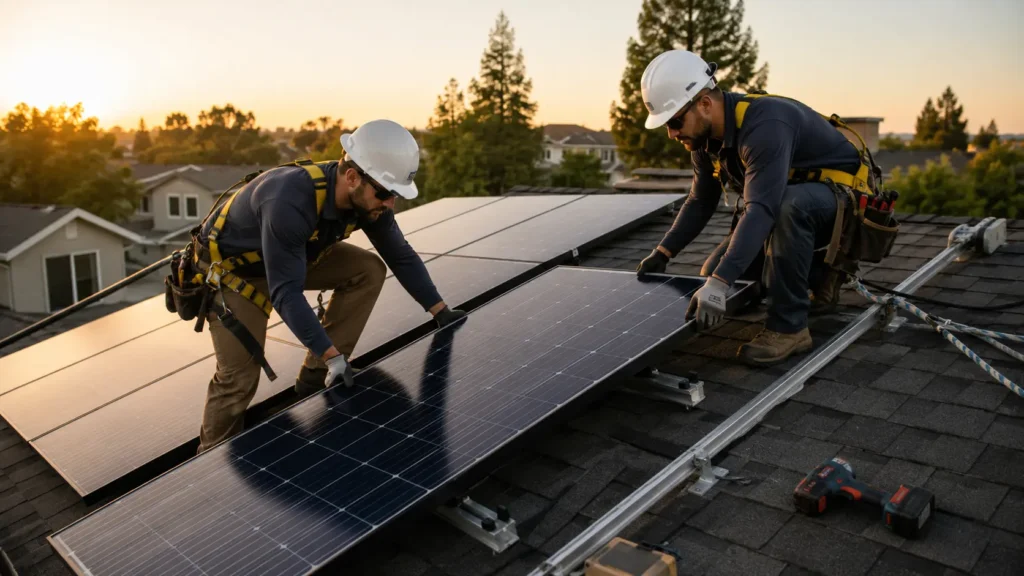
On installation day, the team fits the mounting system and panels, runs cabling, installs the inverter and connects the system to the household electrical installation. The completed system is then tested, commissioned and explained to you.
For a typical home, the physical work commonly takes one to two days. More complicated roofs, larger arrays, electrical upgrades or battery storage can extend this.
For the full sequence from survey to handover, use the dedicated solar panel installation process guide rather than relying on a quotation that simply says “full installation”.
Do you need planning permission, MCS certification or DNO approval?
Planning rules depend on where you live and the property type. Many conventional rooftop systems fall within permitted-development rules, but restrictions can apply to listed buildings, conservation areas, flats and unusual installations.
In England, solar permitted-development rules were updated on 27 August 2026, with transitional provisions running to 27 August 2027. Check the current Planning Portal guidance for domestic solar panels rather than relying on an old summary. Rules differ elsewhere in the UK.
Your installer must also deal with the local Distribution Network Operator, or DNO. The connection route depends on the generating equipment and electrical configuration. Energy Networks Association guidance on connecting generation distinguishes smaller G98 installations from systems requiring other connection procedures. Batteries and export-limitation arrangements can affect the assessment.
MCS certification is a useful quality-assurance check. The current MCS solar PV installation standard covers areas including equipment, structural assessment, design and installation requirements.
Should you add a solar battery?
A battery stores electricity you do not use immediately, so you can use it later. This can increase self-consumption, particularly if the home is empty during the middle of the day.
However, a battery adds upfront cost, stores energy with some losses and normally has a shorter service life than the panels. Energy Saving Trust says a typical battery may last around 10–12 years.
Ask for separate solar-only and solar-plus-battery projections. Compare the extra battery cost with the extra annual saving, usable capacity, efficiency, warranty and likely replacement timing.
A battery can become more attractive if you have high evening demand, use time-of-use tariffs, own an EV or plan to electrify more of the home.
How do solar savings and export payments work?
Solar creates value in two ways. Electricity you generate and use at home reduces the amount you buy. Eligible surplus electricity can also be exported for payment.
Ofgem’s Smart Export Guarantee guidance explains that eligible small-scale generators can receive payments from participating electricity suppliers for exported electricity. Suppliers set their own tariff rates and terms, and your SEG supplier does not have to be the same company that supplies your household electricity.
Do not accept a payback claim unless the quote explains how much generation is expected to be used in the home, how much is expected to be exported and what electricity and export rates have been assumed.
Energy Saving Trust’s current examples show payback with export payments at roughly nine to twelve years across London, Manchester, Aberystwyth and Stirling, depending on location and occupancy. Those figures use July 2026 energy prices and should be treated as context, not a promise for your property.
How to compare home solar installation quotes
Give each installer similar information about your annual electricity use, roof, future EV or heat-pump plans and whether you are considering a battery.
Then compare the system size in kWp, exact panel and inverter models, generation estimate, shading assumptions, warranties, scaffolding, roof work, monitoring and grid paperwork.
Ask who handles the DNO process and what certification and handover documents you will receive. Compare savings using realistic assumptions. Unusually high output or unusually fast payback should be backed by a clear calculation.
The Get Free Quote home comparison service is designed to help homeowners compare written quotations, scope, warranties and provider information rather than making a decision from headline price alone.
A good proposal should show what the system is expected to generate, what it costs, what is included and what could change before installation.
Get Your Free Air Source Heat Pump Quote
Find the right air source heat pump solution for your home. Tell us a few details and our team will help you explore suitable options at a competitive price.
Quick to complete. No obligation.
Get your quote
Enter your details below and one of our team will get back to you.
Frequently asked questions
Find clear answers to common questions comparing air source and ground source heat pumps, including efficiency, installation and running costs, winter performance, noise, land requirements and borehole depth.
Energy Saving Trust currently gives an average domestic solar PV installation cost of around £7,600. Your price can be higher or lower depending on the system size, roof, access, scaffolding, electrical work and equipment.
Energy Saving Trust describes an average 4.5kWp system as typically using around 12 panels and 20–30m² of roof space. Your installer should size the system to your roof and electricity consumption rather than simply using an average.
No. South-facing, unshaded roofs normally give the strongest output, but east- and west-facing roofs can still work. Energy Saving Trust estimates that east- or west-facing systems tend to produce around 15–20% less than directly south-facing systems.
Yes. Solar PV cells generate electricity from daylight and do not require direct sunshine, although output falls when light levels are lower.
Often not, but the exact rules depend on the UK nation, property and installation. Listed buildings, conservation areas and other restricted properties need extra checks. England also updated its permitted-development rules on 27 August 2026.
Additional planning and heritage restrictions usually apply. Do not assume normal permitted-development rights apply to a listed property; check with the relevant local planning authority before work starts.
The physical installation of a typical residential rooftop system usually takes around one to two days, although the full project takes longer because surveys, design, scaffolding, scheduling and network requirements happen before installation.
If significant roof work is likely during the life of the solar system, doing it first can avoid the later cost of removing and reinstalling panels. The survey should therefore check roof condition before the final design is agreed.
It can be, particularly if you generate electricity while the house is empty and use more power in the evening. However, compare the extra battery cost with the expected additional savings rather than assuming storage always improves payback.
Energy Saving Trust currently gives around £4,600 as an indicative cost for a 5kWh battery system, with a much wider range depending on capacity and specification.
Usually, yes. However, tell the installer if future battery storage is likely because inverter selection, cabling, available space and grid arrangements can affect how straightforward the later upgrade is.
In Great Britain, eligible systems can receive export payments through the Smart Export Guarantee. Rates and terms differ between suppliers, so compare available tariffs rather than assuming your existing supplier offers the strongest deal.
MCS is a UK quality-assurance framework for small-scale renewable technologies. Its solar PV standard sets requirements covering the supply, design, installation, commissioning and handover of systems.
They are engineering requirements used when connecting electricity generation to distribution networks. G98 applies to qualifying smaller installations—Energy Networks Association guidance refers to generation below 3.68kW per phase—while other systems can require the G99 process. Your installer should determine the correct route for the proposed design.
Qualifying solar-panel installations in residential accommodation are currently zero-rated for VAT across the UK until 31 March 2027. Under current HMRC rules, the rate is scheduled to return to 5% from 1 April 2027.
Conclusion
Choosing solar is less about finding the “best” panel and more about getting the design right for the property.
Start with roof condition, shading and electricity use. Compare properly specified systems and ask for solar-only and solar-plus-battery figures separately. Check planning requirements, DNO responsibilities, certification, warranties and the assumptions behind any savings forecast.
If the numbers still look attractive after those checks, the next step is a property-specific survey and comparable written quotations. That gives you a strong basis for deciding whether home solar installation is right for your UK property.
CTA: Compare free, no-obligation solar installation quotes based on your property, proposed system and priorities.


