
Solar PV Installers Near Me | Compare UK Solar Quotes
Check Your Eligibility for Boiler Upgrade Scheme (BUS)
Complete your details below to check your eligibility.
Thank you
We've received your details and will be in touch shortly.

Quick Answer: How Do I Find Reliable Solar PV Installers Near Me?
To find a reliable solar PV installer near you, start with MCS-certified contractors that cover your postcode, then compare at least three written quotations. Energy Saving Trust recommends both checking MCS certification and obtaining several quotes before choosing an installer.
Check that each quote includes the proposed system size in kWp, exact panel and inverter models, an annual generation estimate, scaffolding, electrical work, DNO responsibilities, warranties and any battery or optimiser costs.
Do not choose on headline price alone. A proper survey and realistic generation estimate are more valuable than an unusually cheap package or an optimistic savings claim.
Solar PV Installers Near Me: How to Find and Compare Trusted UK Installers
Searching for “solar PV installers near me” is not just about finding someone who can fit panels. The installer may assess your roof, estimate generation, specify equipment, handle grid requirements and provide paperwork needed for warranties or export payments.
A good installer should explain why a system suits your property. Roof direction, shading, available area, electricity use and future plans for an EV, heat pump or battery can all affect the design.
If you want to compare options without contacting installers one by one, Get Free Quote can help you gather and compare suitable quotations. The aim should be to compare like with like: system size, predicted generation, equipment, warranties, scaffolding, electrical work and aftercare.
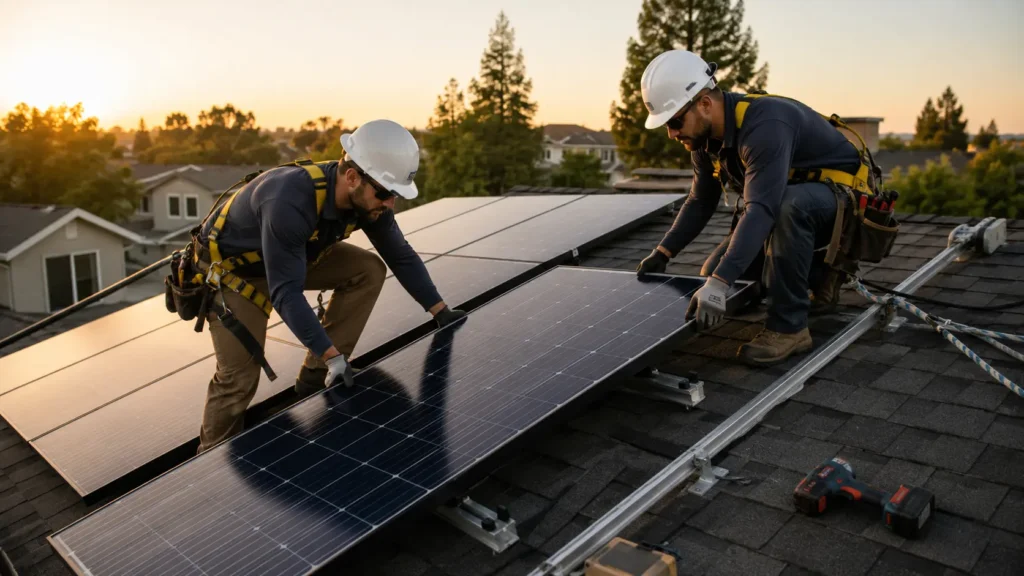
How to Find Solar PV Installers Near You
The best search process combines local availability with independent verification.
1. Search for Installers That Cover Your Postcode
Start with contractors that regularly work in your area.
Energy Saving Trust recommends looking for installers certified under the Microgeneration Certification Scheme and getting quotes from at least three companies. You can search the official MCS Find an Installer service by postcode or region and select Solar PV as the technology.
“Local” should not be your only test. A company based slightly farther away may have better experience with your roof type or system requirements.
2. Verify MCS Certification Yourself
MCS is a key UK certification scheme for small-scale renewable technologies. MCS-certified installers operate under scheme requirements and the MCS Customer Commitment, which sets expectations around consumer protection and the information customers should receive.
Certification also matters commercially. Energy Saving Trust notes that an MCS-certified installation may be required when applying for export tariffs.
Check the installer on the official register rather than relying only on an MCS logo shown on a company website or sales brochure.
3. Compare at Least Three Itemised Quotes
Three quotations make it easier to spot unusual prices, missing items or unrealistic forecasts.
Ask every installer to quote against the same brief. Where you are considering storage, request separate solar-only and solar-plus-battery prices. That makes it easier to see exactly what the battery adds to the project.
4. Insist on a Property-Specific Survey
A desktop estimate can help with early comparisons, but your final design should reflect the actual property.
A proper solar panel installation survey should consider roof condition, orientation, pitch, shading, usable area, cable routes, inverter location and your electrical installation.
If significant roof work is likely in the near future, consider dealing with it before the panels are installed.
What Should You Check Before Choosing a Solar Installer?
Use these checks before signing a contract.
| Check | What You Want to See | Why It Matters |
|---|---|---|
| MCS status | Current certification covering Solar PV | Confirms recognised scheme membership and may be needed for export tariffs |
| Survey | Roof, shading, structure and electrics assessed | Reduces the risk of an unsuitable generic design |
| Generation estimate | Annual kWh output with clear assumptions | Lets you compare likely performance rather than panel wattage alone |
| Equipment | Exact panel, inverter and battery models | Makes product and warranty comparisons possible |
| Scope | Scaffolding, mounting, electrics and paperwork itemised | Helps prevent unexpected extras |
| Warranties | Product, performance and workmanship cover | Clarifies responsibility if something goes wrong |
| DNO responsibility | Written confirmation of who handles it | Helps avoid connection or paperwork problems |
| Aftercare | Monitoring, handover documents and support | Important once the system is operating |
Also check the company’s identity, trading history, recent customer feedback and complaints process. Reviews can be useful, but read the detail rather than relying entirely on the average star rating.
If you are still comparing equipment, review the best solar panels for UK homes before asking installers to price alternatives.
How to Compare Solar PV Quotes Properly
A cheaper quote is not automatically better value. Similar system sizes can include very different equipment, warranties and installation scopes.
| Compare | Questions to Ask |
|---|---|
| System size | How many panels and what total kWp? |
| Predicted output | What annual kWh generation is forecast, and what shading losses are assumed? |
| Inverter | What make, model, rating and warranty are included? |
| Battery | What is the usable capacity, warranty and additional price? |
| Access | Is all required scaffolding included? |
| Electrical work | Are consumer-unit changes, isolators and cabling included? |
| Grid connection | Who handles the relevant DNO process? |
| Handover | Will I receive MCS, electrical, warranty and monitoring documents? |
Be cautious if one proposal predicts dramatically more generation from essentially the same roof.
Ask the installer to explain the assumptions behind its forecast. The largest number is not necessarily the most realistic one.
For a detailed explanation of the work itself, see the solar panel installation process.
How Much Does Solar PV Installation Cost in the UK in 2026?
Energy Saving Trust currently estimates that an average domestic solar PV system costs around £7,600, with a typical system size of approximately 4.5kWp.
Treat this figure as a benchmark rather than a guaranteed quotation.
Your price can change depending on:
Roof access and scaffolding
System size
Panel and inverter specification
Electrical upgrades
Roof condition
Shading and optimiser requirements
Battery storage
Installation complexity
Qualifying installed solar panels currently benefit from 0% VAT until 31 March 2027 under the UK’s temporary VAT relief for eligible energy-saving materials. HMRC currently shows the reduced rate returning after that date unless policy changes.
Ask for one total price that clearly explains what is included. A low headline figure can become poor value if major items are added afterwards.
Before accepting a generation forecast, compare its assumptions with this guide to solar panel output in the UK so you understand how roof direction, shading and system size affect output.
MCS, DNO Paperwork and Smart Export Guarantee Payments
Your installer should explain the network connection process before work starts.
Solar PV connects to the local electricity distribution network. Energy Saving Trust says household systems must be registered with the relevant Distribution Network Operator, or DNO, and that the installer will usually handle this on the homeowner’s behalf.
The exact process depends on the system and connection arrangements. Your quote should therefore state who is responsible for the relevant DNO notification or application.
Can You Get Paid for Surplus Solar Electricity?
If you export surplus electricity in England, Scotland or Wales, you may be eligible for payments through the Smart Export Guarantee (SEG).
Ofgem explains that SEG suppliers set their own export rates, contract lengths and other terms.
Energy Saving Trust also notes that applicants will usually need an eligible renewable system, appropriate certification and a registered smart meter capable of recording exports.
Export payments do not normally begin automatically. You need to apply to a suitable export tariff and provide the requested documentation.
Is a Local Solar Installer Better Than a National Company?
Neither is automatically better.
A local installer may offer easier access to site visits, references and aftercare. A national provider may have larger support teams and more standardised processes.
Compare certification, survey quality, quote transparency, warranty responsibility and aftercare rather than company size.
A company that gives you a detailed, property-specific proposal is generally easier to assess than one selling the same package to every household.
Solar Installer Red Flags to Avoid
Be wary of pressure to sign immediately, vague equipment descriptions, “guaranteed” savings, unexplained finance, missing MCS information or unclear responsibility for scaffolding and electrical work.
The design should reflect your roof, electricity demand and future plans rather than simply maximising the number of panels.
Optimisers and microinverters can be useful on certain roofs, especially where shading or several roof orientations make the design more complicated. They are not automatically necessary for every property.
Ask the installer to explain why any additional component is being recommended and what measurable benefit it provides.
What Happens After You Choose an Installer?
Once you accept a quotation, the installer should confirm the final design, arrange the required network process, schedule scaffolding and agree an installation date.
The physical installation of a typical residential solar system often takes around one or two days, although surveys, design work, DNO requirements and scheduling extend the overall project.
After commissioning, you should receive the relevant handover documents, warranty information, monitoring access and operating guidance.
Keep these documents with your property records.
Get Your Free Air Source Heat Pump Quote
Find the right air source heat pump solution for your home. Tell us a few details and our team will help you explore suitable options at a competitive price.
Quick to complete. No obligation.
Get your quote
Enter your details below and one of our team will get back to you.
Frequently asked questions
Find clear answers to common questions comparing air source and ground source heat pumps, including efficiency, installation and running costs, winter performance, noise, land requirements and borehole depth.
Use the official MCS Find an Installer service and search by postcode or region. Select Solar PV as the technology, then verify any company you are considering directly on the register.
Aim for at least three comparable quotations. Energy Saving Trust recommends obtaining quotes from at least three installers before making a decision.
MCS certification is strongly worth checking and may be required by an energy supplier when you apply for an export tariff. Always check the current requirements of your chosen tariff.
It should clearly identify the system size, panels, inverter, expected generation, mounting equipment, scaffolding, electrical work, DNO responsibilities, warranties and total price.
Energy Saving Trust currently estimates around £7,600 for an average domestic system of approximately 4.5kWp. Your actual quotation will depend on the property and specification.
Not automatically. Compare the system design, equipment, generation forecast, warranties, included work, certification and aftercare as well as price.
Usually, yes. Energy Saving Trust says installers normally register domestic systems with the relevant Distribution Network Operator, but you should confirm responsibility in writing.
They are engineering processes used when connecting electricity generation equipment to the distribution network. The route that applies depends on the system and connection circumstances, so your installer should explain what is required.
The physical installation of a straightforward domestic system often takes around one or two days. Surveys, scaffolding, design work and network requirements mean the complete project usually takes longer.
Not necessarily. Local companies can offer convenient site visits and aftercare, while larger companies may have wider support resources. Compare the actual service, design and protection offered.
It depends on your electricity use, tariffs, budget and how much solar electricity you expect to export. Ask for separate solar-only and solar-plus-battery figures before deciding.
Yes. Solar PV generates electricity from daylight, although output is lower in dull conditions than in strong sunlight.
No. South-facing roofs are often favourable, but east- and west-facing roofs can still produce useful electricity. Energy Saving Trust estimates east- or west-facing systems may generate around 15–20% less than an equivalent directly south-facing system.
Many domestic rooftop installations do not need a planning application, but exceptions apply. Rules also differ around listed buildings, conservation areas and other protected locations, so check the requirements for your property.
The Smart Export Guarantee is the framework under which participating electricity suppliers pay eligible small-scale generators for electricity exported to the grid in Great Britain. Suppliers determine their own rates and terms.
Ask to see the predicted annual generation, assumed self-consumption, export amount, electricity prices and export tariff used in the calculation. Compare the assumptions across every quote.
Check panel product and performance warranties, inverter and battery warranties where applicable, plus the installer's workmanship protection. Understand who deals with each warranty if a problem develops.
If significant roof work is expected soon, completing it first can avoid paying to remove and reinstall the solar array later. A site survey should identify obvious roof-condition concerns.
Final Checklist Before Hiring a Solar PV Installer
Choose an installer who can demonstrate how the proposed system fits your roof, electricity use and priorities.
Verify MCS status, compare at least three itemised quotations and make sure generation assumptions are realistic.
Price matters, but so do design quality, paperwork, warranties and aftercare. Energy Saving Trust says solar panels should typically last 25 years or more, making careful installer selection worthwhile.
If you are ready to compare options, request solar quotations and review the specification, scope and value before deciding whether to proceed.


