
Solar Energy Installers UK: Compare Trusted Installers
Check Your Eligibility for Boiler Upgrade Scheme (BUS)
Complete your details below to check your eligibility.
Thank you
We've received your details and will be in touch shortly.

Quick answer: how do you choose a solar energy installer in the UK?
Look for a solar installer that can demonstrate current MCS certification for solar PV, carries out a property-specific survey and gives you a detailed written quotation.
Compare at least three quotes. Each should state the panel and inverter models, system capacity in kWp, expected annual generation, roof layout, installation work, scaffolding, warranties and responsibility for electricity-network paperwork.
Do not judge installers by headline price alone. A cheaper quotation can become poor value if it omits essential work, uses unrealistic savings assumptions or provides weak aftercare. MCS-certified installers have specific scheme obligations covering installation quality, certification and consumer protection.
Solar Energy Installers UK: How to Choose a Trusted Solar Installer
Choosing between solar energy installers in the UK is not simply a matter of finding the cheapest price per panel. The installer needs to assess your roof, electricity use, shading, electrical system and future plans before recommending a suitable solar PV system.
For most homeowners, the strongest approach is to compare several properly itemised quotations on the same basis. Check the proposed system size, exact equipment, predicted generation, scaffolding, grid-connection work, certification, warranties and aftercare.
Energy Saving Trust recommends getting quotes from at least three installers and checking that the businesses you consider are MCS certified. Its current benchmark for a typical 4.5kWp domestic solar system is around £7,600, although actual quotations vary considerably by property and specification. Energy Saving Trust’s current solar guidance Energy Saving Trust
If you want help exploring your options, you can start with Get Free Quote or use the solar panel quote comparison service to compare what different providers include.
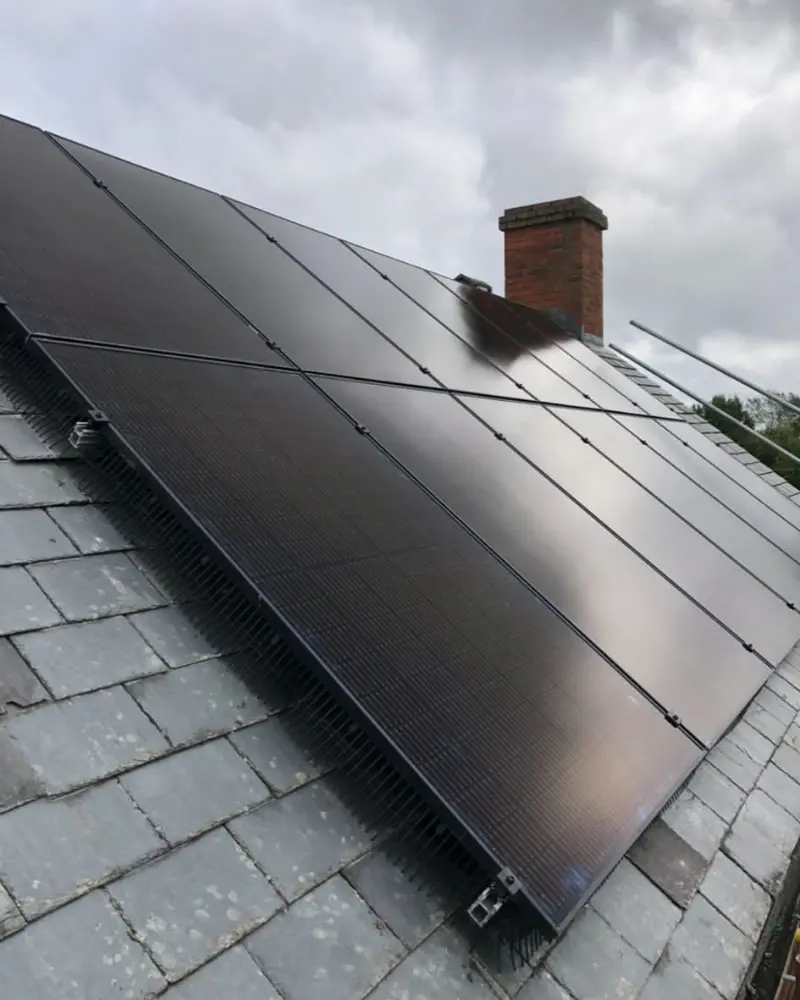
What should you compare between solar energy installers?
| Check | What a good installer should provide |
|---|---|
| MCS status | Current certification covering solar PV |
| Survey | Roof, shading, electrical system, access and usage assessment |
| System design | Panel layout, system capacity and suitable inverter |
| Generation estimate | Property-specific annual output with clear assumptions |
| Quotation | Itemised equipment, installation work and exclusions |
| Grid connection | Clear responsibility for applicable DNO procedures |
| Protection | Product, workmanship and applicable financial protection |
| Handover | Certification, warranties, manuals and monitoring information |
Price matters, but these checks make quotations meaningfully comparable.
Why MCS certification matters
MCS is the main UK certification scheme for small-scale renewable-energy installations. Certification does more than provide a logo for an installer’s website.
Under the current MCS Installer Agreement, certified businesses must maintain certification for the technologies they install, work to the relevant standards and raise an MCS certificate for applicable installations. For domestic contracts, they must also provide an approved financial-protection product. MCS Certified
Check the company itself rather than accepting phrases such as “MCS compliant” without evidence. Certification can cover different technologies, so make sure the business is certified for solar PV.
MCS is also important when you want to receive export payments. Ofgem’s Smart Export Guarantee applies to eligible small-scale renewable generation in Great Britain, including solar PV, subject to the scheme’s requirements. Ofgem’s Smart Export Guarantee guidance Ofgem
Compare at least three solar installation quotes
One quotation tells you what one company wants to sell you. Three comparable quotations start to show whether the proposed specification and price make sense.
Energy Saving Trust specifically recommends getting at least three installer quotes. Energy Saving Trust
However, the quotes need to be comparable. A £7,000 solar-only system and a £10,000 system with a battery, extra scaffolding and a larger array are not competing offers for the same work.
Ask every installer to state:
- total solar array capacity in kWp
- number, make and model of panels
- inverter make, model and capacity
- battery specification, if included
- predicted annual generation
- scaffolding and access costs
- electrical work
- DNO responsibilities
- warranties and workmanship cover
- what happens if additional work becomes necessary.
Recent discussions among UK solar buyers repeatedly focus on these practical omissions, particularly scaffolding, grid paperwork, equipment sizing and insurance-backed warranties. Reddit
A proper site survey should come before the final design
A desktop quotation can be useful at the start, but the final specification should reflect the actual property.
The survey should consider roof dimensions and condition, orientation, pitch, shading, access and suitable fixing methods. The installer should also assess the electrical installation, consumer unit, meter arrangements, inverter position and cable route.
Generation forecasts should reflect those conditions rather than assuming an ideal south-facing, completely unshaded roof.
For a deeper explanation of what should be checked, see the solar panel installation survey guide.
If your roof needs significant repair or replacement soon, deal with that question before installing a system expected to remain in place for decades.
How much do UK solar installers charge?
Energy Saving Trust currently puts a typical 4.5kWp home solar PV installation at around £7,600. Treat that as a benchmark, not a guaranteed quotation. Energy Saving Trust
Your cost can change because of roof size, access, system capacity, scaffolding, equipment choice, roof complexity, electrical upgrades and battery storage.
Qualifying installations of solar panels in residential accommodation currently benefit from a temporary zero rate of VAT. Under current rules, the temporary zero rate runs until 31 March 2027, after which the reduced 5% rate is scheduled to apply. HMRC’s VAT guidance for energy-saving materials GOV.UK
Do not assume the cheapest installer gives the shortest payback. A financial forecast also depends on annual generation, how much solar electricity you use yourself, your electricity tariff and any export payments.
Local or national solar installer?
Neither model is automatically better.
A good local installer may provide strong knowledge of local housing, roof types and network conditions. You may also have direct contact with the people who survey and install the system.
A national business may offer greater administrative capacity, standardised processes or a broader product range.
Company size therefore makes a poor shortcut for installation quality. Compare the actual survey, system design, contract, certification, workmanship protection and aftercare.
This is one area where current search results are often less useful than they appear. Many competing pages rank individual installer brands, while the evidence a homeowner actually needs is property-specific. FMB
What should be included in a solar installer quote?
| Quote item | What to check |
|---|---|
| Panels | Manufacturer, model, quantity, wattage and warranties |
| Inverter | Exact model, capacity, warranty and monitoring |
| Battery | Usable capacity, warranty and compatibility if included |
| System size | Total array capacity in kWp |
| Generation | Annual kWh estimate and assumptions |
| Roof work | Mounting system and agreed panel layout |
| Scaffolding | Whether all required access is included |
| Electrical work | Cabling, protection and any required upgrades |
| DNO work | Who makes or manages the relevant application/notification |
| Handover | Certification, manuals, warranties and monitoring setup |
Equipment matters, but do not select an installer solely because it offers the panel with the highest advertised efficiency. Roof constraints, degradation, warranty terms, manufacturer support and price all affect the decision. The best solar panels UK guide covers panel selection separately.
Solar installer warning signs
Be cautious when an installer gives large savings figures without showing how they were calculated.
The same applies to pressure to sign immediately, unexplained “today only” discounts, vague equipment descriptions or a refusal to provide certification details.
A quotation should not rely on phrases such as “premium panels” when exact model numbers could be provided.
Also check whether important costs have simply been excluded. Scaffolding, difficult roof access, DNO work or electrical upgrades can materially change the final price.
MCS’s consumer-protection requirements place obligations on certified installers around scheme compliance, customer protection and installation records. MCS Certified
What happens after you appoint an installer?
Once you accept a quotation, the job moves from sales into design, grid checks, installation and commissioning.
For most domestic projects, the physical installation itself is relatively quick. Energy Saving Trust says a typical home installation generally takes around one to two days, although the full project takes longer because surveys, scaffolding, design and network requirements happen around it. getfreequote.co.uk
The full sequence is covered in Get Free Quote’s solar panel installation process guide.
Before the job is closed, make sure the monitoring works and you understand basic system operation.
What paperwork should a solar installer give you?
Documentation should not be an afterthought.
MCS’s solar PV handover checklist includes items such as the MCS certificate, invoice, insurance-backed warranty information, component details, performance estimates, commissioning information and operation and maintenance documentation. MCS Certified
Ask what you will receive before signing the contract rather than discovering missing paperwork months later.
This is particularly important if you plan to apply for an export tariff, sell the property or make a future warranty claim.
Choosing between your final solar installers
Put the quotations next to each other and compare the whole project.
Check whether each company has designed for the same roof area and household electricity demand. Compare annual-generation assumptions rather than automatically preferring the largest number.
Then assess equipment, warranties, installer protection, exclusions, aftercare and total price.
A well-specified £8,000 system can represent better value than a £7,000 quotation with unclear equipment, missing scaffolding or optimistic savings claims.
Finally, consider how clearly each installer answers technical questions. A professional installer should be able to explain why a particular panel count, inverter or battery capacity suits your home without hiding behind jargon.
Get Your Free Air Source Heat Pump Quote
Find the right air source heat pump solution for your home. Tell us a few details and our team will help you explore suitable options at a competitive price.
Quick to complete. No obligation.
Get your quote
Enter your details below and one of our team will get back to you.
Frequently asked questions
Find clear answers to common questions comparing air source and ground source heat pumps, including efficiency, installation and running costs, winter performance, noise, land requirements and borehole depth.
Check the installer directly against MCS records and confirm its certification covers solar PV. Do not rely solely on an MCS logo displayed in advertising.
Energy Saving Trust recommends getting quotes from at least three installers. Energy Saving Trust
MCS is a certification scheme rather than a general legal licence to carry out all solar work. However, certification is highly relevant to quality assurance, documentation and access to schemes such as SEG.
Energy Saving Trust currently estimates around £7,600 for a typical 4.5kWp home system. Your actual quotation depends on the property and specification. Energy Saving Trust
Not automatically. Compare equipment, system size, generation assumptions, included work, warranties, certification and aftercare alongside price.
Yes. Roof condition, dimensions, orientation, pitch, shading and access can all affect the design and installation.
Where scaffolding is required, the quotation should make clear whether its full cost is included. Never assume it is included from the headline price.
The quotation should state who manages the relevant grid-connection procedure. In most professionally managed domestic installations, the installer handles or coordinates the required paperwork.
That depends on roof space, shading, location, household electricity consumption and future demand such as an EV, battery or heat pump.
Not automatically. Compare a solar-only system with a solar-plus-battery proposal so you can see the battery's additional cost and expected benefit separately.
Yes. South-facing roofs are often favourable, but east- and west-facing arrays can still produce useful electricity. A property-specific generation estimate is more meaningful than orientation alone. Energy Saving Trust
Yes. Solar PV uses daylight and continues generating during cloudy weather, although output will generally be lower than in strong sunlight. Energy Saving Trust
Many conventional domestic rooftop installations can fall within permitted-development rules, but conditions and exceptions apply. Listed buildings and protected locations need particular care, and rules differ across UK nations. GOV.UK
Check the panel product and performance warranties, inverter warranty, battery warranty where applicable, installer workmanship guarantee and any relevant insurance-backed protection.
For an applicable MCS installation, expect relevant certification plus product and workmanship warranty information, commissioning records, operating instructions and system documentation. MCS Certified
Eligible systems in Great Britain can receive export payments through the Smart Export Guarantee. Individual suppliers determine their tariff rates and contract terms. Ofgem
Qualifying installations currently benefit from the temporary zero rate. Under current legislation, it runs to 31 March 2027, with the 5% reduced rate due to return from 1 April 2027.
Conclusion
Finding reliable solar energy installers in the UK becomes much easier when you compare evidence rather than marketing.
Start with current MCS status and a property-specific survey. Obtain at least three written quotations, then compare the same factors: array size, exact equipment, annual generation, installation scope, DNO work, warranties, paperwork and aftercare.
The lowest price should not automatically win, and neither should the largest predicted saving.
A good solar installation is a long-term home-energy project. Take enough time to understand what you are buying and why the proposed design suits your roof and electricity use.
When you are ready, compare properly specified quotations and ask each installer to put its key assumptions in writing before you commit.


