
Solar Panel Installation Aftercare UK: Maintenance Guide
Check Your Eligibility for Boiler Upgrade Scheme (BUS)
Complete your details below to check your eligibility.
Thank you
We've received your details and will be in touch shortly.

Quick Answer: What Does Solar Panel Installation Aftercare Include?
Solar panel installation aftercare should include a proper handover, system documents, warranty information, monitoring access, maintenance guidance and a clear support route for faults.
For an MCS-certified installation, the handover pack should contain key system information, commissioning records, operating instructions and maintenance recommendations. See the MCS Solar PV Installation Handover Checklist MCS Certified
After that, homeowners should monitor generation, keep new shading under control and arrange cleaning or professional checks only when the equipment, warranty terms or site conditions justify them. Most rooftop systems do not need frequent cleaning, but persistent dirt, bird droppings, lichen or an unexplained fall in output can justify action.
Solar Panel Installation Aftercare: What Should Happen After Your System Is Fitted?
Solar panel installation aftercare starts when commissioning ends. Good aftercare is not about paying for constant servicing. It is about knowing what normal operation looks like, keeping the right documents, spotting faults early and having a clear route to support.
Most UK home solar PV systems need little hands-on maintenance. However, an inverter fault, lost monitoring connection, new shading or damaged cabling can reduce generation without being obvious indoors. A simple aftercare routine protects performance, warranties and your ability to deal with problems quickly.
This guide explains what you should receive after installation, what to check during the first month, how often maintenance is useful, when cleaning is worthwhile and when to call a professional.
Need help comparing solar installation and aftercare options? Compare home-improvement quotes with Get Free Quote before choosing a provider.
What Should Happen Immediately After Installation?
The final stage of a solar project is not simply switching the inverter on. The system should be tested, commissioned and handed over so you know how to use it safely.
If you want to see what happens before this point, read the Get Free Quote guide to the solar panel installation process. Aftercare begins once commissioning is complete.
For an MCS installation, handover information should include your MCS certificate, invoice, warranty information, maintenance requirements and an operation and maintenance manual. The MCS handover checklist also calls for system information, component manuals, commissioning data, fault procedures, shutdown and start-up instructions, and relevant cleaning recommendations. MCS Certified
Keep these records together. They can be useful for warranty claims, a future property sale or export-tariff applications.
The First 30 Days: Build a Baseline
During the first few weeks, learn what normal generation looks like rather than judging the system from one sunny or cloudy day.
Check that your monitoring app or inverter portal records generation consistently. Note the system size, expected annual generation and location of isolators. Save login details securely and make sure the handover documents are easy to find.
For MCS-certified work, the current MCS Installer Agreement requires the installer to raise the MCS certificate within 30 calendar days of commissioning. For domestic contracts, it also requires an approved financial protection product under the scheme rules. Read the current MCS Installer Agreement MCS Certified
You can also review the Get Free Quote guides to the solar PV commissioning process and solar panel installation checklist to understand what should already have been tested before handover.
What Does Good Ongoing Solar Aftercare Include?
Useful aftercare gives clear answers to four questions: Is the system generating normally? What can I check myself? Who do I contact if there is a fault? What is covered by warranty?
Look for working monitoring, guidance on inverter alerts, a named support route, warranty help, equipment-specific maintenance advice and records of repairs or component replacements.
Do not assume every domestic system needs an expensive annual maintenance contract. The appropriate schedule depends on the equipment, warranty conditions, roof access and local environment.
Solar Panel Aftercare Schedule
| When | Homeowner action | When to call a professional |
|---|---|---|
| First month | Confirm monitoring works and save handover documents | Missing certificates, repeated faults or unexplained zero generation |
| Monthly | Glance at the monitoring app | Sustained abnormal output without a weather explanation |
| Every 12–18 months | Check from ground level for dirt, damage, shading or debris | Damage, cabling concerns or difficult roof access |
| Every 1–2 years | Decide whether cleaning is actually needed | Unsafe access or stubborn contamination |
| Every 3–5 years | Review warranty terms and consider a fuller inspection | Electrical testing, inverter diagnostics or a condition report |
| After storms or building work | Check monitoring and inspect from a safe position | Suspected impact damage, water ingress or disturbed wiring |
Energy Saving Trust says solar PV systems generally require little maintenance. It recommends checking panels roughly every 12–18 months for visible contamination and describes a professional service every three to five years as a useful general guide, while noting that warranty conditions can differ. Read Energy Saving Trust’s current solar maintenance guidance Energy Saving Trust
How Do You Know If Your Solar Panels Have a Fault?
A low-output day does not automatically mean something is wrong. Cloud cover, season, shading and time of day all change generation.
Instead, look for patterns. Compare similar days and monthly or annual totals. Use your original generation estimate as context. The Get Free Quote guide to solar panel output in the UK can help explain normal seasonal variation.
Warning signs include zero generation in daylight, repeated inverter errors, one string or panel group performing differently, monitoring going offline without explanation, or a sustained reduction that weather and shading do not explain.
| Symptom | First check | Next step |
|---|---|---|
| Zero generation in daylight | Check monitoring and inverter status | Follow the manual, then contact support if the system itself is offline |
| Lower generation than expected | Compare weather, shading and soiling | Ask for a performance check if the reduction persists |
| New inverter warning | Record the exact error code | Use manufacturer guidance or contact the installer |
| Visible damaged cable or panel | Do not touch it | Arrange professional inspection |
| Roof leak near the array | Protect the property from further damage | Contact the installer or a competent solar/roofing professional |
Monitoring is valuable because it can reveal a problem before a higher electricity bill does.
Do Solar Panels Need Cleaning?
Usually, not very often. Energy Saving Trust says rainfall does much of the cleaning for many rooftop systems. Cleaning becomes more relevant where there is obvious bird fouling, pollen, dust, lichen, nearby trees or persistent grime. Energy Saving Trust
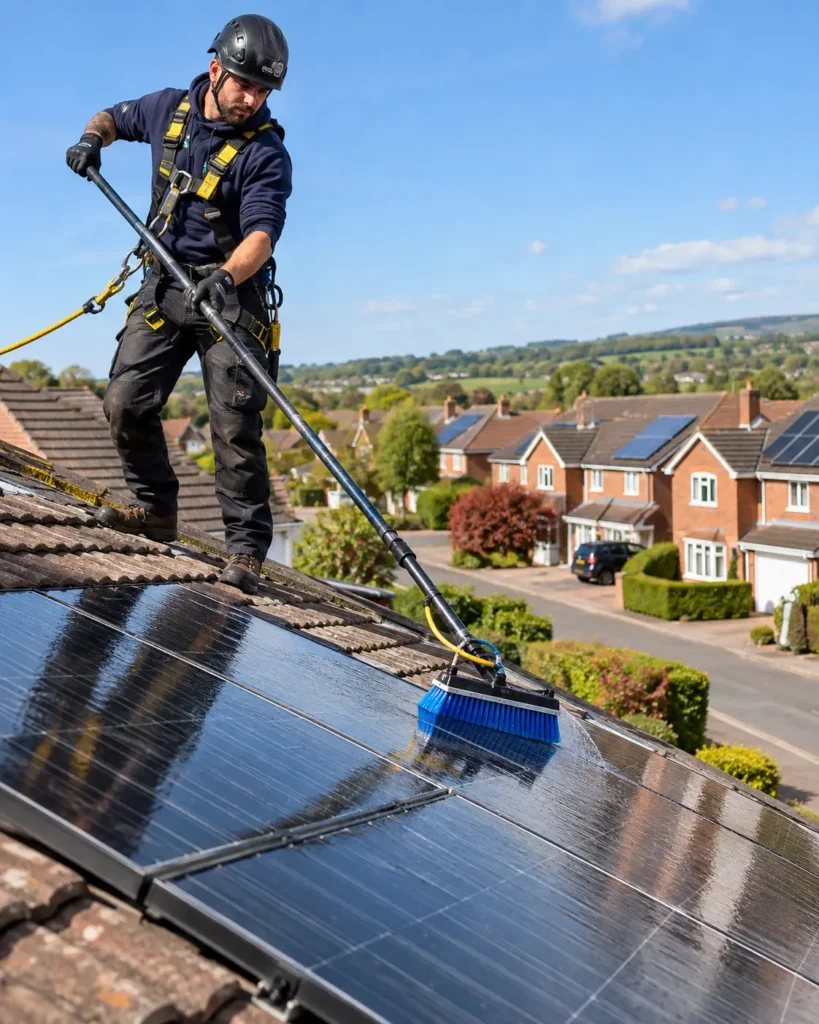
Avoid climbing onto the roof simply to clean panels. If cleaning can be completed safely from ground level, follow the panel manufacturer’s instructions. Energy Saving Trust advises against high-pressure washers because they can affect seals or wiring, and recommends checking manufacturer guidance before using cleaning products. Energy Saving Trust
If safe ground-level cleaning is not practical, use a professional familiar with solar equipment.
What About the Inverter, Battery and Roof?
The panels have no moving parts, but the wider system still needs attention.
The inverter is central to turning solar DC electricity into usable AC electricity. Keep its ventilation clear and act on persistent fault codes. Energy Saving Trust currently says solar inverters typically need replacing after around 10–15 years, earlier than the expected life of the panels themselves. Energy Saving Trust
If you have battery storage, follow the battery manufacturer’s maintenance and temperature guidance. Do not obstruct ventilation around indoor equipment.
From the ground, also watch for new shading, nesting activity, slipped roof materials or anything that appears to have moved after severe weather. Do not remove panels or disturb solar wiring yourself.
Warranties, Export Payments and What Happens If the Installer Disappears
Store panel, inverter, battery and workmanship warranties separately because they can have different terms and claim routes. Read any servicing conditions carefully rather than assuming every warranty works in the same way.
If your installation qualifies for the Smart Export Guarantee, Ofgem says eligible generators can receive payment for electricity exported to the grid. Tariff rates and contract conditions are set by participating SEG suppliers, and your export supplier does not have to be your normal electricity supplier. Check Ofgem’s Smart Export Guarantee guidance for generators Ofgem
If you have a problem with an MCS-certified installation, raise it with the installer first and keep written records. MCS’s current complaints policy covers areas including commissioning, handover, installer conduct, property damage and product or workmanship issues. Where an eligible complaint cannot be resolved directly, MCS says it can review the installation and may refer qualifying cases to its ADR provider. Read the current MCS complaints policy MCS Certified
What Should You Ask About Aftercare Before Choosing an Installer?
Ask who handles faults, what response times are typical, whether monitoring support is included, what servicing is required to preserve warranties and what happens if a manufacturer approves a replacement.
Also ask whether call-out labour, scaffolding or other access equipment is included. A long product warranty can still exclude labour or apply only to one component.
If you are still choosing a company, compare installation quality and long-term support rather than price alone.
Get Your Free Air Source Heat Pump Quote
Find the right air source heat pump solution for your home. Tell us a few details and our team will help you explore suitable options at a competitive price.
Quick to complete. No obligation.
Get your quote
Enter your details below and one of our team will get back to you.
Frequently asked questions
Find clear answers to common questions comparing air source and ground source heat pumps, including efficiency, installation and running costs, winter performance, noise, land requirements and borehole depth.
Solar panel installation aftercare is the support and maintenance that follows commissioning. It can include monitoring setup, documentation, warranty support, fault diagnosis, cleaning advice and professional inspections when required.
There is no universal annual-service rule for every domestic system. Energy Saving Trust currently suggests considering a fuller professional inspection every three to five years, while checking your own warranty for any specific requirements. Energy Saving Trust
Cleaning should generally be condition-led. Energy Saving Trust suggests checking panels every 12–18 months and says a light clean every 12–24 months can be useful where dirt has accumulated, although many systems need less intervention. Energy Saving Trust
Often, yes. UK rainfall removes much ordinary dust and dirt, especially from suitably tilted roof-mounted panels. Persistent bird droppings, lichen and heavy contamination may still require cleaning. Energy Saving Trust
Energy Saving Trust advises against using a high-pressure washer because it can interfere with seals and wiring. Follow the module manufacturer's cleaning instructions instead. Energy Saving Trust
No. Roof work introduces a significant fall risk. Where safe ground-level cleaning is not possible, arrange professional access. Energy Saving Trust
Check the monitoring app or inverter regularly and look at output over time. A sustained unexplained fall, repeated error code or zero daytime generation warrants investigation.
MCS's solar PV handover checklist includes an MCS certificate, invoice, warranty information, maintenance guidance and operation and maintenance information containing system and commissioning details. MCS Certified
Under the current MCS Installer Agreement, an MCS-certified installer must raise the certificate within 30 calendar days of the installation's commissioning date. MCS Certified
Energy Saving Trust says an inverter commonly needs replacing after roughly 10–15 years, although actual life depends on the model, operating conditions and system. Energy Saving Trust
Energy Saving Trust currently says professional cleaning typically starts at around £60–£100 for a standard system, with access and array size affecting the final price. Treat this as an indicative figure rather than a quotation. Energy Saving Trust
First establish whether only the app or internet connection has failed, or whether the solar system itself has stopped generating. Check the inverter status and follow the manufacturer's troubleshooting instructions before requesting support.
Check system monitoring and inspect the array visually from a safe location. If you see damaged panels, displaced components, damaged cables or signs of water ingress, do not touch the equipment; arrange a professional inspection.
Complain to the installer first and keep a written record. For eligible unresolved cases, MCS has a complaints process covering issues including installation quality, commissioning, handover and product problems. MCS Certified
Eligible solar PV generators in Great Britain can receive payments under the Smart Export Guarantee. Individual SEG suppliers set their tariff rates and contract terms.
Conclusion
Solar panel installation aftercare should be simple, documented and proportionate. Keep your handover pack safe, confirm monitoring works and understand normal generation. Then use regular app checks and occasional visual inspections to catch problems early.
Clean panels when the condition of the array justifies it, not simply because a calendar says you must. Treat roof access, damaged cabling, persistent inverter faults and electrical testing as professional work.
Most importantly, know who supports the system and what each warranty covers. Strong aftercare gives you a clear path from spotting a problem to diagnosis, repair and documentation without guesswork.
Ready to compare solar installers and what they include after installation? Use Get Free Quote to compare suitable providers and ask specifically about monitoring, warranties, maintenance and fault support before you choose.


