
Solar Panel Installation Maintenance UK: 2026 Guide
Check Your Eligibility for Boiler Upgrade Scheme (BUS)
Complete your details below to check your eligibility.
Thank you
We've received your details and will be in touch shortly.

Quick answer:
Most UK home solar PV systems need regular monitoring and basic visual checks rather than frequent hands-on servicing. Check panels from ground level, review inverter or app alerts and compare generation with normal seasonal performance. Clean panels when visible dirt, bird mess, lichen or debris is affecting them; routine cleaning is not always necessary because rainfall removes much ordinary dirt. Current MCS guidance for privately owned homes recommends annual customer visual checks, with advisory contractor checks at longer intervals, while Energy Saving Trust suggests a fuller professional service every three to five years. Follow your system manual, warranty and insurer requirements if they specify a different schedule.
Solar Panel Installation Maintenance: What UK Homeowners Need to Do in 2026
installation: get the right handover documents, understand your monitoring and know which checks you can safely do yourself.
For a privately owned domestic system, current MCS guidance is more measured than many service plans suggest. Its 2026 Solar PV Standard gives an advisory schedule of annual customer visual checks, an intermediate MCS-contractor visit at 10 years and a fuller maintenance visit at 15 years. However, MCS says the appropriate frequency can change with system size, building use, roof access and requirements from manufacturers, customers or insurers. MCS Certified
This guide explains what solar panel installation maintenance involves, when cleaning is worthwhile, what a professional should inspect, likely costs and the warning signs that justify an earlier call-out.
If you are planning a system, compare the equipment, warranties, monitoring and aftercare included in each quotation. You can compare solar panel installation quotes before deciding which specification offers the best fit for your property.
Build maintenance into the installation
Good maintenance begins with a good handover. Current MCS rules require a document pack covering maintenance requirements, available maintenance services, manufacturer manuals and warranty details. The handover should also state the recommended interval for the first periodic inspection. MCS Certified
Keep this pack for the life of the system. It gives a future engineer the equipment details, commissioning information and other records needed to investigate faults safely.
Before the scaffolding comes down, confirm that monitoring works and that you recognise normal inverter operation. Ask where relevant isolators are and make sure you understand the shutdown information supplied by the installer.
If you are still planning the project, the solar panel installation process guide explains what should happen from survey and design through commissioning and handover.
Solar panel maintenance schedule for a UK home
There is no single maintenance interval that suits every installation. The table below combines current MCS guidance with practical homeowner checks.
| When | What to do | Who? |
|---|---|---|
| Monthly or seasonally | Review monitoring for alerts or unusual generation changes | Homeowner |
| Once a year | Ground-level check for damage, slipped modules, heavy soiling, new shading and visible inverter faults | Homeowner |
| As needed | Clean when dirt, bird droppings, leaves, salt or lichen build up | Safe ground-level clean or professional |
| System-specific | Follow manufacturer, warranty, installer or insurer inspection requirements | Appropriate contractor |
| Around year 10 | MCS advisory intermediate maintenance for a privately owned domestic system | MCS contractor |
| Around year 15 | MCS advisory full maintenance visit | MCS contractor |
MCS explicitly describes its maintenance frequencies as advisory rather than universal requirements. Energy Saving Trust takes a somewhat more frequent approach and suggests a full professional service every three to five years, while also advising homeowners to check warranty conditions. MCS Certified
Therefore, do not assume an annual paid service is automatically compulsory. Check the handover documents and warranty for your particular equipment first.
Do solar panels need regular cleaning?
Usually, not very often. Energy Saving Trust says rainfall keeps panels clean in many cases and recommends checking them approximately every 12 to 18 months, with cleaning when visible dirt has accumulated. It notes that systems near busy roads, farmland or other dusty environments may need more attention. Energy Saving Trust
Cleaning may also be useful where bird droppings, leaves, coastal salt or lichen affect the array. Ground-mounted and shallow-pitch panels can retain more contamination than well-pitched rooftop panels.
Do not judge cleaning by appearance alone. Compare generation with similar weather and the same time of year. Lower output can result from shading, inverter faults, electrical issues or normal long-term panel degradation as well as dirt.
Our UK solar panel output guide explains the main factors that influence electricity generation.
Clean safely and protect the modules
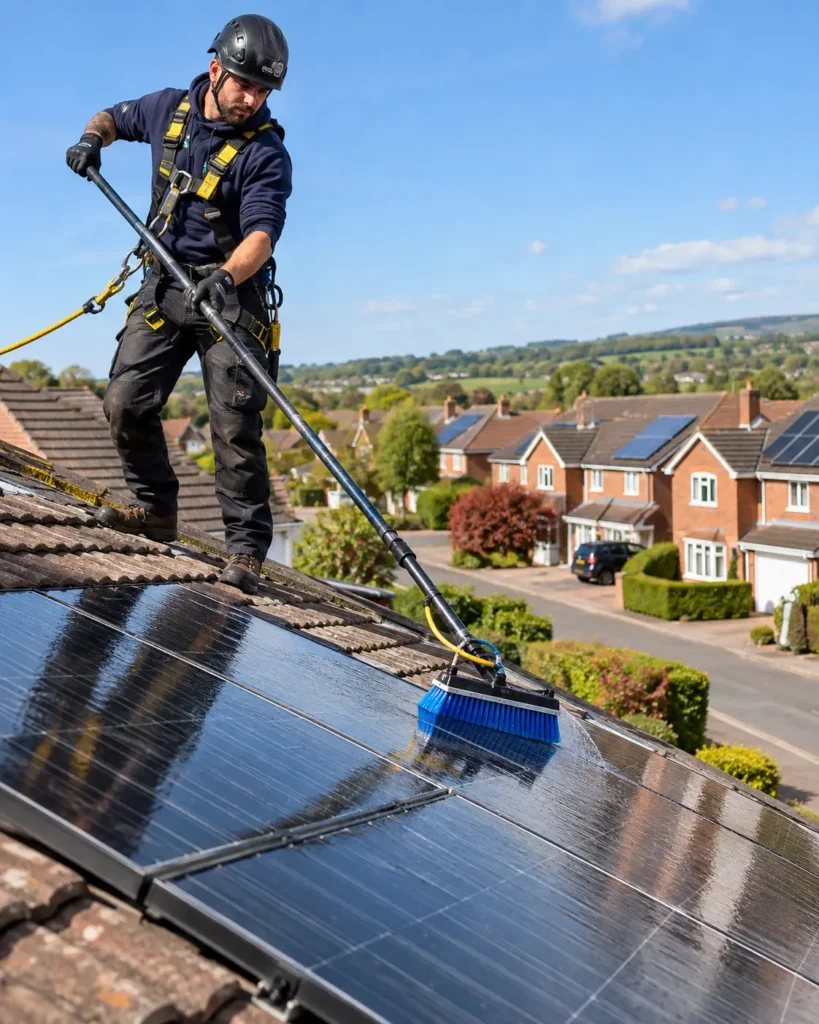
Avoid walking on solar panels or using a pressure washer. Energy Saving Trust warns that high-pressure washing can interfere with panel seals and wiring. It recommends water and a soft brush or sponge, while advising homeowners to check manufacturer instructions before using cleaning products. Energy Saving Trust
For rooftop systems, work from ground level where practical. HSE guidance says work at height should be avoided where possible and that competent people and suitable equipment should be used when it cannot be avoided. HSE
If cleaning requires climbing onto the roof or awkward ladder work, use a competent professional.
What should a professional maintenance visit include?
A useful solar PV maintenance visit is more than a panel wash. MCS separates an intermediate maintenance visit from a fuller technical inspection.
An intermediate visit can include checks of AC and DC isolators, junction boxes, fuses and surge protection, inverter mounting and ventilation, inverter fault logs, connectors, cable condition and labelling. It can also assess whether actual generation remains in line with the original prediction and include DC circuit testing. MCS Certified
A fuller inspection can add checks of module clamps and mounting rails, string resistance and insulation resistance. MCS also lists specialist techniques such as thermographic surveys where appropriate. MCS Certified
Ask the contractor what their service actually includes before booking. Ideally, you should receive a written report showing what was inspected, relevant test results, defects found and recommended action.
Use monitoring as your early-warning system
A modern inverter or monitoring app can reveal faults, communication loss and sudden changes in generation without anyone going near the roof.
Do not compare one cloudy day with a sunny day and immediately assume there is a problem. Look for persistent changes against similar periods or compare performance with the expected generation supplied when the system was commissioned.
MCS includes both homeowner monitoring of recorded generation and contractor assessment of whether generation remains in line with prediction in its maintenance schedule. MCS Certified
Arrange professional help if you notice cracked glass, loose-looking panels, damaged visible cables, water ingress, burning smells, repeated inverter errors or a major unexplained fall in generation.
After severe weather, a ground-level visual check is sensible. Do not climb onto the roof simply to investigate suspected damage.
How much does solar panel maintenance cost?
Solar PV maintenance is generally an occasional expense rather than a large fixed annual cost. Current Energy Saving Trust guidance provides useful benchmarks.
| Item | Indicative cost | Timing |
|---|---|---|
| Professional panel cleaning | About £60–£100 for a standard system | When needed |
| Homeowner monitoring | £0 | Ongoing |
| Professional inspection/service | Varies by scope and access | Follow system guidance |
| Inverter replacement | Around £800 | Commonly around 10–15 years |
These are indicative figures, not quotations. Cost changes with array size, roof height, access equipment, location, fault diagnosis and the work included.
Ask for a written quotation that separates cleaning, electrical testing, replacement parts and access costs. A survey or inspection may be required before a contractor can price repairs accurately.
Do you need a solar panel maintenance contract?
Not automatically. Many homeowners can monitor their system themselves and pay for professional work when the equipment, warranty or maintenance schedule calls for it.
Before signing a contract, ask exactly what you are buying. “Maintenance” might mean only a visual inspection. Another package could include electrical tests, inverter fault-log checks, performance assessment, cleaning and a written condition report.
Be cautious with unsolicited claims that your solar warranty has expired or that urgent maintenance is compulsory. Energy Saving Trust specifically warns that scammers have impersonated MCS or pressured solar owners into maintenance packages. Energy Saving Trust
Verify the business independently rather than relying on information supplied in an unexpected call, email or text.
Who should maintain a solar PV system?
Homeowners can monitor generation and make safe ground-level visual checks. Electrical testing, fault finding and roof-level work require appropriate competence and equipment.
If you are choosing a contractor for a new installation, our MCS-certified solar installers guide explains what certification covers and what other credentials you should check.
Compare quotations on the same scope. One contractor may quote only for cleaning while another includes electrical testing and a written report, making headline prices difficult to compare directly.
A practical five-step solar maintenance plan
- Keep the handover pack. Store commissioning records, system drawings, warranties and manuals together.
- Monitor generation. Check the app or inverter periodically and learn your system’s normal seasonal pattern.
- Make a yearly ground-level visual check. Look for obvious damage, heavy soiling, shading and inverter warnings.
- Clean only when there is a reason. Use safe ground-level methods or a competent professional.
- Book technical maintenance when due or when symptoms appear. Follow your handover schedule, equipment warranty and insurer requirements.
If you are still comparing systems or need quotations for related home improvements, Get Free Quote can help you compare suitable providers and written quotations.
Get Your Free Air Source Heat Pump Quote
Find the right air source heat pump solution for your home. Tell us a few details and our team will help you explore suitable options at a competitive price.
Quick to complete. No obligation.
Get your quote
Enter your details below and one of our team will get back to you.
Frequently asked questions
Find clear answers to common questions comparing air source and ground source heat pumps, including efficiency, installation and running costs, winter performance, noise, land requirements and borehole depth.
There is no universal interval. Current MCS guidance for privately owned domestic systems advises annual homeowner visual checks, with intermediate contractor maintenance around year 10 and fuller maintenance around year 15. These intervals are advisory, and warranty or insurer requirements may differ. MCS Certified
Not necessarily. MCS does not prescribe annual professional servicing for every privately owned domestic system. Check your installer handover pack, manufacturer warranty and insurance conditions before paying for an annual plan. MCS Certified
Energy Saving Trust recommends checking them roughly every 12 to 18 months and cleaning when visible contamination is present. Local conditions may justify more frequent cleaning. Energy Saving Trust
Yes, rainfall removes much ordinary dust and dirt from appropriately pitched panels. Persistent bird droppings, lichen, leaves or other contamination may still require cleaning. Energy Saving Trust
Ground-level cleaning may be possible if it can be done safely and in accordance with the manufacturer's instructions. Avoid accessing a roof unless you have the necessary competence and equipment. HSE
No. Energy Saving Trust advises against pressure washers because they can affect seals and wiring. Energy Saving Trust
Energy Saving Trust recommends water and a soft brush or sponge. Detergents can leave residue, so check the panel manufacturer's instructions before using cleaning products. Energy Saving Trust
Depending on scope, a service can include inverter checks, isolators, connectors, cabling, protection equipment, output assessment and electrical tests. More detailed inspections can include mounting checks and thermal imaging. MCS Certified
Look for persistent output reductions, inverter fault messages, visible damage, significant dirt, new shading, damaged cables or signs of water ingress.
Yes. Monitoring helps you establish normal seasonal performance and spot sudden or persistent changes that could indicate a problem.
Energy Saving Trust says professional cleaning typically starts at around £60–£100 for a standard system, although access and system size can increase the price. Energy Saving Trust
Energy Saving Trust currently suggests that inverters commonly need replacement after around 10–15 years, although actual lifespan depends on the equipment and operating conditions. Energy Saving Trust
Energy Saving Trust currently gives an indicative figure of around £800. Actual quotations vary by inverter type, system design and installation work required. Energy Saving Trust
Some do, while others do not. Check the exact product, workmanship and inverter warranty conditions rather than assuming the same rule applies to every installation.
A ground-level visual check is sensible after severe weather. If panels look damaged or loose, or system performance changes significantly, arrange a professional inspection rather than climbing onto the roof yourself.
Pruning vegetation can restore sunlight to the array where it can be done legally and safely. MCS includes reducing shading caused by vegetation in its homeowner maintenance schedule. MCS Certified
Their value depends on what is included and whether your system actually requires regular professional servicing. Compare the contract against your warranty and maintenance schedule before committing.
Electrical work should be undertaken by someone competent for the work involved. For specialist PV inspection and maintenance, relevant solar PV experience and appropriate certification are particularly useful.
Conclusion
Solar panel installation maintenance is mainly about monitoring, sensible visual checks and timely professional attention rather than constant servicing.
Plan maintenance before the installation is signed off. Make sure you receive your maintenance schedule, warranties, manuals, commissioning information and working monitoring access. Once the system is operating, watch for unusual performance changes, keep vegetation and significant dirt under control, and use competent professionals for roof-level or electrical work.
MCS provides a useful advisory baseline, but manufacturer warranties, insurers and site conditions can justify a different interval. Following the requirements for your own system keeps maintenance proportionate while helping protect safety, performance and long-term value.


