Solar Panel Installation Estimate UK: 2026 Cost Guide
Check Your Eligibility for Boiler Upgrade Scheme (BUS)
Complete your details below to check your eligibility.
Thank you
We've received your details and will be in touch shortly.
Quick Answer: How Much Should You Budget for Solar Panel Installation?
For a typical UK home, a sensible initial solar panel installation estimate is around £6,000–£10,000 before battery storage. Energy Saving Trust currently gives approximately £7,600 for an average 4.5kWp domestic system. Energy Saving Trust
Smaller, straightforward systems can cost less. Larger arrays, difficult scaffolding, premium equipment, complex roofs or electrical upgrades can increase the price.
Treat an online estimate as a planning figure rather than a guaranteed quotation. A survey should confirm roof suitability, panel layout, shading, electrical requirements and access before the installer provides a final scope and price.
Solar Panel Installation Estimate UK: 2026 Cost Guide
If you want a solar panel installation estimate before arranging surveys or speaking to several installers, a realistic starting point for many UK homes is around £6,000–£10,000 for solar panels without a battery. The final figure depends on system size, roof access, equipment, scaffolding and electrical work.
Energy Saving Trust currently puts the average domestic solar PV system at around 4.5kWp and £7,600 installed. That is a useful benchmark, but it is not a fixed price for every property. Energy Saving Trust
A good estimate should do more than give you one headline number. It should tell you roughly how large the proposed system will be, what work is likely to be required and which costs could still change after a site survey.
If you are ready to move from an indicative figure to installer pricing, you can get started with Get Free Quote and compare suitable options.
Typical Solar Panel Installation Estimates in 2026
The following figures are useful planning ranges rather than guaranteed quotations.
| System size | Typical situation | Indicative solar-only estimate |
|---|---|---|
| Around 3kWp | Smaller home or limited roof | £5,000–£6,500 |
| Around 4–4.5kWp | Typical family home | £6,500–£8,500 |
| Around 5–6kWp | Larger home, EV or higher usage | £8,000–£10,500+ |
These ranges are broadly consistent with current market pricing and Energy Saving Trust’s £7,600 benchmark for an average home system. Current government solar cost statistics are based on installation data from the MCS database and show that installed cost per kW varies by system size. GOV.UK
For more detailed cost analysis, see the solar panel cost UK guide.
Why price per panel can be misleading
You are not simply buying solar modules.
Your installation may also include an inverter, roof mounting equipment, cables, isolators, scaffolding, system design, labour, commissioning and connection paperwork.
Some of those costs barely change when a few extra panels are added. This is one reason larger installations can cost less per kWp than smaller systems.
What Does a Solar Panel Installation Estimate Actually Mean?
An estimate is an indicative cost based on the information available at the time.
A quotation should be much more specific.
The current Renewable Energy Consumer Code says its members should make clear that initial cost estimates are not definite figures. A formal quotation should then be provided in writing and should itemise the equipment and services being supplied, exclusions, potential additional work and performance information. recc.org.uk
See the Renewable Energy Consumer Code for the underlying consumer-protection requirements.
This distinction matters because an installer can produce a reasonable desktop estimate from your postcode, energy use and roof information, but they may not yet know whether your consumer unit needs work or whether scaffolding will be unusually complicated.
What Affects a Solar Panel Installation Estimate?
1. System size
The number of panels and total system capacity, measured in kilowatt peak or kWp, usually have the greatest effect on the equipment cost.
However, the biggest system that fits your roof is not automatically the right answer. Your electricity consumption, available roof area and future plans should all influence sizing.
An EV or heat pump may justify allowing for higher future electricity demand.
2. Roof layout and access
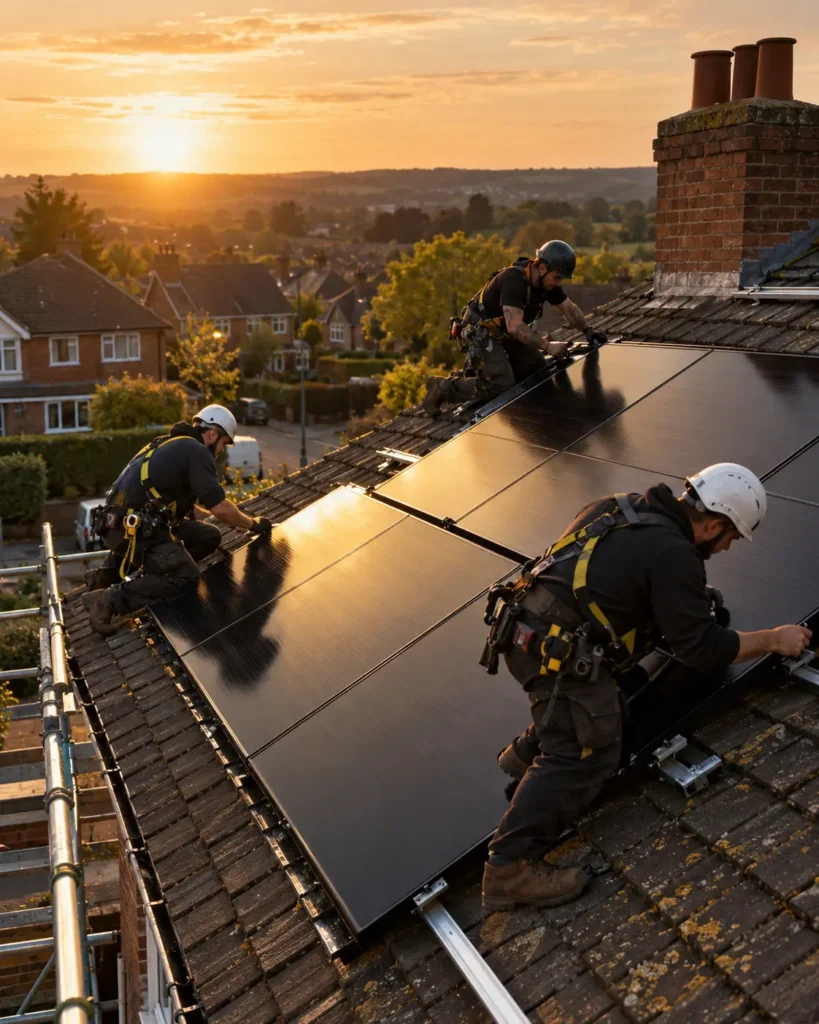
A simple pitched roof with clear access is normally easier to price than a roof with dormers, several elevations, fragile coverings or complicated scaffolding.
Flat roofs can also require different mounting systems and additional structural considerations. Energy Saving Trust notes that flat-roof installations can be more complex and potentially more expensive. Energy Saving Trust
3. Shading and panel layout
Trees, chimneys and nearby buildings can reduce available roof space or affect generation.
An installer may recommend optimisers, microinverters or a different panel layout where shading is significant. These choices can alter the estimate.
4. Inverter and panel specification
Higher-efficiency panels may cost more but can make sense where roof space is limited.
Likewise, a standard string inverter and a hybrid inverter designed for battery integration should not automatically be compared as equivalent products.
5. Electrical work
Your installer needs to consider the consumer unit, earthing arrangements, meter position and cable routes.
Additional electrical work can increase the final figure even when the solar array itself does not change.
6. Battery storage
Ask for battery storage to be priced separately.
This makes it much easier to understand the cost and value of the solar installation itself. Battery capacity, power rating, inverter arrangement and backup capability can all significantly change the total project price.
What Should a Reliable Solar Estimate Include?
| Check | What you should receive |
|---|---|
| System size | Proposed capacity in kWp and approximate panel count |
| Equipment | Panel and inverter specification, or clearly stated assumptions |
| Generation | Estimated annual electricity generation and key assumptions |
| Access | Whether scaffolding and normal roof access are included |
| Electrical work | Known works plus anything still subject to inspection |
| Battery | Separate price and usable capacity where storage is proposed |
| Certification | Responsibility for commissioning, MCS documentation and connection work |
| Exclusions | Anything that could result in additional charges |
A low estimate is not automatically better.
If one proposal includes scaffolding, electrical upgrades and premium equipment while another excludes them, comparing the two headline prices tells you very little.
For a fuller comparison checklist, use the solar panel installation quote guide.
Why Can the Estimate Change After a Solar Survey?
Remote imagery is useful, but it cannot answer every installation question.
An on-site assessment can identify damaged roof coverings, structural concerns, difficult cable routes, unexpected shading, access restrictions or electrical work that was not visible during the initial estimate.
That is why the most useful sequence is:
initial estimate → property assessment → confirmed design → written quotation
Energy Saving Trust’s calculator follows a similar principle: it can estimate suitable system size, cost and potential savings, helping homeowners prepare for conversations with installers. Energy Saving Trust
See Energy Saving Trust’s solar calculator for an independent benchmark.
You can also read what installers should check during a solar panel installation survey.
How to Get a More Accurate Solar Panel Estimate
Before requesting prices, gather a few basic details.
- Check your annual electricity use. Your latest energy bill should show consumption in kWh.
- Describe the roof accurately. Include roof type, orientation, approximate size and obvious shading.
- Mention future electricity demand. Tell the installer if you plan to buy an EV, heat pump or other major electrical load.
- Decide whether to price a battery. Ideally request solar-only and solar-plus-battery figures separately.
- Use the same specification when comparing estimates. Compare total kWp, equipment and installation scope rather than simply the lowest price.
- Request a survey before relying on the final number. The survey should turn assumptions into a property-specific design.
Once you have comparable proposals, the compare solar panel quotes guide can help you assess them on a like-for-like basis.
Example Solar Panel Installation Estimate
Consider a homeowner looking at a 4.5kWp system with no battery.
If the property has a straightforward pitched roof, normal scaffolding requirements and no major electrical upgrades, the current Energy Saving Trust average of about £7,600 provides a sensible starting benchmark. Energy Saving Trust
However, imagine the survey identifies complicated rear access and the need for additional electrical work. The final quote may be higher even though the number of panels has not changed.
Conversely, if scaffolding is already in place because the homeowner is replacing the roof, installation costs may be lower.
The important question is therefore not simply, “How much do 10 solar panels cost?”
A better question is:
“What will a correctly sized solar system cost to install on my property, with all necessary work included?”
That produces a far more useful estimate.
Does VAT Affect Your Estimate?
For eligible residential installations in Great Britain, qualifying energy-saving products supplied and installed by the contractor currently benefit from 0% VAT. Northern Ireland has different rules, so homeowners there should check the applicable VAT treatment. GOV.UK
See GOV.UK guidance on VAT for energy-saving products before assuming a tax treatment in your budget.
There is not currently a universal UK Government grant that simply pays every private homeowner to install solar panels. Other national, local or supplier schemes may provide support in specific circumstances. Energy Saving Trust
What About Export Income?
Your installer may include exported electricity when estimating financial savings.
The Smart Export Guarantee (SEG) enables eligible small-scale generators in Great Britain to receive payment for electricity exported to the grid. Individual suppliers set their own eligible tariffs and terms. Ofgem
See Ofgem’s Smart Export Guarantee guidance for generators.
Be cautious if a sales estimate depends on unusually high export rates or assumes that electricity prices and tariffs will remain unchanged for many years.
Before You Accept an Estimate
Check that you can answer these questions:
- What is the proposed system capacity in kWp?
- Which panels and inverter are assumed?
- What annual generation is predicted?
- Is scaffolding included?
- Are electrical works included?
- Is battery storage clearly separated?
- What could still change after the survey?
- What warranties apply?
- Who handles grid connection and certification?
- How long is the estimate or quotation valid?
MCS-certified installers operate within a quality-assurance framework covering technologies including solar PV, and in-scope installations are registered through the MCS process.
Get Your Free Air Source Heat Pump Quote
Find the right air source heat pump solution for your home. Tell us a few details and our team will help you explore suitable options at a competitive price.
Quick to complete. No obligation.
Get your quote
Enter your details below and one of our team will get back to you.
Frequently asked questions
Find clear answers to common questions comparing air source and ground source heat pumps, including efficiency, installation and running costs, winter performance, noise, land requirements and borehole depth.
Energy Saving Trust currently estimates around £7,600 for an average 4.5kWp domestic system. Smaller or simpler installations may cost less, while larger or more complicated projects can exceed £10,000.
It is useful for budgeting but cannot normally confirm the final price. Roof condition, scaffolding, shading and electrical requirements may only become clear after a survey.
An estimate is an indicative figure. A formal quotation should define the equipment, services, exclusions, price and relevant performance information in writing.
A reasonable 2026 planning figure is approximately £6,000–£8,000, although property-specific factors can move the final price. Current national benchmarks put a typical home system in this general range.
It often does, but never assume it is included. Ask the installer to state clearly whether scaffolding and other access equipment are part of the total price.
Yes. Battery storage can add several thousand pounds depending on capacity, inverter design and features. Ask for separate solar-only and solar-plus-battery prices.
It can if the survey identifies work or site conditions that were not included in the original assumptions. Any changes should be explained clearly before you proceed.
A proper site assessment is highly advisable and may be required to validate the final design. It checks factors such as roof condition, shading, electrics and access.
They can. Flat roofs may need specialist mounting systems and additional structural or access considerations.
Most normal domestic rooftop installations can proceed under permitted development rules, but exceptions exist, including some listed buildings and conservation-area situations. Check the specific property before proceeding.
Qualifying residential solar installations in Great Britain currently benefit from 0% VAT. Different arrangements apply in Northern Ireland.
There is no universal UK Government solar grant available to every private homeowner. Some households may qualify for support through other energy-efficiency or local schemes.
Yes. Comparing several like-for-like proposals makes it easier to identify unusual pricing, specification differences and exclusions.
MCS provides a UK quality-assurance framework for small-scale renewable installations. MCS documentation may also be relevant when demonstrating installation eligibility for export arrangements.
Eligible households in Great Britain can receive payments for exported electricity through Smart Export Guarantee tariffs offered by participating suppliers. Rates and conditions vary between suppliers.
Conclusion
A solar panel installation estimate is most useful when it gives you a realistic planning range and explains the assumptions behind it.
For many UK homes, roughly £6,000–£10,000 for solar without a battery is a reasonable place to begin your research, with Energy Saving Trust’s current £7,600 average for a 4.5kWp system providing a useful national reference point. Energy Saving Trust
However, roof access, system size, equipment and electrical work can move the final figure significantly.
Use an online estimate to understand the likely budget. Then use a survey and detailed written quotation to establish what the installation will actually cost.
When you are ready, Get Free Quote can help you move from an initial estimate to comparing suitable installation options.