Solar Panel Upfront Cost UK 2026: What You’ll Pay
Check Your Eligibility for Boiler Upgrade Scheme (BUS)
Complete your details below to check your eligibility.
Thank you
We've received your details and will be in touch shortly.

Quick answer: what is the upfront cost of solar panels in the UK?
A typical domestic solar panel system costs around £7,600 installed for about 4.5kWp, according to Energy Saving Trust. Battery storage typically adds around £5,000–£8,000. “Upfront cost” can mean either the total cash price or the first payment due when you sign. If you use a Renewable Energy Consumer Code member, RECC says the initial deposit should not exceed 25% of the contract price and should be protected. Qualifying installed energy-saving materials currently benefit from temporary 0% VAT until 31 March 2027. Always check what the quote includes before comparing prices.
For a wider overview of available systems and quotation factors, see solar panel installation quotes.
Solar Panel Upfront Cost UK: How Much Cash Do You Need in 2026?
If you are budgeting for rooftop solar, the useful question is not only “how much do solar panels cost?” It is “how much money will I need to commit at the start, and what is included?”
Energy Saving Trust currently puts a typical 4.5kWp domestic solar PV system at around £7,600. That is a planning benchmark, not a guaranteed quote. Your actual upfront cost can change with system size, roof access, scaffolding, electrical work, equipment choice and whether you add a battery.
This guide focuses on fixed rooftop solar for UK homes. It explains the difference between the total installed price and the deposit due before work starts, what can increase the quote, how storage changes the budget, and which support or finance routes may reduce the cash you need immediately.
Ready for a property-specific price? Start with the Get Free Quote home page and compare complete written quotes rather than headline package prices.
What counts as an upfront solar cost?
“Upfront cost” is used in two ways.
The first is the total installed cash price: what the complete system costs if you pay without borrowing. This normally covers panels, inverter, mounting, electrical components, labour, commissioning and connection work.
The second is the amount due before installation. An installer may take a deposit and then request stage payments. So a £7,600 project does not automatically mean paying £7,600 on the day you sign.
That distinction matters when budgeting. The contract value tells you what the project costs overall. The payment schedule tells you how much cash you actually need at each stage.
Typical solar panel upfront cost in the UK in 2026
| Cost item | Useful 2026 planning figure | What it means |
|---|---|---|
| Typical 4.5kWp domestic solar system | Around £7,600 | Energy Saving Trust benchmark |
| Battery storage | Around £5,000–£8,000 | Typical additional storage cost |
| Initial deposit with a RECC member | No more than 25% | RECC consumer-protection limit |
| VAT on qualifying installation | 0% until 31 March 2027 | Temporary relief under current HMRC rules |
Energy Saving Trust says an average system is around 4.5kWp, often using about 12 panels and 20–30m² of roof area.
The latest Department for Energy Security and Net Zero solar PV cost statistics also show why one national figure cannot describe every home. The official data comes from the MCS Installation Database and is reported by system size and capacity measure.
Larger systems can cost less per kilowatt because fixed costs are spread across more capacity. When comparing quotes, check both the total price and the installed price per kWp, while still considering equipment, generation estimates and installation scope.
For a more detailed benchmark, use the solar panel cost per kW guide rather than duplicating those calculations here.
Why does a full installation cost much more than the panels?
Solar modules are only one part of a rooftop system. A complete quote may also cover:
inverter and monitoring
mounting rails, hooks or an in-roof system
cabling, isolators and electrical protection
scaffolding or safe roof access
roof and electrical labour
survey, design and generation calculations
Distribution Network Operator work
testing, commissioning, certification and handover
warranties and aftercare
This explains why buying individual panels online can make a full installer quote look unexpectedly high.
It is also a recurring concern among UK homeowners comparing quotes: recent discussions frequently question why relatively inexpensive modules translate into installations costing several thousand pounds, with scaffolding, labour, electrical work and grid requirements accounting for much of the difference.
The useful comparison is therefore not panel retail price versus installation price. It is one complete installed system versus another.
How much deposit should you pay?
Check the payment schedule before paying anything.
RECC’s current consumer guidance says you should never pay more than 25% of the contract price upfront when dealing with a RECC member, and that the deposit should be protected. Its Consumer Code also requires members to make the amount and timing of payments clear.
For a £7,600 contract, 25% is £1,900. That is an upper limit under RECC rules, not a standard amount every installer should charge.
Before signing, ask:
How much is due now?
Are further payments required before installation?
How are deposits and advance payments protected?
A clear written schedule is preferable to pressure to pay a large amount quickly.
What can increase the upfront cost?
Roof access and scaffolding
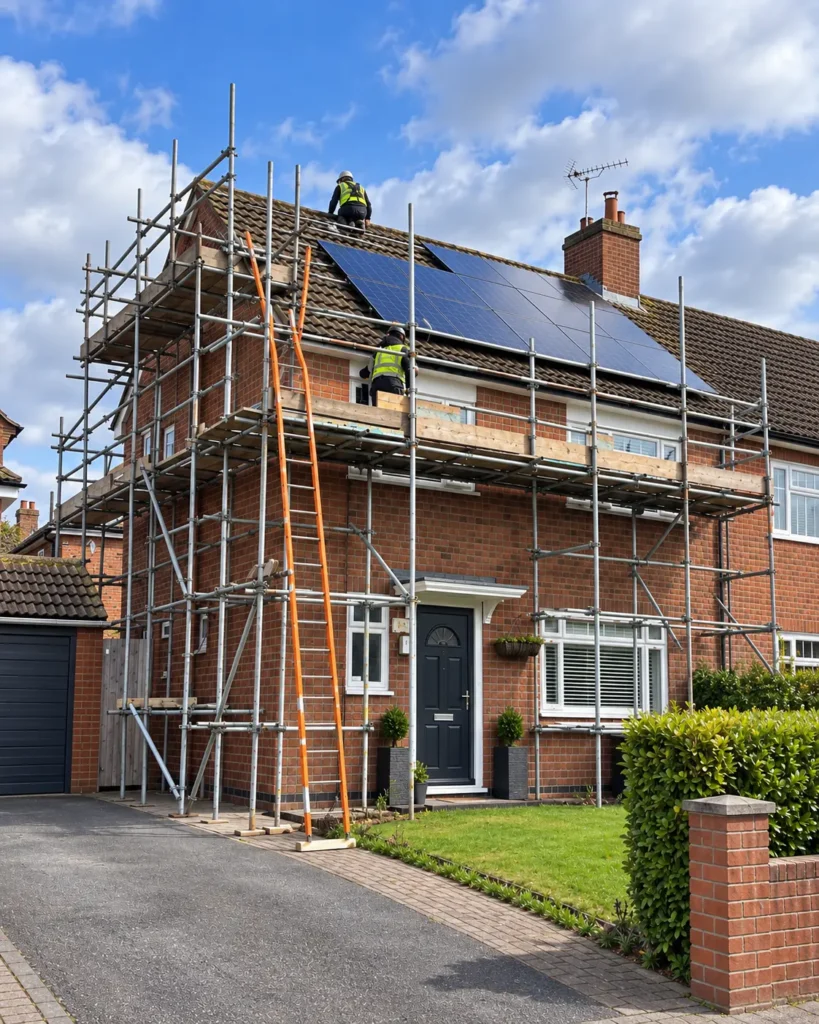
Tall properties, multiple roof elevations, conservatories and restricted access can make scaffolding more expensive.
If suitable scaffold is already in place for roof work, Energy Saving Trust notes that this can reduce solar installation costs.
For property-specific access examples, see the solar panel scaffolding cost guide.
Roof condition
Solar panels may remain in service for decades, so installing them over a roof that soon needs replacement can create avoidable future expense.
Energy Saving Trust specifically identifies the possible need to renew the roof covering as a factor affecting installation cost.
Establish whether repairs are required before accepting the solar quote.
Electrical upgrades
An older consumer unit, long cable routes, earthing work or other electrical changes can add to the price. Ask the installer to state what is included and what remains subject to survey.
Equipment choice
Premium panels, microinverters, optimisers, hybrid inverters and specialist mounting systems can cost more.
The extra spend should solve a clear problem, such as shading, limited roof space or future battery plans. A more expensive specification is not automatically better value.
Should you add a battery upfront?
Battery storage is often the largest optional extra. Energy Saving Trust says it tends to cost around £5,000–£8,000.
A battery can store surplus solar electricity for later use, but the higher upfront price does not automatically mean a faster financial return.
Ask for two quotations:
solar panels without a battery
the same array with the proposed battery
Compare the extra cost with the forecast change in annual savings.
If your budget is limited, ask whether the design can make a later battery retrofit simpler. For example, inverter choice and cable routes can affect future installation work.
Can VAT, grants or finance reduce the upfront cost?
Qualifying installations of energy-saving materials are currently zero-rated for VAT until 31 March 2027 under HMRC guidance. Under the legislation currently in force, installations are due to return to the reduced 5% rate from 1 April 2027. Check the latest position when you receive your quotation.
There is no universal UK solar grant automatically available to every homeowner. Wider schemes can help some households. Energy Saving Trust also advises that funding may be available through broader government programmes.
In England, the Warm Homes: Local Grant can include solar panels for eligible low-income households in privately owned homes with an EPC rating from D to G.
The wider Warm Homes Plan also includes low- and zero-interest consumer finance intended to help households meet the upfront costs of measures including solar panels and batteries.
Finance can reduce the cash needed on day one, but it can increase the total amount paid. Compare the cash price with the total repayable, fees, term and early-repayment conditions.
| Funding route | Upfront cash | Main check |
|---|---|---|
| Cash purchase | Highest | Total installed price and payment protection |
| Finance | Lower | Total repayable, interest/fees and ownership terms |
| Eligible grant support | Potentially much lower | Eligibility and local availability |
| Government-backed low/zero-interest finance | Designed to lower the barrier | Current availability and lender terms |
How can you reduce the initial spend?
First, size the system around your roof and electricity use rather than choosing a package by panel count.
Then:
Get at least three comparable quotes. Energy Saving Trust and RECC both recommend comparing several installers.
Check the full scope. Confirm scaffolding, electrics, DNO work, monitoring, certification and warranties.
Price solar without storage first. This makes the battery premium clear.
Coordinate with planned roof work where appropriate to avoid duplicated access costs.
Avoid extras that do not solve a real need.
Check grants and finance before signing, because availability and eligibility can change.
How to compare quotes before committing cash
A good written quote should state the total system capacity in kWp, exact panel and inverter models, expected annual generation, scaffolding, electrical work, DNO responsibilities, warranties, payment schedule and exclusions.
Use the solar panel installation quote guide for a more detailed comparison checklist.
Also check the generation estimate. The current MCS solar PV standard requires installers to explain that performance estimates are guidance rather than guarantees because solar radiation and real-world self-consumption vary.
If export income is part of the financial case, check the tariff you can actually access. Ofgem’s Smart Export Guarantee enables eligible generators in Great Britain to receive payments for exported electricity, but suppliers set their own rates and contract terms.
Get Your Free Air Source Heat Pump Quote
Find the right air source heat pump solution for your home. Tell us a few details and our team will help you explore suitable options at a competitive price.
Quick to complete. No obligation.
Get your quote
Enter your details below and one of our team will get back to you.
Frequently asked questions
Find clear answers to common questions about upfront solar panel costs, deposits, batteries, VAT, grants, finance, quotes, payback and unexpected installation costs.
Energy Saving Trust currently uses around £7,600 for a typical 4.5kWp domestic solar installation. Your quote can be higher or lower depending on your property and system specification.
Not necessarily. Installers may use a deposit followed by staged payments. Check the exact payment schedule before signing.
RECC says consumers using one of its members should never pay more than 25% of the contract value upfront, and advance payments should be protected.
A full installation would normally include panels, inverter, mounting equipment, wiring, labour and commissioning. Check whether scaffolding, electrical upgrades and DNO-related work are included rather than assuming they are.
Energy Saving Trust currently estimates battery storage at around £5,000–£8,000.
Usually, yes. However, inverter choice, electrical design and cable routes can affect the cost and complexity of adding storage later.
Qualifying installations currently benefit from the temporary 0% VAT rate until 31 March 2027. HMRC states that the reduced 5% rate is due to apply afterwards under current rules.
There is no universal grant for every homeowner. Some households may qualify through wider schemes, including the Warm Homes: Local Grant in England.
Finance can spread the cost, while eligible households may qualify for grant support. Government-backed low- and zero-interest lending is also part of the Warm Homes Plan, although availability and lender terms must be checked at the time you apply.
It should be clearly stated either way. Never assume scaffolding is included in a headline package price.
The modules are only part of the project. A complete installation also requires mounting equipment, an inverter, electrical work, safe roof access, labour, testing, paperwork and other installation services.
Not automatically. Compare system capacity, exact equipment, expected generation, warranties, included work, exclusions and payment protections before judging value.
Energy Saving Trust and RECC recommend obtaining at least three quotes.
They can, but the period varies with installation cost, electricity use, location and export income. Energy Saving Trust’s current examples for Great Britain show roughly 9–12 years in several locations when export payments are included.
There is no universal contingency figure. The better approach is to obtain a post-survey, itemised quote that identifies provisional costs such as electrical upgrades, access work or roof repairs before signing.
Conclusion
For homeowners researching solar panel upfront cost UK, around £7,600 is a sensible current benchmark for a typical 4.5kWp solar-only installation. Adding a battery can raise the budget by roughly £5,000–£8,000.
The amount due before installation may be much lower than the total project price. If you choose a RECC member, the initial deposit should not exceed 25% of the contract value and should be protected.
Compare complete written quotations, separate essential work from optional upgrades, and judge finance by the total repayable rather than the monthly figure alone.