
Replace Oil Boiler With Heat Pump: UK Guide 2026
Check Your Eligibility for Boiler Upgrade Scheme (BUS)
Complete your details below to check your eligibility.
Thank you
We've received your details and will be in touch shortly.

Quick answer: can you replace an oil boiler with a heat pump?
Yes. In many UK homes, an air-to-water heat pump can replace an oil boiler and continue to supply a wet central-heating system. It takes heat from outdoor air, raises its temperature using a refrigeration cycle and transfers that heat into water for radiators or underfloor heating. It can also heat water stored in a cylinder.
The main difference is heat delivery. Oil boilers often run at higher water temperatures for shorter periods. Heat pumps usually work more efficiently at lower flow temperatures for longer periods. That means heat loss, radiator output, pipework, hot-water storage and controls all need checking before design.
Replace an Oil Boiler With a Heat Pump: UK Guide 2026
Replacing an oil boiler with an air source heat pump can make sense for many off-gas-grid homes, but it is not a simple appliance swap. The heat pump, radiators, pipework, hot-water storage and controls need to work as one system.
For oil-heated homes in England and Wales, 2026 is also an important time to compare the options. Eligible off-gas-grid properties replacing oil can currently receive £9,000 through the Boiler Upgrade Scheme (BUS), rather than the standard £7,500 heat-pump grant. The temporary uplift runs until 31 March 2027.
This guide explains what changes, how to judge suitability, what happens to radiators and hot water, what costs to compare and what to ask for before signing a quotation.
Get a free quote: Compare surveyed air source heat pump quotations through Getfreequote.co.uk.
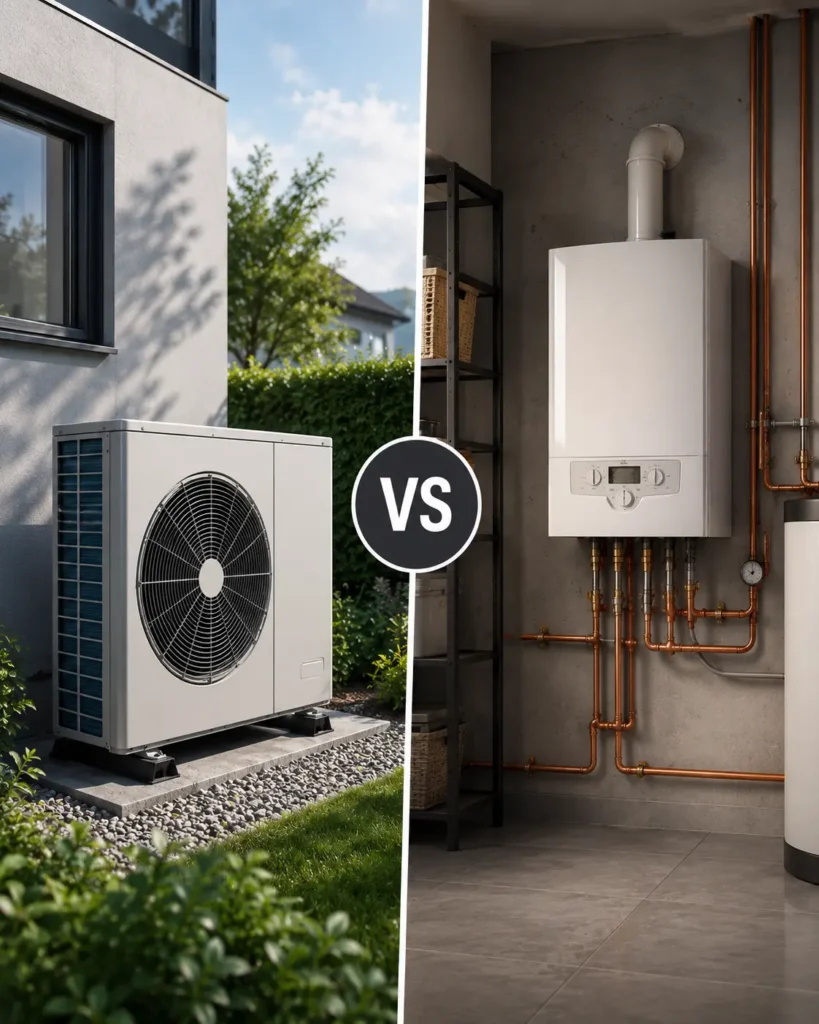
Oil boiler vs air source heat pump
| 2-bedroom property | Typical cost before BUS | £7,500 BUS grant | Potential homeowner cost |
|---|---|---|---|
| Straightforward small terrace or heat-pump-ready home | £7,500–£9,500 | -£7,500 | £0–£2,000 |
| Typical 2-bed terrace or semi | £9,000–£11,500 | -£7,500 | £1,500–£4,000 |
| More complex retrofit | £11,500–£12,500+ | -£7,500 | £4,000–£5,000+ |
Should you replace an oil boiler with a heat pump?
The case is often strongest where the oil boiler is already approaching replacement, the home has a wet heating system, there is space for an outdoor unit and hot-water storage, and a heat-loss assessment shows the property can be heated at a sensible flow temperature.
A heat pump also removes dependence on oil deliveries and tank storage. However, the grant should not drive the decision by itself. A poorly designed system can still produce disappointing comfort or electricity use.
Older homes are not automatically unsuitable. The key question is how much heat the building loses on a cold day and how efficiently that heat can be delivered. If you are unsure, start with our guide to whether your home is suitable for a heat pump.
What changes when the oil boiler is removed?
An air-to-water heat pump can still use radiators or underfloor heating, so much of the wet heating layout may remain.
Outside air passes across an evaporator containing refrigerant. The refrigerant absorbs heat, a compressor raises its pressure and temperature, and a condenser transfers that heat into the home’s heating water. An expansion valve then lowers the refrigerant pressure so the cycle can repeat.
This is why a heat pump can deliver several units of heat for each unit of electricity it uses. Seasonal performance is expressed as SCOP, or seasonal coefficient of performance.
The practical point is simple: heat pumps usually perform best when they do not have to make very hot water.
Will your existing radiators work?
Possibly. Replacing an oil boiler does not mean every radiator must go.
Energy Saving Trust’s heat pump installation guidance says heat pumps typically send water to radiators at around 35–45°C, lower than many fossil-fuel systems. Larger radiators can compensate because they have more surface area, but some existing radiators may already be sufficient.
The decision should be room by room. MCS heat-load guidance says calculations should consider building fabric, room dimensions, air-change rates, indoor temperatures and local winter conditions. The installer can then check whether each radiator can meet that room’s heat demand at the proposed water temperature.
If it can, it may stay. If it cannot, options include a larger radiator, another emitter, practical insulation improvements or a different design.
See our guide to using a heat pump with existing radiators for the detailed checks.
What about hot water and the oil tank?
Most oil-to-heat-pump conversions need a hot-water cylinder sized for the household. An existing cylinder still needs checking because its coil or storage arrangement may not suit the new system.
If you currently have an oil combi boiler and no cylinder, make sure the quotation includes the new hot-water solution and the space required.
Also ask what happens to the old boiler, remaining fuel and oil tank. The quote should state who disconnects or removes each item and whether making-good work is included. Do not assume oil-tank work is covered simply because the heat pump is fully priced.
How much does it cost?
Energy Saving Trust’s current air source heat pump guidance gives around £12,000 as a typical air source heat pump installation cost before grants. Actual quotations vary with heat-pump size, radiator changes, cylinder work, pipework, electrical work, access and the condition of the existing system.
For an oil-heated property, compare the complete project price. Ask for the heat pump, cylinder, emitters, controls, electrical work, removal work, commissioning and grant deduction to be clear.
A survey is needed for an accurate figure.
What grant can oil-heated homes get in 2026?
In England and Wales, BUS currently offers £7,500 for an eligible air-to-water heat pump. Until 31 March 2027, an additional £1,500 is available where the property is heated by oil or LPG and has no mains gas connection. That takes support to £9,000 for qualifying off-gas-grid oil homes.
The installer applies for the voucher, and Ofgem says the grant should be deducted from the eligible installation cost. The installer must also be MCS certified.
From 28 April 2026, a valid EPC is no longer mandatory for a BUS application, although details must be supplied if a valid EPC exists. Insulation can still reduce heat loss and improve comfort even when it is not a grant condition.
For full eligibility rules, see our dedicated guide to the grant for replacing an oil boiler with a heat pump.
Will a heat pump be cheaper to run than oil?
It can be, but there is no universal saving.
Energy Saving Trust notes that a heat pump will not necessarily be cheaper to run than a newer oil boiler. The result depends on electricity prices, oil prices, property heat demand and the heat pump’s seasonal efficiency.
A useful heat-pump calculation is:
Annual heat demand ÷ SCOP = approximate electricity use
For example, a home needing 12,000kWh of useful heat with a SCOP of 3.2 would use about 3,750kWh of electricity for that heat. The bill then depends on the tariff.
Ask each installer for the annual heat demand, predicted SCOP, expected electricity use and tariff assumption behind its estimate. Our air source heat pump running-cost guide explains the calculation in more detail.
Do heat pumps work in winter?
Yes, provided the system is sized for the property’s design heat loss.
As outdoor temperatures fall, the home loses more heat and an air source heat pump generally becomes less efficient. In cold, damp weather the outdoor coil can also frost, so the unit periodically runs a defrost cycle.
That is normal. The design question is whether the selected heat pump and emitters can still meet the home’s required output at the local winter design temperature.
How does the replacement process work?
A sensible oil-to-heat-pump project follows seven steps:
- Survey the building, emitters, pipework, cylinder space, electrical supply and outdoor location.
- Calculate room-by-room heat loss.
- Design the heat pump, flow temperature, radiators, cylinder and controls together.
- Confirm BUS eligibility, the final price and all exclusions.
- Agree responsibility for the old boiler, tank and remaining oil.
- Install, commission and set up the controls correctly.
- Monitor comfort and electricity use through the first heating season.
How to compare heat-pump quotes
Do not compare heat-pump brand and headline price alone.
Ask each installer to show the peak heat loss, design flow temperature, radiator changes, cylinder size, predicted seasonal efficiency and estimated annual electricity use. Check whether electrical upgrades, oil-system removal and building work are included.
A cheaper quote can be poor value if it relies on unnecessarily high water temperatures or leaves important work as later extras.
Get Your Free Air Source Heat Pump Quote
Find the right air source heat pump solution for your home. Tell us a few details and our team will help you explore suitable options at a competitive price.
Quick to complete. No obligation.
Get your quote
Enter your details below and one of our team will get back to you.
Frequently asked questions
Find clear answers to common questions about replacing an oil boiler with an air source heat pump, including Boiler Upgrade Scheme support, radiators, underfloor heating, hot-water cylinders, insulation, older homes, winter performance, running costs, oil tanks, planning and heat-pump sizing.
Yes. An air-to-water heat pump can replace an oil boiler in many homes while continuing to use a wet radiator or underfloor-heating system.
An air-to-water heat pump is normally the closest equivalent because it heats water for radiators, underfloor heating and a domestic hot-water cylinder.
Potentially. Until 31 March 2027, qualifying properties in England and Wales heated by oil or LPG and without a mains gas connection can receive £9,000 towards an eligible air-to-water or ground source heat pump.
No. Each radiator should be checked against the calculated heat loss of its room at the proposed flow temperature. Some may remain while others need upgrading.
No. Properly sized radiators can work effectively with a heat pump. Underfloor heating is useful because of its large surface area, but it is not essential.
Often, but not always. Existing cylinders need checking for capacity and compatibility. Homes currently using an oil combi boiler will usually need a new hot-water arrangement.
No. A heat pump can work in older and less-insulated properties. However, practical insulation improvements can reduce heat loss, required heat-pump output and running costs.
Potentially. Age alone does not decide suitability. A room-by-room heat-loss assessment, emitter sizing and achievable flow temperature are more important.
Yes. They are designed to operate in cold weather. Efficiency normally falls as outdoor temperature drops, and defrost cycles are normal in cold, damp conditions.
Sometimes, but not always. The answer depends on the oil price, electricity tariff, heat demand and the heat pump's SCOP. A property-specific comparison is more useful than a national average.
Energy Saving Trust currently gives a typical figure of around £12,000 before grants, but individual projects can vary substantially.
Current BUS rules do not provide grants for fossil-fuel hybrid heat-pump systems. The funded heat-pump installation must meet the applicable scheme requirements.
That depends on the installation contract. Confirm who will deal with remaining oil, isolate the tank, remove it if required and complete any associated making-good work.
Many installations fall within permitted-development rules, but the exact position varies across the UK and depends on the property and installation. Listed buildings and other restricted properties need particular care. England's permitted-development rules were widened in May 2025.
The system should be sized from a proper heat-loss calculation rather than floor area or the output of your old boiler alone. MCS guidance calls for room-by-room heat-loss assessment when designing the heating system.
Conclusion
Replacing an oil boiler with an air source heat pump can be practical for many UK homes, especially where the existing boiler is already due for replacement.
The decision should be based on the whole system: heat loss, radiator output, hot-water needs, operating temperature, net installation cost and predicted seasonal performance.
In England and Wales, qualifying off-gas-grid oil homes can currently receive up to £9,000 through BUS until 31 March 2027. Even with that support, ask for the design assumptions in writing before choosing an installer.
Next step: Get a free air source heat pump quote and ask for the heat-loss figures, proposed flow temperature and expected annual electricity use.


