
Solar Panel Fitting UK: Costs, Rules & Installer Guide
Check Your Eligibility for Boiler Upgrade Scheme (BUS)
Complete your details below to check your eligibility.
Thank you
We've received your details and will be in touch shortly.

Quick Answer: What Does Solar Panel Fitting Involve in the UK?
Solar panel fitting normally includes a site survey, system design, roof mounting, panel installation, inverter and electrical work, grid-connection checks, testing, commissioning and handover. A typical domestic rooftop installation is often completed in one to two days on site, although surveys, scaffolding, grid requirements and scheduling make the full project longer. The final design should be based on your roof, shading and electricity use rather than a standard package. For most homeowners, the key checks are roof condition, expected annual generation, MCS certification, warranties, planning constraints and exactly what the quotation includes.
Solar Panel Fitting UK: What Homeowners Need to Know in 2026
Solar panel fitting in the UK is usually straightforward once the right system has been designed for the property. The important decisions happen before anyone goes onto the roof: checking the roof condition, shading, usable area, electrical setup, expected generation, grid connection requirements and whether the proposed system suits how you use electricity.
This guide is for UK homeowners comparing solar quotes or preparing for installation. It focuses on what a proper fitting should include, what affects cost, when planning or building rules matter, how long the work takes and what documents you should receive afterwards.
If you want a detailed roof-to-switch-on sequence, use our separate solar panel installation process guide rather than duplicating it here. That existing guide already covers the individual installation stages in depth. getfreequote.co.uk
Ready to compare options? Get Free Quote can help you compare suitable solar quotations for your property without treating the cheapest headline price as the only factor.
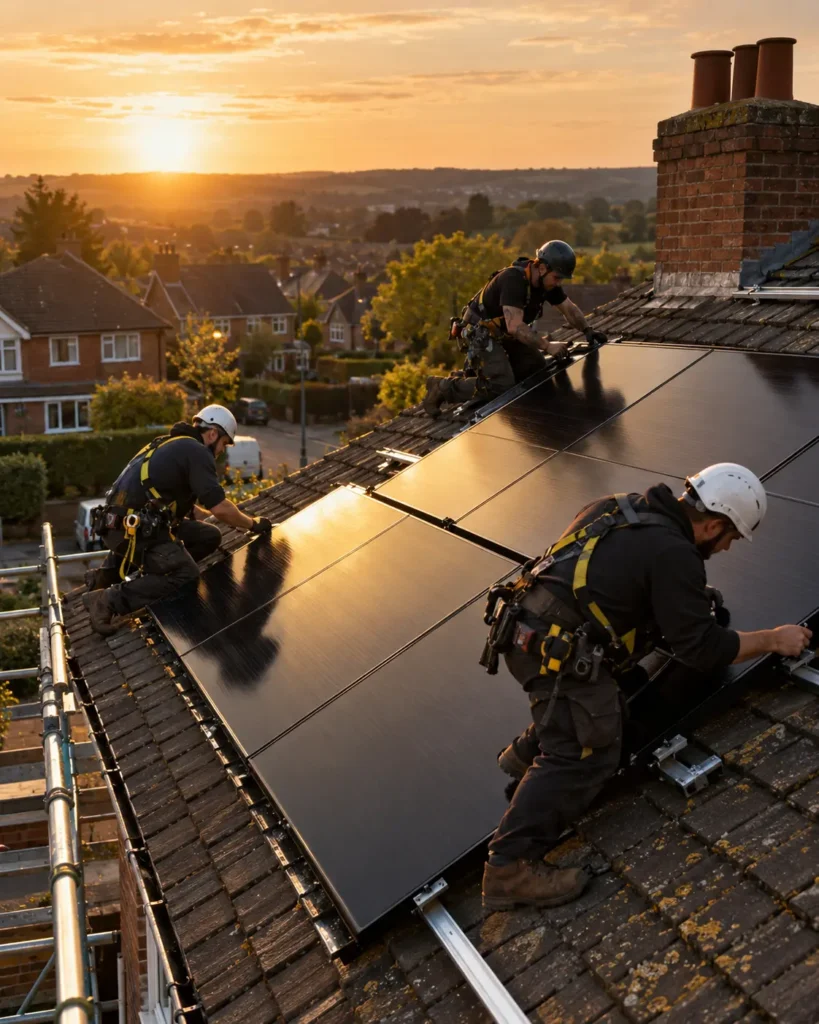
Solar Panel Fitting at a Glance
| Item | Typical UK position |
|---|---|
| Typical domestic system | Around 4.5 kWp is a useful current reference size |
| Indicative installed cost | Around £7,600 for a typical domestic system |
| Physical fitting time | Often 1–2 days |
| Roof check | Condition, structure, pitch, orientation and shading |
| Installer standard | MCS-certified installer is the usual benchmark |
| Export payments | Eligible Great Britain systems can use the Smart Export Guarantee |
| VAT | Qualifying installations in Great Britain currently benefit from 0% VAT |
Energy Saving Trust currently uses an average domestic system of around 4.5 kWp and an indicative installation cost of about £7,600. Actual properties and quotations can differ significantly. Energy Saving Trust
What Should a Proper Solar Panel Fitting Include?
A solar fitting is more than attaching panels to tiles. The installer should turn survey information into a property-specific design, then install the mounting system, panels, inverter, cabling, protection equipment and monitoring.
The quote should state the panel model, number of modules, total capacity in kWp, inverter specification and estimated annual generation in kWh. Under the current MCS Solar PV Installation Standard, certified contractors must calculate estimated annual generation and expected self-consumption before the contract is awarded. MCS Certified
That matters because two systems with the same price can offer very different value. One may be larger, use different components or make more realistic assumptions about how much solar electricity you will use at home.
Is Your Home Suitable for Solar Panel Fitting?
Start with the roof. A survey should check its condition, covering, dimensions, pitch, orientation, shading and structural suitability. If the roof is approaching replacement, dealing with that first can avoid paying to remove and refit panels later. Our guide to whether you need a new roof before solar panels covers this decision in more detail.
South-facing roofs are often productive, but they are not the only option. East- and west-facing arrays can also generate useful electricity. Shading from trees, chimneys, dormers or nearby buildings should be accounted for when estimating output. Energy Saving Trust confirms that roof direction, usable space and shading are important suitability factors. Energy Saving Trust
Your electricity use matters too. A larger system is not automatically better. Ask how the predicted generation compares with your consumption and when you normally use power. For more detail on generation, see the solar panel output UK guide.
If you expect to add a battery, EV charger or heat pump later, tell the designer before the system is specified.
A proper solar panel installation survey should also check the consumer unit, meter position, likely inverter location and cable routes. This is where an early estimate becomes a practical installation plan.
How Much Does Solar Panel Fitting Cost in the UK?
The current Energy Saving Trust solar panel guide uses around £7,600 as the indicative cost of a typical 4.5 kWp domestic solar PV installation. Treat this as a benchmark rather than a guaranteed quotation. Energy Saving Trust
Your price can change with system size, panel and inverter choice, scaffolding, roof height, access, roof repairs, flat-roof mounting, electrical upgrades and whether you add battery storage.
In Great Britain, current GOV.UK VAT guidance for energy-saving products applies 0% VAT to qualifying products supplied and installed in homes, including solar panels. Northern Ireland has different VAT conditions, so check the treatment applying to your property. GOV.UK
A good quote should separate optional extras and make assumptions clear. If one price is much lower, compare the actual equipment and scope before assuming it represents better value.
Do You Need Planning Permission or Building Approval?
Planning rules are devolved across the UK. In many cases rooftop solar benefits from permitted-development rights, but limits apply and protected buildings or locations can change the answer.
In England, domestic solar permitted-development rules were updated on 27 August 2026, with a 12-month transitional period. Planning Portal’s current England guidance explains the transitional arrangements. Wales and Scotland have their own permitted-development rules, while Northern Ireland maintains separate planning legislation. Planning Portal
Building requirements are separate from planning permission. In England, for example, Part P applies to relevant domestic electrical installations, including rooftop photovoltaic systems. Roof structure and weatherproofing also need appropriate consideration. GOV.UK
Ask the installer in writing who will deal with planning checks, structural requirements, electrical certification and any building-control obligations.
How Long Does Solar Panel Fitting Take?
For a typical home, the physical fitting often takes one to two days. More complicated roofs, larger systems, batteries or electrical upgrades can extend the work. Energy Saving Trust
The whole project takes longer because survey, design, equipment ordering, scaffolding, grid checks and scheduling happen beforehand. Do not confuse a one-day installation with the total project timeline.
Before booking, ask for both the expected installation duration and the likely time from accepting the quotation to commissioning.
How to Compare Solar Panel Fitting Quotes
Compare the specification, not only the total price. MCS-certified installation is a strong baseline because the MCS standard covers solar PV supply, design, installation, commissioning and handover. MCS Certified
Energy Saving Trust recommends obtaining quotes from at least three MCS-certified installers.
| Compare | What to look for |
|---|---|
| System size | Total kWp and panel count |
| Generation estimate | Annual kWh and assumptions used |
| Self-consumption | A realistic estimate for your household |
| Equipment | Exact panel and inverter make/model |
| Roof work | Mounting method, scaffolding and roof assumptions |
| Grid connection | Who handles DNO requirements and export limits |
| Warranties | Panel, inverter and workmanship terms |
| Handover | MCS certificate, electrical paperwork, monitoring and warranties |
Do not accept descriptions such as “premium panels” without model numbers. Ask whether shading has been included and what household behaviour the savings calculation assumes.
If export income matters to your calculation, check Smart Export Guarantee eligibility. Ofgem’s Smart Export Guarantee guidance confirms that eligible small-scale generators in Great Britain can receive payments for exported electricity. Individual suppliers decide their tariff rates and contract terms. Ofgem
What Should Happen After the Panels Are Fitted?
The installer should test and commission the system before handover. You should also be shown how to use the monitoring system and recognise basic inverter or system alerts.
Keep the paperwork together. Depending on the installation, this may include your MCS certificate, electrical certificates, grid-connection documentation, panel and inverter warranties, workmanship guarantee, system layout, commissioning details and maintenance information.
If you want to sell surplus electricity, compare export tariffs afterwards. Smart Export Guarantee payments are not automatic; you need to apply to a participating supplier and satisfy its eligibility conditions. Ofgem
Is Solar Panel Fitting Worth It?
Solar panels can reduce the electricity you buy from the grid and may also earn export income. However, payback depends on your installation cost, location, electricity consumption, self-consumption and export tariff.
Energy Saving Trust’s current examples show payback periods varying by household and UK location, with examples around 9–12 years in its latest Great Britain modelling. These are estimates rather than promises. Energy Saving Trust
A useful quotation therefore combines realistic generation, realistic self-consumption and an itemised installation cost. Treat unusually fast payback claims cautiously unless the installer shows the assumptions behind them.
Get Your Free Air Source Heat Pump Quote
Find the right air source heat pump solution for your home. Tell us a few details and our team will help you explore suitable options at a competitive price.
Quick to complete. No obligation.
Get your quote
Enter your details below and one of our team will get back to you.
Frequently asked questions
Find clear answers to common questions comparing air source and ground source heat pumps, including efficiency, installation and running costs, winter performance, noise, land requirements and borehole depth.
Energy Saving Trust currently uses around £7,600 for a typical 4.5 kWp domestic installation. The actual price depends on system size, access, scaffolding, equipment, roof type and any electrical or roofing work required. Energy Saving Trust
A typical domestic rooftop system can often be physically installed in one to two days. Surveying, design, scaffolding and grid arrangements mean the complete project usually takes longer. Energy Saving Trust
Often not, because many domestic installations fall within permitted-development rights. However, the rules differ across England, Wales, Scotland and Northern Ireland, with additional restrictions affecting some listed buildings and protected areas. Planning Portal
Yes. Flat roofs can support solar PV, but mounting, wind loading, structural capacity, waterproofing, drainage and planning rules need careful consideration. getfreequote.co.uk
If substantial roof work is likely during the life of the solar system, completing it first can prevent the additional cost of removing and reinstalling the array later.
No. South-facing roofs can perform well, but east- and west-facing roofs can also produce useful amounts of electricity. Shade and usable roof area can be just as important. Energy Saving Trust
Yes. Solar PV generates electricity from daylight and continues producing power in cloudy conditions, although output is generally lower than in strong direct sunlight. Energy Saving Trust
Energy Saving Trust recommends obtaining quotations from MCS-certified installers. MCS sets standards covering the design, installation, commissioning and handover of solar PV systems. Energy Saving Trust
That depends on panel wattage, available roof space, your electricity use and the intended system size. Compare systems using their total capacity in kWp rather than panel count alone.
Your Distribution Network Operator manages the local electricity network. A grid-connected solar installation may require notification or approval depending on its design, so confirm that your quotation states who handles the relevant grid-connection work.
Often yes, but tell your installer if future battery storage is likely. Choosing compatible equipment and suitable electrical arrangements from the start may simplify a later upgrade.
Eligible generators in Great Britain can receive payments for exported electricity through the Smart Export Guarantee. Rates and contract conditions vary between suppliers. Ofgem
Current GOV.UK guidance gives qualifying domestic installations in Great Britain a 0% VAT rate on eligible energy-saving products and installation work. Northern Ireland has different rules. GOV.UK
Depending on the system, expect relevant MCS documentation, electrical certification, grid-connection paperwork, equipment warranties, workmanship information, commissioning documents and operating instructions.
Solar PV combines roof work with fixed electrical installation and grid-connection requirements. A DIY installation may also complicate certification and eligibility for export tariffs, so householders normally use appropriately qualified professional installers.
Conclusion
Good solar panel fitting starts with good design. Check the roof, understand the proposed output, compare like-for-like quotations and make sure responsibility for planning, grid connection, certification and handover is clear before signing.
If your roof needs work, deal with that before the array goes on. If the property is suitable, compare the complete installation rather than chasing the lowest headline price.
When you are ready, Get Free Quote can help you compare suitable solar options and understand what each quotation actually includes.


