Gas Boiler to Heat Pump Conversion: UK Guide 2026
Check Your Eligibility for Boiler Upgrade Scheme (BUS)
Complete your details below to check your eligibility.
Thank you
We've received your details and will be in touch shortly.
Quick Answer: How Does a Gas Boiler to Heat Pump Conversion Work?
A gas boiler can be completely replaced by an air-to-water heat pump in many UK homes. The installer first calculates how much heat each room loses, then designs a system capable of meeting that demand at an efficient water temperature.
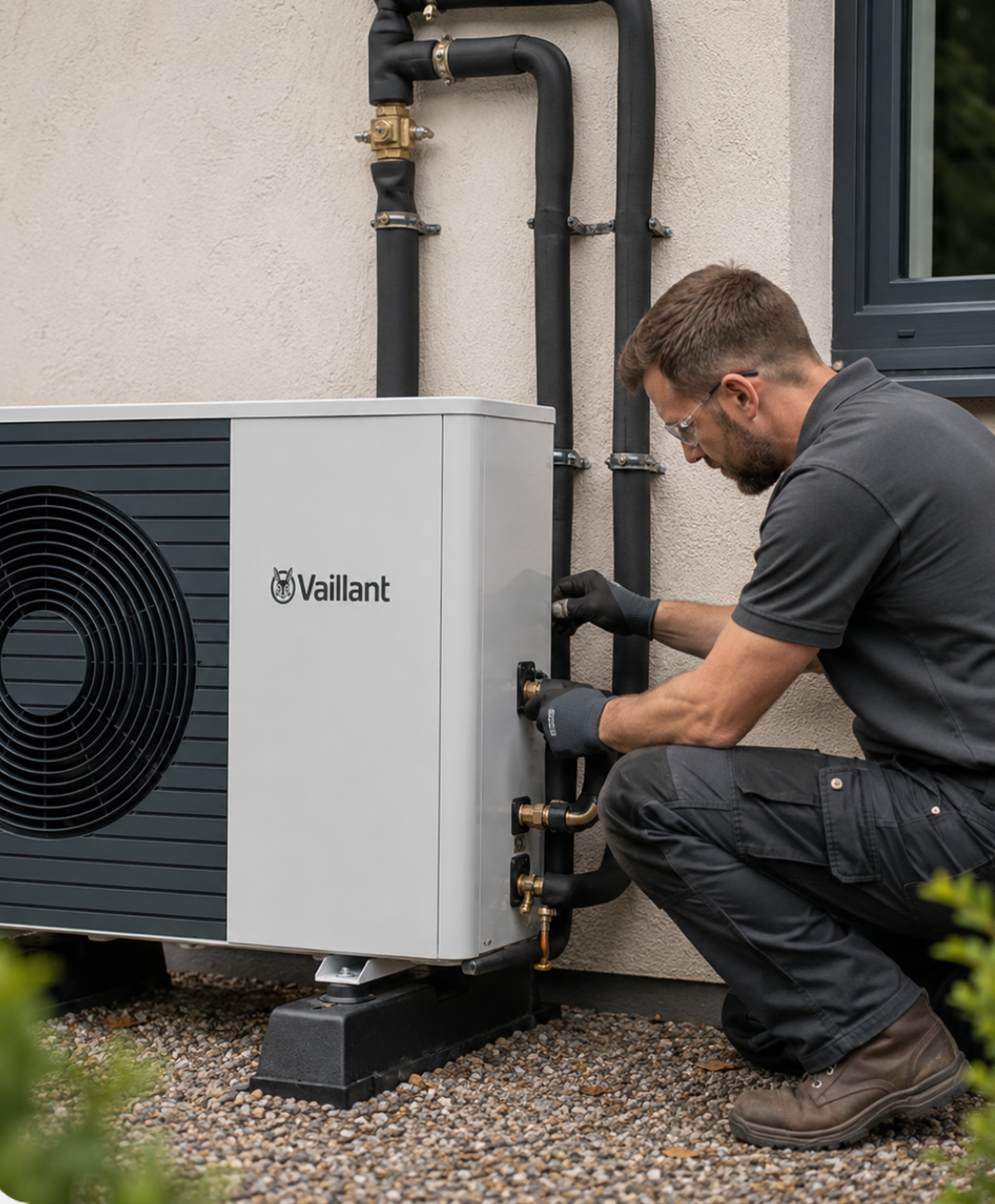
The gas boiler is removed. An outdoor heat-pump unit is installed and connected to the home’s wet central-heating system. Existing radiators are retained where they provide enough output, while undersized radiators may be upgraded. Homes replacing a combi boiler usually need a hot-water cylinder.
A typical domestic air-source heat-pump installation costs around £11,000–£12,000 before grants, although complex conversions can cost more.
Considering a conversion? Compare free, no-obligation home improvement quotes based on your property and proposed system.
Gas Boiler to Heat Pump Conversion: What Actually Changes in Your Home?
Converting from a gas boiler to a heat pump is not a simple appliance swap. The boiler comes out, but the wider heating system also needs to be assessed and, in some homes, adapted.
An air-to-water heat pump can take over both central heating and domestic hot water. However, it normally heats radiators at lower water temperatures than a gas boiler and usually stores hot water in a cylinder rather than producing it instantly like a combi.
That means a successful gas boiler to heat pump conversion starts with heat-loss calculations and system design, not simply choosing a heat-pump model.
This guide explains what happens to your boiler, radiators, pipework, hot water, electrics and gas supply, plus what the conversion can cost and how the Boiler Upgrade Scheme affects the price.
If you are still deciding whether switching technology makes sense, read our guide to replacing a gas boiler with a heat pump first.
Gas Boiler vs Heat Pump: What Changes?
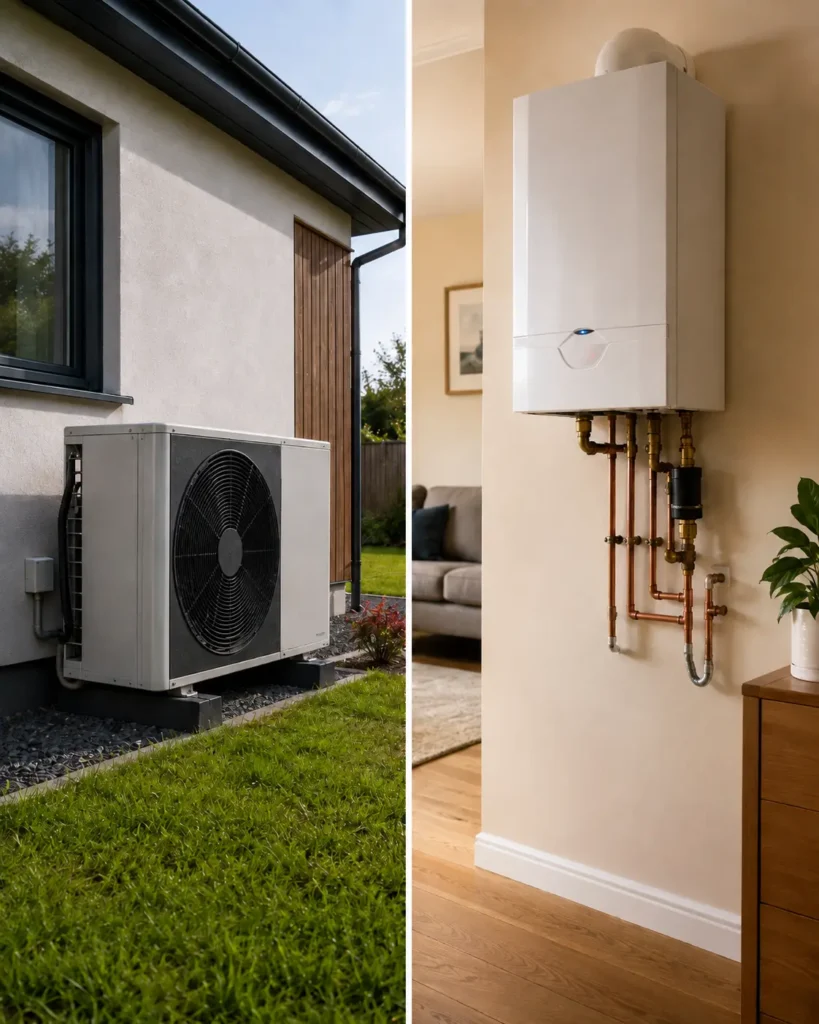
| Area | Gas boiler system | After heat-pump conversion |
|---|---|---|
| Main heat source | Indoor gas boiler | Usually an outdoor air-to-water heat pump |
| Heating-water temperature | Often relatively high | Normally lower for efficient operation |
| Radiators | Designed around existing boiler temperatures | Checked room by room; some may need upgrading |
| Hot water | Combi or cylinder | Usually stored in a suitable cylinder |
| Fuel | Mains gas | Electricity |
| Heating pattern | Can provide short bursts of high-temperature heat | Usually longer, steadier heating periods |
| Gas connection | Required | May be removable if no other gas appliances remain |
What Actually Happens During the Conversion?
An air-source heat pump collects low-temperature energy from outdoor air.
Refrigerant inside the system absorbs that heat. A compressor then raises the refrigerant’s pressure and temperature. The heat passes through a heat exchanger into the water circulating around your central-heating system.
Afterwards, the refrigerant passes through an expansion device, cools and starts the cycle again.
The important practical difference is that a heat pump generally works most efficiently when the temperature difference between the outdoor air and the heating water remains relatively small.
That is why the conversion affects more than the appliance itself.
1. Your Home Is Surveyed and Its Heat Loss Calculated
The first meaningful step should be a room-by-room heat-loss calculation.
The installer assesses areas such as:
wall, roof and floor construction;
insulation;
windows and doors;
room dimensions;
ventilation and air leakage;
desired indoor temperatures; and
local winter design conditions.
These calculations show how many watts of heat each room needs during cold weather.
They also help determine the heat-pump capacity, radiator sizes and proposed flow temperature.
A previous boiler’s kW rating should not simply be copied. Gas boilers are frequently sized differently from heat pumps, while domestic combi boilers may have high outputs primarily to meet instantaneous hot-water demand.
For more detail, see our heat-loss calculation guide for heat pumps.
2. The Installer Checks Your Radiators
One of the biggest misconceptions about conversion is that every radiator automatically needs replacing.
It does not.
Heat pumps normally circulate cooler water than traditional boiler systems. Energy Saving Trust guidance describes heating flow temperatures around 40–45°C as common for many heat-pump installations.
Because radiator output falls as water temperature falls, each existing radiator must be compared with that room’s calculated heat loss.
A generously sized double-panel radiator may already be adequate. A small single-panel radiator in a high-loss room may not be.
The result might be:
no radiator changes;
upgrades in a few rooms;
wider or deeper radiators;
fan-assisted emitters; or
underfloor heating where appropriate.
Read our dedicated guide to using a heat pump with existing radiators before assuming a complete radiator replacement is necessary.
3. A Combi Boiler Usually Means Adding Hot-Water Storage
A gas combi boiler heats domestic hot water when you open a tap. A standard air-to-water heat pump normally works differently.
Most systems use a hot-water cylinder.
Energy Saving Trust confirms that the cylinder size should reflect household hot-water demand, and homes without an existing cylinder need suitable internal space for one. Energy Saving Trust air-source heat pump guidance
The installer should consider:
number of occupants;
showers and baths;
simultaneous hot-water demand;
available cylinder space;
recovery time; and
the cylinder’s heat-exchanger design.
If you already have a cylinder, it does not automatically mean it can stay. Its coil and capacity need checking for the new system.
See our heat-pump hot-water cylinder guide for the detailed requirements.
4. Pipework May Stay — or Need Alteration
A heat pump moves a relatively large volume of lower-temperature water around the heating system.
Existing pipework must therefore provide adequate flow without excessive resistance.
Many conventional heating systems can be retained partly or completely. However, narrow or restrictive pipework can require alteration in some properties.
That does not mean every home with microbore pipework needs a full repipe. The designer should assess pipe diameter, circuit lengths, required water flow and pressure losses before recommending changes.
Ask for any proposed pipework replacement to be explained in the quotation.
5. The Outdoor Unit and Electrical Supply Are Installed
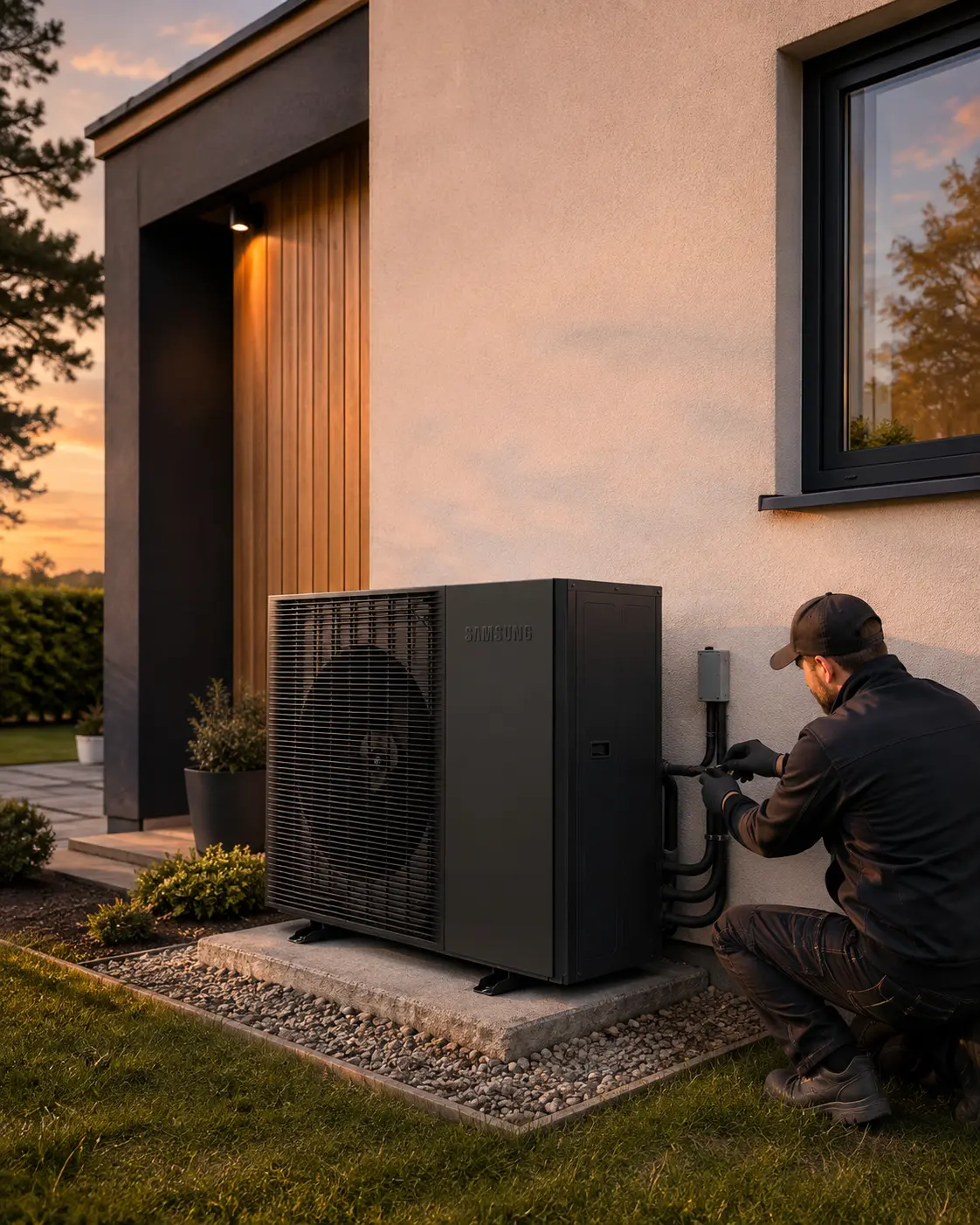
Unlike a gas boiler, an air-source heat pump needs an outdoor unit with unrestricted airflow.
Its position must consider:
airflow;
maintenance access;
condensate drainage;
pipe routes;
visual impact;
noise requirements; and
planning rules.
Many domestic air-source heat-pump installations in England can fall under permitted-development rights when the relevant conditions are met. The rules were widened in 2025, but restrictions still apply, including special circumstances involving listed buildings and designated land. Planning Portal guidance for domestic air-source heat pumps
Rules vary across the UK, so the installer should check the requirements applying to your property.
The electrical installation also needs assessment. Depending on the proposed heat pump and existing supply, electrical alterations may be required before commissioning.
6. Your Gas Boiler Is Removed
Once the replacement system is ready to be connected, the existing boiler can be isolated and removed.
Associated boiler equipment that is no longer required may also come out.
The heat pump then becomes the principal heating system.
For a Boiler Upgrade Scheme-funded installation, a new fossil-fuel hybrid system combining the heat pump with a gas boiler is not eligible. GOV.UK specifically excludes hybrid heat-pump systems from the grant. Current Boiler Upgrade Scheme grant guidance
7. What Happens to Your Gas Meter?
Removing the boiler does not automatically remove your gas connection.
If you still use gas for cooking, a fire or another appliance, you may wish to retain it.
If the boiler was your final gas appliance, you can consider having the gas connection removed. Energy Saving Trust notes that this can eliminate the ongoing gas standing charge, although disconnection itself may involve a charge.
Do not simply interfere with the meter or gas supply yourself. Appropriate professionals and your energy supplier or network operator need to handle the relevant work.
8. The System Is Commissioned and Controls Are Set Up
A heat-pump conversion is not finished when the final pipe is connected.
Commissioning should include checks such as:
filling and testing the system;
removing trapped air;
checking for leaks;
balancing radiators;
configuring heating controls;
setting weather compensation where applicable;
checking hot-water operation; and
confirming that the system performs as designed.
Energy Saving Trust specifically identifies commissioning and homeowner handover as important final stages. Energy Saving Trust heat-pump installation guide
You should also receive operating instructions, warranty details and relevant installation documentation.
How Long Does a Gas Boiler to Heat Pump Conversion Take?
The physical installation commonly takes a few days.
Energy Saving Trust says a typical installation is around three days, although radiator replacements, pipework alterations, underfloor heating and more complicated buildings can extend the job. Heating will normally be unavailable for much of the installation period.
The complete process is longer because surveying, design, quotation, grant administration and scheduling happen before engineers arrive.
| Stage | What happens |
|---|---|
| Survey | Property, heat loss, radiators, cylinder space, electrics and outdoor location assessed |
| Design | Heat-pump size, flow temperature, emitters, cylinder and controls specified |
| Preparation | Grant, planning and any preliminary works resolved |
| Installation | Boiler removed; heat pump, cylinder and required system alterations fitted |
| Commissioning | System tested, balanced and controls configured |
| Handover | Homeowner receives instructions, documents and warranty information |
How Much Does Conversion Cost?
Energy Saving Trust currently puts a typical air-source heat-pump installation at around £11,000–£12,000, depending on the guidance page and installation assumptions. Actual quotations vary substantially.
Costs can rise where the project requires:
several radiator replacements;
extensive pipework changes;
a new hot-water cylinder;
electrical upgrades;
difficult outdoor-unit positioning;
building work; or
complex controls.
These are indicative figures, not quotations. A survey is required to establish the actual conversion cost.
Boiler Upgrade Scheme support in 2026
For an eligible mains-gas property in England or Wales, the Boiler Upgrade Scheme currently provides £7,500 towards an air-to-water heat pump. The scheme is installer-led and requires an MCS-certified installer.
The temporary £9,000 grant available until 31 March 2027 applies to qualifying off-gas-grid properties replacing oil or LPG. It does not normally increase the grant for a mains-gas boiler conversion.
Will a Heat Pump Be Cheaper to Run Than Your Gas Boiler?
Not automatically.
Using Ofgem’s average Direct Debit price-cap rates for 1 October to 31 December 2026, electricity costs 26.32p/kWh and gas costs 7.97p/kWh. Current Ofgem electricity and gas unit rates
At those rates, a 90%-efficient gas boiler produces useful heat for roughly 8.86p/kWh. A heat pump paying the standard electricity rate reaches a similar energy cost at a seasonal efficiency of approximately 3.0.
That is only an illustration. Your actual result depends on seasonal performance, tariff, heat demand, controls and whether you eliminate the gas standing charge.
The conversion should therefore be designed for low practical flow temperatures rather than judged from headline heat-pump efficiency alone.
How to Prepare for a Gas Boiler to Heat Pump Conversion
Before accepting a quotation, ask for these seven points in writing:
Room-by-room heat loss — not only a whole-house estimate.
Heat-pump capacity — with an explanation of how it was selected.
Design flow temperature — because it affects efficiency and radiator output.
Radiator schedule — showing what stays, what changes and why.
Hot-water design — including cylinder capacity and proposed location.
Pipework and electrical changes — clearly itemised rather than discovered during installation.
Predicted seasonal performance — so you can assess likely electricity consumption.
The strongest quotation is not necessarily the cheapest one. It is the quotation that makes the proposed heating design understandable.
Get Your Free Air Source Heat Pump Quote
Find the right air source heat pump solution for your home. Tell us a few details and our team will help you explore suitable options at a competitive price.
Quick to complete. No obligation.
Get your quote
Enter your details below and one of our team will get back to you.
Frequently asked questions
Find clear answers to common questions about converting from a gas boiler to a heat pump, including combi boilers, radiators, hot-water cylinders, pipework, installation time, costs, Boiler Upgrade Scheme grants, running temperatures and planning permission.
Yes. A correctly designed air-to-water heat pump can provide central heating and stored domestic hot water, allowing the gas boiler to be removed completely.
Yes. The main change is hot water. Most standard air-to-water heat pumps store domestic hot water in a cylinder instead of heating it instantaneously like a combi boiler.
No. Each radiator should be checked against the heat loss of its room at the proposed heating-water temperature. Some existing radiators may already provide sufficient output.
No. A heat pump can work in older and less well-insulated properties. However, reducing unnecessary heat loss can lower the heating requirement and may allow smaller radiators or lower operating temperatures.
Possibly. The installer must check its capacity and heat exchanger against the heat pump's requirements. Some existing cylinders are unsuitable and need replacement.
Often, but not always. The designer needs to check pipe diameter, circuit resistance and required water-flow rates. Narrow pipework does not automatically mean the whole house needs repiping.
A typical physical air-source heat-pump installation takes around three days, according to Energy Saving Trust. Complex radiator, pipework, electrical or building alterations can extend this.
Energy Saving Trust currently indicates a typical air-source heat-pump installation cost of around £11,000–£12,000 before grant support. Property-specific modifications can increase or decrease the final quotation.
Yes, if you and the property meet the eligibility rules. Eligible air-to-water heat-pump installations in England and Wales currently receive a £7,500 grant.
Normally not. The £9,000 uplift until 31 March 2027 applies to qualifying off-gas-grid properties replacing oil or LPG heating. A standard eligible mains-gas conversion receives £7,500.
A new fossil-fuel hybrid system combining a gas boiler and heat pump is not eligible for the Boiler Upgrade Scheme.
Usually, yes. Heat-pump radiators often feel warm rather than very hot because the system generally operates at lower water temperatures for longer periods.
It can, but there is no guarantee. Seasonal efficiency, electricity and gas prices, tariffs, heating demand and flow temperature all affect the result.
If you no longer use any gas appliances, you can investigate disconnecting the gas supply. This can remove the ongoing gas standing charge, although the disconnection process itself may have a cost.
Many domestic installations qualify as permitted development, but conditions and exceptions apply. Planning rules also differ across England, Wales, Scotland and Northern Ireland, so check the requirements for your property before installation.
Usually not. The heat-loss calculation and proposed flow temperature should determine which radiators genuinely need changing. Replacing them first risks choosing unsuitable sizes.
There is no universal temperature. Many systems are designed around relatively low flow temperatures, often approximately 40–45°C, but the correct figure depends on the property, emitters and winter heat loss.
The installer or relevant heating professional normally isolates and removes it as part of the conversion where that work is included in the quotation. Confirm disposal and any associated gas work before signing the contract.
Is Converting From Gas to a Heat Pump Worth It?
For many homes, yes — particularly when an ageing boiler already needs replacing and the property can operate efficiently at sensible heating-water temperatures.
The conversion is most straightforward when there is a suitable outdoor-unit position, practical cylinder space and a heating system that needs only modest adaptation.
More complicated homes can still use heat pumps, but the design becomes increasingly important.
Do not start by asking whether a particular heat-pump brand will replace your boiler. Start by asking how much heat your home loses, what water temperature it needs and what changes are required to make the entire heating system work efficiently.
Once those questions have credible answers, you can compare quotations on a like-for-like basis and make a far more informed decision.
Ready to explore the next step? Compare properly surveyed heat-pump options before agreeing to a conversion.