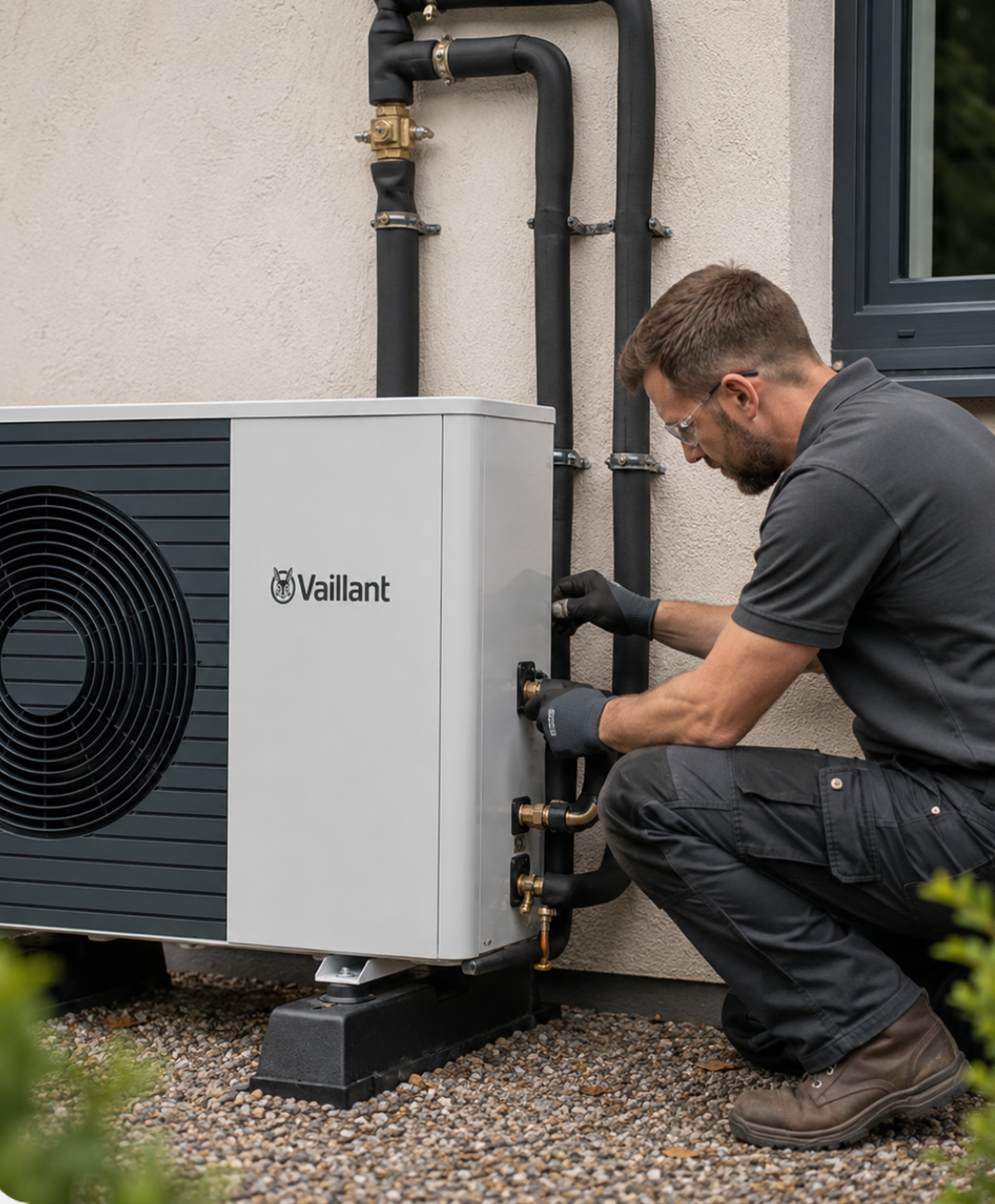
Replace Boiler With Heat Pump UK: 2026 Costs & Grants
Check Your Eligibility for Boiler Upgrade Scheme (BUS)
Complete your details below to check your eligibility.
Thank you
We've received your details and will be in touch shortly.
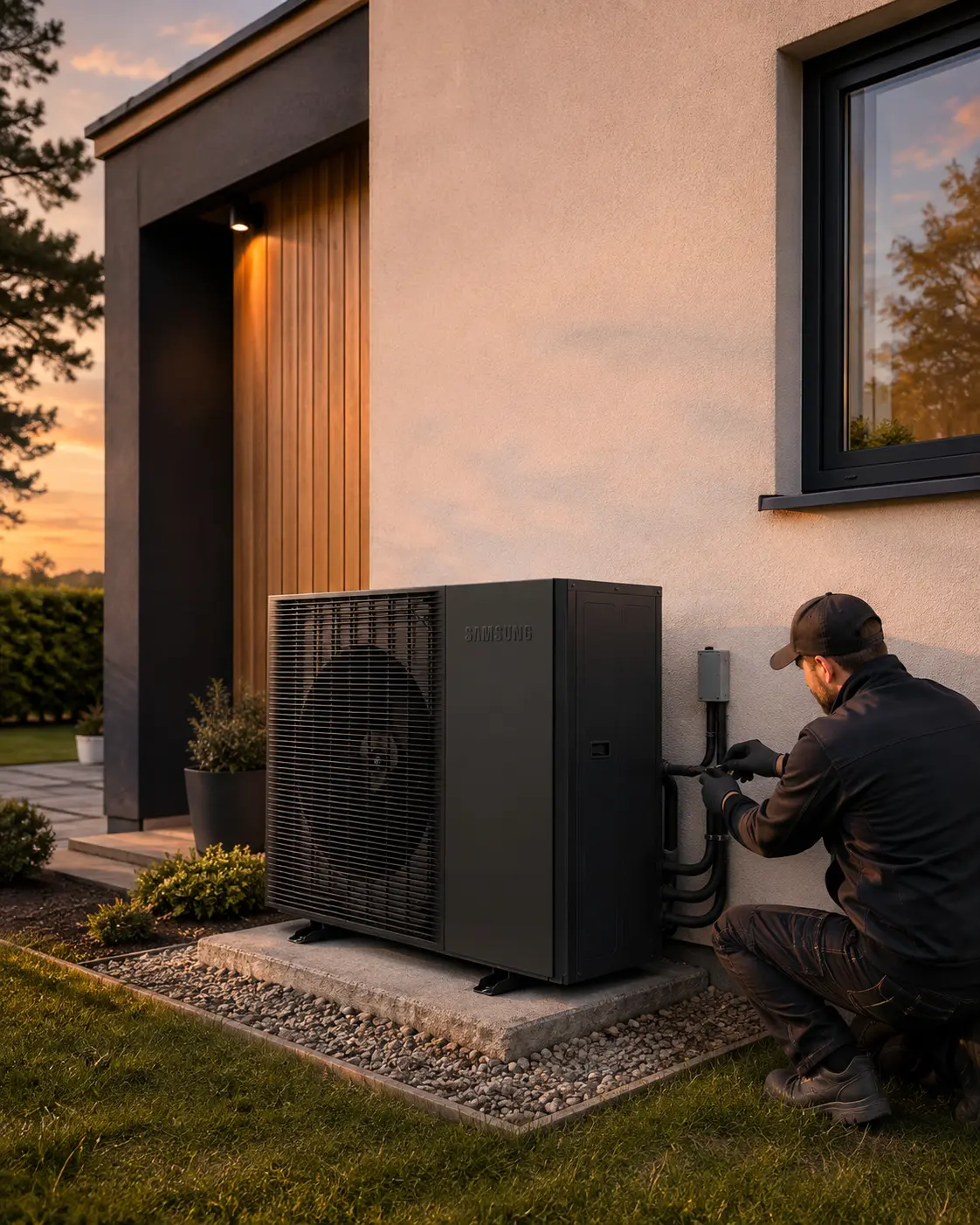
Quick Answer: Can You Replace a Boiler With a Heat Pump?
Yes. In many UK homes, a gas, oil or LPG boiler can be replaced by an air-to-water heat pump.
The key question is not simply whether a heat pump can produce enough heat. A properly designed system must meet your home’s room-by-room heat loss while operating at a sensible water temperature.
You may be able to retain much of your existing heating system. Some radiators can often stay, while others may need upgrading. Homes with combi boilers will usually also need a hot-water cylinder or another hot-water storage solution.
Before committing, ask for a room-by-room heat-loss calculation, proposed flow temperature, radiator schedule, expected seasonal efficiency and a complete quotation showing every required alteration.
Replace Boiler With Heat Pump UK: Costs, Grants and What Changes in 2026
Replacing a boiler with a heat pump is now a realistic option for many UK homes, but it is not a simple appliance swap.
A boiler produces high-temperature water by burning gas, oil or LPG. An air-to-water heat pump works differently. It extracts low-grade heat from the outside air, raises its temperature and transfers that heat into the water circulating through your radiators or underfloor heating.
That change affects more than the appliance itself. Your radiators, pipework, hot-water cylinder, controls, electrical supply and outdoor space may all need checking before a heat pump can replace your boiler effectively.
For homeowners in England and Wales, the Boiler Upgrade Scheme can currently contribute £7,500 towards an eligible air source or ground source heat pump. Some eligible homes heated by oil or LPG and without a mains gas connection can receive £9,000 until 31 March 2027.
This guide explains what actually changes when you replace a boiler with a heat pump, what it can cost, whether your existing radiators can stay and when making the switch makes financial sense.
If you are comparing options, Get Free Quote can help you compare heating quotations based on your property rather than headline prices alone.
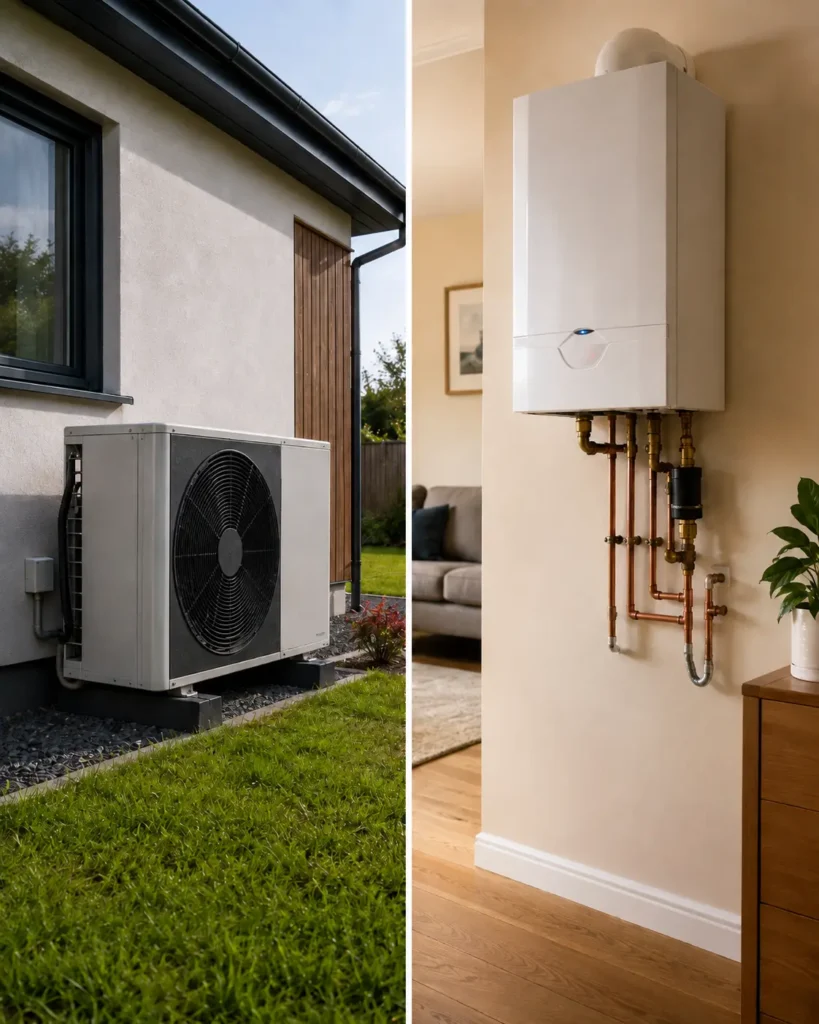
Boiler to Heat Pump: What Usually Changes?
| Part of your heating system | What may happen when you switch |
|---|---|
| Boiler | Removed and replaced by a heat pump |
| Radiators | Some may stay; undersized radiators may need upgrading |
| Pipework | Retained where suitable, but restrictive sections may need alteration |
| Hot water | Combi-boiler homes usually need hot-water storage |
| Controls | Replaced with heat-pump and weather-compensation controls |
| Outdoor space | Required for an air-to-water outdoor unit |
| Electricity supply | Checked for sufficient capacity and a suitable circuit |
| Gas connection | Can potentially be disconnected if nothing else uses gas |
Can a Heat Pump Directly Replace Your Boiler?
Mechanically, an air-to-water heat pump can connect to a wet central-heating system in much the same way as a boiler.
However, the two technologies deliver heat differently.
A boiler can send relatively hot water through compact radiators for short periods. Heat pumps generally become more efficient when they run for longer using cooler water.
Energy Saving Trust says heat-pump radiator systems often operate at around 35–45°C, although the correct design temperature depends on the property.
That means the installer needs to assess the entire heating system rather than simply replacing the boiler box.
For a gas-specific conversion, see the guide to replacing a gas boiler with a heat pump.
Will Your Existing Radiators Work With a Heat Pump?
Possibly — and replacing every radiator should not be assumed.
Radiator output falls when the water flowing through it becomes cooler. A radiator that easily heats a bedroom with boiler water at 70°C may provide much less heat when supplied at 40–45°C.
The correct approach is to calculate the heat loss of each room and compare it with the radiator’s output at the proposed heat-pump temperature.
MCS guidance treats room-by-room heat-loss calculations as fundamental to correct heat-pump sizing. The calculation considers factors including building fabric, room dimensions, ventilation, desired indoor temperature and local winter conditions.
Some existing radiators may already be large enough. Others might need changing to wider, double-panel or triple-panel models.
Read the detailed heat pump with existing radiators guide before assuming a complete radiator replacement is unavoidable.
What Happens to Hot Water?
This is often the biggest practical change for households replacing a combi boiler.
A combi heats tap water immediately and therefore needs no cylinder. Most air-to-water heat-pump systems instead store hot water in a cylinder.
If you already have a cylinder, the installer will need to check whether it is suitable. Older boiler cylinders can have heat-exchanger coils designed for hotter boiler water, so keeping the existing cylinder is not always the most efficient option.
If cylinder space is difficult, other solutions may sometimes be possible. Energy Saving Trust notes that alternatives can include heat batteries or point-of-use water heaters, depending on the system design.
How Does a Heat Pump Produce Heat From Cold Air?
An air source heat pump can extract useful heat even when the weather feels cold.
The process uses a refrigeration cycle:
Outdoor air passes across an evaporator containing refrigerant.
The refrigerant absorbs heat and evaporates.
An electrically powered compressor increases the refrigerant’s pressure and temperature.
A condenser transfers that heat into the home’s heating water.
An expansion valve reduces the refrigerant pressure so it can absorb heat again.
Energy Saving Trust describes the same four-stage process of evaporation, compression, condensation and expansion.
Because the heat pump moves existing heat rather than creating all its heat from electricity, it can produce several units of heat from each unit of electrical energy consumed.
This efficiency is commonly expressed as CoP, or coefficient of performance. Seasonal performance is usually more useful for comparing annual running costs because outdoor conditions vary through the year.
How Much Does It Cost to Replace a Boiler With a Heat Pump?
Energy Saving Trust currently gives a typical air source heat-pump installation cost of around £11,000, although individual quotations can differ significantly. Property size, heat-pump capacity, radiator changes, pipework, cylinder requirements and electrical work all affect the final figure.
| Cost consideration | What to check |
|---|---|
| Heat pump and installation | Full price before grants |
| Boiler Upgrade Scheme | Usually £7,500 for eligible air-to-water systems |
| Oil/LPG off-grid uplift | Up to £9,000 total support for qualifying properties until 31 March 2027 |
| Radiator upgrades | Number and size required |
| Hot-water cylinder | Whether a new cylinder is included |
| Electrical work | Consumer unit, cabling or supply changes |
| Pipework | Any larger or rerouted sections |
| VAT | Qualifying heat-pump installations in Great Britain currently benefit from 0% VAT until 31 March 2027 |
The VAT relief applies to qualifying installed energy-saving materials, including air source and ground source heat pumps.
Always compare complete system quotations rather than the advertised price of the outdoor unit.
What Heat Pump Grants Are Available in 2026?
The Boiler Upgrade Scheme applies in England and Wales.
The current grant is £7,500 towards an air source heat pump and £7,500 towards a ground source heat pump. Until 31 March 2027, eligible properties heated by oil or LPG with no mains gas connection can receive an additional £1,500, taking heat-pump support to £9,000.
The installer normally applies for the BUS grant and deducts it from the amount you pay.
Property owners can qualify, including landlords and second-home owners, subject to scheme rules. Most new-build properties and social housing do not qualify.
An MCS-certified installer is required for a BUS-funded installation.
Scotland and Northern Ireland have different support arrangements, so check the current scheme where the property is located.
Is a Heat Pump Cheaper to Run Than a Gas Boiler?
It can be, but there is no universal answer.
From 1 October to 31 December 2026, Ofgem’s average Direct Debit price-cap rates across Great Britain are 26.32p/kWh for electricity and 7.97p/kWh for gas.
A simple comparison shows why heat-pump efficiency matters.
A 90% efficient gas boiler needs roughly 1.11kWh of gas to provide 1kWh of useful heat. At the current average cap rate, that is about 8.9p per useful kWh of heat.
A heat pump with a seasonal performance of 3.0 uses roughly 0.33kWh of electricity for the same useful heat, costing about 8.8p at 26.32p/kWh.
At a seasonal performance of 3.5, the electricity cost falls to roughly 7.5p per useful kWh.
These are simplified comparisons and exclude standing charges, hot-water behaviour and tariff differences. However, they illustrate why the system design and achieved seasonal efficiency matter more than the heat pump’s headline efficiency.
A suitable heat-pump tariff can also change the calculation.
Is Your Home Ready for a Heat Pump?
Most homes should be judged through proper design rather than by age, EPC rating or house type alone.
Before replacing the boiler, check:
Room-by-room heat loss: Can the heat pump meet winter demand?
Radiator output: Can each room stay warm at the proposed flow temperature?
Insulation: Are there sensible improvements that would reduce avoidable heat loss?
Hot-water space: Where will the cylinder or alternative storage system go?
Outdoor location: Is there suitable airflow, service access and acceptable noise?
Electrical supply: Can the property support the proposed system?
Pipework: Are existing pipe sizes and layouts suitable?
Predicted efficiency: What seasonal performance has the installer designed for?
A Victorian terrace is not automatically unsuitable, and a modern house is not automatically ready.
For a more detailed assessment, see is my home suitable for a heat pump?.
What Happens During the Replacement?
A good installation starts with a survey and system design.
The installer should calculate heat loss, size the heat pump, check every radiator, confirm the hot-water requirement and choose the outdoor-unit position before installation begins.
During the work, the old boiler is normally removed, the heat pump is positioned outside, plumbing and electrical connections are made, and the cylinder and radiators are upgraded where required.
Energy Saving Trust says a typical heat-pump installation takes around three days, although extensive radiator, pipework or underfloor-heating work can make the project longer.
You can see the process in more detail in the air source heat pump installation guide.
Planning rules vary around the UK. In England, domestic air source heat pumps can fall under permitted-development rights when the relevant limits and MCS planning requirements are met. Listed buildings, conservation areas and unusual installations need particular care.
When Does Replacing a Boiler With a Heat Pump Make Most Sense?
The strongest opportunity is often when your boiler already needs replacing.
At that point, compare the additional cost of moving to a heat pump rather than treating the entire heat-pump quotation as an extra expense. A new boiler also costs money.
Renovations are another good opportunity because radiators, floors, pipework and hot-water storage may already be changing.
Switching immediately is less compelling purely on financial grounds if you have a relatively new, reliable boiler and the proposed heat-pump installation requires extensive alterations.
The best quote is not necessarily the one with the lowest upfront price. Ask each installer to show the heat loss, flow temperature, radiator changes, predicted seasonal performance and estimated annual energy use behind the design.
Get Your Free Air Source Heat Pump Quote
Find the right air source heat pump solution for your home. Tell us a few details and our team will help you explore suitable options at a competitive price.
Quick to complete. No obligation.
Get your quote
Enter your details below and one of our team will get back to you.
Frequently asked questions
Find clear answers to common questions about replacing a boiler with a heat pump, including gas and oil boilers, radiators, underfloor heating, hot-water cylinders, installation time, costs, Boiler Upgrade Scheme grants, winter operation, insulation and planning permission.
Yes. An air-to-water heat pump can replace a gas boiler in many UK homes, provided the system is correctly sized and the radiators, pipework and hot-water arrangement are suitable.
Yes. Oil-heated homes can be particularly suitable candidates. Eligible off-gas-grid oil-heated properties in England and Wales can currently receive up to £9,000 through the Boiler Upgrade Scheme until 31 March 2027.
Often, yes. Each radiator should be checked against that room's calculated heat loss at the proposed heat-pump flow temperature.
No. Some homes keep most or even all existing radiators. Others need selected upgrades in rooms with higher heat loss.
No. Heat pumps work with radiators as well as underfloor heating. Underfloor heating can be useful because its large surface area allows lower water temperatures.
Usually, if you are installing a conventional air-to-water heat pump. This is particularly relevant when replacing a combi boiler.
Possibly. Its size and heat-exchanger design must suit the heat pump. An installer should check it rather than automatically replacing or retaining it.
A straightforward installation commonly takes around three days. More extensive pipework, radiator or underfloor-heating work can extend the programme.
Energy Saving Trust currently gives a typical figure of around £11,000 for an air source heat pump, before considering grants. Actual quotes vary substantially.
Eligible air source and ground source heat pumps in England and Wales currently receive £7,500. Certain qualifying oil- and LPG-heated off-grid properties can receive £9,000 until 31 March 2027.
Generally not for a standard hybrid system. BUS-funded systems must replace the existing eligible heating system in accordance with scheme rules, and hybrid heat pumps are not eligible for the standard heat-pump grant.
They can be. Running costs depend heavily on seasonal heat-pump efficiency and electricity tariffs. With current October–December 2026 average cap prices, roughly 3.0 seasonal efficiency is around the simplified break-even point against a 90% gas boiler.
Yes. Air source heat pumps continue extracting heat from outdoor air in cold weather, although their efficiency normally falls as outdoor temperatures drop.
Frost can form on the outdoor heat exchanger in cold, damp conditions. The unit periodically runs a defrost cycle to remove it. This is a normal part of heat-pump operation.
Potentially. Age alone does not decide suitability. Heat loss, radiator capacity, insulation, available space and system design are more important.
Not necessarily. However, cost-effective insulation improvements can reduce heat loss, allow lower flow temperatures and potentially reduce both heat-pump size and running costs.
Often not. In England, many domestic installations qualify as permitted development when the relevant conditions are met. Rules differ elsewhere in the UK, and listed buildings or conservation areas may require additional checks.
Not necessarily. If your boiler is approaching replacement, planning ahead gives you time to obtain heat-loss surveys and compare designs instead of making an emergency heating decision.
Conclusion
Replacing a boiler with a heat pump can work well in many UK homes, but successful conversions depend on system design rather than simply selecting a heat-pump model.
Your existing radiators may be usable. Your pipework may remain largely intact. However, a combi-boiler home will usually need a new hot-water solution, and some properties benefit from radiator, insulation or electrical upgrades.
For eligible households in England and Wales, current Boiler Upgrade Scheme support can significantly reduce the upfront cost. Meanwhile, 2026 energy prices mean a well-performing heat pump can compete closely with — or beat — gas on the cost of useful heat.
Before deciding, compare complete surveyed quotations and insist on seeing the calculations behind them.